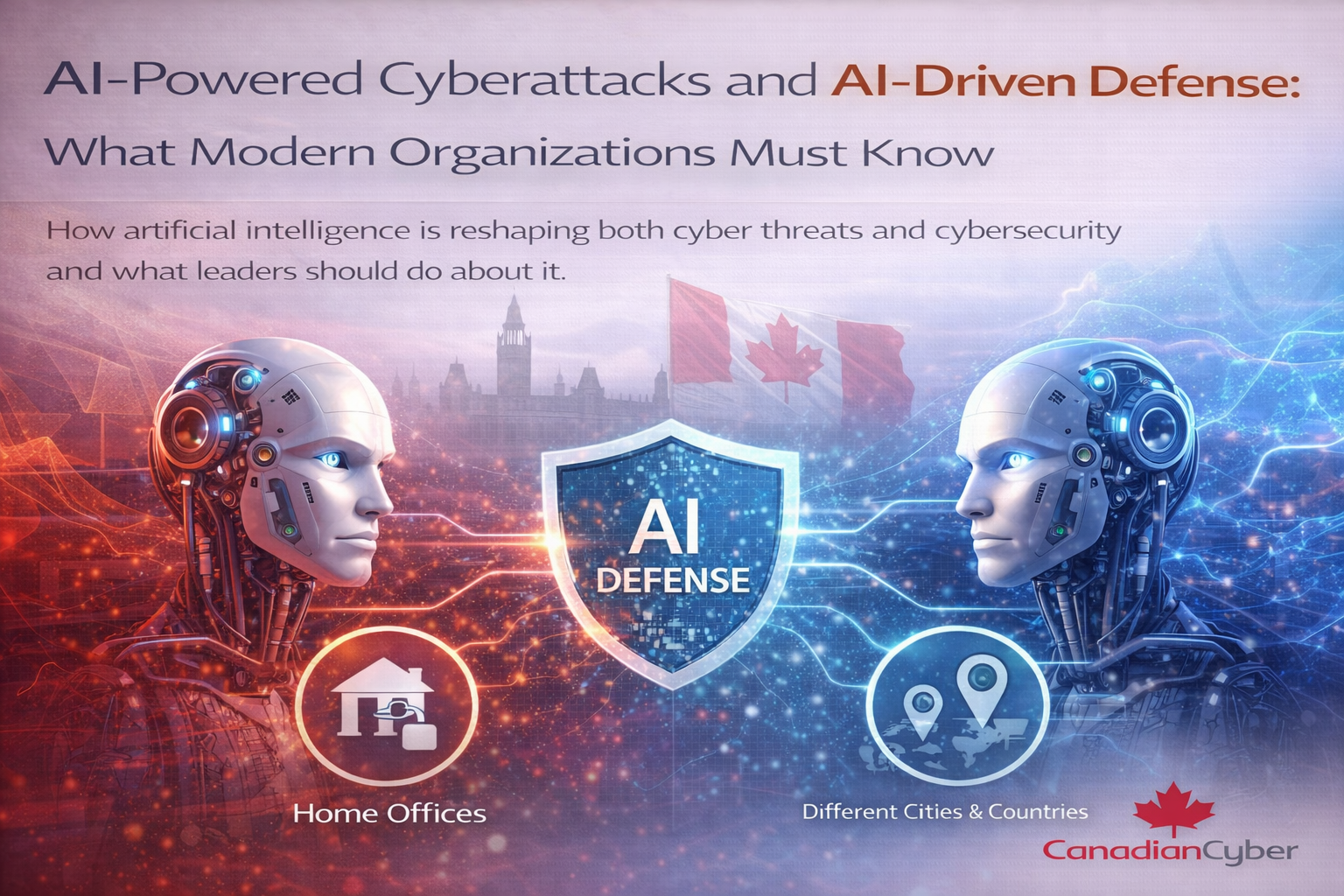
AI-Powered Cyberattacks and AI-Driven Defense: What Modern Organizations Must Know
How artificial intelligence is reshaping both cyber threats and cybersecurity and what leaders should do about it.
Artificial intelligence is no longer an emerging technology in cybersecurity. It is already embedded on both sides of the cyber battlefield.
Attackers use AI to move faster, blend in better, and scale attacks. Defenders use AI to detect threats earlier, analyze behavior, and reduce noise.
This dual reality has changed cybersecurity permanently.
Key question for leaders: How do we leverage AI for defense without underestimating its risks?
Why AI Has Become Central to Modern Cybersecurity
Traditional cybersecurity relied on known attack signatures, static rules, and manual investigation. AI changed that model.
Modern environments are cloud-based, highly distributed, data-heavy, and constantly changing. AI helps process this scale and complexity. At the same time, AI also lowers the barrier for sophisticated attacks.
How Cybercriminals Are Using AI Today
AI has become a force multiplier for attackers. It improves speed, realism, and targeting.
1) AI-Generated Phishing and Social Engineering
AI-powered phishing is more dangerous because it uses natural language that feels human, mimics the writing style of executives or vendors, references real business context, and scales personalization across thousands of targets.
The result: messages no longer look “obviously suspicious,” and even trained employees can be fooled.
2) Adaptive Malware and Evasion Techniques
Modern malware increasingly uses AI techniques to change behavior dynamically, avoid sandbox detection, delay execution to bypass security tools, and adapt based on the environment.
This makes purely signature-based defenses less effective.
3) Automated Reconnaissance and Targeting
AI enables attackers to scan networks rapidly, identify exposed services, prioritize high-value systems, and select targets based on the likelihood of success.
Attacks are increasingly data-driven not opportunistic.
Real-World Impact: What Recent Incidents Reveal
Many recent incidents follow a similar pattern: targeted phishing that leads to credential theft, lateral movement that avoids detection,
and faster exploitation after initial access.
What’s changed: Even when AI isn’t visible on the surface, its influence is clear attacks are faster, smarter, and harder to stop early.
How Defenders Are Using AI to Fight Back
AI is not only a threat. When implemented correctly, it is one of the most powerful defensive tools available.
The goal is better visibility, faster response, and less noise.
1) AI-Based Threat Intelligence and Detection
AI-driven tools can identify abnormal behavior, detect threats without known signatures, and correlate activity across systems.
This helps teams spot attacks earlier and focus on what matters.
AI is best at: answering “What doesn’t belong here?”
2) Anomaly Detection and Behavioral Analysis
Instead of looking for known attacks, AI looks for unusual login patterns, unexpected data access, and abnormal system behavior. This is especially valuable in cloud environments and remote workforces.
3) Faster Incident Response and Triage
AI helps teams prioritize alerts, group related events, and respond faster under pressure.
In real incidents, minutes can prevent major damage.
4) Supporting Compliance and Governance
AI and automation can support continuous evidence collection, risk trend analysis, and compliance monitoring for ISO 27001, SOC 2, and NIST. With proper oversight, this reduces manual effort and improves consistency.
The Limits of AI in Cybersecurity
AI is powerful, but it is not infallible. Organizations should treat AI as assistance, not authority.
- AI lacks business context: it can flag behavior, but it can’t decide risk appetite or trade-offs.
- AI can amplify bad assumptions: poor inputs and weak tuning can create alert fatigue or miss threats.
- AI does not replace accountability: auditors and regulators still expect human oversight and documented decisions.
Simple rule: AI provides insight. People provide responsibility.
Why Cybersecurity Leadership Matters More in the AI Era
As AI accelerates both threats and defense, leadership responsibility increases.
Executives and boards should be asking clear, practical questions.
Questions leaders should ask
- How is AI being used in our security program today?
- What new risks does AI introduce for our business?
- Who owns AI-related cyber risk and governance?
- How do we validate that AI-driven decisions are defensible?
The Role of vCISO Services in AI-Driven Security
A Virtual CISO (vCISO) helps organizations use AI safely and effectively by translating AI-driven findings into business risk, governing AI use within security programs, and aligning AI tools with ISO 27001, SOC 2, and NIST.
AI provides the data. Leadership provides the direction.
A Fictional Example: AI With and Without Oversight
(This example is fictional but reflects real-world patterns.)
An organization deployed AI-based security tools. Alerts increased and dashboards looked better.
Yet leadership still asked: “What risks matter most? Are we safer? What decisions should we make?”
After engaging a vCISO, AI insights were prioritized, risk decisions were documented, and governance improved.
AI stopped being overwhelming and became useful.
How Canadian Cyber Helps Organizations Navigate AI-Driven Cyber Risk
At Canadian Cyber, we focus on balanced, responsible use of AI with strong governance and clear accountability.
How we support AI-aware security
| Service | What you get |
|---|---|
| vCISO Services | Strategic leadership, AI-aware risk governance, executive and board reporting |
| ISO 27001 & SOC 2 Support | Practical compliance, continuous readiness, automation with human oversight |
| Modern Security Strategy | AI-enabled detection, human-led decisions, future-ready programs |
AI Changes the Tools, Not the Responsibility
AI will keep evolving. Attackers will adapt. Defenders will improve. But accountability remains human.
Organizations that succeed will embrace AI thoughtfully, strengthen governance, invest in leadership, and focus on resilience not hype.
Ready to Build an AI-Aware Cybersecurity Strategy?
We’ll help you use AI responsibly, align it with compliance, and keep decision-making clear at the leadership level.
Stay Connected With Canadian Cyber
Follow Canadian Cyber for ISO 27001, SOC 2, and practical AI-era cybersecurity insights: