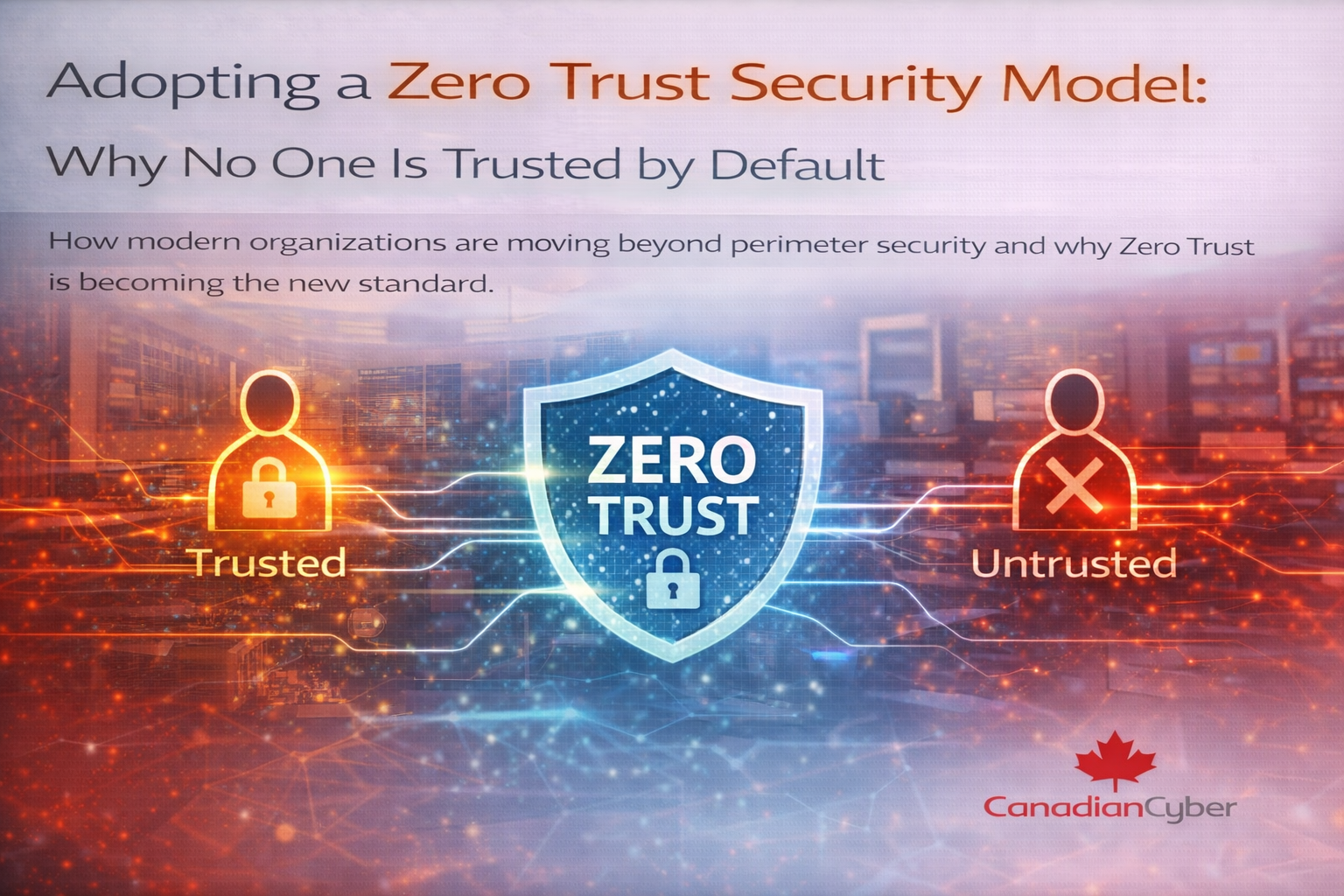
Adopting a Zero Trust Security Model: Why No One Is Trusted by Default
How modern organizations are moving beyond perimeter security and why Zero Trust is becoming the new standard.
For decades, cybersecurity followed a simple rule: If you’re inside the network, you’re trusted.
That model worked when employees worked in offices, systems lived on local servers, and networks had clear boundaries.
But that world no longer exists.
Modern security reality: Cloud, remote access, and constant change have erased the perimeter.
Trust based on “where you are” is no longer defensible.
Today’s environments are cloud-based, remote-first, highly connected, and constantly changing. As a result, the traditional perimeter has disappeared. This is why organizations across every industry are adopting a Zero Trust security model where no user, device, or system is trusted by default.
Why the Perimeter-Based Security Model Is Failing
Traditional perimeter security assumes internal users are safe, external threats come from outside, and firewalls are enough.
Modern breaches prove otherwise.
Common causes of major incidents
- Stolen credentials
- Compromised endpoints
- Phishing and social engineering
- Third-party access abuse
Once attackers gain initial access, traditional networks often allow them to move freely.
The problem is rarely the tools it’s the assumption of trust.
Key point: Most organizations don’t get breached because they lack a firewall.
They get breached because trust is granted too easily.
What Is Zero Trust Security (In Plain Terms)?
Zero Trust is a security philosophy built on one principle:
Never trust. Always verify.
Instead of assuming anything is safe, Zero Trust requires continuous verification of users and devices, strict access controls, and limited movement inside networks.
Trust is not granted based on location. It is earned and re-verified constantly.
The Core Principles of Zero Trust
1) Verify Every User and Device
Every access request is validated using identity, device health, location, and context.
Even trusted employees must verify themselves continuously.
2) Least Privilege Access
Users receive only the access they need, only for the time they need it.
This limits damage when credentials are compromised.
3) Micro-Segmentation
Networks are broken into smaller zones so compromised systems can’t access everything.
This restricts lateral movement and helps contain attacks quickly.
4) Continuous Monitoring
Zero Trust assumes breaches will happen. Security teams continuously monitor behavior, access patterns, and activity so anomalies are detected early before major damage occurs.
Why Organizations Are Moving to Zero Trust Now
Several trends have accelerated Zero Trust adoption:
- Remote and hybrid work becoming permanent
- Cloud-first architectures replacing internal networks
- Increased ransomware and identity-based attacks
- Regulatory and customer pressure for stronger controls
Industry analysts and security leaders consistently recommend Zero Trust as a long-term strategy not a short-term fix.
Breaches That Zero Trust Could Have Reduced
Many high-profile breaches share common patterns:
- One compromised credential
- Excessive internal access
- No segmentation
- Detection that comes too late
In these cases, attackers moved laterally, abused privileged access, and expanded damage before anyone could react.
A Zero Trust model would have limited access scope, restricted movement, and triggered earlier alerts.
Reality check: Zero Trust doesn’t prevent every breach but it dramatically reduces impact.
Zero Trust Is Not a Product — It’s a Strategy
One common mistake is thinking Zero Trust is a tool, a platform, or a one-time deployment.
It isn’t.
Zero Trust is a strategy that spans identity and access management, device security, network architecture, monitoring, and governance.
Successful adoption happens in phases.
How Zero Trust Aligns with Security Frameworks
Zero Trust supports requirements found in:
- ISO 27001
- SOC 2
- NIST Cybersecurity Framework
These frameworks emphasize access control, risk-based decision-making, and continuous monitoring all of which Zero Trust strengthens.
The Role of Leadership in Zero Trust Adoption
Zero Trust is not just a technical decision. It requires executive buy-in, clear risk ownership, policy alignment, and ongoing oversight.
Without leadership support, Zero Trust initiatives stall and this is where many organizations struggle.
Leadership question: Are we implementing Zero Trust as a security project or as a risk governance strategy?
How vCISO Services Support Zero Trust
A Virtual CISO (vCISO) helps organizations adopt Zero Trust in a structured, measurable way by:
- Designing a phased Zero Trust roadmap
- Prioritizing controls based on business risk
- Aligning Zero Trust with ISO 27001 and SOC 2 expectations
- Communicating strategy clearly to executives and boards
Zero Trust succeeds when it’s guided not improvised.
A Fictional Example: Containing a Breach with Zero Trust
(This example is fictional but reflects real-world patterns.)
An organization experienced a phishing attack and credentials were stolen.
But because Zero Trust was already in place:
- MFA blocked most access attempts
- Segmentation limited movement
- Alerts triggered immediately
The incident was contained. Operations continued. Damage was minimal.
How Canadian Cyber Helps Organizations Adopt Zero Trust
At Canadian Cyber, we help organizations move to Zero Trust practically and sustainably.
We focus on strategy first technology second.
What we deliver
| Service | How it supports Zero Trust |
|---|---|
| vCISO Services | Zero Trust strategy, roadmap, executive reporting, risk-based prioritization |
| ISO 27001 & SOC 2 Alignment | Control mapping, governance integration, audit readiness and continuous compliance |
| Ongoing Security Oversight | Policy guidance, continuous improvement, incident readiness, and maturity tracking |
Zero Trust Is About Reducing Assumptions
Security failures often begin with assumptions:
- “This user is trusted.”
- “That system is safe.”
- “It’s probably fine.”
Zero Trust replaces assumptions with verification.
And in today’s threat landscape, that shift matters.
Ready to Build a Zero Trust Security Strategy?
Let us help you move beyond perimeter security and adopt a Zero Trust model built for modern risk.
Stay Connected With Canadian Cyber
Follow Canadian Cyber for ISO 27001, SOC 2, and practical cybersecurity insights built for modern organizations: