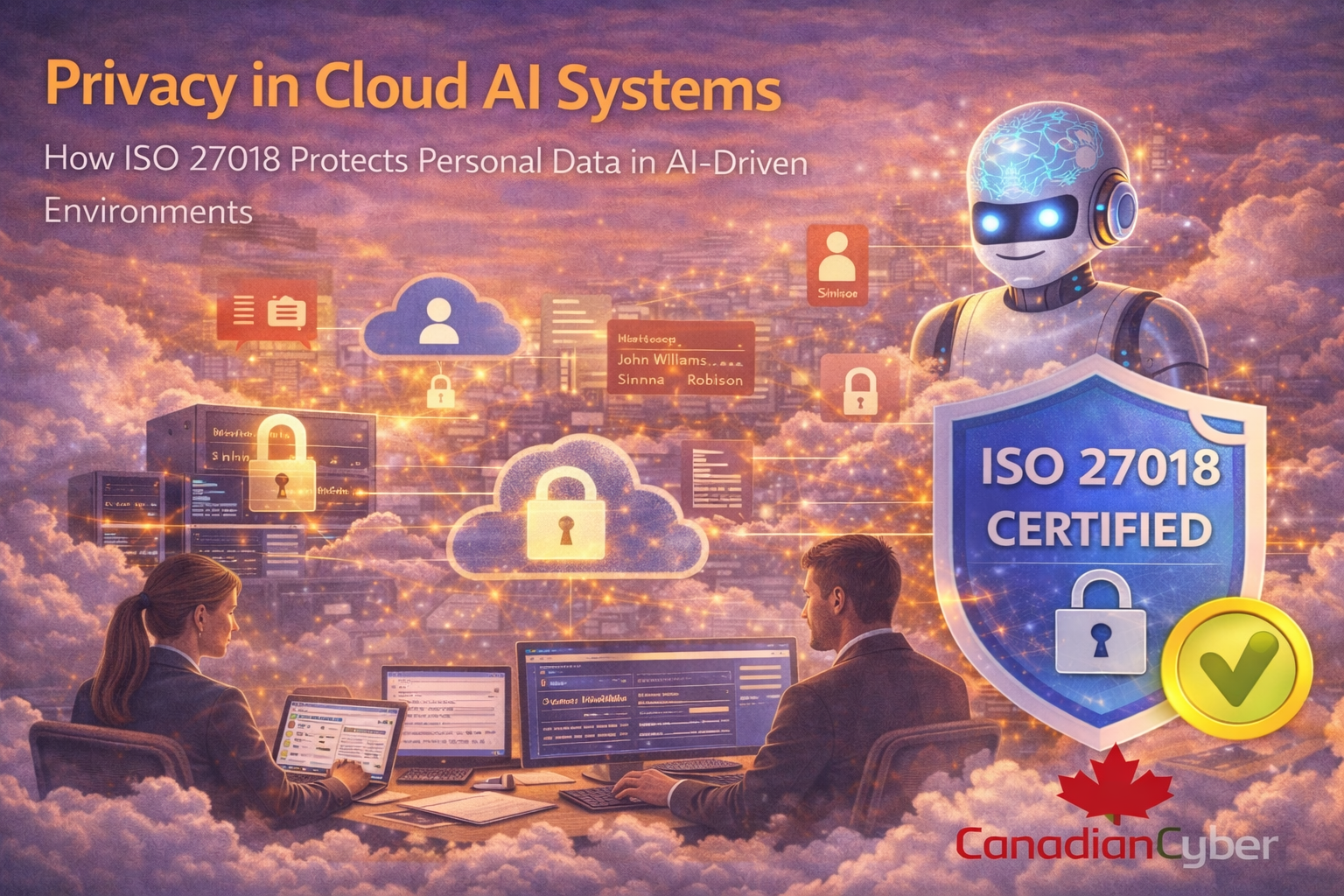
Privacy in Cloud AI Systems: How ISO 27018 protects personal data in AI-driven environments
AI systems learn fast.
They ingest data.
They analyze patterns.
They generate insight.
But much of that data is personal.
Customer records.
User behaviour.
Health and financial information.
When AI runs in the cloud, privacy becomes the real risk.
ISO 27018 exists for this exact reason.
It sets cloud privacy controls for personal data.
And it makes those controls auditable.
Why Privacy in Cloud AI Needs Its Own Standard
Traditional security standards focus on protection.
They cover things like:
- Firewalls
- Access controls
- Encryption
Privacy requires more.
It answers questions like:
- Who can use personal data?
- For what purpose?
- For how long?
- And with what transparency?
AI amplifies these risks.
Training data is reused.
Models retain patterns.
Errors scale quickly.
ISO 27018 addresses what security alone cannot.
What Is ISO 27018 (In Simple Terms)
ISO 27018 is the cloud privacy standard.
It builds on ISO 27001 and ISO 27017, but focuses on Personally Identifiable Information (PII)
processed in cloud services.
It applies when:
- Personal data is stored or processed in the cloud
- The organization acts as a data controller or processor
- Cloud services support AI or analytics workloads
ISO 27018 turns privacy promises into enforceable controls.
Quick Snapshot: ISO 27018 for Cloud AI
| Category | Details |
|---|---|
| Primary focus | Protection of personal data (PII) in cloud systems |
| Best for | AI platforms, SaaS, cloud analytics, ML pipelines |
| Key risk addressed | Unauthorized or unintended use of personal data |
| Supports | PIPEDA, Quebec Law 25, global privacy expectations |
| Outcome | Transparent, accountable cloud AI privacy |
Why AI Makes Cloud Privacy Harder
AI systems introduce privacy challenges that traditional apps do not.
Including:
- Training on large, mixed datasets
- Reuse of data beyond the original purpose
- Accidental inclusion of personal data in models
- Difficulty deleting data once models are trained
A single mistake can expose sensitive information at scale.
ISO 27018 provides guardrails for these exact risks.
Key ISO 27018 Controls That Matter for AI
ISO 27018 is practical.
It enforces privacy protections that AI teams can implement and prove.
1) Restricting PII Use to Defined Purposes
Personal data must only be used for agreed purposes.
ISO 27018 requires
- Clear documentation of why PII is used
- No secondary use without authorization
- Controls to prevent data drift
This is critical for AI training pipelines.
2) Strong Access Controls and Logging
Privacy must be observable.
ISO 27018 enforces
- Role-based access to PII
- Detailed access logging
- Monitoring of data usage
For AI systems, this means:
- Limiting who can access training datasets
- Tracking model access and inference usage
3) Data Deletion and Return Guarantees
One of the hardest AI questions is:
“Can we delete the data?”
ISO 27018 requires
- Clear data deletion procedures
- Proof of deletion on request
- Defined retention limits
This supports privacy rights under Canadian law.
4) Breach Notification and Transparency
Privacy failures must be visible.
ISO 27018 requires
- Defined breach notification processes
- Timely communication
- Clear responsibility between cloud provider and customer
This aligns with Canadian privacy expectations.
Unsure how personal data flows through your AI systems?
Map your privacy risks before they become findings.
Preventing Privacy Issues in AI Training Data
Many AI privacy issues start quietly.
A dataset includes names.
Logs capture identifiers.
Models memorize sensitive patterns.
ISO 27018 supports safer AI by enforcing:
- Data minimization
- Controlled dataset access
- Clear ownership of training data
- Accountability for preprocessing steps
Privacy must be designed in.
Not discovered later.
Reducing Bias and Accidental Exposure in AI Models
Privacy and fairness intersect.
ISO 27018 encourages:
- Transparent data handling
- Documented data sources
- Controlled reuse of personal information
This helps reduce:
- Bias introduced by sensitive attributes
- Leakage of personal information through models
- Reputational and regulatory risk
Trustworthy AI starts with privacy discipline.
ISO 27018 and Canadian Privacy Laws
ISO 27018 aligns naturally with Canadian requirements.
Including:
- PIPEDA — accountability, purpose limitation, safeguards
- Quebec Law 25 — transparency, logging, consent, governance
ISO 27018 supports:
- Clear data residency practices
- Access logging and traceability
- Defined roles for cloud providers and customers
It provides structure where regulations demand proof.
Preparing for privacy audits or regulatory reviews?
Build compliance with ISO 27018.
Why Privacy Frameworks Matter More Than Promises
Customers no longer accept assurances.
They want:
- Evidence
- Documentation
- Independent standards
ISO 27018 answers the hardest question:
“How do you protect personal data in cloud AI systems?”
With controls.
With accountability.
With proof.
How Canadian Cyber Helps Secure Privacy in Cloud AI
We bridge privacy, cloud, and AI.
Our services include:
- ISO 27018 implementation and mapping
- Cloud PII risk assessments
- AI data-flow and privacy reviews
- Alignment with ISO 27001, 27017, and SOC 2
Privacy that supports innovation.
Not blocks it.
Build Privacy-First Cloud AI Systems
If your organization:
- Uses AI in the cloud
- Processes personal or sensitive data
- Operates under Canadian privacy laws
ISO 27018 is essential.
Stay Connected With Canadian Cyber
Follow us for practical insights on compliance, risk, and cybersecurity: