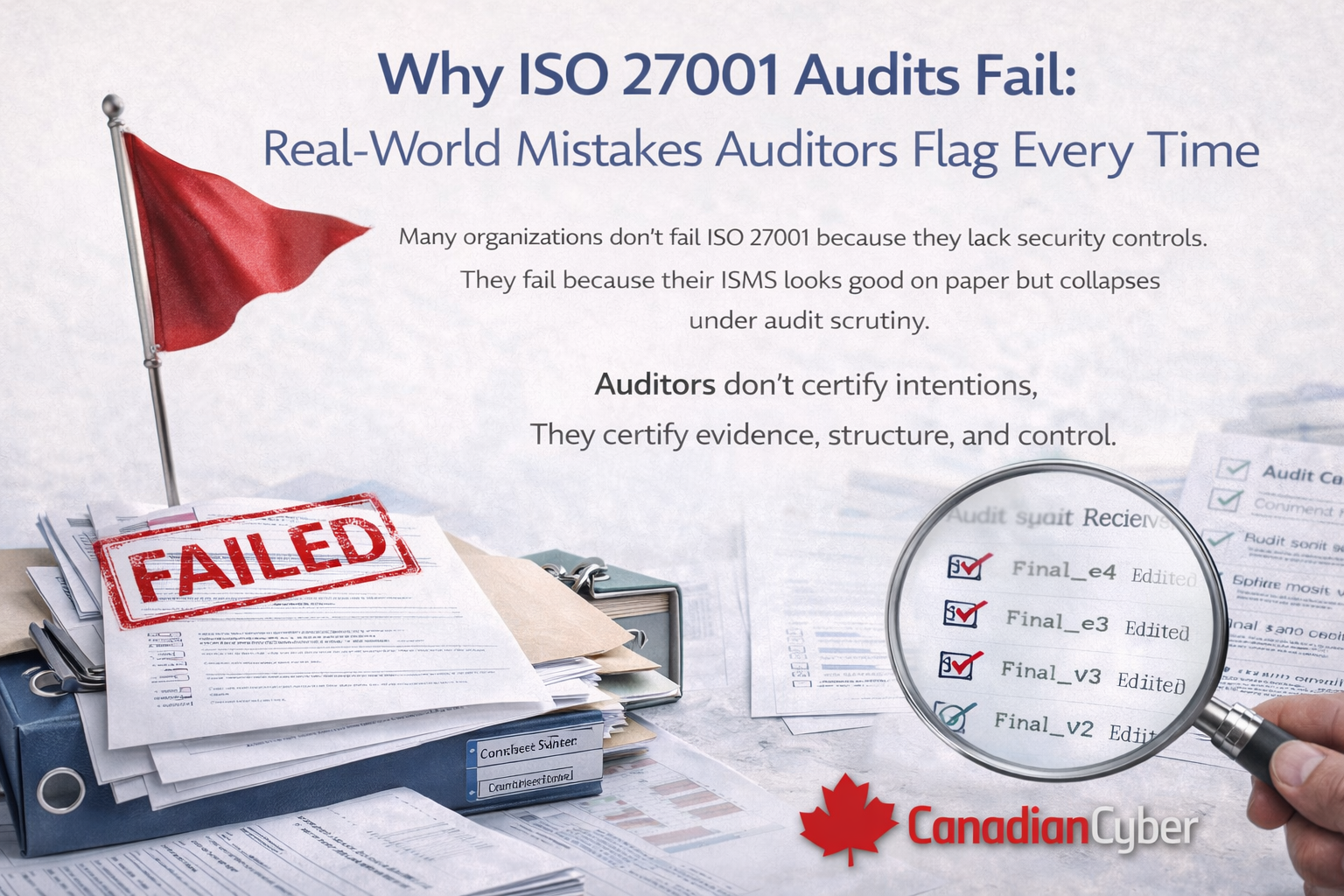
Why ISO 27001 Audits Fail: Real-World Mistakes Auditors Flag Every Time
Learn the most common ISO 27001 audit failures, the clauses auditors cite, and how to fix your ISMS with evidence, ownership, and control before certification or surveillance audits.
Auditors don’t certify intentions. They certify evidence, structure, and control.
Many organizations don’t fail ISO 27001 because they lack security controls. They fail because their ISMS looks good on paper but collapses under audit scrutiny.
This guide covers the real mistakes auditors flag and how to avoid them.
Unsure whether your ISMS would pass an audit?
Book a Free ISO 27001 Readiness Assessment (30 minutes). No obligation. No sales pressure. Real audit insight.
A hard truth about ISO 27001 audits
Most failed audits come as a surprise to leadership. Internally, everything felt ready:
- Policies existed
- Risk assessments were completed
- Documents were “available”
If your ISMS isn’t structured for evidence, it isn’t audit-ready.
Quick snapshot: what auditors flag most
| Audit failure area | What it looks like | ISO 27001 impact |
|---|---|---|
| Document control | Multiple versions, no approvals | Clause 7.5 nonconformity |
| Risk management | Excel register, no linkage, no reviews | Clause 6.1 major risk |
| Control evidence | “Implemented” without proof | Annex A gaps |
| Ownership & leadership | No named owners, weak governance | Clause 5 nonconformity |
| Continuous improvement | No internal audits, no corrective actions | Clause 10 nonconformity |
Failure #1: “We have the documents” (but no control)
A common audit moment sounds like: “Yes, we have the policy, let me find the latest version.”
What auditors see
- Multiple versions of the same policy
- No formal approval record
- No defined document owner
- No review history
How to fix it
- Centralize policies in one library
- Enable version control
- Use approvals + owner fields
- Schedule review cycles
Audit impact: Documented information without control is a nonconformity under Clause 7.5.
Failure #2: risk assessments that don’t drive decisions
Many organizations do a risk assessment once then never revisit it. Auditors expect risk management to be living, traceable, and actionable.
Typical findings
- Risk register stored in spreadsheets
- No linkage to Annex A controls
- No evidence of treatment decisions
- No management approval
- Risks never reviewed or updated
What “good” looks like
- Defined risk methodology + scoring
- Owners assigned to each risk
- Risk treatments linked to controls
- Review cadence with evidence
- Management sign-off recorded
Audit impact: Risk management gaps often become major findings under Clause 6.1.
Red flag: If your risk register lives in Excel, you’re relying on manual process for one of the most audited areas of ISO 27001.
Failure #3: Annex A controls with no evidence
Documenting “Implemented” is not enough. Auditors ask:
- Where is the evidence?
- Who owns the control?
- How is it monitored?
- When was it last reviewed?
Common failures
- Controls documented but not evidenced
- Evidence scattered across systems
- No traceability between risks, controls, and records
How to fix it
- Create an evidence library mapped to controls
- Use standard naming + metadata (owner, frequency)
- Link evidence to each control and related risks
- Keep evidence current with reminders
Failure #4: no clear ISMS ownership
An ISMS without ownership always fails eventually. Auditors immediately notice:
- No named control owners
- No accountability structure
- Minimal leadership involvement
- No governance framework
Audit impact: Weak leadership and governance is a nonconformity under Clause 5 (Leadership).
Failure #5: SharePoint used as “just a folder”
Many organizations say: “Our ISMS is in SharePoint.” But auditors find:
- Flat folder structures
- No approval workflows
- No permission model
- No audit trails
- No lifecycle management
SharePoint can support ISO 27001 but only when designed as a system, not storage.
Want to know if your SharePoint setup is audit-ready?
A quick readiness review can identify structural gaps before an auditor does.
Failure #6: no evidence of continuous improvement
ISO 27001 is not a one-time project. Auditors look for:
- Internal audits
- Management reviews
- Incident tracking
- Corrective actions
- Demonstrable improvement over time
Audit impact: A static ISMS often leads to nonconformities under Clause 10 (Improvement).
The pattern behind failed ISO 27001 audits
Almost every failed audit shares the same root cause: the ISMS exists but it is not operationally controlled.
Documents exist. Processes exist. But evidence, ownership, and traceability do not.
How successful organizations avoid these failures
Teams that pass audits consistently do three things well:
- Centralize ISMS documentation
- Enforce ownership, approvals, and controls
- Maintain evidence that is always audit-ready
This is why many organizations choose a properly structured SharePoint-based ISMS — it turns “audit prep” into a normal operating rhythm.
How Canadian Cyber helps
At Canadian Cyber, we help organizations:
- Identify audit-breaking gaps early
- Design ISMS structures auditors expect
- Implement ISO 27001-aligned ISMS using SharePoint
- Prepare confidently for certification and surveillance audits
Our ISMS SharePoint Platform is purpose-built for ISO 27001 not generic document storage.
Free ISO 27001 readiness assessment (highly recommended)
Before an auditor finds the gaps, you should. Get clear, actionable next steps in 30 minutes.
No obligation. No pressure. Just clarity.
Stay connected with Canadian Cyber
Follow Canadian Cyber for ongoing ISO 27001 insights, compliance guidance, and SharePoint best practices:
Regular insights on ISO 27001, ISMS operations, audit readiness, and Microsoft 365 security.