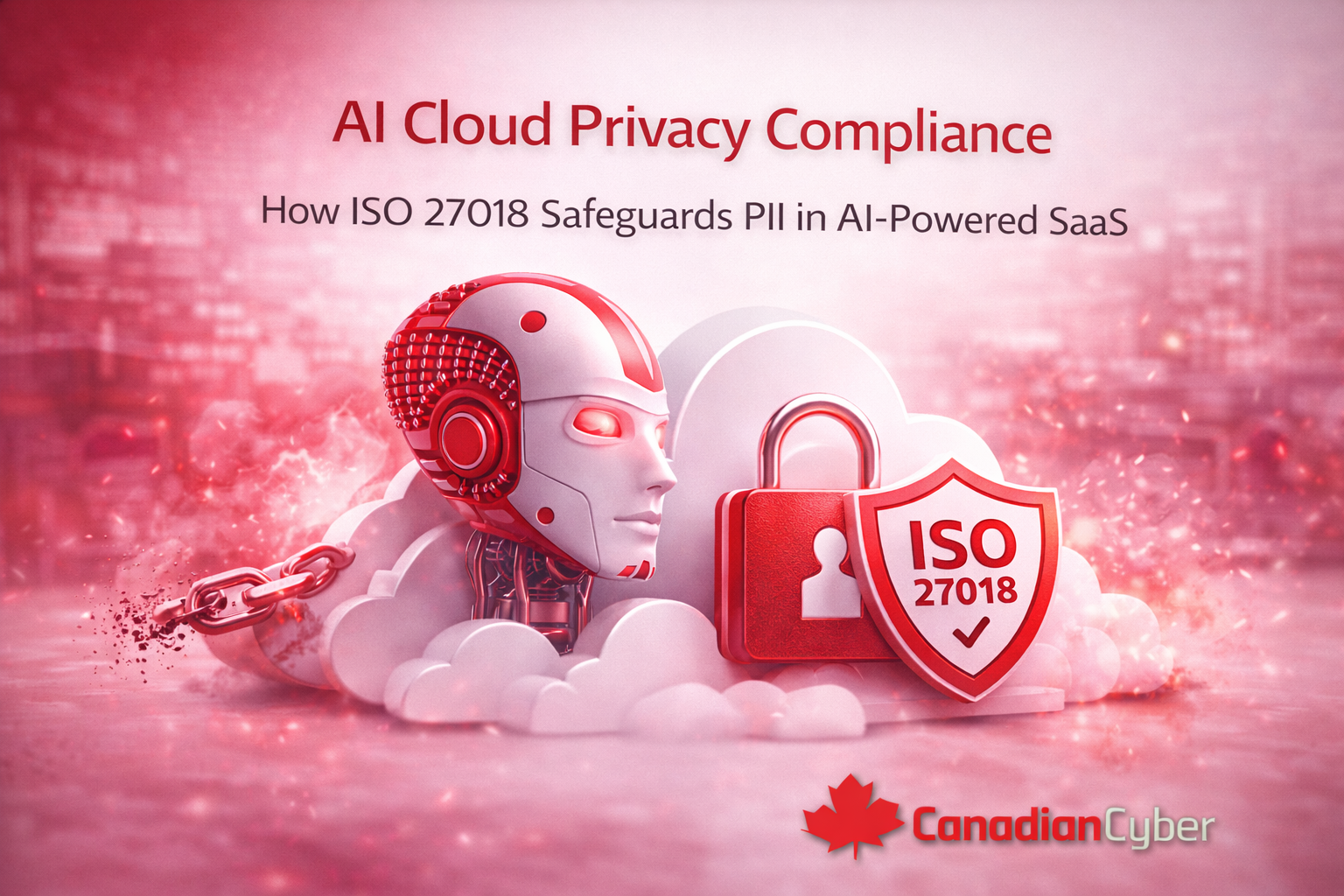
AI Cloud Privacy Compliance: How ISO 27018 Safeguards PII in AI-Powered SaaS
AI is transforming SaaS.
It personalizes experiences, automates decisions, and analyzes massive datasets in seconds.
But it also raises a question that regulators, customers, and boards now ask:
How is personal data protected when AI is involved?
In 2026, AI cloud privacy compliance is no longer theoretical.
It’s a real requirement and ISO 27018 has become a key part of the answer.
If your AI uses customer data (training, tuning, retrieval, or inference), you need
privacy controls you can prove.
Designed for privacy evidence, approvals, and audit-ready governance inside Microsoft 365.
Why AI changes the privacy risk equation
Traditional SaaS already handles personal data.
AI-powered SaaS goes further.
- Train or fine-tune models on customer data
- Infer sensitive attributes (even if you didn’t collect them directly)
- Combine datasets in new ways
- Generate outputs that may expose PII
Bottom line: even well-intentioned AI can create privacy risk if controls are weak.
That’s why privacy leaders are rethinking cloud governance.
The growing pressure on Canadian organizations
Canadian privacy expectations are rising.
Privacy officers must now consider:
- PIPEDA accountability principles
- Quebec’s Law 25 transparency and consent requirements
- Regulator expectations for AI and automated decision-making
Customers are also more aware and less forgiving.
Trust now depends on provable privacy controls, not promises.
What is ISO 27018 (and why it matters for AI)?
ISO 27018 is the international standard for protecting Personally Identifiable Information (PII) in cloud environments.
It extends ISO 27001 with privacy-specific controls focused on:
Know what’s processed and why.
Use data only as approved.
Less PII, less exposure.
Retention with boundaries.
Evidence and auditability.
Quick snapshot: AI privacy risk vs ISO 27018
| AI Privacy Risk | ISO 27018 Control | Result |
|---|---|---|
| Unclear data use in AI | Purpose limitation + transparency | Defensible processing |
| Over-collection for training | Data minimization | Smaller blast radius |
| PII leakage in outputs | Access control + logging + safeguards | Provable oversight |
| Over-retention “just in case” | Retention + secure deletion | Lifecycle control |
Key AI privacy risks in cloud SaaS
Privacy managers usually worry about the same four failure points:
- Training data creep: models trained on more data than intended.
- Lack of transparency: customers don’t know how data is used in AI systems.
- Over-retention: data kept “just in case” for future tuning.
- PII exposure in outputs: AI responses unintentionally revealing personal data.
ISO 27018 addresses these risks by forcing clear rules, tighter access, and stronger evidence.
How ISO 27018 protects PII in AI-powered SaaS
1) Transparency by design
ISO 27018 requires clear documentation of what PII is processed, why it’s used, and how long it’s retained.
This aligns with modern AI disclosure expectations.
2) Consent and purpose limitation
AI systems must respect the original purpose of data collection.
ISO 27018 helps prevent silent reuse of PII and “scope creep” without review.
3) Data minimization
Just because AI can use more data doesn’t mean it should.
Minimization reduces privacy exposure in models, pipelines, and outputs.
4) Secure deletion and lifecycle control
AI systems often outlive the data that trained them.
ISO 27018 strengthens retention boundaries and supports secure deletion when PII is no longer required.
5) Accountability and auditability
Privacy without proof doesn’t scale.
ISO 27018 pushes access logging, role-based controls, and evidence that stands up to audits and due diligence.
Building or running AI-powered SaaS?
Prove AI cloud privacy compliance with controls you can show not just explain.
Why ISO 27018 matters more than ever for AI SaaS
ISO 27018 helps you answer the questions buyers now ask during due diligence:
- Can you prove how customer data is used in AI?
- How do you prevent unauthorized AI data processing?
- What happens to PII when models evolve?
Without a structured privacy framework, these answers become risky.
With ISO 27018, you can make them defensible.
Aligning ISO 27018 with Canadian privacy laws
ISO 27018 doesn’t replace PIPEDA or Law 25.
It supports them by strengthening transparency, accountability, and control over PII.
That makes privacy compliance easier to demonstrate during audits, customer reviews, or investigations.
How Canadian Cyber helps with AI cloud privacy compliance
- Mapping ISO 27018 controls to AI data flows (training, RAG, inference, logging)
- Designing privacy-by-design ISMS structures inside Microsoft 365
- Supporting audits, certifications, and customer due diligence
- Aligning AI governance with Canadian privacy expectations
We focus on real environments, not theory.
The goal is simple: protect PII while keeping AI delivery fast.
Final thought
AI is powerful.
Personal data is sensitive.
When the two meet in the cloud, privacy must be intentional.
Protect PII. Enable AI. Earn trust.
ISO 27018 turns AI cloud privacy compliance from a concern into a strength.
Stay Connected With Canadian Cyber
Follow us for practical insights on AI, cloud privacy, and compliance: