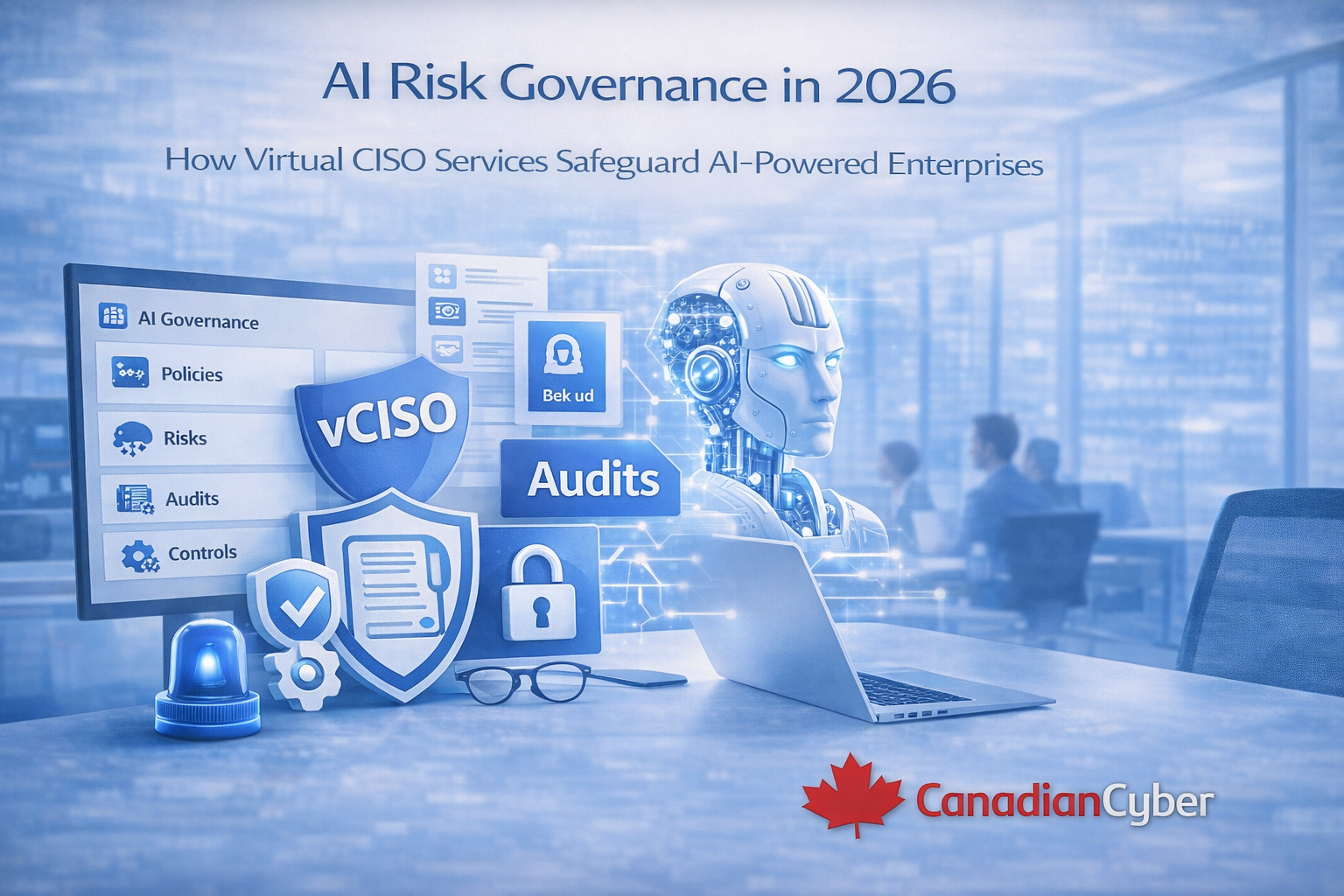
AI Risk Governance in 2026: How Virtual CISO Services Safeguard AI-Powered Enterprises
AI risk is no longer “an IT problem.” It is a governance and accountability problem.
Here’s how vCISO leadership helps organizations manage AI risk without slowing innovation.
Read time: 6–8 minutes
Keywords: AI risk governance, vCISO, responsible AI, privacy by design, Law 25, PIPEDA, ISMS
In 2026, boards want a clear owner for AI risk.
A vCISO builds that accountability, adds AI risk into the ISMS, and keeps evidence audit-ready with automation.
Board question to prepare for:
“Who is accountable if our AI system causes harm?”
The board meeting that changed the AI conversation
The board meeting was supposed to be routine.
Revenue was up.
The AI roadmap looked ambitious.
Customer adoption was accelerating.
Then one question stopped the room:
“Who is accountable if our AI system causes harm?”
Not a technical question. A governance one.
In 2026, this moment is becoming familiar across Canadian organizations using AI.
The new reality: AI risk is now a board-level issue
AI is no longer experimental.
It impacts real people and real outcomes at scale.
- It processes sensitive data
- It influences decisions
- It shapes customer outcomes
- It operates continuously
With that power comes risk.
And unlike traditional cybersecurity threats, AI risk crosses technology, ethics, privacy, and regulation.
Key takeaway:
If no one owns AI risk, everyone is exposed.
Why AI changes cybersecurity strategy
Traditional programs focus on protecting networks, systems, and data.
AI adds new risk paths that don’t sit neatly behind a firewall.
These risks require governance.
Not because teams are careless.
Because AI moves too fast to manage informally.
Canada’s AI expectations are rising fast
Even without a single “AI law” applied everywhere, the direction is clear.
Canadian organizations are expected to show responsible oversight.
- Responsible AI governance principles
- Privacy-by-design expectations under PIPEDA and Law 25
- Clear accountability for how data is used and protected
What regulators and buyers want:
oversight, documentation, and accountability.
“We didn’t know” does not age well.
The leadership gap most AI programs face
Many AI initiatives start in product and engineering.
That’s normal.
What’s missing is executive ownership of AI risk.
- No clear AI usage policies
- No formal risk assessments for AI systems
- No audit trail of decisions and approvals
- No single point of accountability
This is where Virtual CISOs (vCISOs) are stepping in.
What a vCISO brings to AI risk governance
A vCISO doesn’t “add more meetings.”
They add structure.
And they make oversight real.
1) Establish AI governance foundations
Define where AI is used, what data it touches, and which risks matter most.
AI stops being informal experimentation and becomes a governed capability.
2) Create clear AI usage policies
Generative AI is powerful.
Without rules, it becomes unpredictable.
A vCISO builds policies that clarify who can use AI, for what purpose, and with what data.
3) Integrate AI risks into the ISMS
AI risks should not live in a separate document.
A vCISO adds AI risk into the risk register, maps controls, assigns owners, and sets review cycles.
4) Address advanced AI threats
Modern AI brings threats teams may not have faced before:
model poisoning, prompt injection, and output manipulation.
A vCISO ensures these risks are understood, documented, and mitigated where possible.
Where technology enables governance at scale
Governance fails when it lives in email threads and scattered documents.
That’s why Canadian Cyber pairs vCISO services with a SharePoint-based ISMS platform.
- Document AI policies and approvals
- Track AI-related risks with owners and review dates
- Store evidence and audit trails in one place
- Keep records inside Microsoft 365 (where teams already work)
Running AI without formal governance?
Put AI risk under executive security leadership and build audit-ready oversight inside Microsoft 365.
Trust is the new AI differentiator
Customers don’t just ask if your AI is innovative.
They ask if it is responsible.
Organizations that can show:
- Structured oversight
- Clear accountability
- Documented controls and decisions
Win trust faster with customers, partners, and regulators.
AI governance is not about slowing innovation
The best AI programs are not restricted.
They are disciplined.
- Governance reduces uncertainty
- Governance prevents costly missteps
- Governance enables confident scaling
AI works for the business, not against it.
How Canadian Cyber helps AI-driven organizations
Canadian Cyber supports AI-powered enterprises with practical governance.
No hype. No theory-only frameworks.
Just leadership and evidence that holds up under scrutiny.
- Experienced vCISO leadership
- AI risk assessment and control mapping
- Embedding AI risk into ISMS programs
- Automation for documentation, review cycles, and audit trails
Final thought
In 2026, the question is no longer:
“Should we govern AI?”
It is:
“Who is accountable for it?”
Next step:
Govern AI risk before it governs you.
Want AI oversight that your board can defend?
Get vCISO-led AI governance and an ISMS platform that keeps evidence audit-ready all year.
Stay Connected With Canadian Cyber
Follow us for insights on AI risk, cybersecurity leadership, and compliance automation: