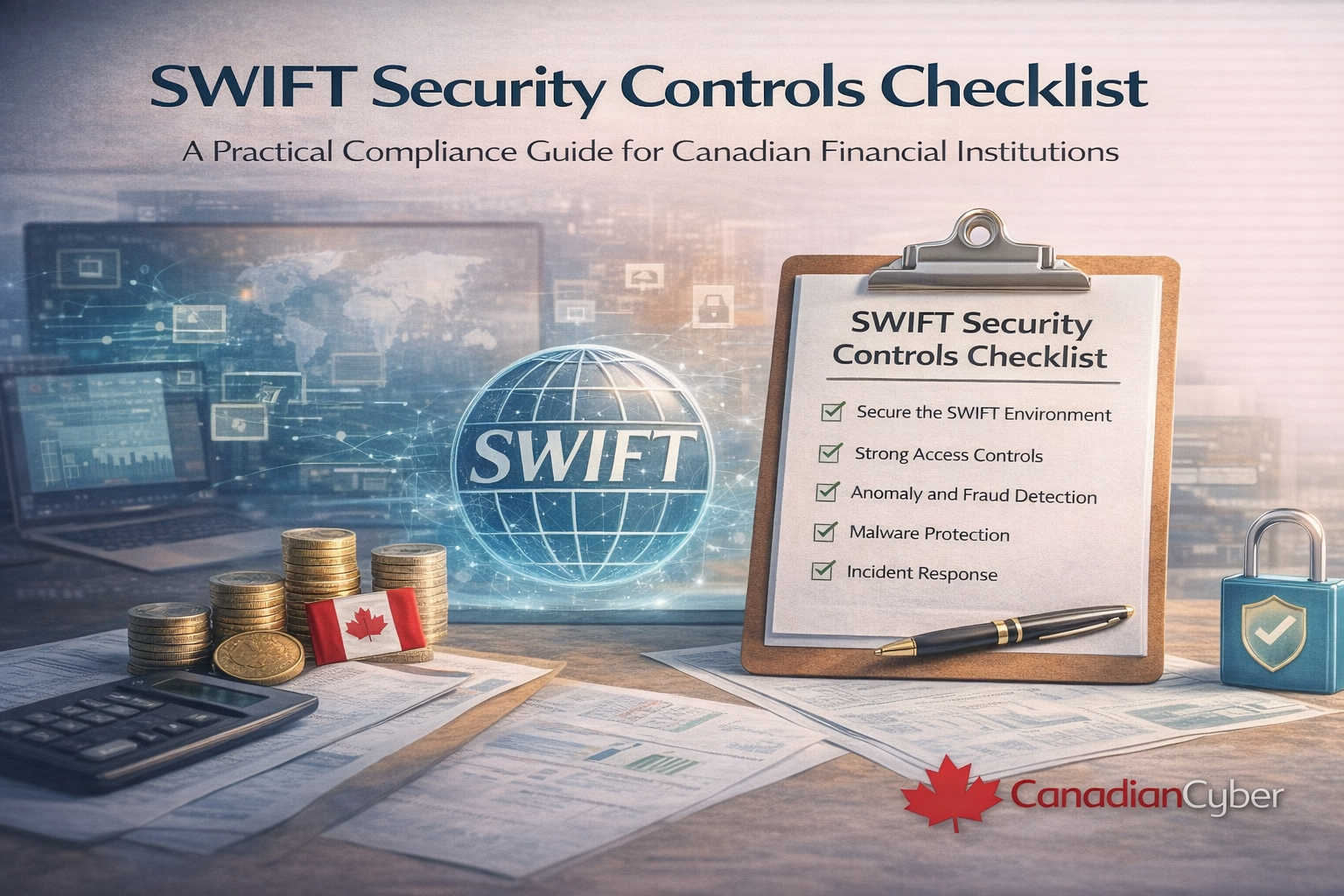
SWIFT Security Controls Checklist
A Practical Compliance Guide for Canadian Financial Institutions
For banks and credit unions connected to the SWIFT network, cybersecurity isn’t optional it’s mandatory. The SWIFT Customer Security Programme (CSP) exists to prevent fraud, unauthorized transactions, and systemic risk across the global financial system.
Yet many Canadian financial institutions still struggle with one question:
“Are we actually meeting all SWIFT mandatory controls or just assuming we are?”
This guide breaks down the core SWIFT CSP control areas into a clear, practical checklist, with implementation and evidence tips
you can use right now.
Why SWIFT CSP Compliance Matters More Than Ever
- One weak control can enable large-scale fraud.
- Attackers often exploit internal access not just malware.
- Regulators expect provable, ongoing compliance.
For Canadian institutions, SWIFT CSP compliance is tightly linked to
OSFI expectations, internal audit scrutiny, and board-level risk oversight.
SWIFT CSP Control Areas (At a Glance)
| Control area |
What it’s protecting |
Common failure point |
| Secure the environment |
SWIFT infrastructure isolation & hardening |
“Convenience” connections to general IT networks |
| Restrict access |
Privileged access & transaction authority |
Weak MFA, shared accounts, incomplete reviews |
| Detect anomalies |
Fraud signals & unusual transaction patterns |
Logs exist but no review/alert process |
| Respond & recover |
Containment, escalation, and recovery |
Plans exist but aren’t tested |
| Governance & assurance |
Proof, attestation, ownership, and remediation |
Attestation completed without independent review |
The Practical SWIFT CSP Checklist
Use this as a working checklist for internal validation, audit preparation, and ongoing assurance.
✅ 1) Secure the SWIFT Environment
Objective: Prevent unauthorized access to SWIFT systems.
- SWIFT infrastructure isolated from general IT networks
- Firewalls configured with least-privilege rules
- No direct internet access to SWIFT components
- Secure hardening of SWIFT servers (baseline + exception handling)
Common gap: SWIFT systems connected to broader networks “for convenience.”
✅ 2) Strong Access Controls & Privileged Account Management
Objective: Ensure only authorized users can initiate or approve transactions.
- Multi-factor authentication (MFA) for SWIFT users
- Role-based access aligned to job responsibilities
- No shared or generic accounts
- Regular access reviews documented (schedule + approvals)
Auditors look for: clear evidence of who has access, why they have it, and when it was reviewed.
✅ 3) Transaction Monitoring and Anomaly Detection
Objective: Detect fraud before funds move.
- Monitoring of SWIFT messages for unusual patterns
- Alerts for abnormal transaction values or destinations
- Independent verification of high-risk transactions
- Logs retained and protected from tampering
Best practice: monitoring should be independent of the transaction initiator.
✅ 4) Malware Protection and System Integrity
Objective: Prevent compromise of SWIFT endpoints.
- Anti-malware controls on SWIFT servers
- Regular patching and vulnerability management
- Application allowlisting (where feasible)
- Monitoring for unauthorized changes (integrity checks)
Reality: many SWIFT incidents begin with compromised endpoints.
✅ 5) Incident Response and Recovery Readiness
Objective: Respond quickly if something goes wrong.
- Documented incident response plan covering SWIFT scenarios
- Clear escalation paths and decision authority
- Regular testing of response procedures (tabletops + lessons learned)
- Evidence of improvement actions from past incidents/exercises
Key point: a plan that isn’t tested doesn’t count.
✅ 6) Governance, Assurance, and Attestation
Objective: Prove compliance not just claim it.
- Annual SWIFT CSP self-attestation completed accurately
- Independent internal or external review of controls
- Clear senior-level ownership of SWIFT security
- Findings tracked to closure (owner, due date, evidence)
Where many institutions fall short: attestation without independent assurance and tracked remediation.
Audit-Ready Evidence: What to Keep (So You Don’t Scramble Later)
If you want SWIFT controls to stand up in audit, keep evidence consistent and easy to retrieve.
| Control theme |
Evidence examples |
Cadence |
| Access control |
Access reviews, joiner/mover/leaver logs, MFA enforcement |
Monthly/Quarterly |
| Monitoring |
Alert rules, review logs, anomaly investigations |
Daily/Weekly |
| Hardening & patching |
Baseline configs, patch reports, vulnerability remediation |
Monthly |
| Governance |
Attestation package, internal review results, remediation tracking |
Quarterly/Annual |
Want to validate your SWIFT controls before audit season?
Get an independent review and an evidence-ready remediation plan before gaps become incidents.
How ISO 27001 Strengthens SWIFT CSP Compliance
SWIFT CSP focuses on specific technical controls. ISO 27001 provides the governance framework around them.
Together, they ensure controls are documented, ownership is clear, reviews happen on schedule, and evidence is always available.
Practical takeaway: many institutions use ISO 27001 to operationalize SWIFT CSP so compliance becomes continuous not a once-a-year scramble.
How Canadian Cyber Supports SWIFT CSP Compliance
- Assess SWIFT CSP control maturity and evidence quality
- Perform independent internal audits and readiness reviews
- Align SWIFT controls with ISO 27001 governance
- Centralize evidence using our ISMS SharePoint Platform
- Provide vCISO oversight for ongoing assurance
Final Takeaway
SWIFT CSP compliance isn’t a checkbox. It’s a continuous discipline that protects customer trust, institutional reputation, and the financial system itself. A structured checklist backed by governance makes the difference.
Move from annual attestation stress to continuous confidence.
We’ll help you validate mandatory controls, strengthen evidence, and keep SWIFT security audit-ready year-round.
Stay Connected With Canadian Cyber
Follow us for insights on financial cybersecurity, SWIFT compliance, ISO 27001, and vCISO strategy: