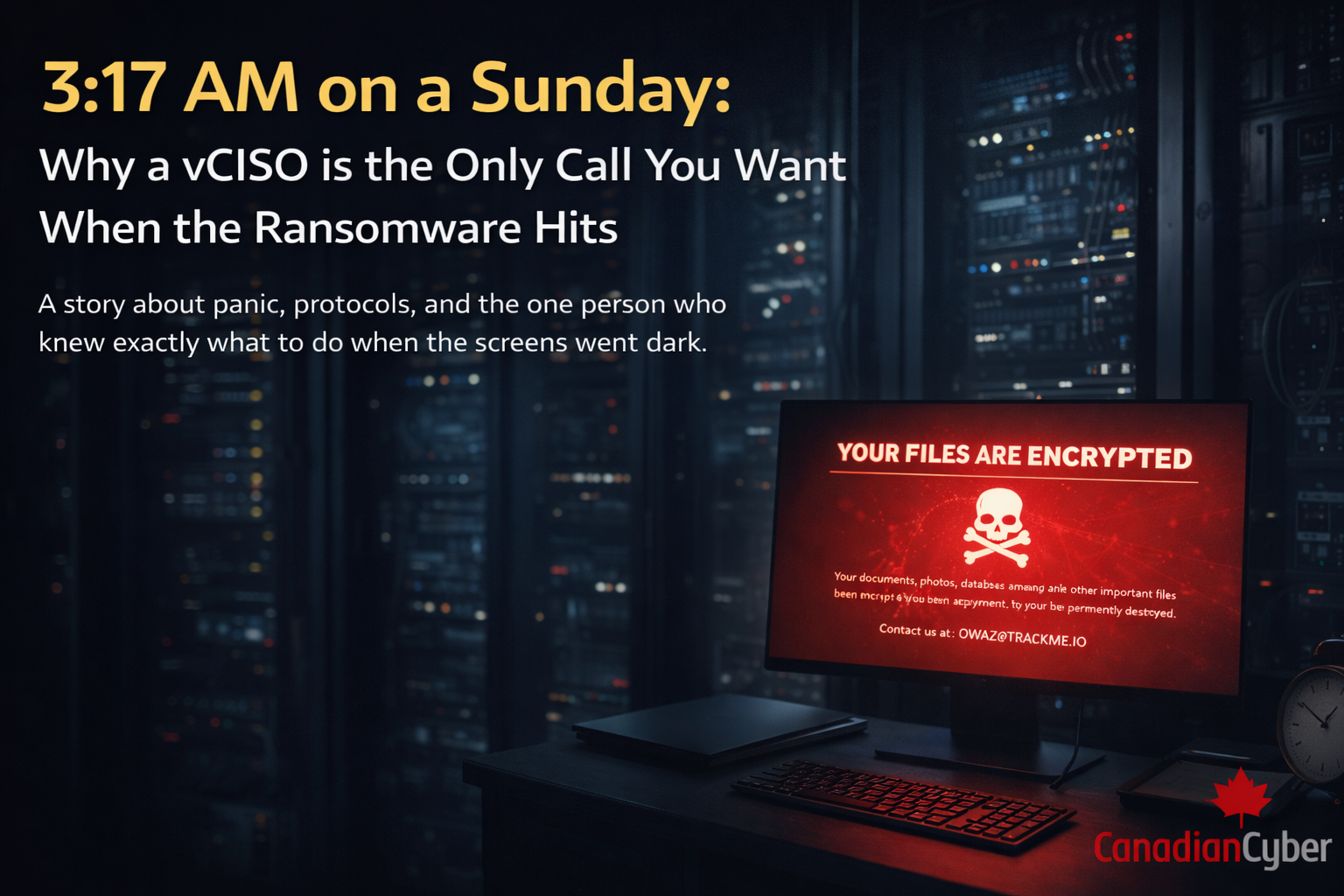
3:17 AM on a Sunday: Why a vCISO is the Only Call You Want When the Ransomware Hits
Subtitle: A story about panic, protocols, and the one person who knew exactly what to do when the screens went dark.
Author’s Note
The following story is fictional. But every detail the confusion, the pressure, the clock ticking, and the structured response that saved the day is drawn from real incidents Canadian Cyber has guided clients through across Canada.
Names have been changed. The lessons are real.
Prologue: The Day Before
Friday, 4:47 PM
“Everything looks quiet.”
Marcus Chen, IT Manager at Northpoint Logistics, sent the weekly status email and closed his laptop. Forty-eight hours of uninterrupted weekend stretched ahead. His phone buzzed a text from his brother about Sunday’s barbecue.
He smiled, tossed the phone on the passenger seat, and drove home.
He had no idea that 2,800 kilometers away, a threat actor was already inside.
The initial access had happened three weeks earlier a spear-phishing email opened by a sales coordinator who thought she was downloading a routine purchase order. The credentials were valid. The access was quiet. The dwell time had begun.
By Friday evening, the attacker had mapped Northpoint’s network, identified the backup servers, and deployed the ransomware payload.
It sat dormant, waiting for its execution time.
3:17 AM, Sunday.
Why this story matters
- Ransomware is not a “tech problem.” It’s a leadership, legal, operations, and communications problem at the same time.
- The first 60 minutes are where outcomes are decided: spread vs. containment, panic vs. command.
- A vCISO turns response into execution because the plan already exists.
Part I: The Screens Go Dark
Sunday, 3:17 AM
The first alert triggered silently a server in the Winnipeg data center reporting unusual disk encryption activity.
- By 3:22 AM, seventeen more servers followed.
- By 3:31 AM, the shared drives went dark.
- By 3:47 AM, the ransom note appeared on every screen in the company.
“Your files are encrypted. Contact us within 48 hours or the data will be sold.”
Sunday, 6:43 AM
Marcus woke to 47 missed calls and 112 Slack notifications.
He scrolled, bleary-eyed, through the first few messages:
- “Servers down.”
- “Ransomware.”
- “Can’t access anything.”
- “What do we do?”
His stomach dropped. He had never handled a ransomware attack. He had read about them. He had attended a webinar once.
But the actual moment the real thing was nothing like the slides.
He called his most senior technician.
“I don’t know what to do,” Marcus admitted.
Neither did anyone else.
Part II: The Hour of Panic
Sunday, 7:15 AM – Northpoint Logistics Emergency Bridge
By 7:15, the bridge line was chaos.
- IT Team: Shouting over each other about which systems to isolate first.
- Sales Director: Demanding to know when customer orders would process.
- HR: Asking if they should tell employees not to log in Monday morning.
- Legal Counsel: Warning everyone not to say anything that could be used against them.
- CEO: Silent. Staring at his screen. Waiting for someone to tell him what to do.
No one did.
Marcus tried. He really tried. He started listing steps from memory: isolate, contain, assess.
But every time he spoke, someone interrupted with a new emergency.
The CEO finally spoke:
“Does anyone here actually know how to handle this?”
Silence.
This is the moment most companies die. Not from the ransomware itself. From the paralysis.
The confusion. The conflicting instructions that let the attacker’s clock keep ticking while defenders argue about who should call whom.
Northpoint was 47 minutes into its response and had accomplished nothing except burning time.
Part III: The One Call
Sunday, 7:48 AM
“I have a contact,” Marcus said quietly. “From a cybersecurity webinar last year. A vCISO firm. Canadian Cyber.”
The CEO grabbed his phone.
“Call them. Now.”
Sunday, 7:52 AM – First Contact
The phone rang twice.
“Sarah Voss, Canadian Cyber incident response. What’s happening?”
The CEO explained servers down, ransom note, IT team in chaos, no plan.
Sarah’s voice was calm. Not slow calm. There’s a difference.
“Okay. Here’s what we’re going to do.”
- Put me on speaker with everyone on your bridge.
- I assign tasks. No one does anything else until I assign it.
- Questions after execution, not during.
Sarah was connected to the bridge within 60 seconds.
Part IV: The Calm in the Storm
Sunday, 7:58 AM – The vCISO Takes Command
“Everyone, this is Sarah. I’m a vCISO with Canadian Cyber. I’ve done this before many times.
Here’s how this works: I assign. You execute. Questions after execution, not during. Understood?”
Murmurs of agreement.
“Good. Let’s go.”
First 5 Minutes – Triage
Sarah asked the right questions and gave the first priority order:
- Isolate the core switches from the internet (fast, not graceful).
- Power down domain controllers (stop encryption mid-process).
- Confirm backup status (offline vs. encrypted).
Minutes 5–10 – Communication Control
- Draft internal message: “technical incident” (no ransomware mention).
- Do not speculate. Do not leak. Send to Sarah for review.
- External communications on hold until legal advises.
Minutes 10–15 – Legal and Insurance
- Pull cyber insurance policy and incident reporting window.
- Prepare regulator notification template (prepare now, decide later).
Minutes 15–20 – Backups
Backup status?
“Good news. Our offline backups are offline. Literally. The tapes were disconnected. They’re clean.”
“Perfect. Do not restore until root cause is confirmed. Otherwise they’ll re-encrypt.”
By 8:23 AM—less than 30 minutes after Sarah joined—the situation was controlled:
- Network isolated
- Domain controllers offline
- Backups confirmed clean
- Communications drafted
- Insurance clock started
- Evidence preserved
When ransomware hits, speed comes from structure
If your response plan is “figure it out on the call,” you’re already behind. A vCISO builds the plan before it’s needed.
Part V: The Investigation
Sunday, 9:45 AM – Root Cause Analysis
With the fire contained, Sarah shifted to investigation. Logs. Domain controller logs. Firewall logs. Email gateway logs.
Patient zero.
Two hours later, they found it: a sales coordinator’s workstation. The email was still in her deleted folder a fake purchase order from a “new vendor.”
Key lesson:
Valid credentials + weak access controls = effortless lateral movement.
MFA would have stopped the login cold. Training might have prevented the click.
The CEO asked the question leaders always ask:
“Could we have stopped this?”
Sarah didn’t sugarcoat it. “Maybe.” Then she delivered the deeper truth:
“You survived because you had a plan even if you didn’t know you had one. You don’t need to know what to do. You just need to know who to call.”
Part VI: The Recovery
Sunday, 3:14 PM – First Systems Restored
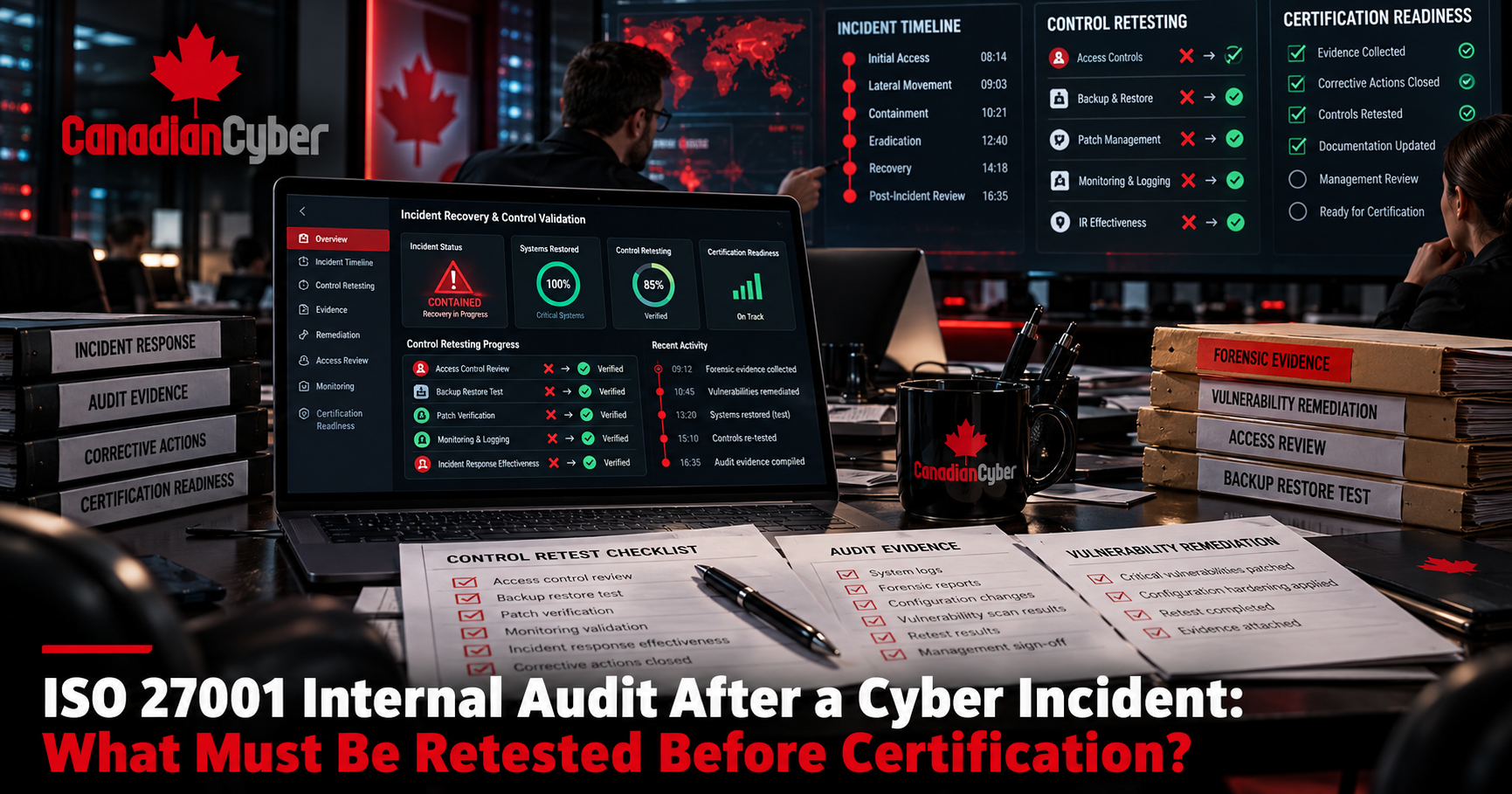
By mid-afternoon, the first non-critical systems were restored from clean backups. Sarah supervised every restore verifying the attacker’s foothold was removed before any system touched the network.
Sunday, 8:47 PM – Customer Communications
“Northpoint Logistics experienced a technical incident affecting some systems. Our team responded immediately. No customer data was exfiltrated. Operations will resume normally Monday afternoon. We apologize for any inconvenience.”
Short. Accurate. No speculation. No admissions of liability. Perfect.
Monday, 11:32 AM – Operations Resume
By Monday morning, core systems were back. By noon, the first customer shipments processed. By Monday evening, the only evidence anything had happened was the forensic images Sarah instructed them to preserve.
The ransom was never paid.
Part VII: The Debrief
Two Weeks Later
The CEO, Marcus, Jennifer, and Sarah sat around a conference table. The mood was different now relieved, reflective, determined.
CEO:
“When this started, we were chaos. Seven hours later, we had a plan. What actually happened?”
Sarah:
“You hired a vCISO. Not just for the crisis the foundation was built in advance: IRP, tabletop exercises, role definitions.
When the crisis hit, you didn’t need to invent anything. You just needed to execute.”
Marcus admitted what most IT leaders realize too late: the tabletop wasn’t a waste of time. It was rehearsal for survival.
“You don’t build the fire escape during the fire.”
The vCISO Difference: A Side-by-Side
| Without a vCISO | With a vCISO |
|---|---|
| Who leads? Whoever talks loudest | Designated Incident Commander |
| What’s the plan? “Let’s Google it” | Tested IRP with clear steps |
| Communication? Panic, rumors, leaks | Controlled, approved, timed |
| Backups? “We think they’re working” | Validated and tested |
| Insurance? Missed deadline | Reported within window |
| Ransom paid? Often | Rarely |
Northpoint Logistics fell squarely into the “With a vCISO” column not because they had a full-time security executive, but because they had access to one when it mattered.
What a vCISO Actually Does During a Crisis
- Incident Commander: Assigns. Directs. Stops debate. Speed requires authority.
- Communication Shield: Prevents premature disclosure, speculation, and internal panic.
- Technical Translator: Converts IT chaos into executive clarity and decisions.
- Process Enforcer: Prevents “restore too early” mistakes that lead to re-encryption.
- Confidence Anchor: Calm is contagious. So is panic. The vCISO sets the tone.
Why a vCISO, Not Just a Retainer
Incident response retainers are better than nothing. But a retainer doesn’t build your incident response capability before the crisis.
A vCISO does the work in advance:
- Builds and tests your IRP
- Runs tabletop exercises with your team
- Understands your environment and leadership dynamics
- Tests backups and validates restore paths
- Trains teams on roles before the crisis
When Sarah joined at 7:52 AM, she wasn’t a stranger. She was executing a plan she had already built.
The 5 Stages of vCISO-Led Incident Response
| Stage | What Happens | vCISO Role |
|---|---|---|
| 1. Preparation | Before the incident | Build IRP, run tabletops, train teams, test backups |
| 2. Detection | First alert to confirmation | Triage, scope assessment, escalation decisions |
| 3. Containment | Stop the spread | Direct isolation, resets, network blocks |
| 4. Eradication | Remove the threat | Root cause analysis, backdoor checks, removal |
| 5. Recovery | Restore operations | Validate clean restores, monitor recurrence |
| 6. Lessons Learned | After the crisis | Debrief, update IRP, implement preventive controls |
Northpoint moved through all six stages in under 48 hours. Most organizations without a vCISO never make it past Stage 2.
The Stats Behind the Story
- 60% of small businesses that suffer a cyberattack shut down within six months.
- Ransomware dwell time averages 5–9 days enough time to map systems and target backups.
- Organizations with tested IRPs contain breaches dramatically faster than those without.
- Teams with vCISO-led response pay ransoms far less often because recovery paths exist.
Northpoint could have been a statistic. Instead, they became a case study.
Epilogue: Six Months Later
Northpoint Logistics had its best quarter ever. Not despite the ransomware attack—because of how they handled it.
- Customers stayed. Trust deepened due to recovery speed and controlled communication.
- Insurance renewed. At a better rate, supported by documentation and oversight.
- The board invested. MFA everywhere, EDR, and a three-year vCISO engagement.
- Marcus got promoted. He knew when to call for help leadership under pressure.
- The employee learned. No blame. Better training. A stronger culture.
Mature organizations don’t blame. They learn.
The Question Every Leader Must Answer
If ransomware hit at 3:17 AM on a Sunday… would you respond like Northpoint or become the statistic?
- Do you have an Incident Response Plan?
- Have you tested it this year?
- Do your backups actually work?
- Does everyone know their role?
- Do you have someone who’s done this before?
If you answered “no” to any of these, you are not ready.
Your Move
If you’re a CEO: You don’t need to understand encryption algorithms. You need to know who to call at 3:17 AM on a Sunday.
If you’re an IT Manager: You don’t need all the answers. You need a plan and a partner who’s done this before.
If you’re a Compliance Officer: You don’t need to prevent every attack. You need to prove you were prepared when one happened.
Canadian Cyber’s vCISO services help you build readiness before the crisis:
- Experienced incident commanders who’ve handled real breaches
- Tested IRPs built for your environment
- Tabletop exercises that train your team before the crisis
- 24/7 availability when the screens go dark
- Regulatory guidance to stay compliant through the chaos
You don’t build the fire escape during the fire. You build it now.
The 15-Minute Incident Readiness Assessment
We’ll review your current incident response capabilities in one call and tell you:
- How you’d perform in the first 60 minutes of ransomware
- The single biggest gap in your preparedness
- One thing you can fix this week to reduce risk immediately
This is not a sales pitch. It’s a readiness check because at 3:17 AM, guessing is not a strategy.
P.S. The Detail That Saved Northpoint
When Sarah asked about backups, Marcus didn’t hesitate:
“They’re offline. Tapes. Disconnected.”
That one fact disconnected, offline, immutable backups saved the company. If backups were network-connected, the ransomware would have encrypted them too.
Don’t wait for 3:17 AM to find out if you’re ready.
Stay Connected With Canadian Cyber
Follow us for vCISO insights, incident readiness playbooks, ISO 27001 guidance, and practical security leadership advice: