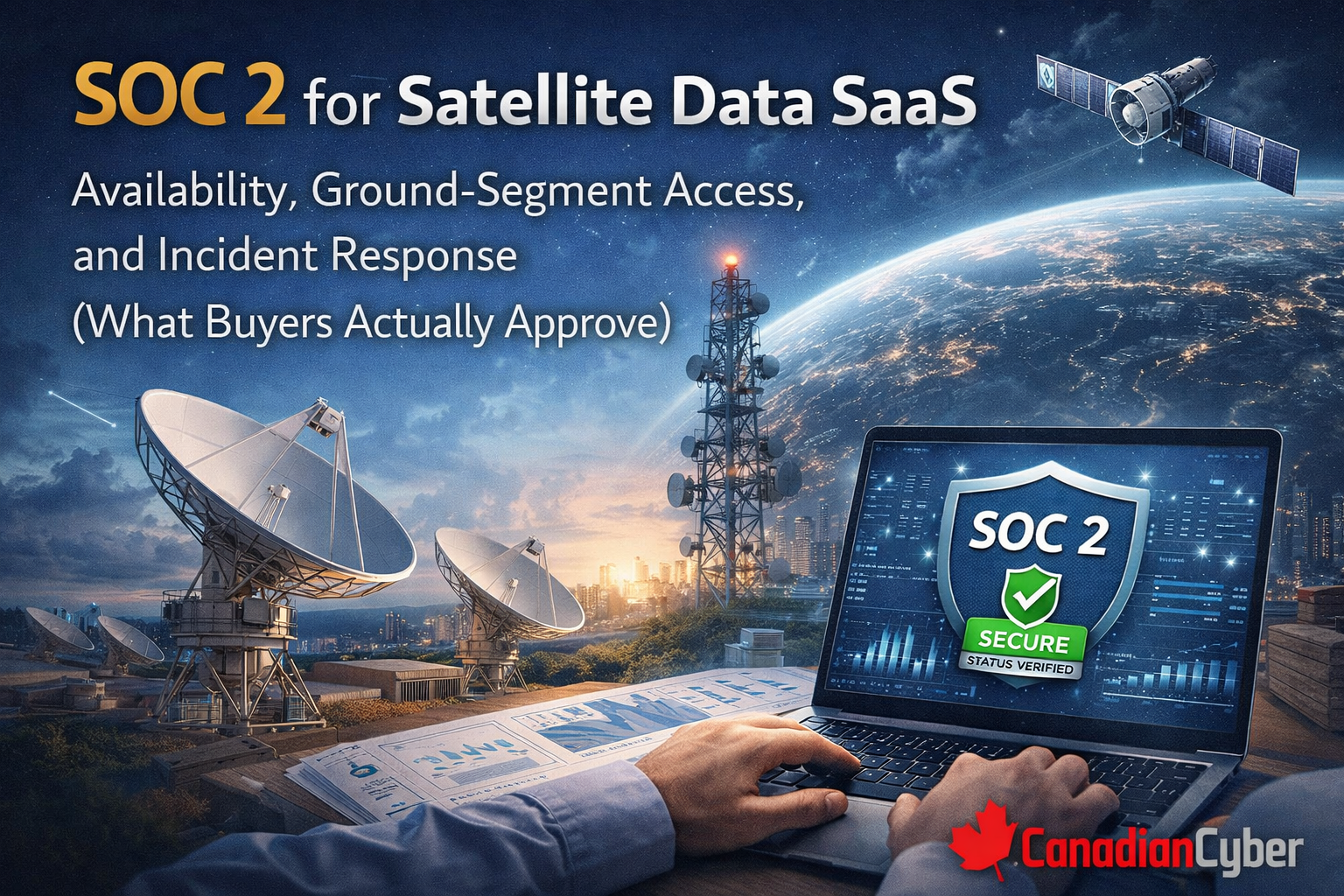
Why satellite SaaS SOC 2 is different
Most SaaS platforms protect user accounts and APIs. Satellite data SaaS has to protect much more than that. Buyers expect you to show reliable control over the operational chain that makes data useful in the first place.
Satellite data SaaS also has to protect:
- ground-segment systems and integrations
- tasking, downlink, and processing pipelines
- privileged access to sensitive operations and data flows
- scheduled and time-sensitive availability requirements
- high-volume storage and egress patterns
- partner and vendor dependencies such as ground stations, cloud processing, and imagery providers
buyers do not want a generic SOC 2 story. They want proof you can run a reliable and secure service under real-world operational constraints.
The SOC 2 criteria that matter most for satellite data SaaS
Most satellite data SaaS companies should start with Security and often add Availability. Confidentiality is also common when imagery, derived products, customer tasking data, or customer-specific operational details are sensitive.
Security
Always in scope.
Availability
Often a deal requirement.
Confidentiality
Common when operational or customer data is sensitive.
The sections below focus on Availability, Ground-Segment Access, and Incident Response because those are the areas buyers push on first.
1) Availability: Proving you can deliver during critical windows
Availability in satellite data SaaS is not just website uptime. It is mission-relevant uptime tied to ingestion schedules, processing windows, and delivery SLAs.
| Buyer question |
What they really mean |
| What are your uptime commitments and how are they measured? |
Define availability in service terms, not vague marketing language. |
| Do you have redundancy for critical components? |
Show resilience architecture and capacity planning. |
| What happens if a pipeline stage fails? |
Prove failover, queueing, alerts, and recovery discipline. |
| Do you test restore and recovery? |
Backups are not enough without restore evidence. |
| How do you handle scheduled maintenance? |
Show disciplined change management that protects delivery windows. |
A) Define availability in service terms
Instead of only saying “platform uptime,” define availability in the same way customers experience the service:
Ingestion availability
Processing availability
Delivery availability
Evidence:
- availability definition and measurement approach
- SLA or SLO statement and how it is calculated
B) Resilience architecture
Buyers do not need deep architecture detail, but they do need confidence that the service has resilience where it matters.
Controls that pass fast
- redundant processing workers
- queueing and backpressure handling for bursts
- multi-zone deployment for core services where applicable
- failover runbooks for critical components
- capacity monitoring for CPU, storage, queue depth, and egress
Evidence: high-level architecture diagram, sanitized capacity dashboard snapshots, quarterly capacity review records.
C) Backup and restore testing
This is where auditors often push hardest because restore evidence is stronger than backup claims.
Evidence:
- backup configuration summary
- restore test records for critical systems
- RTO and RPO targets plus actual test results
D) Change management that protects availability
Many availability failures are change failures. Your evidence has to show that risky changes go through controlled rollout and validation.
Evidence:
- staged rollout and rollback approach
- change approvals for high-risk changes
- 3–5 sampled changes per quarter with PR approvals, CI checks, deployment logs, and post-deploy validation notes
If your SOC 2 story is not yet proving service reliability during critical windows, the fastest improvement is to tighten restore evidence, privileged access governance, and operational incident samples.
2) Ground-segment access: Controlling the real privileged plane
Ground-segment and processing environments are the crown-jewel pathways in satellite data SaaS. Reviewers want to know exactly who can access those systems, how access is controlled, and whether high-risk actions are visible.
High-risk systems include
- tasking configuration systems
- downlink coordination and ingest endpoints
- processing workflows and pipeline configurations
- storage locations and export paths
A) Privileged access model
Controls that pass fast
- separate admin accounts
- least privilege roles
- MFA for all privileged access
- documented and monitored break-glass accounts
- quarterly privileged access reviews
Evidence: admin role list, quarterly review sign-off, MFA enforcement proof, break-glass procedure and monitoring evidence.
B) Access pathways are controlled
Ground-segment access should never depend on ad hoc pathways or convenience openings.
- approved remote access methods only
- VPN, jump host, or brokered access
- no direct internet exposure of management interfaces
- vendor access is time-bound and approved
Evidence: remote access standard, vendor access approval samples, and session access logs where feasible.
C) Logging for admin actions and pipeline changes
You need to show who changed pipeline configurations, permissions, export settings, and monitoring logic.
Evidence:
- admin action log samples
- monthly or quarterly log review sign-offs
- alert-to-ticket chain for a privileged change
3) Incident response: Proving you can handle availability and security events together
In satellite data SaaS, incidents are often blended. A pipeline outage may be caused by misconfiguration, partner failure, or attack. Suspicious access may become an availability issue. Ground-segment dependencies may require coordinated internal and vendor response.
A) Incident response runbooks
Scenario-specific runbooks should cover
- ingestion pipeline failure during scheduled downlink
- processing backlog or queue overload
- credential compromise on privileged access
- suspicious bulk export or egress spike
- vendor outage such as ground station or provider failure
- ransomware affecting the processing environment
Evidence: runbook library with version control, at least one tabletop annually, PIR template, and one completed PIR sample.
B) Two-stage communications model
This helps you communicate early without overclaiming.
Initial notice
What you know, what you are doing, and when the next update is coming.
Confirmed impact notice
Scope, customer impact, actions taken, and prevention steps once the picture is clearer.
Evidence:
- internal and external comms templates
- sample incident timeline showing update cadence
C) Operational proof: alert to ticket to resolution
Auditors trust operating evidence more than program descriptions. Show real examples where something was detected, triaged, handled, and improved.
Provide 2–3 examples showing:
- alert triggered
- ticket created
- triage actions taken
- resolution recorded
- follow-up improvement captured
These can be availability incidents, not only classic security events.
The evidence pack that gets you approved faster
If your SOC 2 story is not converting into approvals, the issue is often packaging. Build a buyer-friendly trust pack that focuses on what matters to them.
Satellite SaaS SOC 2 Trust Pack outline
- scope statement showing what systems are covered
- availability SLO/SLA definition and measurement model
- privileged access model for ground-segment and pipeline admins
- incident response and communication approach
- backup and restore testing cadence
- how to request the SOC 2 report under NDA if applicable
Keep internal unless required under NDA
- detailed architecture diagrams with sensitive network information
- deep detection logic and forensic details
- internal admin lists and tool configurations
Common deal-blocking gaps in satellite data SaaS
- availability defined only as website uptime instead of pipeline or delivery availability
- no restore test evidence
- too many privileged users and no quarterly review
- vendor or partner access unmanaged or permanent
- no log review evidence
- incident response exists but has no tabletop record or PIR process
- missing change management samples for authorized change proof
Practical takeaway:
fixing two or three of these often unlocks enterprise approvals quickly.
Next Steps
If you are a satellite data SaaS company and SOC 2 is slowing deals or failing to generate trust, the fastest path is to make availability, ground-segment access, and incident response evidence visible and buyer-friendly.
Final takeaway
Satellite data SaaS buyers are not just buying an interface. They are buying dependable access to time-sensitive data and the operational systems behind it. That is why your SOC 2 story has to be grounded in service availability, privileged operational access, and incident response discipline.
When you can show restore tests, admin reviews, approved remote access paths, scenario-specific runbooks, and real alert-to-resolution evidence, your trust story becomes concrete and much easier for buyers to approve.
In one line
Buyers approve satellite data SaaS when they can see that your platform stays available, your privileged plane stays controlled, and your incident handling stays disciplined under pressure.
Follow Canadian Cyber
Practical cybersecurity + compliance guidance: