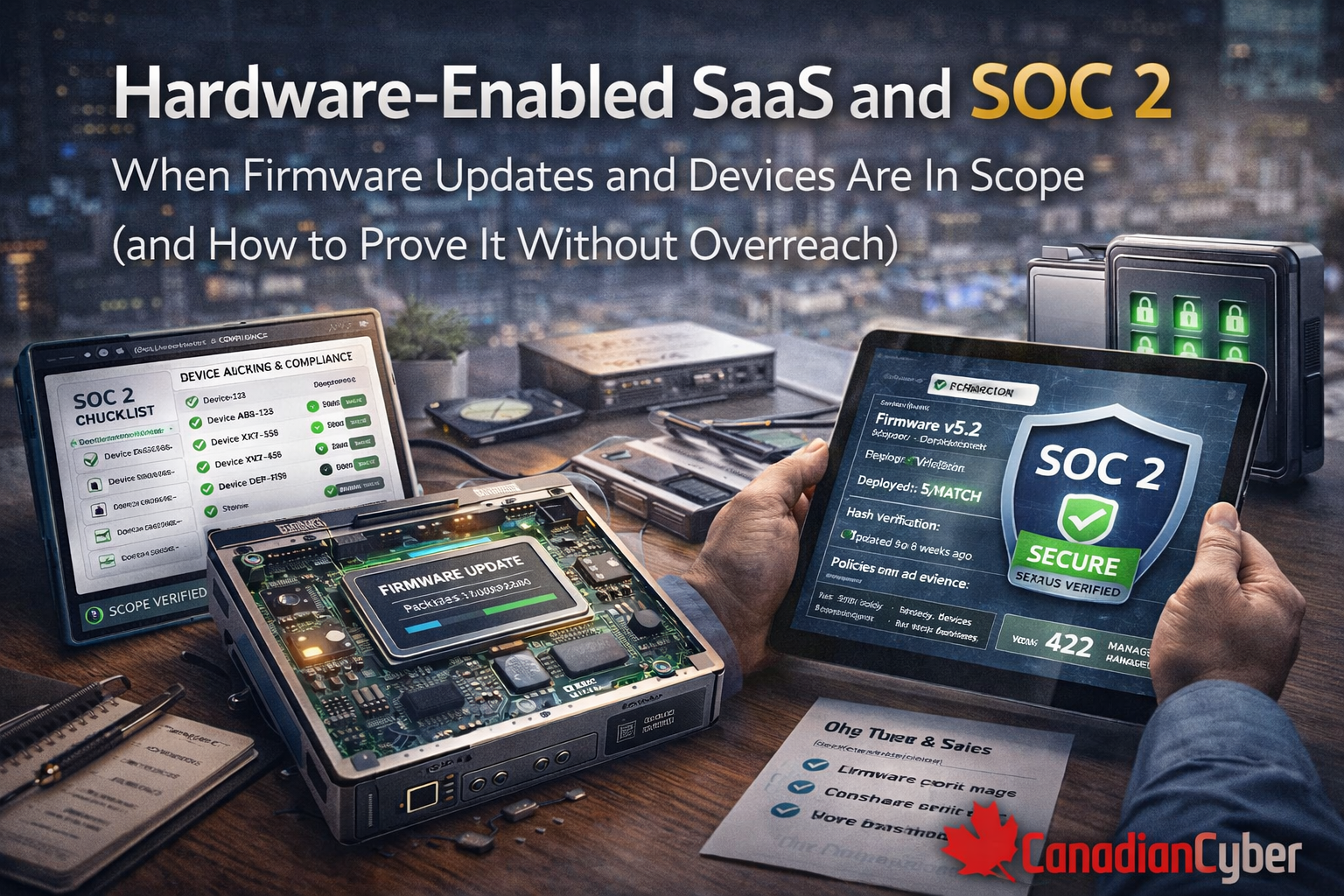
Why this is a high-impact scoping decision
If you scope hardware incorrectly, you usually get one of two bad outcomes.
Outcome A: Scope overreach
You include every device variant, field deployment, and customer-managed network. The audit becomes huge, expensive, and still cannot fully cover what customers do in their own environments.
Outcome B: Scope underreach
You exclude devices entirely, but your service depends on them for data, commands, or safety-adjacent workflows. Buyers stop treating the SOC 2 as meaningful and due diligence drags on.
The practical answer is usually hybrid:
include what you control and operate, document what customers control, and build evidence around device identity, firmware governance, telemetry trust, and operational safety.
The core rule: scope follows responsibility
SOC 2 scope should cover the system components and processes that create or process customer data, enforce access control, affect availability and service commitments, and are operated by your organization.
| Scoping category |
Typical components |
| In scope |
Device identity platform, firmware update service, provisioning workflows, telemetry ingestion, admin tooling, remote command features you operate |
| Partially in scope / shared |
Physical device in the field and its configuration, depending on who manages it and what guarantees you make |
| Usually out of scope |
Customer networks, customer-controlled physical security, customer-managed device handling unless you provide it as a managed service |
When devices are in scope for SOC 2
Trigger 1: The device authenticates to your cloud
If a device uses credentials or certificates to connect to your ingestion endpoint, device identity becomes part of your security boundary.
What becomes in scope
- identity issuance and provisioning
- certificate or token lifecycle
- revocation and quarantine process
- tenant binding from device to customer or site
Trigger 2: You push firmware updates or configure devices remotely
If you can update firmware, you are operating a change management and operational safety system, not just a web app deployment process.
What becomes in scope
- firmware release process
- signing and integrity verification
- staged rollouts and canaries
- rollback and failure handling
- approvals and release logging
Trigger 3: Device telemetry drives customer decisions or billing
If customers rely on device telemetry for operational decisions, alerts, compliance reporting, or billing, then integrity and completeness controls are part of your trust story.
What becomes in scope
- ingestion validation
- dedupe and replay controls where relevant
- missing data detection
- tenant isolation in telemetry pipelines
- export and egress controls
Trigger 4: Your support team can access device data or operate devices
If support can view sensitive telemetry, trigger diagnostics, change settings, or initiate updates, then privileged access governance and auditability are required.
What becomes in scope
- support access governance
- least privilege and approval model
- audit logs for privileged actions
- access review cadence
Practical next step
If buyers keep asking whether your devices and firmware are “part of SOC 2,” the fastest win is a clean system boundary statement plus shared responsibility table and evidence for the controls you actually operate.
When devices are usually not in scope
Devices can often be excluded as customer-managed endpoints if customers physically control the device and environment, customers manage local network security, your service does not guarantee device hardening beyond basic requirements, and your SOC 2 scope clearly defines the boundary and shared responsibility.
Key message:
you are not ignoring device risk. You are scoping it correctly and controlling what you actually operate.
The vCISO scoping model buyers actually accept
1) System boundary statement
Your boundary statement should make it obvious what is in scope, what is shared, and what is outside the boundary.
Include in scope
- cloud services and components
- device identity and provisioning
- firmware update pipeline if applicable
- telemetry ingestion and storage
- admin and support access pathways
Explicitly list out of scope
- customer networks
- physical security at customer sites
- customer device handling and local configuration unless managed by you
2) Shared responsibility table
A simple shared responsibility table removes a huge amount of buyer confusion.
| Domain |
You (Vendor) |
Customer |
| Device identity |
Issue, rotate, and revoke credentials |
Protect device from theft or tampering |
| Network exposure |
Secure cloud endpoints |
Segment and secure local network |
| Firmware updates |
Sign, stage, monitor, and roll back |
Approve maintenance windows if required |
| Telemetry integrity |
Validate, isolate, and monitor |
Install and maintain devices correctly |
| Physical access |
Define any tamper expectations |
Maintain physical security controls |
Firmware updates: the controls auditors actually care about
1) Signed firmware and integrity verification
If firmware is in scope, reviewers expect you to show it cannot be modified in transit or by unauthorized parties.
Evidence
- signing approach documented
- key management controls for release signing
- verification steps in the release pipeline
2) Release approvals as authorized change
Firmware should be treated like production code, not informal operations work.
Evidence
- sample release approvals
- branch protections and CI checks
- deployment logs
- security review triggers for sensitive release components
3) Staged rollout and rollback
Firmware failures are availability incidents, so auditors want to see controlled rollout and rollback discipline.
Controls and evidence
- canary deployments
- phased rollout by cohort
- rollback mechanism or kill switch
- rollout plan template
- sample staged rollout record
- sanitized rollback incident record if used
4) Update failure monitoring
Reviewers want proof that you detect failed updates, stalled versions, and rollout anomalies before customers discover them first.
Evidence
- monitoring dashboard snapshot
- alert to ticket to resolution sample
- rules for detecting elevated failure rates and outdated device versions
Device identity: what “good” looks like in SOC 2 terms
SOC 2 reviewers want to know devices cannot be easily impersonated and that compromised devices can be isolated without putting other customers at risk.
Controls
- unique per-device identity
- provisioning workflow with approvals for critical fleets
- certificate or token rotation policy
- revocation and quarantine process
- logs for provisioning, rotation, and revocation
Evidence pack
- identity model document
- sample provisioning log
- sample revocation ticket plus proof the device was blocked
- quarterly review of who can provision devices
Telemetry pipelines: integrity, completeness, and tenant isolation
For hardware-enabled SaaS, telemetry is often the actual data product. Buyers care whether it arrives securely, completely, and only within the right tenant boundary.
Controls buyers ask about
- TLS enforced at ingestion
- replay and duplicate protections where needed
- rate limiting per device and tenant
- schema validation and DLQ so bad payloads are not dropped silently
- tenant isolation in processing and storage
- export restrictions and audit logs
Evidence: gateway or WAF config, validation rules summary, missing data detection evidence, log retention proof, review sign-offs, and 2–3 alert-to-ticket examples.
Availability: why SOC 2 Availability often matters here
If firmware failures or telemetry outages affect customer operations, then Availability often becomes important to your trust story.
What auditors will ask
- Do you monitor service health?
- Do you test restores?
- Do you have incident runbooks?
- Can you recover from a bad deployment?
Evidence: monitoring dashboards, restore test records, incident runbooks for rollout failure, ingestion outage, and device identity compromise, plus one annual tabletop record at minimum.
The minimum evidence set that passes faster
If you want a buyer-trusted story without bloating scope, produce these artifacts:
- System boundary and shared responsibility statement
- Device identity model with provisioning and revocation proof
- Firmware release governance and staged rollout proof, if firmware applies
- Telemetry pipeline controls for validation, isolation, and missing data detection
- Privileged access review evidence for device and admin tooling
- Logging and retention proof plus log review sign-offs
- Incident response runbooks and one tabletop record
- Change management samples with PR approvals and deploy logs
That is hardware-enabled SaaS SOC 2 in buyer language:
clear scope, clean responsibility boundaries, and evidence around the controls customers actually rely on.
Common mistakes and how to avoid them
Mistakes
- saying devices are out of scope with no shared responsibility statement
- treating firmware updates like informal ops work
- using shared secrets across devices
- having no rollback or failure-handling proof
- letting support access everything without approvals
Fixes
- define boundaries and customer responsibilities clearly
- make firmware follow change control and staged rollout
- move to per-device identity with revocation
- create rollback process and monitoring evidence
- enforce least privilege, time-bound access, and audit logs
Next steps
If buyers are getting stuck on devices, firmware, or telemetry in your SOC 2 story, the solution is usually not a bigger audit. It is a better scope model and better evidence.
Final takeaway
Hardware-enabled SaaS does not need a bloated SOC 2 scope to be credible. It needs a defensible one. The question is not whether every physical device in every customer environment belongs in scope. The question is whether the systems you operate device identity, firmware governance, telemetry ingestion, privileged access, and incident response are clearly in scope and clearly evidenced.
When you scope that boundary properly and package the evidence around it, procurement moves faster, buyers trust the report more, and auditors stop pulling the conversation into unhelpful extremes.
In one line
The right SOC 2 scope for hardware-enabled SaaS is not “all devices” or “no devices.” It is “everything you operate that makes the device-plus-cloud system trustworthy.”
Follow Canadian Cyber
Practical cybersecurity + compliance guidance: