Get in touch
info@canadiancyber.ca


Rafia Rizwan

April 3, 2026
A real-world case study showing how an MSP scaled ISO 27001 and SOC 2 compliance across clients using a SharePoint ISMS template and structured evidence model.
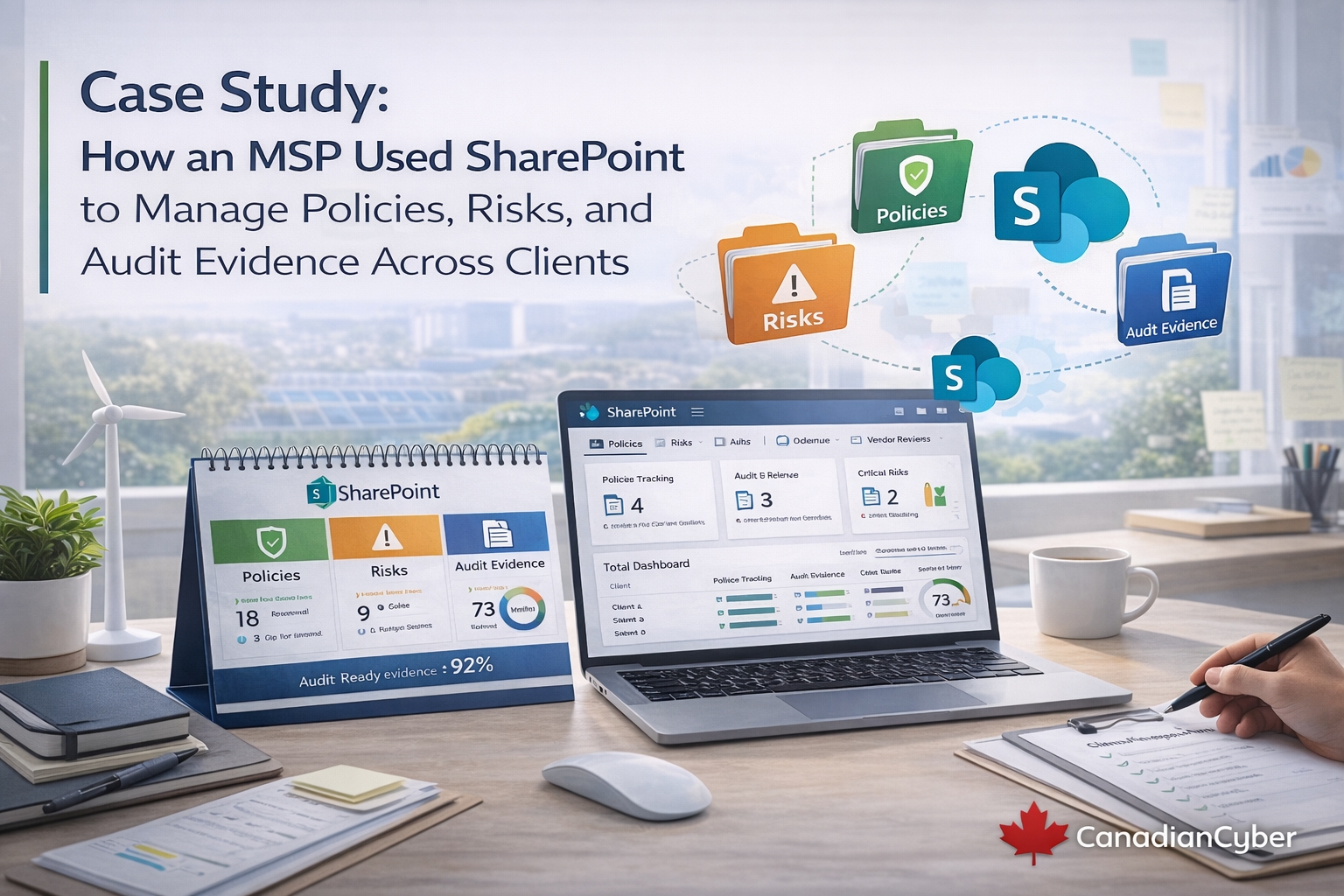
MSPs have a unique compliance problem. They do not just maintain one internal security program. They often support many client environments at once, each with different policy needs, evidence expectations, industries, and audit styles.
That becomes hard to manage very quickly if the system behind it is loose. Policies drift. Evidence ends up in ticketing tools, inboxes, and random shared folders. Risk registers go stale. Corrective actions lose momentum. New analysts start improvising because nobody is fully sure where things belong.
This case study shows how a growth-stage MSP used SharePoint to create a repeatable client compliance operating model. The result was better consistency, cleaner audits, faster evidence retrieval, and a system that scaled without turning into chaos.
The MSP served clients across SaaS, manufacturing, and professional services. Demand for ISO 27001 support, SOC 2 readiness, internal audits, and evidence packs was increasing often for multiple clients at once.
The issue was not lack of skill. The issue was scale. The team knew how to do the work. What they did not have was a system designed to support many client compliance environments in a clean and repeatable way.
This created a familiar MSP problem. The work was possible, but it was too dependent on memory, individual habits, and last-minute effort.
Instead of buying a heavy GRC platform immediately, the MSP made a more practical decision. It built a standardized SharePoint ISMS template and deployed that structure per client, with controlled variations where needed.
The goal was not to make every client identical. The goal was to give every client the same operating model: the same structure, the same evidence logic, the same approval expectations, and the same audit-readiness approach.
Each client received a dedicated SharePoint site based on a consistent template. That template became the MSP’s client compliance operating system.
This library held approved policies only. Versioning was enabled, review dates were tracked, and policy approvals were recorded. This kept the “source of truth” stable and made it easier to answer auditor questions about currency and approvals.
Operational procedures, incident response guides, DR tabletop scripts, and change workflows lived here. This separated execution documents from governance documents while keeping both controlled.
Evidence was stored by period. Each quarter had its own logical grouping, and inside that period the categories stayed consistent across clients.
Each client had risks, owners, treatments, due dates, and risk acceptance workflows with expiry dates. This kept risk governance current and made management review much easier.
Findings were mapped directly to actions. Closure evidence was required. Verification was mandatory. This improved the quality of findings-to-fixes closure and reduced repeat issues.
Where in scope, vendors were tiered, review dates were assigned, SOC reports and notes were linked, and exceptions were tracked with expiry dates.
This was one of the strongest design decisions. Auditors could review approved policies, selected evidence packs, management review outputs, and corrective action summaries without seeing unrelated systems or internal-only material.
This was the biggest operational improvement. The MSP stopped treating evidence as something that simply existed somewhere. Instead, evidence had to be complete, attributable, and reviewable.
They achieved this using metadata and approvals. Each evidence item carried control links, period, owner, evidence type, and status. Approval turned “uploaded” into “usable.” Mapping linked the evidence to controls and audit samples.
The MSP used one base control model aligned to ISO 27001 core expectations and SOC 2 Security, with common extensions where needed. Then it added light overlays for each client, based on industry needs, contract-specific controls, or unique vendor requirements.
This meant the team did not have to reinvent the whole model for every client.
Instead of relying on quarterly panic, the MSP introduced a small monthly routine and a focused quarterly routine for each client.
| Cadence | Typical activities | Why it helped |
|---|---|---|
| Monthly | Log review sign-off, patch or exception review, evidence due list, corrective action updates | Kept evidence moving continuously |
| Quarterly | Privileged access review, vendor review, tabletop exercise, management review update | Reduced quarter-end scramble and improved review quality |
Because the cadence stayed small and repeatable, clients could actually sustain it.
The MSP also created an internal roll-up dashboard for itself. This was not client-facing. It showed readiness across active compliance clients using the same metadata logic.
They did not need a GRC platform to see readiness. They needed consistent structure and metadata.
Because the auditor view was curated and consistent, auditors could sample quickly, trace evidence to controls, verify approval status, and move on without long email threads.
Clients knew what was due, who owned it, where it went, and what approved evidence meant. This reduced confusion and made the MSP look much more mature.
New analysts ramped faster. Teams stopped improvising their own systems. Leadership could actually see where readiness was strong and where it was slipping.
After deploying the SharePoint ISMS template across active compliance clients, the MSP saw clear operational gains.
Most importantly, the MSP stopped rebuilding the same compliance system from scratch for every new client.
This approach is repeatable because it is simple. It does not depend on a heavy new platform. It depends on consistent structure, metadata, approval logic, and a cadence clients can actually keep.
If you implement those well, your compliance services become much easier to scale.
MSPs do not usually fail at compliance because they lack knowledge. They fail when the system behind the work cannot scale across clients.
This case shows a more practical path. One operating model. Many client workspaces. One evidence discipline. One cadence. One way to see readiness clearly.
That is what makes compliance support easier to deliver, easier to explain, and much easier to grow.