Success Story • Internal Audit • ISO 27001 Readiness
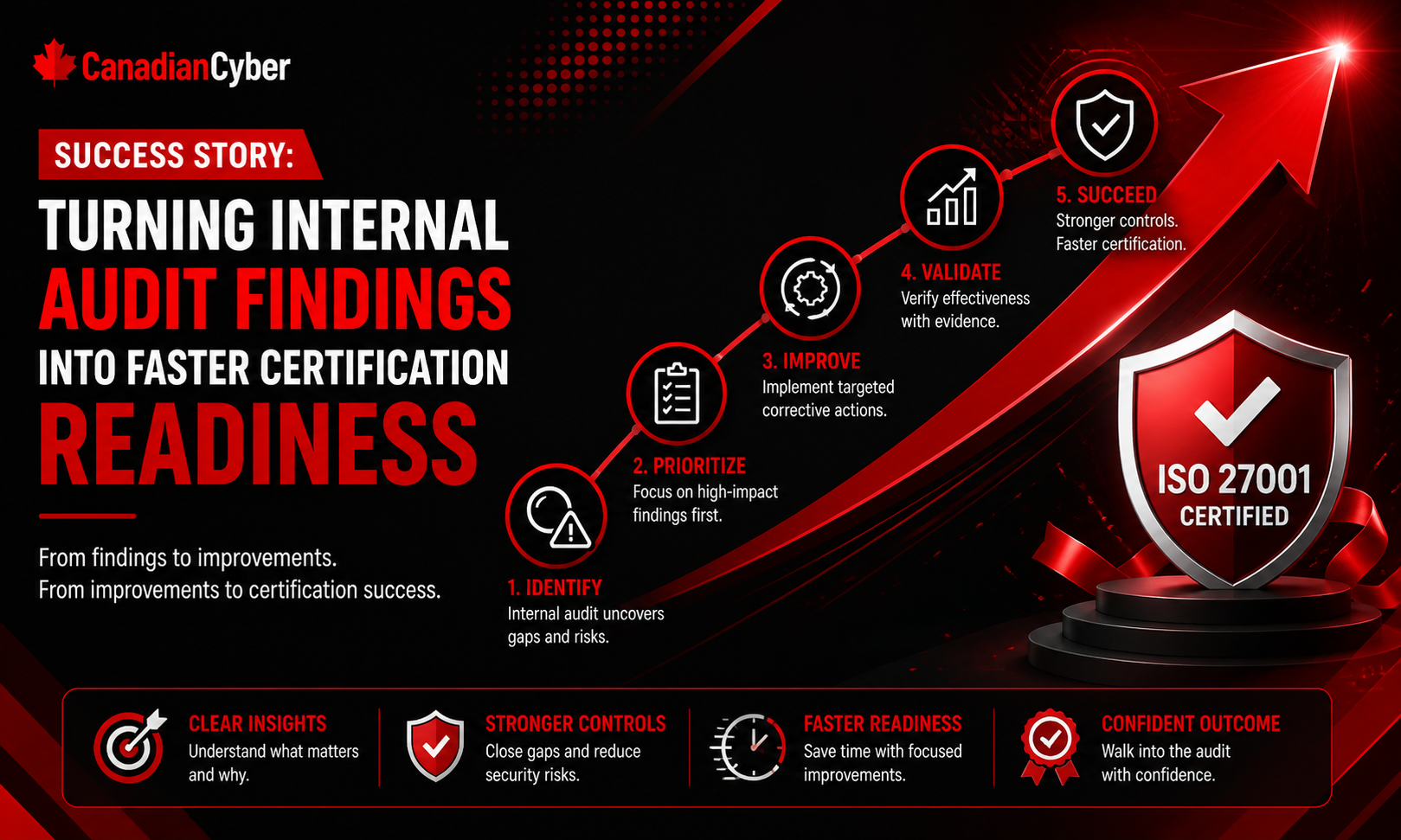
Success Story: Turning Internal Audit Findings into Faster Certification Readiness
Internal audit findings are not setbacks. Used properly, they become a practical roadmap for faster ISO 27001 certification readiness.
Quick Snapshot
| Internal Audit Finding | Readiness Improvement |
|---|---|
| Evidence Hard to Retrieve | Moved evidence into structured SharePoint with metadata and review status. |
| Weak Access Review Proof | Added reviewer, review date, user lists, removals, and approval records. |
| Inconsistent Vendor Reviews | Created a vendor register with risk rating, data handled, evidence reviewed, and next review date. |
| Untested Incident Plan | Ran a tabletop exercise and improved escalation, communication, and documentation templates. |
Introduction
Internal audits are often misunderstood.
Many teams treat them as a formality. A checklist exercise. Something to complete before the real audit.
The organizations that move fastest toward certification treat internal audit as a diagnostic tool, not a box-ticking exercise.
This success story shows how a company used internal audit findings to accelerate ISO 27001 readiness instead of delaying it.
Want Your Internal Audit to Speed Up Certification?
Canadian Cyber helps teams turn internal audit findings into practical remediation plans, evidence improvements, and certification readiness actions.
The Company
Let’s call the company SecureFlow SaaS.
SecureFlow was a growing SaaS platform preparing for ISO 27001 certification to support enterprise sales.
The company had:
- strong engineering practices
- cloud-based infrastructure
- growing customer base
- increasing security questionnaire pressure
- leadership commitment to certification
They had already:
- defined ISMS scope
- created core policies
- built a risk register
- implemented basic controls
- started collecting evidence
But they had not yet tested whether everything worked together.
The Situation Before Internal Audit
On paper, SecureFlow looked ready. But the compliance lead had concerns.
- evidence was stored but not always consistent
- access reviews were completed but not well documented
- vendor reviews existed but lacked structure
- incident response plan was written but not tested
- corrective actions were tracked loosely
- ownership was defined but not enforced
The team decided to run a full internal audit before engaging the certification body.
The Internal Audit Approach
Instead of treating internal audit as a checklist, the company structured it around real audit scenarios.
| Area Tested | What the Audit Checked |
|---|---|
| Access Control | Can the team prove access was reviewed? |
| Risk Management | Are risks owned, reviewed, and treated? |
| Vendor Oversight | Is vendor risk assessment documented? |
| Incident Response | Can the team explain how it responds to incidents? |
| Backup and Recovery | Where is the latest backup test record? |
| Policy Governance | Who approved each policy and when? |
Need an Internal Audit That Feels Like a Real Rehearsal?
We help teams test controls, challenge assumptions, and prepare for auditor-style questions before certification audit day.
Key Findings
The internal audit identified several practical issues.
- Evidence existed but was hard to retrieve: Files were stored, but not organized consistently.
- Access review lacked strong proof: The review happened, but documentation was incomplete.
- Vendor reviews were inconsistent: Some vendors had full assessments, while others had minimal notes.
- Incident response was untested: The plan existed, but the team had never practiced it.
- Corrective action tracking was weak: Actions were recorded, but closure evidence was unclear.
- Policy approvals were missing audit trails: Policies existed, but approval records were incomplete.
The Turning Point
Instead of seeing these findings as a setback, SecureFlow treated them as a roadmap.
They asked: what would an external auditor expect to see?
Then they focused on closing gaps quickly.
Step 1: Centralizing Evidence
The team moved all ISMS evidence into a structured SharePoint environment.
They added metadata:
- control area
- owner
- period covered
- evidence type
- review status
Result:
- faster retrieval
- clearer ownership
- reduced audit stress
Step 2: Strengthening Access Review Evidence
They improved access reviews by documenting the full review trail.
- reviewer
- review date
- linked user lists
- recorded removals
- final approval
Access reviews became defensible because auditors could follow the process clearly.
Step 3: Standardizing Vendor Reviews
They created a structured vendor register and prioritized critical vendors first.
| Vendor Register Field | Why It Helped |
|---|---|
| Risk rating | Prioritized review depth |
| Data handled | Showed sensitivity |
| Evidence reviewed | Created assurance record |
| Approval decision | Documented acceptance |
| Next review date | Kept oversight active |
Are Your Vendor Reviews Audit-Ready?
Canadian Cyber helps build vendor registers, risk ratings, evidence review workflows, approval records, and reassessment schedules.
Step 4: Running an Incident Tabletop
They simulated a real incident: a compromised admin account affecting customer data.
The exercise revealed:
- unclear escalation path
- missing communication steps
- weak documentation template
Result:
- incident response became practical
- team confidence improved
- evidence was created for audit
Step 5: Fixing Corrective Action Tracking
They replaced scattered tracking with a structured corrective action tracker.
Each action included:
- owner
- due date
- status
- evidence of completion
- verification
This created better accountability, clearer audit trails, and faster closure.
Step 6: Adding Policy Approval Records
They updated their policy library to include approval and version control details.
- approval status
- approver
- approval date
- version
- review schedule
Governance became visible, and policies became audit-ready.
The Results
Within weeks, SecureFlow transformed its ISMS.
| Improvement | Impact |
|---|---|
| Internal audit findings were resolved quickly | Issues became actionable fixes |
| Evidence became easier to access | Audit preparation time dropped |
| Control ownership improved | Each control had a responsible person and clear output |
| Confidence increased across the team | Employees understood what was expected |
| Certification readiness accelerated | The company moved into certification audit with fewer surprises |
What Changed Most
The biggest shift was mindset.
| Before Internal Audit | After Internal Audit |
|---|---|
| Compliance felt theoretical | Controls were tested |
| Evidence felt scattered | Evidence was structured |
| Readiness felt uncertain | Gaps were visible |
| Improvements were unclear | Improvements were targeted |
Turn Findings Into Faster Readiness
Canadian Cyber helps teams close internal audit findings, organize evidence, strengthen documentation, and prepare for certification with fewer surprises.
Lessons Learned
- Internal audit is not a formality: It is a preparation tool.
- Findings are valuable: They show exactly what to fix before the real audit.
- Evidence matters as much as controls: If you cannot prove it, it may not count.
- Testing workflows is critical: Plans must be practiced, not just written.
- Structure reduces stress: Organized evidence saves time and effort.
Canadian Cyber’s Take
At Canadian Cyber, we often see teams rush toward certification without fully using internal audit.
That creates risk.
The strongest organizations use internal audit as a rehearsal. They:
- test controls
- validate evidence
- challenge assumptions
- identify gaps early
- fix issues quickly
This makes certification smoother and faster.
Takeaway
Internal audit findings are not a problem. They are an opportunity.
SecureFlow improved certification readiness by:
- treating findings as actionable work
- organizing evidence
- strengthening control documentation
- testing real workflows
- improving ownership
- closing gaps quickly
Certification is easier when problems are found early, not during the final audit.
How Canadian Cyber Can Help
At Canadian Cyber, we help organizations turn internal audit findings into practical improvements that accelerate certification readiness.
- internal audit planning and execution
- gap analysis and remediation support
- SharePoint ISMS setup and evidence tracking
- corrective action management
- incident response tabletop exercises
- ISO 27001 readiness programs
- vCISO guidance for continuous compliance
Stay Connected With Canadian Cyber
Follow Canadian Cyber for practical guidance on ISO 27001, internal audits, evidence management, certification readiness, and vCISO support.