SOC 2 • AI Platforms • Data, Models & Access Risk
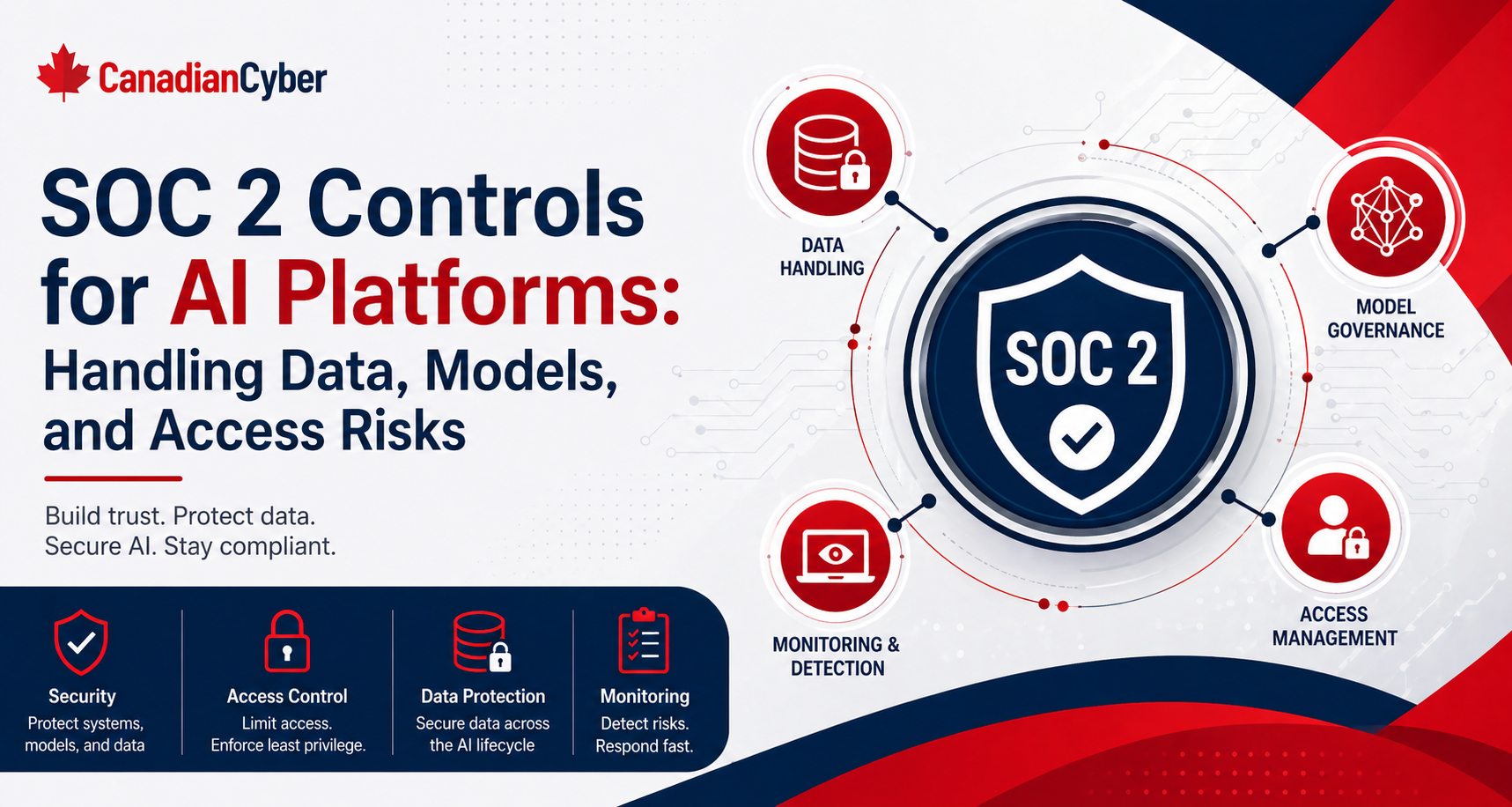
SOC 2 Controls for AI Platforms: Handling Data, Models, and Access Risks
AI platforms need SOC 2 controls that go beyond standard SaaS security, especially around customer data, training boundaries, model governance, prompts, embeddings, and tenant separation.
Quick Snapshot
| AI SOC 2 Area | What Needs Control |
|---|---|
| Data Handling | Customer data, prompts, outputs, embeddings, logs, deletion, and retention |
| Model Governance | Model versions, prompts, system instructions, provider dependencies, and approvals |
| Access Risk | Employee access to customer AI data, training datasets, model admin tools, and support queues |
| Tenant Segregation | Customer data, embeddings, retrieval systems, exports, and AI workflow boundaries |
Introduction
AI platforms create a different kind of SOC 2 challenge.
They are not just storing customer data. They may be training on it, processing it, embedding it, summarizing it, labeling it, or sending it through model workflows.
SOC 2 for AI platforms is about proving that data, models, and access are governed clearly enough for customers to trust the system.
SOC 2 readiness for AI platforms is not only about normal SaaS controls. It also needs clear control over:
- customer data
- training datasets
- model access
- prompts and outputs
- embeddings
- support access
- vendors and model providers
- logging and monitoring
- change management for models
Preparing an AI Platform for SOC 2?
Canadian Cyber helps AI companies build practical SOC 2 controls around customer data, model governance, access, vendors, and audit evidence.
Why AI Platforms Face Tougher SOC 2 Questions
Buyers are becoming more careful about AI risk.
They want to know:
- Is our data used for training?
- Can other customers benefit from our data?
- Who can access prompts and outputs?
- Are model changes reviewed?
- Are embeddings protected?
- Can support staff see sensitive records?
- Which third-party AI providers are involved?
- How do you prevent data leakage?
- How do you monitor misuse?
These questions go beyond basic cloud security. They test whether the AI platform has real governance around how data moves through the system.
A Common Scenario
Picture this: an AI SaaS platform helps companies analyze support tickets, contracts, or customer documents.
The platform uses:
- uploaded customer files
- prompts
- model outputs
- embeddings
- third-party model APIs
- internal review tools
- analytics dashboards
- support tickets
- training or fine-tuning workflows
The company already has MFA, encryption, logging, policies, and cloud security. But during SOC 2 readiness, new questions appear:
- Are customer documents used to train models?
- Are prompts retained?
- Are outputs reviewed by employees?
- Are embeddings treated as sensitive data?
- Can model providers access customer content?
- Are model changes tested before release?
- Is customer data separated in AI pipelines?
1. Data Handling Controls
AI platforms need strong clarity around what data is collected, processed, retained, and reused.
| Key Control Questions | Evidence Examples |
|---|---|
| What customer data enters the AI workflow? | AI data flow diagram |
| Is customer data used for training or fine-tuning? | Training data policy and customer data use statement |
| Are prompts, outputs, and embeddings retained? | Data retention schedule |
| Can data be deleted when required? | Deletion procedure and sample deletion ticket |
A strong AI data control model usually includes:
- data inventory for AI workflows
- clear training-use policy
- customer opt-in or opt-out where needed
- retention rules for prompts, outputs, and embeddings
- restrictions on using customer data for model improvement
- deletion workflows
- minimization of sensitive data in logs
- encryption for stored AI artifacts
Can You Explain How Customer Data Moves Through Your AI System?
We help AI platforms map data flows, retention rules, training boundaries, embeddings, deletion workflows, and evidence requirements.
2. Model Governance Controls
SOC 2 reviewers may not audit model quality the same way they audit access control, but model governance still matters.
Model changes can affect security, confidentiality, reliability, and customer trust.
AI platforms should define controls for:
- model selection
- model version tracking
- approval before production model changes
- testing before release
- rollback planning
- risk review for major AI workflow changes
- documentation of model provider dependencies
Evidence Examples
- model inventory
- model change log
- approval records
- testing results
- rollback plan
- vendor review for model providers
- risk assessment for major model changes
3. Access Controls for AI Systems
Access risk is especially important because AI platforms often contain sensitive content in multiple forms.
That includes:
- raw customer files
- prompts
- outputs
- embeddings
- training datasets
- review queues
- admin dashboards
A strong access model includes:
- least privilege
- role-based access
- MFA for administrative access
- restricted access to prompts, outputs, and embeddings
- approval for elevated support access
- logging of sensitive data access
- regular privileged access reviews
- fast offboarding
Who Can See Prompts, Outputs, and Embeddings?
Canadian Cyber helps AI teams review admin roles, support access, privileged users, training dataset access, and sensitive AI workflow permissions.
4. Customer Data Segregation
Multi-tenant AI platforms need to prove that one customer’s data does not leak into another customer’s results or training context.
Better controls include:
- tenant-aware authorization
- tenant-scoped vector stores or access controls
- testing for cross-tenant retrieval
- restrictions on shared training datasets
- secure export controls
- monitoring for unusual access patterns
| Segregation Question | Evidence Example |
|---|---|
| Are embeddings tenant-scoped? | Retrieval boundary documentation |
| Can one customer query another customer’s documents? | Tenant isolation test results |
| Are exports tenant-specific? | Access control configuration |
5. Logging and Monitoring
AI platforms need logs that support investigation without creating unnecessary privacy exposure.
Better controls include:
- log AI workflow access events
- log model configuration changes
- log privileged admin actions
- monitor unusual usage or abuse
- retain logs for investigation
- minimize sensitive prompt/output content in logs
Logs should help investigations without becoming a new source of sensitive AI data exposure.
6. Vendor and Third-Party AI Provider Risk
Many AI platforms rely on external providers.
These may include:
- foundation model APIs
- cloud AI services
- annotation tools
- data labeling vendors
- vector database providers
- monitoring tools
- support platforms
Better controls include:
- AI vendor inventory
- vendor risk ranking
- review of provider security documentation
- contract review for data use and retention
- subprocessor tracking
- annual reassessment for critical AI vendors
Are Your AI Providers SOC 2 Ready Too?
We help review third-party AI providers for data use, prompt retention, subprocessor exposure, security evidence, contracts, and reassessment schedules.
7. Change Management for AI Workflows
AI systems change quickly.
New prompts, retrieval rules, model settings, training data, and provider updates can all affect customer outcomes and data handling.
Better controls include:
- version control for prompts and configurations
- peer review for AI workflow changes
- testing before release
- approval for high-risk changes
- deployment logs
- rollback procedures
What AI Platforms Usually Miss
- no clear statement on customer data use for training
- prompts and outputs retained without defined rules
- embeddings not treated as sensitive
- model changes not reviewed like production changes
- third-party AI providers not reviewed deeply enough
- support staff can view too much customer content
- logs contain sensitive prompt data
- tenant isolation is assumed but not tested
Practical SOC 2 Readiness Checklist for AI Platforms
| Area | Question |
|---|---|
| Data Use | Is customer data used for training, and is that clearly controlled? |
| Retention | Are prompts, outputs, and embeddings retained intentionally? |
| Access | Who can view customer AI data and model artifacts? |
| Segregation | Can one tenant’s data influence another tenant’s results? |
| Model Changes | Are model, prompt, and retrieval changes reviewed? |
| Vendors | Are third-party AI providers reviewed for data use and retention? |
| Logging | Can activity be investigated without overexposing sensitive content? |
| Deletion | Can customer AI data be deleted from relevant stores? |
Build an AI SOC 2 Control Story Customers Trust
Canadian Cyber helps AI platforms prepare evidence, map controls, assess tenant segregation, review vendors, and strengthen model governance before audit.
Canadian Cyber’s Take
At Canadian Cyber, we often see AI platforms approach SOC 2 like traditional SaaS.
That is a good starting point, but it is not enough.
AI platforms need extra clarity around:
- data reuse
- training boundaries
- model access
- embeddings
- prompt retention
- third-party model providers
- tenant separation
- AI workflow changes
The strongest SOC 2 programs are the ones that can explain not just where customer data is stored, but how it moves through the AI system and what prevents misuse.
Takeaway
SOC 2 controls for AI platforms need to cover more than standard cloud security.
The most important areas are:
- data handling
- model governance
- access control
- tenant segregation
- logging and monitoring
- vendor risk
- change management
Buyers do not only want to know that your AI platform is secure. They want to know that their data will not be misused, over-retained, exposed, or quietly turned into someone else’s model advantage.
How Canadian Cyber Can Help
At Canadian Cyber, we help AI platforms prepare for SOC 2 with practical control design around data, models, access, and vendor risk.
- SOC 2 readiness for AI platforms
- AI data flow and retention reviews
- model governance control mapping
- access and tenant segregation assessments
- third-party AI provider risk reviews
- evidence structure and audit preparation
- vCISO guidance for AI security and trust
Stay Connected With Canadian Cyber
Follow Canadian Cyber for practical guidance on SOC 2, AI security, model governance, SaaS compliance, vCISO support, and audit readiness.