

Security Assessment • Cyber Budget • Risk Reduction • vCISO • Executive Security
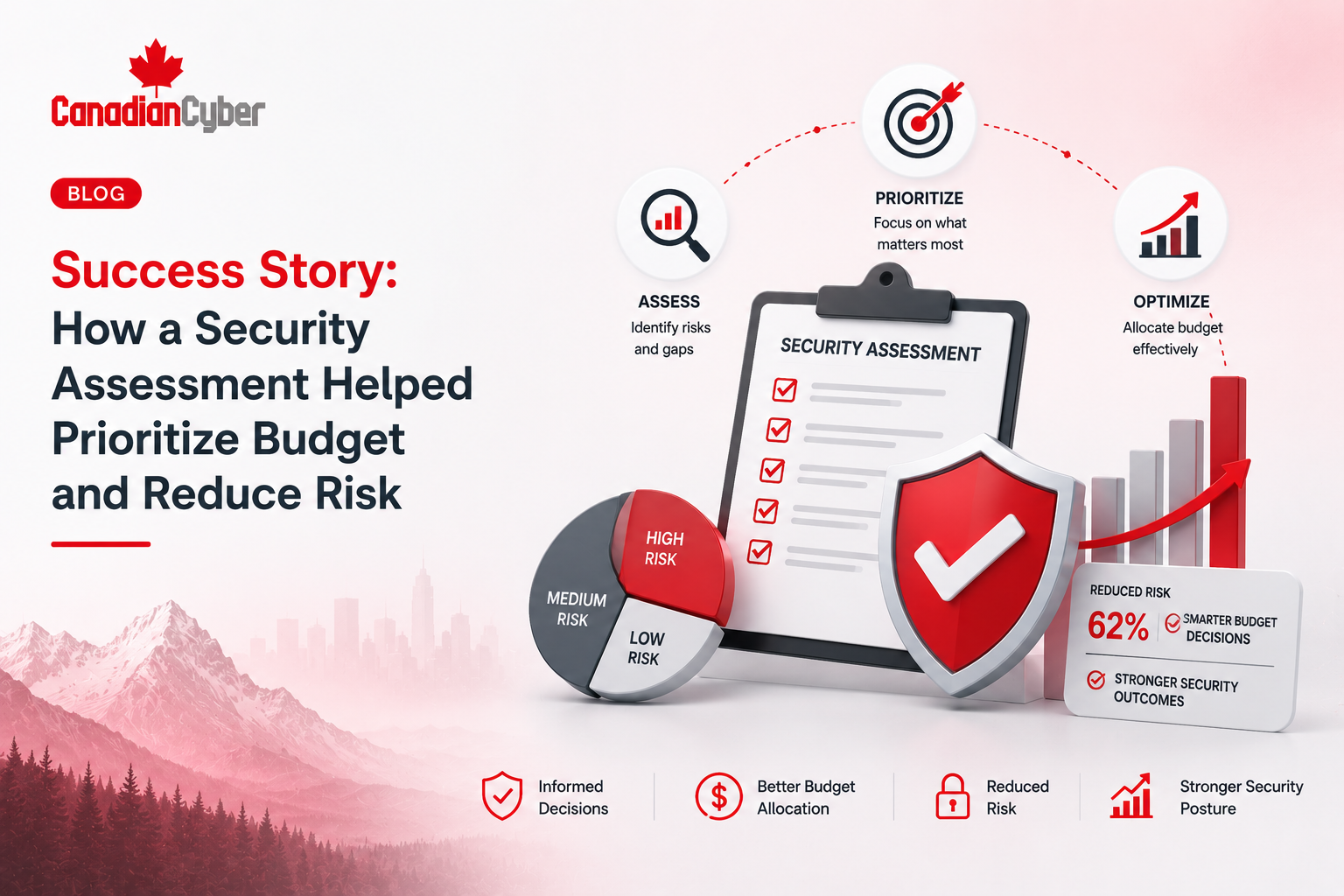
Success Story: How a Security Assessment Helped Prioritize Budget and Reduce Risk
A security assessment should not only produce a long report. It should help leadership decide what to fund, what to fix first, and which risks actually matter. When done well, it turns cybersecurity from scattered spending into a clear business roadmap.
Quick Snapshot
| Area | What Improved |
|---|---|
| Business Context | Growing company with security tools, audit pressure, and unclear priorities. |
| Main Problem | Leadership did not know which risks deserved budget first. |
| Assessment Focus | Access control, cloud security, vendors, backups, incident response, policies, and evidence. |
| Key Outcome | Budget was redirected toward high-risk gaps instead of low-value tools. |
| Business Impact | Better risk visibility, stronger executive decisions, and a practical 90-day roadmap. |
Introduction
The leadership team had a problem.
They were spending money on cybersecurity, but they were not sure if they were spending it well.
They had tools. They had an IT provider. They had policies. They had cyber insurance. They had security awareness training. They had backups.
But when the CEO asked, “Are we actually reducing risk?” the room went quiet.
The team could list activities. But they could not clearly explain:
- which risks were highest
- which systems were most exposed
- which controls were working
- which evidence was missing
- which budget requests mattered most
- which fixes should happen first
That is where the security assessment changed the conversation. This success story shows how one company used a cybersecurity assessment to prioritize budget, reduce real risk, and give leadership a clear plan.
Need a Security Assessment That Leads to Action?
Canadian Cyber helps organizations assess cyber maturity, identify high-priority risks, build executive roadmaps, and align security budget with business impact.
Meet the Company
Let’s call the company Northstar Cloud.
Northstar Cloud was a growing software company with enterprise customers and a small internal team.
The company handled:
- customer account data
- business documents
- support tickets
- API integrations
- employee records
- cloud infrastructure
- vendor-managed systems
- source code
- production logs
Security was becoming more important because of enterprise procurement reviews, SOC 2 readiness pressure, cyber insurance renewal, customer security questionnaires, board questions, vendor risk, AI tool usage, and remote work.
The company did not ignore security. But security work was scattered.
The Starting Problem
Before the assessment, Northstar’s budget conversations sounded like this:
“We need a better endpoint tool.”
“We should buy a GRC platform.”
“We need penetration testing.”
“We should improve backups.”
“We need SOC 2 soon.”
Every idea sounded useful. But not every idea had the same risk impact.
| Leadership Question | Why It Mattered |
|---|---|
| What is our biggest cyber risk? | Budget should follow risk. |
| Which controls are weak? | Fixes need prioritization. |
| Which tools are underused? | Avoid waste. |
| Which gaps affect customers? | Support sales and trust. |
| Which gaps affect insurance? | Reduce renewal friction. |
| What should we fix in 90 days? | Create momentum. |
A security assessment should help leadership say yes, no, or not yet.
The Assessment Approach
The assessment reviewed security through a business-risk lens.
It did not only count tools. It checked whether controls were operating and whether evidence existed.
| Area | What Was Reviewed |
|---|---|
| Identity and Access | MFA, admin access, offboarding, access reviews. |
| Cloud Security | Configuration, logging, monitoring, backups. |
| Secure Development | Code review, deployment control, scanning. |
| Vendor Risk | Critical vendors, contracts, data handled, assurance. |
| Incident Response | Plan, roles, tabletop testing, escalation. |
| Backup and Recovery | Backup coverage, restore testing, access control. |
| Evidence Readiness | SOC 2, ISO 27001, customer reviews, insurance. |
| Governance | Risk register, board reporting, budget decisions. |
The goal was not to shame the team. The goal was to find the highest-value security improvements.
What the Assessment Found
The company had several strengths. But it also had gaps that created real business risk.
| Strength | Why It Helped |
|---|---|
| MFA enabled for most users | Reduced account takeover risk. |
| Cloud backups configured | Supported recovery. |
| Pull requests used | Supported change control. |
| Security awareness training assigned | Improved staff awareness. |
| Endpoint protection deployed | Improved device visibility. |
| Gap | Risk |
|---|---|
| Privileged access not reviewed regularly | Excessive access risk. |
| Vendor reviews informal | Third-party risk unclear. |
| Restore testing missing | Recovery was assumed, not proven. |
| Incident response plan untested | Crisis readiness weak. |
| Logs collected but not reviewed | Detection evidence weak. |
| Budget not mapped to risk | Spending could miss priorities. |
The company did not need random spending. It needed prioritization.
Budget Priority 1: Access Control
Access control became the first budget priority because weak access can quickly become customer data risk.
| Need | Why It Mattered |
|---|---|
| Quarterly access review process | Reduce excessive access. |
| Privileged access review | Focus on admin accounts. |
| Offboarding evidence cleanup | Prove former users are removed. |
| Support access logging | Protect customer data. |
| Service account review | Control non-human access. |
Budget decision: Leadership approved time and support for a structured access review workflow instead of buying another tool first.
Risk reduced: The company reduced the chance that former users, over-permissioned staff, or unreviewed admin accounts could access sensitive systems.
Evidence created: MFA report, admin access review, user access review, offboarding samples, exception register, and support access log sample.
Sometimes the best security investment is not a new platform. It is making an existing control operate properly.
Budget Priority 2: Backup and Recovery Testing
The company had backups. But the assessment found no formal restore test evidence.
That became a high-priority gap. Backups are only useful if the company can restore from them.
| Need | Why It Mattered |
|---|---|
| Restore test for critical systems | Prove recovery capability. |
| Backup admin access review | Reduce tampering risk. |
| Recovery procedure update | Improve response speed. |
| Ransomware recovery scenario | Test real-world pressure. |
Leadership funded a restore testing exercise and backup access review before buying additional resilience tools. The company moved from “we think we can recover” to “we have tested recovery.”
Budget Priority 3: Vendor Risk Management
Vendor risk was informal. That created customer and compliance risk.
The company depended on:
- cloud hosting
- payment processing
- support platforms
- email providers
- analytics tools
- source code platforms
- AI tools
- HR and payroll systems
| Need | Why It Mattered |
|---|---|
| Vendor register | Know critical suppliers. |
| Risk tiering | Focus on high-risk vendors. |
| Assurance review | Check SOC 2, ISO, or security evidence. |
| Contract and DPA tracking | Support privacy and customer trust. |
| Remediation tracker | Follow up on vendor gaps. |
Need a Vendor Risk Program?
Canadian Cyber can help build vendor registers, supplier reviews, remediation trackers, and customer-ready sub-processor summaries.
Budget Priority 4: Incident Response Tabletop
The company had an incident response plan. But no one had practiced it.
The assessment flagged this as a high-impact, low-cost improvement.
| Need | Why It Mattered |
|---|---|
| Executive tabletop | Test decision-making. |
| Ransomware scenario | Test recovery and communication. |
| Customer data scenario | Test legal and privacy escalation. |
| Corrective action tracker | Turn lessons into fixes. |
| Communication templates | Avoid panic messaging. |
Leadership approved a tabletop exercise involving executives, IT, legal, communications, and customer success. The company improved readiness before a real incident and created evidence for cyber insurance, SOC 2 readiness, and customer trust.
Budget Priority 5: Evidence and Governance
The assessment found that evidence was scattered.
Some evidence lived in email. Some lived in cloud consoles. Some lived in GitHub. Some lived in spreadsheets. Some lived with the IT provider. Some did not exist yet.
| Need | Why It Mattered |
|---|---|
| Evidence vault | Centralize proof. |
| Metadata and naming rules | Make evidence searchable. |
| Control owner list | Assign accountability. |
| Risk register | Track business risk. |
| Board reporting pack | Improve leadership visibility. |
| Policy approval workflow | Strengthen governance. |
Organize Risk, Evidence, and Governance in SharePoint
Canadian Cyber’s ISMS SharePoint solution helps organizations manage risks, controls, evidence, policies, audits, corrective actions, and management review in one structured workspace.
What the Company Stopped Funding First
The assessment also helped leadership delay lower-priority spending. That was just as valuable.
| Deferred Spend | Why It Was Delayed |
|---|---|
| Extra security tool | Existing tools were underused. |
| Full GRC platform | SharePoint evidence workspace was enough for current maturity. |
| Advanced SIEM expansion | Log ownership and review process needed first. |
| Broad policy rewrite | Policies needed approval and evidence mapping first. |
| Large-scale penetration test | Basic control gaps needed cleanup first. |
A good assessment does not only tell you what to buy. It tells you what not to buy yet.
The 90-Day Roadmap
The assessment produced a practical roadmap.
First 30 Days: Fix the Basics
| Action | Outcome |
|---|---|
| Complete privileged access review | Reduce access risk. |
| Build top-risk register | Create leadership visibility. |
| Approve core policies | Strengthen governance. |
| Create evidence workspace | Organize proof. |
Days 31–60: Prove Recovery and Vendor Control
| Action | Outcome |
|---|---|
| Run restore test | Prove backup recovery. |
| Build vendor register | Improve third-party risk. |
| Review critical vendors | Support customer trust. |
| Create owner matrix | Assign accountability. |
Days 61–90: Test Response and Report Progress
| Action | Outcome |
|---|---|
| Run tabletop exercise | Improve incident readiness. |
| Create corrective action tracker | Close findings. |
| Build board reporting pack | Improve executive decisions. |
| Define next-phase roadmap | Continue maturity improvement. |
Business Impact
The security assessment improved more than controls. It improved decision-making.
| Before | After |
|---|---|
| Budget requests were scattered. | Budget mapped to top risks. |
| Controls existed but evidence was weak. | Evidence plan created. |
| Backups assumed. | Restore testing prioritized. |
| Vendor risk informal. | Vendor register funded. |
| Incident plan untested. | Tabletop scheduled. |
| Leadership unsure. | Board-ready roadmap created. |
The company reduced risk in the areas that mattered most: access control, recovery readiness, vendor exposure, incident response, governance, audit evidence, and customer trust.
Lessons for Other Companies
- Do not start with tools. Start with risk. Tools should support controls, not replace strategy.
- Budget should follow business impact. Fund the gaps that affect customer data, revenue, operations, insurance, and audits.
- Evidence matters. If you cannot prove the control, it may not help during procurement, insurance, or audit.
- Quick wins matter. Access reviews, restore tests, vendor registers, and tabletop exercises can create fast risk reduction.
- Leadership needs a roadmap. Executives need risk, priority, budget, and decisions.
Security Budget Prioritization Checklist
Use this before approving your next cyber spend.
| Question | Yes / No |
|---|---|
| Does this spend reduce a top business risk? | |
| Does it protect customer data or critical systems? | |
| Does it support SOC 2, ISO 27001, or cyber insurance evidence? | |
| Does it close a known audit or customer review gap? | |
| Is there an owner for the control? | |
| Can we measure improvement after funding it? | |
| Are we already underusing a tool we own? | |
| Is this more urgent than access control, backups, vendors, or incident response? | |
| Can this be completed in the next 90 days? |
If several answers are “no,” pause before spending.
What Good Looks Like
A strong security assessment should produce:
- top risks
- control maturity scores
- evidence gaps
- budget priorities
- quick wins
- 90-day roadmap
- control owners
- executive summary
- audit readiness view
- cyber insurance improvement areas
- customer trust improvements
- next-phase recommendations
It should not only say what is wrong. It should help the company decide what to do.
Canadian Cyber’s Take
At Canadian Cyber, we often see organizations spending money on cybersecurity without a clear risk map.
That creates waste.
One company buys tools before fixing access. Another buys a platform before testing backups. Another prepares for SOC 2 without evidence. Another renews cyber insurance without proving controls.
A security assessment brings clarity. It helps leadership understand what matters, what can wait, and what needs funding now. The goal is not to scare the business. The goal is to focus the business.
Takeaway
A security assessment can turn cyber budget from guesswork into strategy.
Start by understanding risk. Then prioritize:
- access control
- backup and recovery
- vendor risk
- incident response
- evidence readiness
- policy governance
- cloud security
- secure development
Fund the controls that reduce the most risk and support the business. Delay spending that does not solve a real problem yet.
How Canadian Cyber Can Help
Canadian Cyber helps organizations turn security assessments into practical budget and risk reduction roadmaps.
- cybersecurity maturity assessments
- security budget prioritization
- risk-based security roadmaps
- vCISO advisory
- SOC 2 readiness assessments
- ISO 27001 readiness assessments
- access control reviews
- backup and restore evidence reviews
- vendor risk reviews
- incident response tabletop exercises
- cloud security reviews
- SharePoint evidence workspace setup
- executive cyber reporting
- cyber insurance readiness support
Stay Connected With Canadian Cyber
Follow Canadian Cyber for practical guidance on cybersecurity assessments, budget prioritization, risk reduction, SOC 2, ISO 27001, SharePoint ISMS, vCISO leadership, vendor risk, and evidence management.