AI Governance • ChatGPT Security • ISO 42001 • vCISO • Business Risk
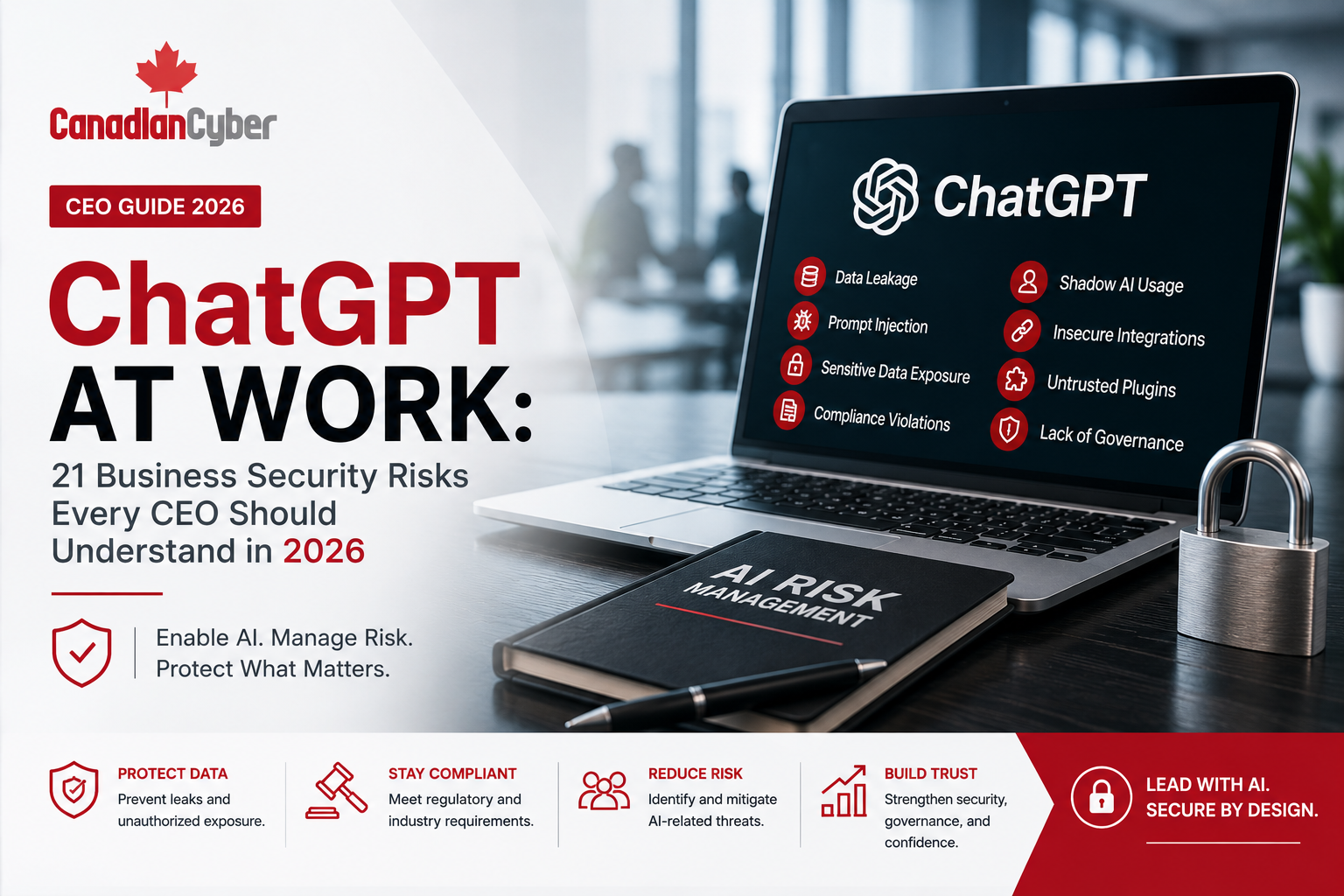
ChatGPT at Work: 21 Business Security Risks Every CEO Should Understand in 2026
ChatGPT is already inside the workplace. Employees use it to draft emails, summarize documents, write code, analyze spreadsheets, prepare reports, answer customer questions, and support daily decision-making. The opportunity is real, but so are the risks.
Canadian Cyber AI Governance Support
Use ChatGPT Safely With Clear Policies, Controls, and Accountability
Canadian Cyber helps organizations assess ChatGPT workplace risks, create AI use policies, review vendors, train employees, align with ISO 42001, strengthen ISO 27001 and SOC 2 readiness, and build SharePoint-based AI governance workspaces.
Quick Snapshot
| CEO Concern | Why It Matters |
|---|---|
| Confidential Data in Prompts | Employees may paste client data, contracts, source code, financial records, or personal information. |
| Shadow AI Use | Staff may use personal or unapproved AI tools outside company controls. |
| AI-Generated Mistakes | Wrong outputs can affect customers, contracts, reports, decisions, or security work. |
| Third-Party App Risk | Connected apps and custom AI tools may access company data. |
| Lack of Accountability | No one owns AI risk, monitoring, approval decisions, or incident response. |
| Compliance Readiness | ISO 42001, SOC 2, ISO 27001, ISO 27018, and customer reviews increasingly include AI governance questions. |
Quick Answer
ChatGPT at work can create business security risks when employees use AI without clear policies, approved tools, data handling rules, access controls, vendor reviews, human oversight, monitoring, and incident response.
The biggest risks include confidential data leakage, shadow AI use, inaccurate outputs, unsafe integrations, prompt injection, privacy exposure, intellectual property concerns, and weak governance evidence.
Practical takeaway: CEOs should treat workplace AI as a business risk management issue, not only an IT issue.
ChatGPT Is Already Inside the Workplace
Employees are using ChatGPT to draft emails, summarize documents, analyze spreadsheets, write code, prepare meeting notes, generate reports, answer customer questions, review contracts, and support daily decisions.
For CEOs, the question is no longer whether employees are using AI. The real question is whether the organization is using ChatGPT safely, with the right controls, policies, monitoring, and accountability.
In 2026, ChatGPT at work creates major opportunities for productivity. It also creates business security risks when employees paste sensitive information into prompts, connect AI tools to company data, rely on inaccurate outputs, use unapproved AI apps, or share AI-generated content without review.
ChatGPT should not be treated as a personal productivity shortcut only. It should be governed as a business system that can touch sensitive data, decisions, customers, and compliance evidence.
Who This Guide Is For
- CEOs and founders introducing AI across the business.
- CTOs and CIOs responsible for secure AI adoption.
- COOs managing productivity and process changes.
- CISOs, vCISOs, and security leaders building AI controls.
- Legal and compliance leaders reviewing AI risk.
- SaaS companies adding AI to operations or products.
- Organizations preparing for ISO 42001, ISO 27001, SOC 2, ISO 27018, or client security reviews.
Why ChatGPT at Work Matters Now
AI adoption has moved faster than most governance programs. Employees are not waiting for formal AI policies. They are already using ChatGPT and similar tools to speed up work.
That creates a leadership challenge. If the company blocks AI completely, employees may use it secretly. If the company allows AI without rules, sensitive data may be exposed. If the company buys enterprise AI tools without training, misuse can still happen.
Enterprise customers, auditors, insurers, boards, and regulators are paying closer attention to AI use. AI is becoming part of the organization’s broader security and compliance environment.
Practical rule: AI governance should help employees use AI safely, not scare them away from using it.
The CEO’s View: ChatGPT Is a Business Risk, Not Just an IT Tool
Many organizations make the mistake of assigning AI security only to IT. That is too narrow.
ChatGPT at work affects customer confidentiality, employee productivity, sales proposals, legal documents, financial analysis, software development, support responses, HR workflows, marketing claims, procurement reviews, vendor risk, privacy obligations, intellectual property, board oversight, and audit readiness.
The CEO does not need to review every prompt. But the CEO does need to make sure the organization has clear governance, including:
data handling rules
accountability
training
vendor review
access controls
monitoring
incident response
legal and privacy review
AI risk register
management review
Need a Practical ChatGPT Governance Plan?
Canadian Cyber helps CEOs, CTOs, legal, compliance, and security teams build practical AI governance programs that support productivity, security, and compliance readiness.
21 Business Security Risks of ChatGPT at Work
Risk 1: Employees Paste Confidential Data Into Prompts
Employees may paste customer contracts, client records, source code, financial data, employee information, legal documents, incident reports, security findings, vendor contracts, product roadmaps, support tickets, or personal information into prompts.
Risk 2: Shadow AI Tools Outside Company Control
Employees may use personal ChatGPT accounts or unapproved public AI tools because they are easy to access. This can create risk around access, retention, admin visibility, connected apps, offboarding, and vendor terms.
Risk 3: Wrong AI Outputs Used in Business Decisions
AI can produce confident but incorrect answers. This can affect legal summaries, financial analysis, policy interpretation, security recommendations, customer responses, HR decisions, compliance answers, and technical documentation.
Risk 4: AI-Generated Customer Responses Without Review
Support, sales, and customer success teams may use AI to draft replies. If responses are not reviewed, customers may receive incorrect guidance, unsupported security claims, wrong pricing statements, or unapproved commitments.
Risk 5: Sensitive Data in Uploaded Files
Employees may upload contracts, spreadsheets, customer exports, HR records, financial reports, incident logs, audit evidence, source code, or board materials into ChatGPT for summarization or analysis.
Risk 6: AI Use Without Legal or Privacy Review
ChatGPT may be used in workflows involving personal information, customer data, regulated data, contracts, or intellectual property. Legal and privacy teams should review approved use cases, notices, data terms, and retention rules.
Risk 7: Weak AI Vendor Review
AI vendors should be reviewed like other critical technology providers. Review data processing terms, security evidence, privacy documentation, subprocessors, retention settings, training data terms, incident notification, data location, admin controls, and contractual protections.
Risk 8: Connected Apps and Data Access
Business AI tools may connect to internal apps, files, email, calendars, drives, ticketing systems, or knowledge bases. This creates access risk if permissions, approvals, and data flows are not reviewed.
Risk 9: Prompt Injection
Prompt injection happens when malicious or hidden instructions influence AI behavior. This risk matters when AI tools are connected to documents, websites, emails, tickets, code repositories, or internal systems.
Risk 10: AI Hallucinations in Compliance Work
Employees may use ChatGPT to answer security questionnaires, draft audit responses, or summarize compliance obligations. If outputs are not verified, the company may give inaccurate answers to customers or auditors.
Risk 11: Source Code Exposure
Developers may paste code into ChatGPT for debugging or documentation. This can expose proprietary logic, API keys, secrets, customer-specific code, architecture details, vulnerability context, or security configurations.
Risk 12: Employees Use AI to Generate Risky Code
AI-generated code may contain vulnerabilities such as insecure authentication, poor input validation, hardcoded secrets, unsafe dependencies, weak encryption choices, access control flaws, or insecure API patterns.
Risk 13: Overreliance on AI for Cybersecurity Advice
Employees may ask ChatGPT for incident response, security configuration, policy wording, or vulnerability remediation advice. AI can support analysis, but security-sensitive outputs should be verified by qualified reviewers.
Risk 14: Inconsistent AI Use Across Departments
Sales, legal, HR, development, support, marketing, and finance teams may all use AI differently. Without a central policy, each department creates its own risk profile.
Risk 15: No AI Use Policy
A company without an AI policy leaves employees guessing. A practical AI policy should define approved tools, prohibited data, approved use cases, human review, vendor approval, incident reporting, and accountability.
Risk 16: No Training for Employees
Policies are not enough. Employees need practical training on what not to paste, how to verify outputs, how to handle customer data, how to use approved tools, and how to report AI incidents.
Risk 17: No Monitoring or Usage Visibility
Monitoring does not mean reading every conversation. It means governance around approved workspaces, admin settings, usage trends, high-risk use cases, connected apps, user access, policy exceptions, and incident reporting.
Risk 18: No Offboarding Controls for AI Tools
When employees leave, AI access should be removed. Offboarding should include workspace access, connected apps, custom GPT or assistant ownership, API keys, shared prompt libraries, and admin roles.
Risk 19: AI-Generated Content Creates IP and Brand Risk
Marketing, sales, product, and leadership teams may publish AI-generated content. Risks include copyright concerns, unverified claims, brand inconsistency, false statistics, unsupported comparisons, and regulatory overstatements.
Risk 20: No AI Incident Response Process
AI incidents may include confidential data pasted into an unapproved tool, AI-generated customer misinformation, prompt injection, sensitive output exposure, unauthorized connected app access, or AI-generated code vulnerabilities.
Risk 21: No Board or Executive Oversight
AI risk is now a leadership topic. Boards and executive teams may ask where AI is being used, which tools are approved, what data is restricted, who owns AI governance, how incidents are handled, and whether the company is ready for ISO 42001.
Practical Table: ChatGPT Risks and Recommended Controls
| Risk Area | Business Risk | Recommended Control |
|---|---|---|
| Confidential Data in Prompts | Customer, legal, or IP exposure. | Data handling rules and employee training. |
| Shadow AI | No admin control or visibility. | Approved AI tool list and monitoring where needed. |
| AI Hallucinations | Wrong decisions or customer responses. | Human review for high-impact outputs. |
| Connected Apps | Excessive access to internal data. | App approval and permission review. |
| Prompt Injection | AI manipulation or data leakage. | Security testing and restricted AI integrations. |
| AI-Generated Code | Vulnerabilities in software. | Secure code review and scanning. |
| Vendor Risk | Weak third-party assurance. | AI vendor review and contracts. |
| No Accountability | Risk is unmanaged. | AI governance owner and management review. |
Build AI Governance Before Risk Becomes an Incident
Canadian Cyber supports ISO 42001 implementation, ISO 27001 implementation, SOC 2 readiness, cybersecurity assessments, vCISO services, AI incident response tabletop exercises, and SharePoint-based AI governance workspaces.
CEO Checklist: How to Govern ChatGPT at Work
| Action Item | Done? |
|---|---|
| Create an approved AI tool list. | |
| Define what data employees must not enter into ChatGPT. | |
| Review business or enterprise AI workspace settings. | |
| Assign an AI governance owner. | |
| Create an AI use policy. | |
| Train employees on safe ChatGPT use. | |
| Review connected apps and integrations. | |
| Create a process for AI vendor reviews. | |
| Require human review for customer-facing AI outputs. | |
| Build an AI incident response process. | |
| Add AI risks to the risk register. | |
| Report AI governance status to leadership. |
Common Mistakes to Avoid
- Assuming employees are not using ChatGPT. They probably are. The safer approach is to govern use instead of pretending it is not happening.
- Blocking AI without offering an approved option. If employees see value in AI but the company provides no approved tool, shadow AI risk increases.
- Treating enterprise AI tools as risk-free. Business-grade tools may provide stronger controls, but internal misuse, poor configuration, unsafe integrations, and weak training can still create risk.
- No clear data rules. Employees need simple guidance on what they can and cannot paste into ChatGPT.
- No human review. AI-generated customer responses, legal summaries, financial analysis, security recommendations, and code should be reviewed.
- Ignoring AI in compliance programs. AI use should be considered in ISO 42001, ISO 27001, SOC 2, ISO 27018, vendor risk, privacy, and incident response programs.
- No evidence. If customers or auditors ask about AI governance, the company should be able to show policies, training, vendor reviews, risk assessments, approved use cases, and incident records.
How Canadian Cyber Helps
Canadian Cyber helps organizations move from informal AI use to structured AI governance.
We help companies identify where ChatGPT and AI tools are used, what risks exist, what controls are needed, and what evidence should be retained.
Canadian Cyber can support:
SharePoint AI Governance Workspace
Canadian Cyber’s ISMS SharePoint Solution can help organize AI tool inventories, AI risk registers, approved use cases, AI vendor reviews, employee training evidence, AI incident records, AI policy libraries, access review records, governance approvals, management review dashboards, and client-ready AI governance evidence.
This helps CEOs, CTOs, legal, compliance, security, and operations teams work from one controlled governance system.
Frequently Asked Questions
Is ChatGPT safe to use at work?
ChatGPT can be used safely at work when the organization uses approved business tools, defines data handling rules, trains employees, reviews vendors, controls connected apps, and monitors high-risk use cases.
Can employees paste customer data into ChatGPT?
Employees should only enter customer data into approved tools and approved workflows. Organizations should define what data is allowed, restricted, or prohibited based on privacy, confidentiality, legal, and customer requirements.
Should CEOs block ChatGPT at work?
Blocking ChatGPT may reduce some risk, but it can also push employees toward shadow AI tools. A better approach is to provide approved tools, clear rules, training, monitoring, and accountability.
What is the best framework for AI governance?
ISO 42001 is a strong framework for building an AI management system. It can be aligned with ISO 27001, SOC 2, ISO 27018, privacy programs, vendor risk management, and cybersecurity governance.
What should a ChatGPT workplace policy include?
A workplace ChatGPT policy should include approved tools, prohibited data, approved use cases, human review rules, customer data restrictions, vendor review requirements, incident reporting, employee training, and management accountability.
How can Canadian Cyber help with ChatGPT governance?
Canadian Cyber helps organizations assess AI risks, create practical governance controls, support ISO 42001 implementation, align AI use with ISO 27001 and SOC 2, design AI incident response procedures, and build SharePoint AI governance workspaces.
Takeaway
ChatGPT at work can improve productivity, but it also creates business security risks that CEOs should understand in 2026.
The biggest risks include confidential data exposure, shadow AI use, inaccurate outputs, unsafe integrations, vendor risk, prompt injection, AI-generated code vulnerabilities, weak training, poor monitoring, and lack of executive oversight.
The goal is not to stop AI adoption. The goal is to govern it.
Using ChatGPT at Work?
Canadian Cyber can help you turn AI adoption into a controlled business advantage. We can assess your AI risks, create practical governance controls, support ISO 42001 implementation, align AI use with ISO 27001 and SOC 2, design AI incident response procedures, and build a SharePoint AI governance workspace inside Microsoft 365.
Stay Connected With Canadian Cyber
Follow Canadian Cyber for practical guidance on ChatGPT security, AI governance, ISO 42001, ISO 27001, SOC 2, ISO 27018, vCISO support, SharePoint ISMS, and business security risk.