SaaS Security
Enterprise Reviews
Vendor Due Diligence
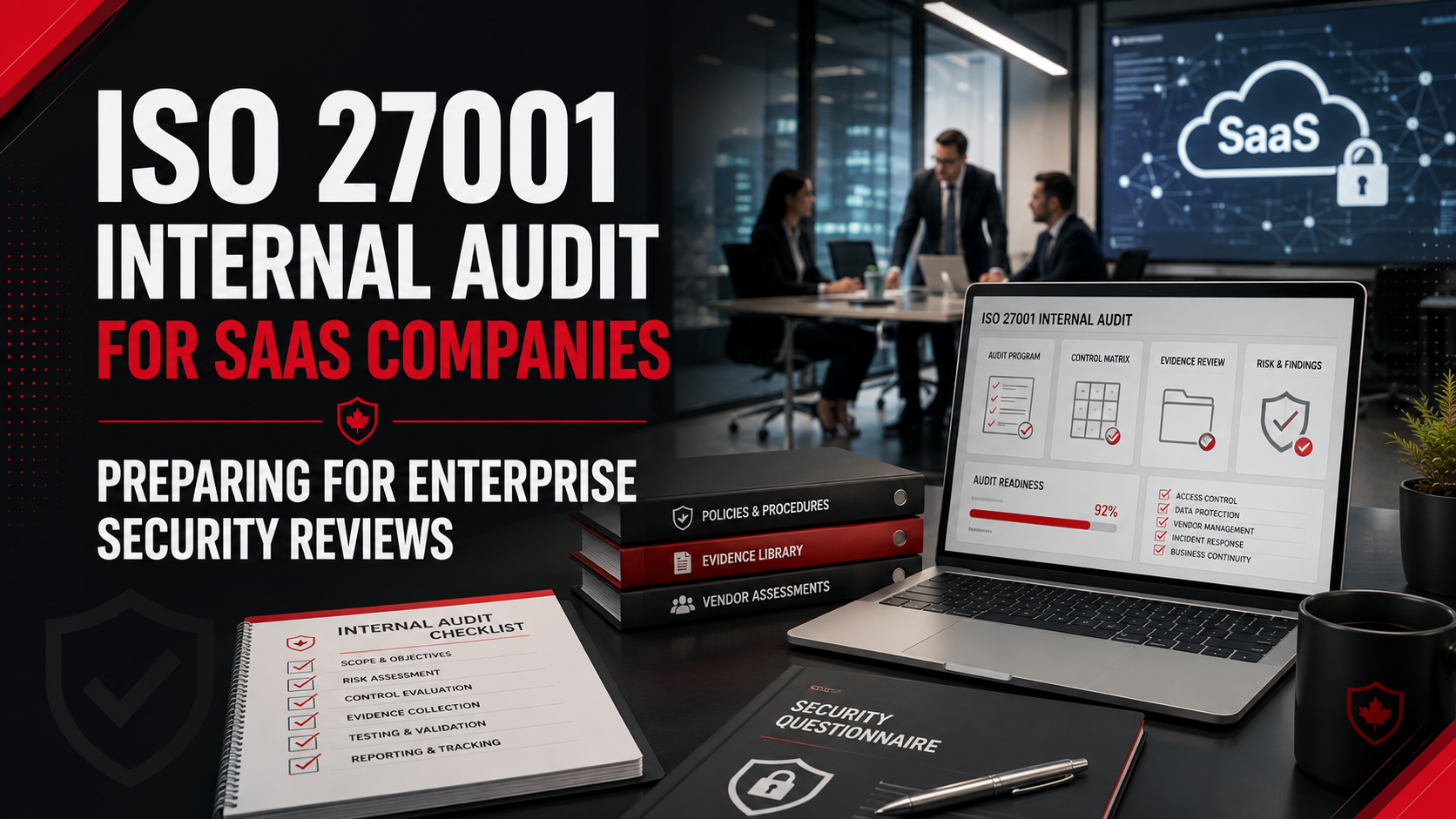
ISO 27001 Internal Audit for SaaS Companies Preparing for Enterprise Security Reviews
Enterprise buyers do not only buy software. They buy trust. A strong ISO 27001 internal audit helps SaaS companies prove that their security program, evidence, controls, risks, and owners are ready for serious customer review.
Quick Answer
How should SaaS companies use ISO 27001 internal audit before enterprise security reviews?
SaaS companies should use ISO 27001 internal audit to test whether security controls, evidence, risks, vendors, access reviews, incident response, secure development, business continuity, and corrective actions are ready for enterprise buyers.
Enterprise buyers want proof. They do not want promises, screenshots without context, outdated policies, or scattered evidence.
Bottom line: Internal audit helps SaaS companies identify gaps before customers do, organize evidence, prepare control owners, verify corrective actions, and build a client-ready evidence pack.
Canadian Cyber SaaS Security Review Readiness
Prepare Your SaaS Evidence Before the Buyer Asks
Canadian Cyber helps SaaS companies prepare for enterprise security reviews with ISO 27001 internal audits, evidence readiness reviews, vCISO support, SOC 2 alignment, SharePoint ISMS workspaces, and client-ready evidence packs.
We help find evidence gaps, test controls, prepare customer-facing summaries, verify corrective actions, and organize the proof enterprise buyers expect.
Quick Snapshot
| Enterprise Buyer Question | Internal Audit Should Confirm |
|---|---|
| Do you have a security management system? | ISMS scope, policies, risk process, and management review. |
| How do you protect customer data? | Access control, encryption, data handling, and monitoring. |
| How do you manage cloud security? | Cloud configuration, logging, admin access, and backup evidence. |
| How do you review employees and access? | Joiner-mover-leaver process, access reviews, MFA, and offboarding. |
| How do you manage vendors? | Vendor register, risk ratings, DPAs, subprocessors, and assurance reviews. |
| How do you handle incidents? | Incident plan, reporting, tabletop exercise, and lessons learned. |
| How do you secure development? | Change control, code review, security scans, and vulnerability management. |
| How do you improve? | Internal audit findings, corrective actions, verification, and management review. |
Why Enterprise Security Reviews Are Hard for SaaS Companies
Enterprise security reviews are not simple paperwork.
They are trust exams.
The buyer wants to know whether your SaaS company can protect sensitive data, maintain availability, control access, manage vendors, respond to incidents, and improve security over time.
The challenge is that SaaS companies often grow faster than their governance process.
Enterprise buyers do not want to hear that security is important. They want evidence that security is managed.
Who This Blog Is For
- SaaS founders, CEOs, COOs, CTOs, and CIOs.
- Security leaders, compliance managers, and ISMS managers.
- Sales and revenue leaders responding to enterprise buyers.
- Customer success teams supporting procurement reviews.
- vCISO teams supporting SaaS security maturity.
- B2B SaaS companies selling to enterprise clients.
- AI SaaS, FinTech SaaS, HealthTech SaaS, HRTech, and EdTech companies.
- MSPs and cloud service providers.
- Canadian SaaS companies preparing for ISO 27001.
- Teams using Microsoft 365 and SharePoint for ISMS evidence.
Why ISO 27001 Internal Audit Matters Before Enterprise Review
ISO 27001 internal audit helps SaaS companies find gaps before customers, certification auditors, or procurement teams find them.
It tests whether the ISMS is working in practice.
It also helps the company prepare stronger, faster, and more consistent answers for buyer security reviews.
Practical rule: An internal audit is a rehearsal for enterprise trust.
The Enterprise Security Review Problem
Enterprise buyers may ask for proof through security questionnaires, vendor risk platforms, procurement portals, contract reviews, customer audits, cyber insurance forms, privacy assessments, legal due diligence, technical reviews, or architecture reviews.
If evidence is scattered, the response becomes slow and risky.
Common SaaS Evidence Problems
What Enterprise Buyers Really Want to See
1. Governance
They want proof that security is managed by leadership and not handled casually.
2. Risk Management
They want risks identified, assessed, treated, reviewed, and owned.
3. Control Operation
They want evidence that controls operate, not just policies that describe them.
4. Accountability
They want named owners, deadlines, approvals, and escalation.
5. Improvement
They want findings, incidents, and gaps to lead to corrective action.
ISO 27001 Internal Audit Areas SaaS Companies Should Prioritize
A SaaS internal audit should be risk-based.
For enterprise review readiness, the following areas deserve special attention.
1. ISMS Scope and SaaS Platform Boundaries
Enterprise buyers want clarity on what is covered.
Audit questions: Is the SaaS platform included? Are production systems, cloud environments, support processes, customer data flows, vendors, and AI features included where relevant?
Evidence: ISMS scope statement, system architecture, data flow diagram, asset inventory, cloud inventory, vendor register, and scope approval record.
2. Risk Register and Risk Treatment
SaaS buyers want to know whether security risk is actively managed.
Audit questions: Are customer data, cloud, vendor, AI, access, and availability risks included? Are treatment actions tracked and overdue risks escalated?
Evidence: risk methodology, risk register, treatment plan, accepted risk approvals, risk reviews, and management review risk summary.
3. Access Control and Identity Governance
Access control is one of the most important enterprise review topics.
Audit questions: Is MFA enforced? Are users provisioned by role? Are privileged users, cloud admins, contractors, support roles, and terminated users reviewed?
Evidence: MFA report, access requests, user access reviews, privileged access reviews, offboarding records, exception register, and removed access proof.
4. Secure Development and Change Management
Enterprise buyers want confidence that speed does not bypass security.
Audit questions: Are changes approved? Are code reviews performed? Are security scans completed? Are AI coding assistants governed?
Evidence: secure development policy, change tickets, pull request approvals, release notes, scan results, vulnerability tracker, and deployment logs.
5. Vulnerability Management
Enterprise security teams often ask detailed vulnerability questions.
Audit questions: Are scans performed? Are vulnerabilities prioritized, assigned, remediated, escalated, and verified?
Evidence: vulnerability policy, scan reports, tracker, remediation tickets, penetration test report, remediation evidence, and exception approvals.
6. Vendor and Subprocessor Management
SaaS companies depend on cloud providers, payment processors, analytics tools, support platforms, AI tools, and development vendors.
Audit questions: Is the vendor register complete? Are critical vendors risk-rated? Are DPAs, subprocessors, and assurance reports reviewed?
Evidence: vendor register, critical vendor list, risk assessments, DPAs, subprocessor list, SOC 2 reports, ISO certificates, and AI vendor reviews.
Preparing for an Enterprise SaaS Security Review?
Canadian Cyber helps SaaS companies use ISO 27001 internal audit to build trust-ready evidence before procurement, legal, or vendor risk teams ask for it.
More Internal Audit Areas SaaS Buyers Care About
7. Incident Response and Customer Notification
Enterprise buyers want to know what happens if something goes wrong.
Audit questions: Is the plan current? Are roles defined? Has a tabletop been performed? Are customer notification steps clear?
Evidence: incident response plan, incident register, tabletop report, lessons learned, notification procedure, escalation matrix, and corrective actions.
8. Backup, Restore, and Business Continuity
Enterprise buyers care about availability and recovery.
Audit questions: Are backups configured, monitored, reviewed, and tested? Are recovery objectives defined?
Evidence: backup policy, backup reports, restore test evidence, BCP, DR plan, recovery objectives, test results, and management review summary.
9. Security Awareness and Role-Based Training
Enterprise buyers want assurance that people understand security responsibilities.
Audit questions: Are new hires, contractors, developers, support teams, and employees trained on security and AI use rules?
Evidence: training policy, completion report, new hire records, contractor records, role-based training, phishing results, and acknowledgments.
10. AI Governance and Shadow AI
Enterprise buyers are asking more questions about AI use, data handling, model outputs, human review, and AI vendors.
Audit questions: Are AI tools inventoried? Are customer data restrictions defined? Are AI vendors reviewed? Are AI incidents reportable?
Evidence: AI tool inventory, approved AI tool list, acceptable use policy, AI risk assessment, AI vendor reviews, coding assistant policy, and Shadow AI assessment.
11. Management Review and Executive Oversight
Enterprise buyers want to know security is governed by leadership.
Audit questions: Were risks, audit results, incidents, corrective actions, objectives, resources, and decisions reviewed?
Evidence: agenda, attendee list, input pack, risk dashboard, audit summary, incident summary, action tracker, decision log, and objectives report.
12. Corrective Actions and Continual Improvement
Enterprise buyers may ask whether findings are fixed.
Audit questions: Are findings tracked? Are root causes documented? Are owners assigned? Is closure evidence verified?
Evidence: NCR register, OFI tracker, corrective action tracker, root cause records, closure evidence, verification notes, management updates, and security roadmap.
Enterprise Security Review Evidence Pack for SaaS Companies
A SaaS company should prepare a client-ready evidence pack before the buyer asks.
This evidence pack should be clear, approved, current, and easy to share through a controlled process.
Recommended Evidence Pack
Practical rule: A strong evidence pack helps sales, security, legal, and procurement move faster.
How Internal Audit Helps Sales Teams
Security evidence is not only a compliance asset.
It is a revenue asset.
Common SaaS Internal Audit Findings That Hurt Enterprise Reviews
Enterprise buyers see this as a direct data access risk.
Buyers may question whether critical suppliers are managed.
An outdated register suggests weak governance.
Buyers may lose trust if documentation and operations do not align.
Backups without restore proof do not prove recoverability.
A plan without tabletop evidence may look immature.
Open findings may raise certification and customer concerns.
SaaS buyers care deeply about how product changes are controlled.
Shadow AI can create data leakage and contractual concerns.
Scattered evidence slows security reviews and creates inconsistent answers.
30-60-90 Day Readiness Plan for SaaS Companies
0–30 Days: Find the Gaps
- Complete internal audit.
- Review enterprise questionnaire requirements.
- Identify missing evidence.
- Update risk register.
- Review access controls.
- Review vendor register.
- Assign corrective action owners.
31–60 Days: Fix the Evidence
- Complete access reviews.
- Complete vendor reviews.
- Test incident response.
- Complete restore test.
- Update policies.
- Close high-risk findings.
- Organize evidence in SharePoint.
61–90 Days: Build the Trust Pack
- Verify corrective actions.
- Prepare enterprise evidence pack.
- Create customer-ready summaries.
- Build SharePoint evidence room.
- Prepare control owners for customer questions.
- Align ISO 27001 evidence with SOC 2.
- Create executive readiness dashboard.
SaaS ISO 27001 Internal Audit Checklist for Enterprise Reviews
| Readiness Question | Ready? |
|---|---|
| ISMS scope covers the SaaS platform and customer data flows. | |
| Risk register includes customer data, cloud, vendor, access, AI, and availability risks. | |
| Risk treatment actions are assigned and tracked. | |
| Access reviews are completed for users, admins, contractors, and support roles. | |
| MFA is enforced and evidenced. | |
| Offboarding records prove timely access removal. | |
| Secure development controls are documented and operating. | |
| Change tickets include approvals, testing, and release evidence. | |
| Vulnerability findings are tracked and remediated. | |
| Critical vendors are reviewed and risk-rated. | |
| DPAs, contracts, and subprocessor records are stored. | |
| Incident response plan is tested. | |
| Backup restore testing is documented. | |
| Security awareness training is complete. | |
| AI tools and Shadow AI risks are assessed where relevant. | |
| Management review includes audit results and risk decisions. | |
| Corrective actions have owners, due dates, evidence, and verification. | |
| Client-ready evidence pack is prepared. | |
| Evidence is stored in a controlled SharePoint workspace. |
How SharePoint Helps SaaS Companies Prepare Evidence
A structured SharePoint ISMS can help SaaS companies prepare for enterprise security reviews by centralizing evidence.
It gives sales, security, compliance, IT, legal, and leadership one trusted workspace for buyer-ready proof.
Canadian Cyber’s ISMS SharePoint Solution can help organize:
- ISMS scope, policy library, risk register, and Statement of Applicability tracker.
- Control register and audit evidence library.
- Access review evidence and vendor register.
- Subprocessor records and incident register.
- Change evidence and vulnerability evidence.
- Training evidence and backup restore evidence.
- Management review dashboard and corrective action tracker.
- AI governance workspace and client-ready evidence room.
- Power Automate reminders, Teams notifications, and auditor-ready views.
Enterprise review readiness improves when evidence is organized before the buyer asks.
How Canadian Cyber Helps
Canadian Cyber helps SaaS companies prepare for enterprise security reviews using ISO 27001 internal audit, vCISO support, evidence readiness, SOC 2 alignment, and SharePoint-based ISMS workflows.
We help SaaS teams move from reactive questionnaire responses to proactive trust readiness.
Canadian Cyber can support:
- ISO 27001 internal audits for SaaS companies.
- Enterprise security review readiness.
- Security questionnaire readiness.
- vCISO services and evidence readiness reviews.
- SharePoint ISMS implementation.
- Client-ready evidence room setup.
- Risk register and SoA reviews.
- Access control evidence testing.
- Vendor risk review.
- Incident response tabletop exercises.
- Backup and restore evidence review.
- Secure development evidence review.
- Corrective action verification.
- Management review preparation.
- SOC 2 readiness alignment.
- ISO 27017 cloud control support and ISO 27018 privacy control support.
- ISO 42001 AI governance readiness, Shadow AI reviews, and cybersecurity assessments.
Canadian Cyber’s SaaS Readiness Approach
Canadian Cyber helps SaaS teams move from reactive questionnaire responses to proactive trust readiness.
Our approach includes:
- Internal audit review and evidence gap assessment.
- Control owner interviews.
- Enterprise buyer question mapping.
- Risk-based corrective action plan.
- SharePoint evidence workspace.
- Security roadmap and vCISO leadership support.
- Management review reporting.
- Client-ready evidence pack.
Takeaway
Enterprise security reviews are no longer a late-stage paperwork exercise.
For SaaS companies, they are a revenue gate.
A strong product may win attention. Strong security evidence helps win trust.
ISO 27001 internal audit helps SaaS companies test scope, risk management, access control, vendor reviews, secure development, vulnerability management, incident response, backup and recovery, training, AI governance, management review, corrective actions, and evidence quality.
When internal audit is done well, it becomes more than compliance. It becomes a competitive advantage.
Ready to Get Your SaaS Platform Ready for Enterprise Buyers?
Canadian Cyber can help your SaaS company prepare for enterprise security reviews, ISO 27001 certification, SOC 2 readiness, and customer due diligence.
We provide ISO 27001 internal audits, SaaS security review readiness, vCISO services, evidence gap assessments, SharePoint ISMS workspaces, client-ready evidence rooms, SOC 2 alignment, ISO 42001 AI governance readiness, ISO 27017 cloud control support, ISO 27018 privacy support, and cybersecurity assessments.
Stay Connected With Canadian Cyber
Follow Canadian Cyber for practical guidance on ISO 27001 internal audits, SaaS security reviews, enterprise buyer readiness, SOC 2, ISO 42001, ISO 27017, ISO 27018, SharePoint ISMS, vCISO services, cybersecurity assessments, and certification readiness.