Clause 10
Corrective Action
Continual Improvement
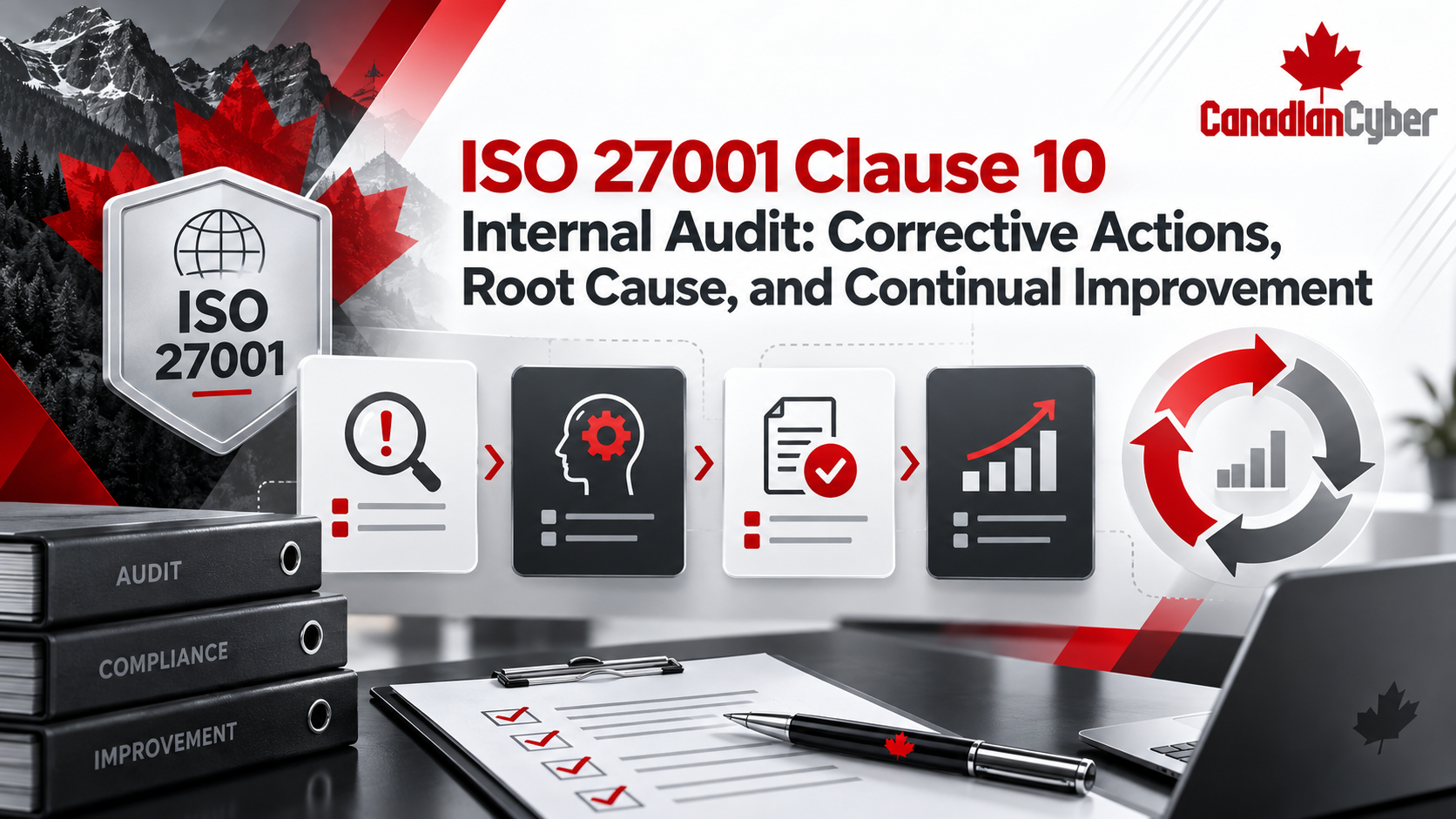
ISO 27001 Clause 10 Internal Audit: Corrective Actions, Root Cause, and Continual Improvement
A practical ISO 27001 Clause 10 internal audit guide for testing corrective actions, root cause analysis, awareness gaps, finding closure, repeat findings, lessons learned, and continual improvement evidence.
Quick Answer
What should an ISO 27001 Clause 10 internal audit test?
An ISO 27001 Clause 10 internal audit should test whether nonconformities and control weaknesses are corrected properly.
It should also check whether root causes are identified, owners are assigned, closure evidence is verified, and lessons learned are shared.
Strong Clause 10 evidence proves that the organization fixed the cause, not only the symptom.
Clause 10 Is Where the ISMS Learns
Clause 10 asks whether the organization improves after weaknesses are found.
Finding a problem is not enough.
Closing a ticket is not enough.
The real test is whether the organization understood the cause, fixed the process, informed the right people, verified the correction, and reduced the chance of repeat findings.
Practical rule: ISO 27001 Clause 10 should prove learning, not only remediation.
The Main Clause 10 Audit Question
The strongest audit question is not, “Was the finding closed?”
A better question is:
Can the organization prove that it understood the cause, corrected the issue, changed the process or behavior, and verified that the issue will not simply return?
ISO 27001 Clause 10 Audit Snapshot
| Clause 10 Area | What Internal Audit Should Test |
|---|---|
| Nonconformity | Was the problem clearly identified and understood? |
| Correction | Was the immediate issue contained or corrected? |
| Root Cause | Did the organization determine why the issue happened? |
| Corrective Action | Does the action address the cause, not only the symptom? |
| Awareness | Were affected employees and control owners told what changed? |
| Verification | Did someone verify that the issue was really resolved? |
Why Clause 10 Matters
Clause 10 proves whether the ISMS improves after problems are identified.
Without strong corrective action, the same issues can return during the next internal audit, certification audit, surveillance audit, client review, or incident.
A weak corrective action process creates repeat findings. A strong process creates learning.
Weak Clause 10 Evidence
A tracker says “closed,” but root cause, awareness, verification, and recurrence checks are missing.
Strong Clause 10 Evidence
The organization identifies the cause, updates the process, informs the right people, verifies the fix, and prevents recurrence.
Clause 10 Is Also an Awareness Test
Many internal audit findings are not caused by a missing policy.
They happen because people do not know the process, do not understand their role, or do not know where evidence should be stored.
Therefore, corrective action should not always end with technical remediation.
Awareness question: Do the people involved understand what changed and what they now need to do differently?
1. Review the Nonconformity Description
Corrective action starts with a clear description of the problem.
The finding should explain what went wrong, what evidence was missing, and why it matters.
Audit Questions
- Is the nonconformity clearly written?
- Does it identify the requirement?
- Does it identify the evidence reviewed?
- Does it explain the actual gap?
- Does the owner understand the finding?
Common finding: corrective action begins from a vague finding, so owners do not understand what they must fix.
2. Separate Correction From Corrective Action
Correction and corrective action are not the same thing.
Correction fixes the immediate issue. Corrective action addresses why the issue happened.
| Type | Example |
|---|---|
| Correction | Complete the missed access review. |
| Corrective Action | Update the access review procedure, assign a named owner, include vendor accounts, add reminders, and train the owner. |
Practical rule: correction fixes today. Corrective action protects tomorrow.
3. Test Root Cause Analysis
Root cause analysis should explain why the nonconformity happened.
It should go deeper than “human error,” “oversight,” “forgotten,” or “lack of time.”
Practical rule: “human error” should usually be the start of root cause analysis, not the end.
Need to Audit Clause 10 Before Certification?
Canadian Cyber helps organizations audit ISO 27001 Clause 10 corrective actions, root causes, finding closure, control owner awareness, lessons learned, and continual improvement before certification.
We help move teams from “finding closed” to “finding genuinely resolved.”
4. Test Whether Awareness Was Part of the Root Cause
Some corrective actions fail because awareness is never considered.
Internal audit should ask whether affected people understood the requirement, their role, the deadline, the escalation path, and the evidence requirement.
Evidence to Review
- Training records.
- Policy acknowledgments.
- Role-based training.
- Control owner interviews.
- Procedure communication.
- Teams, email, or SharePoint communication records.
Common finding: a control failure is corrected technically, but the people responsible are never retrained or informed.
5. Test Corrective Action Quality
A strong corrective action should be specific and measurable.
It should tell the organization exactly what will change.
| Weak Action | Stronger Action |
|---|---|
| Remind staff. | Train the control owner on the updated process and require acknowledgment. |
| Monitor going forward. | Add reminders, assign an owner, define evidence, and verify the next cycle. |
| Update process. | Update the procedure, approve it, publish it, communicate it, and test understanding. |
6. Test Corrective Action Ownership
Someone must own the corrective action.
The ISMS Manager may track the action, but should not automatically own every remediation.
Audit Questions
- Who owns the action?
- Is the owner close to the issue?
- Does the owner have authority to fix it?
- Does the owner understand the required evidence?
- Are overdue actions escalated?
Practical rule: the ISMS Manager can coordinate remediation. The real control owner should usually own the fix.
7. Test Awareness After the Corrective Action
After the corrective action is implemented, relevant people should understand what changed.
This is where internal audit becomes awareness-focused.
Audit Questions
- Was the updated process communicated?
- Were affected employees informed?
- Were control owners retrained?
- Was the policy or procedure republished?
- Can sampled employees explain the new requirement?
Practical rule: corrective action should change understanding when understanding was part of the problem.
8. Test Closure Evidence
A finding should not be closed because the owner says “done.”
Internal audit should verify evidence.
Practical rule: status is not closure evidence.
9. Re-Test the Control
The best way to verify corrective action is often to re-test the control.
Closure evidence proves the fix was implemented. Re-testing proves the fix works.
| Finding Type | How to Re-Test |
|---|---|
| Access Review Finding | Check user population, vendor accounts, privileged accounts, exceptions, removals, and approval. |
| Policy Control Finding | Check current version, approval, review date, published copy, and employee communication. |
| Vendor Review Finding | Check criticality, security review, risk rating, conclusion, open issues, and next review date. |
10. Look for the Same Problem Elsewhere
Corrective action should consider whether the issue could exist in other areas.
Fix the pattern, not only the sample.
Audit Questions
- Could the same problem affect other systems?
- Could it affect other departments?
- Could other control owners have the same awareness gap?
- Could other vendors have the same review gap?
- Was broader sampling performed?
11. Test Repeat Findings
Repeated findings are an important Clause 10 warning sign.
They may mean that the root cause was wrong, the corrective action was weak, awareness was not improved, or management did not follow up.
Evidence to Review
- Previous internal audit reports.
- Corrective action history.
- Management review minutes.
- Training records.
- Repeat finding analysis.
Practical rule: repeat findings are evidence that the previous corrective action may not have been effective.
12. Test Lessons Learned
Clause 10 should create organizational learning.
Lessons learned should not remain with only the person who fixed the problem.
Practical rule: a lesson that stays in the corrective action tracker is not yet organizational learning.
13. Test Management Review of Corrective Actions
Leadership should see important corrective actions.
This includes high-risk findings, repeat findings, overdue actions, resource-dependent actions, and issues affecting certification readiness.
Audit Questions
- Are open corrective actions reviewed?
- Are overdue actions escalated?
- Are repeat findings highlighted?
- Are resource blockers discussed?
- Are awareness or training gaps discussed?
What Continual Improvement Should Look Like
Continual improvement does not mean creating constant paperwork.
It means the ISMS becomes stronger over time.
Corrective Action Evidence Matrix
| Area | Weak Evidence | Strong Evidence |
|---|---|---|
| Finding | Vague issue statement. | Clear requirement, gap, and evidence. |
| Root Cause | “Human error.” | Process, awareness, ownership, or system cause identified. |
| Corrective Action | “Monitor going forward.” | Specific change, owner, date, and evidence. |
| Awareness | No communication. | Affected users trained and informed. |
| Closure | Owner says complete. | Evidence attached and verified. |
| Improvement | No lesson shared. | Process, training, or system improved. |
Common Clause 10 Internal Audit Findings
Sample Clause 10 Finding Language
Weak Finding
Corrective actions are not effective.
Stronger Finding
The internal audit reviewed four corrective actions closed during the previous quarter. Two actions were marked closed after missing evidence was uploaded. However, no root cause analysis was completed and no process change was implemented. One similar control gap reappeared during the current audit sample. This indicates that closure focused on correcting the record rather than preventing recurrence.
Clause 10 Awareness Interview Questions
| Interview Group | Questions to Ask |
|---|---|
| Control Owners | What finding was assigned to you? Why did it happen? What changed after the finding? |
| Employees | Were you informed about the updated process? Do you know what changed? |
| ISMS Manager | How do you distinguish correction from corrective action? How do you verify closure? |
| Internal Auditors | Do you re-test controls? Do you check whether awareness was part of root cause? |
| Leadership | Which corrective actions are overdue? Which findings repeated? Which issues need resources? |
Clause 10 Internal Audit Checklist
| Checklist Area | What to Confirm |
|---|---|
| Finding Quality | The finding describes the gap, requirement, evidence, owner, and scope. |
| Correction | The immediate issue is corrected and not confused with corrective action. |
| Root Cause | Ownership, awareness, procedure, workflow, tool, and resource causes are considered. |
| Corrective Action | The action addresses root cause, has an owner, has a due date, and defines evidence. |
| Awareness | Updated processes are communicated and relevant people are trained. |
| Verification | Closure evidence is reviewed, controls are re-tested, and repeat findings are analyzed. |
How SharePoint Can Support Clause 10
A SharePoint ISMS workspace can make corrective actions more visible, accountable, and audit-ready.
It can track findings, root causes, corrective actions, awareness needs, closure evidence, repeat findings, verification, and management review status.
Track owners, due dates, status, evidence, and closure approval.
Track cause categories and repeated finding patterns.
Capture what changed and who needs to know.
Track awareness actions after corrective action.
Show findings pending closure evidence or re-testing.
Show overdue, high-risk, repeated, and certification-impacting actions.
Practical rule: a corrective action tracker should show more than open and closed. It should show why, what changed, who learned, and how closure was verified.
High-Intent Buyer Signals for Clause 10 Support
Organizations may need professional support when these problems appear:
How Canadian Cyber Helps
Canadian Cyber helps organizations audit ISO 27001 Clause 10 corrective actions, root causes, awareness gaps, closure evidence, and continual improvement.
We help teams move from “finding closed” to “finding genuinely resolved.”
Our support includes ISO 27001 Clause 10 internal audits, corrective action reviews, root cause analysis reviews, finding closure verification, control re-testing, repeat finding analysis, security awareness gap reviews, control owner awareness testing, lessons learned reviews, SharePoint corrective action tracker setup, management review preparation, certification readiness reporting, vCISO services, SOC 2 readiness alignment, ISO 42001 AI governance readiness, ISO 27017, ISO 27018, and cybersecurity assessments.
Frequently Asked Questions
What is ISO 27001 Clause 10?
ISO 27001 Clause 10 focuses on improvement. It covers nonconformities, corrective actions, effectiveness checks, and continual improvement of the ISMS.
What is the difference between correction and corrective action?
Correction fixes the immediate problem. Corrective action addresses the underlying cause so the problem is less likely to happen again.
Why is awareness relevant to corrective action?
Awareness matters because many findings involve unclear responsibilities, weak training, poor communication, or misunderstanding of procedures.
What is a good ISO 27001 root cause?
A good root cause explains why the control failed. It may involve unclear ownership, inadequate training, missing reminders, outdated procedures, weak escalation, or poor workflow design.
How should corrective action closure be verified?
Closure should be verified through supporting evidence and, where appropriate, re-testing the control to confirm that the updated process works.
What is a repeated finding?
A repeated finding is the same or similar issue appearing again after it was previously considered resolved. It may indicate weak root cause analysis or ineffective corrective action.
Can SharePoint help track corrective actions?
Yes. SharePoint can track findings, root cause, owners, due dates, evidence, awareness actions, verification, repeat findings, and management review status.
Can Canadian Cyber help review Clause 10 corrective actions?
Yes. Canadian Cyber helps organizations review root causes, verify corrective action closure, test awareness gaps, re-test controls, build SharePoint trackers, and prepare for ISO 27001 certification readiness.
Takeaway
Clause 10 is not simply about closing findings.
It is about learning from them.
A strong internal audit should test whether the organization corrected the immediate issue, identified the real root cause, considered awareness gaps, assigned the right owner, changed the process, communicated the change, verified closure evidence, re-tested the control, looked for similar issues, and shared lessons learned.
When the people responsible for the control understand what went wrong and what they now need to do differently, corrective action becomes continual improvement.
Audit Clause 10 Corrective Actions Before Certification
Canadian Cyber can help your organization review Clause 10 corrective actions, root causes, awareness gaps, and continual improvement evidence before an ISO 27001 internal audit or certification audit.
We provide ISO 27001 Clause 10 internal audits, corrective action reviews, root cause analysis reviews, finding closure verification, awareness testing, control re-testing, SharePoint ISMS corrective action dashboards, management review preparation, vCISO support, SOC 2 readiness alignment, ISO 42001 AI governance readiness, ISO 27017, ISO 27018, and cybersecurity assessments.
Stay Connected With Canadian Cyber
Follow Canadian Cyber for practical guidance on ISO 27001 internal audits, Clause 10, corrective actions, root cause analysis, security awareness, continual improvement, certification readiness, SharePoint ISMS, SOC 2 readiness, AI governance, vCISO services, ISO 42001, ISO 27017, ISO 27018, and cybersecurity maturity.