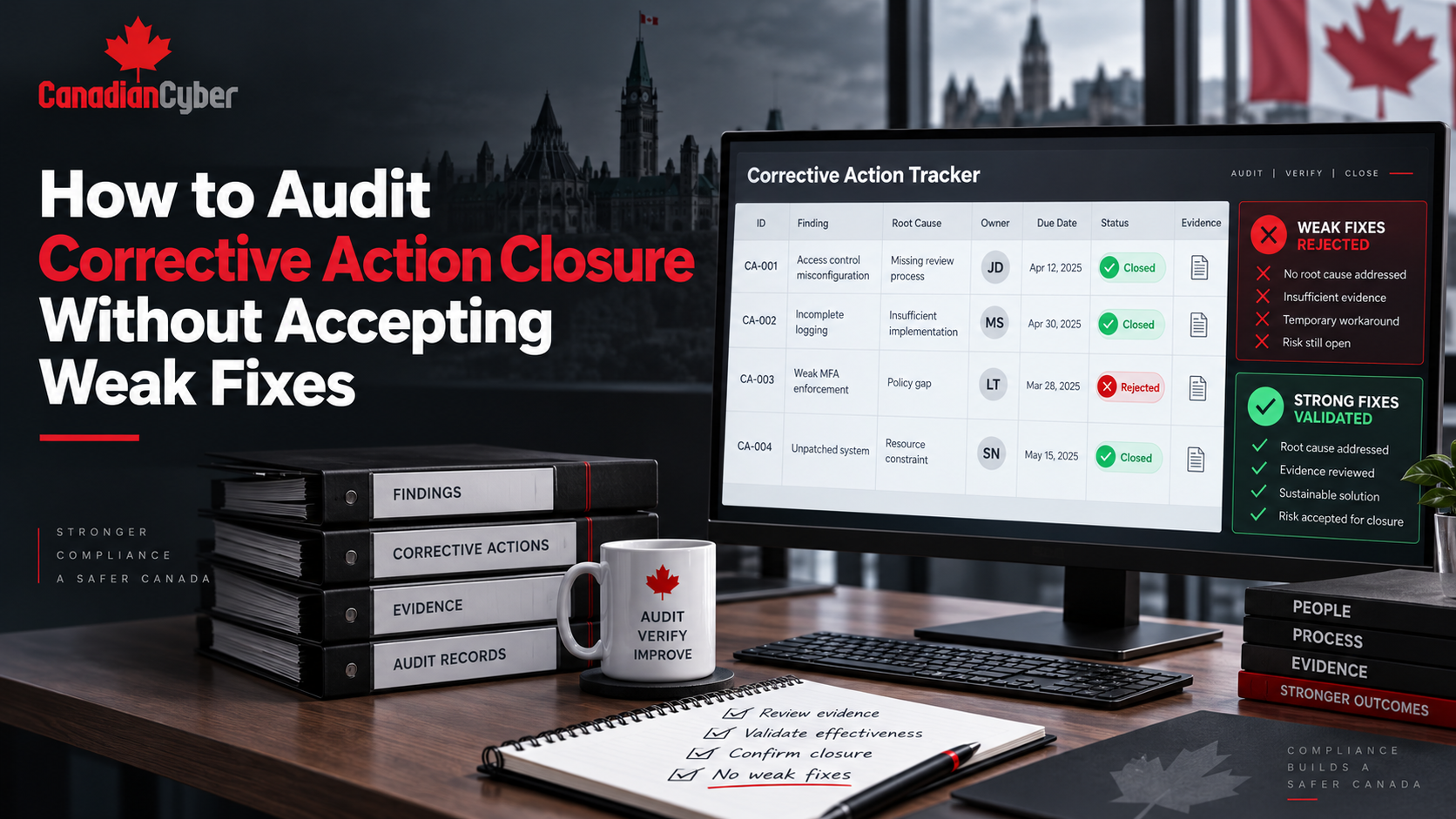
Corrective Action
Root Cause
Closure Evidence
How to Audit Corrective Action Closure Without Accepting Weak Fixes in ISO 27001
A practical ISO 27001 internal audit guide for verifying corrective action closure, challenging weak fixes, reviewing root cause, re-testing controls, checking awareness, and proving findings are genuinely resolved.
Quick Answer
How do you audit ISO 27001 corrective action closure?
To audit corrective action closure, check whether the immediate issue was fixed and the real cause was addressed.
Do not close a finding only because an owner says it is complete or uploads a file.
Strong closure should include root cause, corrective action evidence, awareness where needed, re-testing, recurrence checks, and independent verification.
Do Not Close Findings Too Easily
One of the biggest mistakes in ISO 27001 internal audit is closing findings too quickly.
A control owner uploads a document. The tracker is updated. The status changes from open to closed.
However, that does not always mean the weakness is gone.
A weak fix may make the finding disappear from the tracker while leaving the real problem untouched.
Practical rule: a closed finding should mean the problem is fixed and less likely to return.
The Main Closure Audit Question
The strongest closure question is not, “Did you complete the action?”
A better question is:
Can you prove that the control now works, the cause has been addressed, and the people responsible understand the updated process?
Corrective Action Closure Audit Snapshot
| Closure Area | What Internal Audit Should Test |
|---|---|
| Immediate Correction | Was the original issue actually fixed? |
| Root Cause | Did the organization identify why the problem happened? |
| Corrective Action | Did the action address the cause, not only the symptom? |
| Awareness | Were affected owners or employees informed about the new process? |
| Re-Testing | Was the control tested again after the fix? |
| Closure Approval | Did someone verify closure before the finding was closed? |
Why Corrective Action Closure Is Often Too Weak
Many organizations treat closure as an administrative step.
The owner says the action is done. Someone uploads a file. The finding is closed.
However, internal audit should ask whether the evidence proves that the control now works properly.
Weak Closure Can Hide
Repeat findings, unclear ownership, weak training, poor communication, outdated procedures, missing reminders, and weak root cause analysis.
Strong Closure Should Prove
The original gap was fixed, the process changed, owners understand the update, evidence is retained, and recurrence risk is lower.
1. Confirm the Original Finding Is Fully Understood
Before approving closure, go back to the original finding.
Do not review the corrective action in isolation.
Audit Questions
- What exactly was the original nonconformity?
- Which requirement was not met?
- What evidence supported the finding?
- Was the issue isolated or systemic?
- Did the corrective action address the full finding?
Common finding: a corrective action closes one part of the issue but leaves another part unresolved.
2. Separate the Immediate Fix From the Real Fix
Internal audit should separate correction from corrective action.
The first action may fix the missing record. The second makes recurrence less likely.
| Example Area | Weak Closure | Stronger Closure |
|---|---|---|
| Access Review | Complete the missing review. | Assign owner, define population, add reminders, include privileged and vendor accounts, and re-test next cycle. |
| Policy Approval | Upload the approval. | Update the document control workflow and review the full policy register for missing approvals. |
Practical rule: a correction closes the gap once. A corrective action should prevent the gap from returning.
3. Challenge Weak Root Cause Analysis
Weak closure usually starts with weak root cause analysis.
Words like “human error,” “oversight,” “forgotten,” or “missed task” may describe the event. They do not always explain why the control failed.
Practical rule: if the root cause is vague, the corrective action will probably be vague too.
4. Reject Corrective Actions That Are Too Weak
Some actions sound acceptable but do not create sustainable change.
Internal audit should challenge vague wording before accepting closure.
| Weak Action | What to Ask |
|---|---|
| Remind the team. | Who was reminded, what changed, and how will this be verified? |
| Monitor going forward. | Who monitors it, how often, and what happens when it is overdue? |
| Update the document. | Was it approved, published, communicated, and used in practice? |
Need to Verify Corrective Action Closure Before Certification?
Canadian Cyber helps organizations review ISO 27001 corrective action closure, challenge weak fixes, verify root cause, re-test controls, review awareness evidence, and prepare audit-ready closure records.
We help move findings from “closed in the tracker” to “actually fixed.”
5. Test Whether Awareness Was Part of the Fix
Internal auditors should ask whether the finding happened because someone did not understand their responsibility.
This is especially important for access reviews, vendor reviews, incident reporting, document control, training evidence, backup testing, change management, and risk treatment.
Evidence to Review
- Training records.
- Policy acknowledgment records.
- Employee communications.
- Teams announcements.
- Updated procedures.
- Control owner interview notes.
Practical rule: a changed process without changed awareness may still fail.
6. Verify Closure Evidence
Closure evidence should prove implementation.
Do not accept a status update alone.
Practical rule: “completed” is a status. Evidence proves completion.
7. Re-Test the Control
Re-testing is one of the strongest ways to validate closure.
Implementation evidence proves the action happened. Re-testing proves the control works.
| Control Area | What to Re-Test |
|---|---|
| Access Review | Employee accounts, privileged accounts, vendor accounts, exceptions, removals, and approval. |
| Document Control | Version, approval, review date, published library, obsolete archive, permissions, and communication. |
| Vendor Management | Classification, security review, risk rating, conclusion, open issues, and next review date. |
| Awareness Finding | Training, acknowledgment, employee understanding, and role-specific responsibilities. |
8. Test Whether the Fix Is Sustainable
A fix may work once and still fail later.
Internal audit should test whether the process will still work next quarter or next year.
Audit Questions
- Does the control depend on one person remembering?
- Is there a calendar or reminder?
- Is backup ownership defined?
- Are exceptions escalated?
- Does management see overdue items?
Practical rule: a sustainable corrective action should not depend on memory alone.
9. Check Whether the Same Weakness Exists Elsewhere
Do not close a finding before checking whether the same problem exists in similar areas.
Fix the systemic weakness, not only the audit sample.
10. Review Repeated Findings
Repeated findings are a major warning sign.
They may indicate that previous closure was too weak.
Evidence to Review
- Previous audit reports.
- Historical corrective action tracker.
- Root cause records.
- Management review minutes.
- Repeat finding analysis.
Practical rule: a repeat finding is often evidence that the previous corrective action was not effective.
11. Test Independent Closure Verification
The person who performs the corrective action should not always be the only person deciding it is complete.
Important findings should have objective closure verification.
Audit Questions
- Who verified closure?
- Was the verifier independent enough?
- Did the verifier review evidence?
- Was re-testing performed?
- Were unresolved parts reopened?
12. Test Management Visibility
Not every corrective action needs executive involvement.
However, high-risk, overdue, repeated, or certification-critical findings should be visible to leadership.
Evidence to Review
- Management review minutes.
- Corrective action dashboard.
- Internal audit findings summary.
- Risk register.
- Certification readiness dashboard.
Corrective Action Closure Evidence Matrix
| Closure Area | Weak Evidence | Strong Evidence |
|---|---|---|
| Original Finding | Vague issue. | Clear requirement, sample, and gap. |
| Root Cause | “Human error.” | Process, ownership, awareness, or system cause. |
| Corrective Action | “Monitor going forward.” | Process redesigned with owner and evidence. |
| Awareness | No communication. | Affected owners trained and informed. |
| Re-Testing | None. | Next control cycle independently sampled. |
| Management Review | Not visible. | High-risk and overdue actions escalated. |
Common Weak Fixes Internal Auditors Should Reject
Was it approved, current, communicated, and used?
Who was trained, and was understanding tested?
Was the full population included, and were exceptions corrected?
Does the owner understand deadlines and evidence requirements?
Was it approved, published, and communicated?
Was the change tested, monitored, and re-testable?
Sample Internal Audit Finding
Weak Finding
Corrective action closure is weak.
Stronger Finding
The internal audit reviewed six corrective actions marked closed during the previous quarter. Three were closed after missing evidence was uploaded, but root cause analysis did not explain why the evidence was missed. Two actions involved control owners who had not received updated process guidance, and one similar issue reappeared during current audit sampling. No re-test evidence was retained. This indicates closure is focused on administrative completion rather than control effectiveness and recurrence prevention.
Corrective Action Closure Interview Questions
| Interview Group | Questions to Ask |
|---|---|
| Control Owners | What was the original finding? Why did it happen? What changed after the finding? |
| ISMS Manager | How do you decide a finding is ready for closure? Who verifies corrective action evidence? |
| Internal Auditors | Do you re-test corrected controls? How do you challenge weak fixes? |
| Leadership | Which findings remain overdue? Which open issues could affect certification? |
Corrective Action Closure Checklist
| Checklist Area | What to Confirm |
|---|---|
| Original Finding | Requirement, evidence, scope, and owner understanding are clear. |
| Root Cause | Root cause goes beyond human error and considers awareness, ownership, workflow, and resources. |
| Corrective Action | Action addresses root cause, has an owner, has a due date, and defines evidence. |
| Closure Evidence | Evidence is current, complete, approved where needed, and linked to the finding. |
| Re-Testing | The updated control is sampled, results are documented, and repeat findings are checked. |
| Final Closure | Closure is verified, recurrence risk is reduced, and final approval is documented. |
How SharePoint Can Support Strong Corrective Action Closure
A SharePoint ISMS workspace can make corrective action closure more disciplined.
It can track root cause, correction, corrective action, ownership, evidence, training needs, re-test dates, repeat findings, closure approvals, reminders, Teams notifications, and management review status.
Track findings, owners, dates, evidence, and closure approval.
Track root cause quality and repeated patterns.
Track re-test dates, results, and exceptions.
Track owners who need updated awareness or role-based training.
Escalate overdue and high-risk closure items.
Show findings pending root cause, evidence, re-test, or approval.
Practical rule: a corrective action tracker should make weak closure difficult.
High-Intent Buyer Signals for Corrective Action Closure Support
Organizations may need professional support when these problems appear:
How Canadian Cyber Helps
Canadian Cyber helps organizations review ISO 27001 corrective action closure without accepting weak fixes.
We help teams verify whether findings are genuinely resolved, whether root cause was addressed, whether control owners understand the updated process, and whether closure evidence is strong enough for certification readiness.
Our support includes ISO 27001 corrective action closure reviews, internal audit finding verification, root cause analysis reviews, corrective action quality reviews, control re-testing, repeat finding analysis, control owner awareness testing, closure evidence verification, SharePoint corrective action tracker setup, management review preparation, certification readiness reporting, internal audit fieldwork, vCISO services, SOC 2 readiness alignment, ISO 42001 AI governance readiness, ISO 27017, ISO 27018, and cybersecurity assessments.
Frequently Asked Questions
What does corrective action closure mean in ISO 27001?
Corrective action closure means the organization has addressed the issue, dealt with the root cause, implemented the action, retained evidence, and verified that the control now works effectively.
Is uploading missing evidence enough to close a finding?
Not always. Uploading evidence may correct the immediate issue, but the auditor should still check why the evidence was missing and whether the process needs to change.
Should corrective actions be re-tested?
Yes, where appropriate. Re-testing is one of the strongest ways to confirm that a corrective action works in practice.
What is a weak corrective action?
A weak corrective action is vague, addresses only the symptom, lacks ownership, has no evidence requirement, ignores awareness gaps, or does not reduce recurrence risk.
Why does awareness matter during closure?
A control may fail because the owner does not understand the requirement, deadline, evidence expectation, or escalation process. In those cases, awareness or training should be part of the corrective action.
Can SharePoint help verify corrective action closure?
Yes. SharePoint can track root cause, actions, owners, evidence, training requirements, re-tests, repeat findings, closure approvals, and management review status.
Can Canadian Cyber help verify ISO 27001 corrective actions?
Yes. Canadian Cyber helps organizations review closure evidence, challenge weak fixes, re-test controls, assess awareness gaps, build SharePoint corrective action trackers, and prepare for certification readiness.
Takeaway
Corrective action closure should never become a checkbox exercise.
A finding is not closed because the owner says it is done, a file was uploaded, a ticket was updated, or a spreadsheet says closed.
A strong internal audit should verify the original issue, root cause, process change, awareness update, closure evidence, re-testing, recurrence review, and independent closure approval.
The final question is simple: would you be comfortable showing this closure evidence to the certification auditor and defending why the issue will not return?
Verify Corrective Action Closure Before Certification
Canadian Cyber can help your organization verify corrective action closure before an ISO 27001 internal audit or certification audit.
We provide corrective action closure reviews, root cause analysis reviews, control re-testing, awareness testing, repeat finding analysis, SharePoint ISMS corrective action dashboards, management review preparation, vCISO support, SOC 2 readiness alignment, ISO 42001 AI governance readiness, ISO 27017, ISO 27018, and cybersecurity assessments.
Stay Connected With Canadian Cyber
Follow Canadian Cyber for practical guidance on ISO 27001 internal audits, corrective action closure, root cause analysis, control re-testing, security awareness, continual improvement, certification readiness, SharePoint ISMS, SOC 2 readiness, AI governance, vCISO services, ISO 42001, ISO 27017, ISO 27018, and cybersecurity maturity.