Internal Audit
Root Cause
Repeat Findings
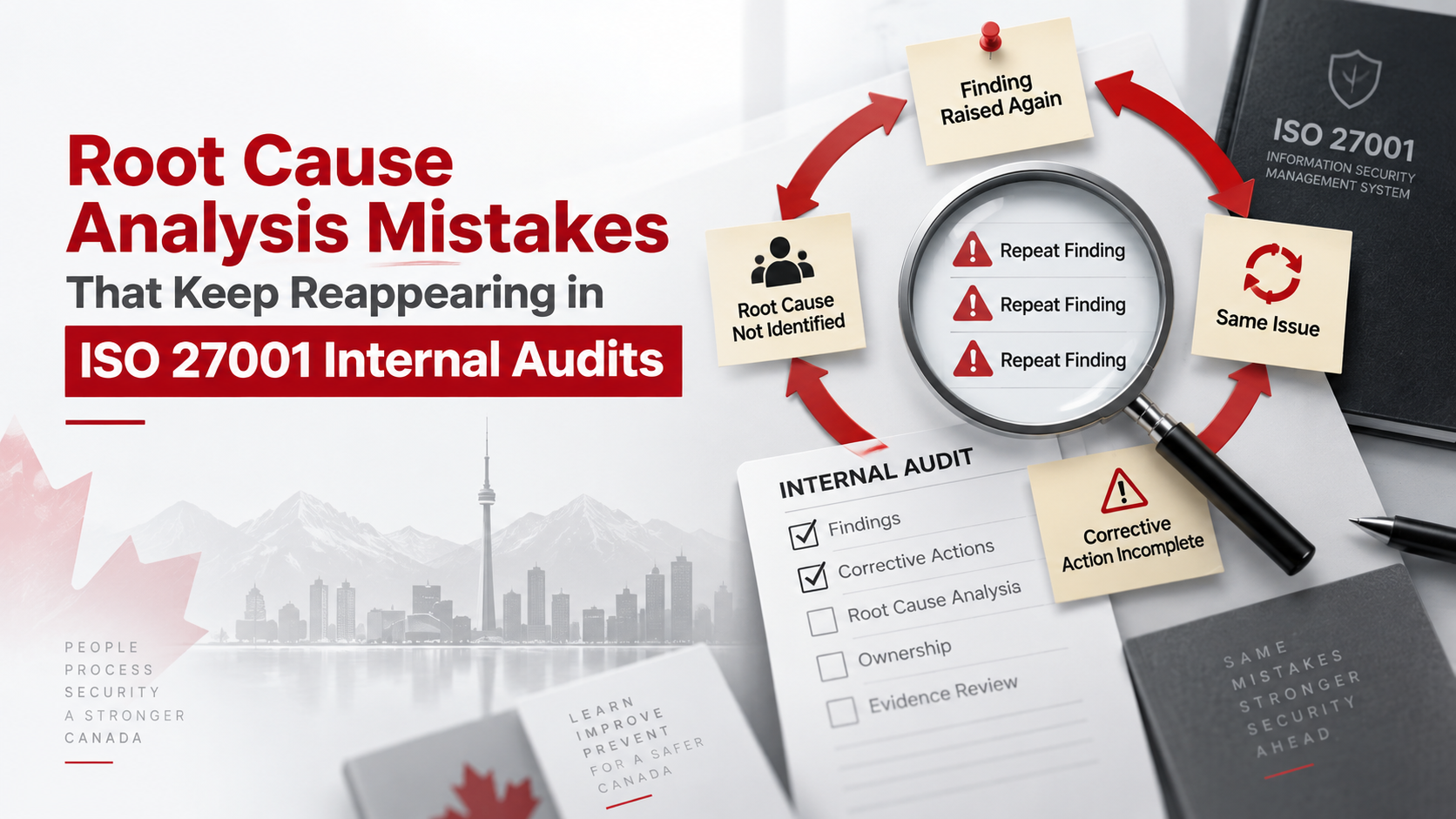
Root Cause Analysis Mistakes That Keep Reappearing in ISO 27001 Internal Audits
A practical guide for auditing ISO 27001 root cause analysis, repeat findings, weak corrective actions, awareness gaps, ownership problems, re-testing, and certification readiness.
Quick Answer
Why does ISO 27001 root cause analysis fail?
ISO 27001 root cause analysis fails when organizations stop at surface explanations.
Common weak answers include “human error,” “lack of awareness,” “forgotten task,” or “process not followed.”
A strong internal audit should test why the control failed, why it stayed undetected, and whether the corrective action changed the process behind the finding.
Repeat Findings Are a Warning Sign
One of the clearest signs of a weak ISMS is a finding that keeps coming back.
The issue may look slightly different each time. It may appear as a missed access review, overdue policy, vendor review gap, missing training evidence, weak offboarding, or backup test not completed.
But underneath, the same root cause may still exist.
When root cause analysis stops too early, corrective actions usually become weak. Then the finding returns.
Practical rule: if the same finding appears again, the previous root cause analysis deserves another look.
Root Cause Analysis Audit Snapshot
| Root Cause Mistake | What Internal Audit Should Test |
|---|---|
| “Human Error” | Why did the person make the error? |
| “Lack of Awareness” | What exactly did they not know, and why? |
| “Forgotten Task” | Why was there no reminder, backup owner, or escalation? |
| “Process Not Followed” | Was the process practical, current, and understood? |
| “One-Off Issue” | Was broader sampling performed before concluding that? |
| “Closed Finding” | Was the root cause removed or only the symptom fixed? |
Who This Guide Is For
This guide is useful for organizations preparing for ISO 27001 internal audits, Stage 1 audits, Stage 2 audits, surveillance audits, and recertification audits.
The Main Root Cause Audit Question
The strongest question is not only, “What caused the problem?”
A better question is:
What allowed this problem to happen and remain undetected?
That question forces the auditor to examine ownership, process design, training, awareness, reminders, escalation, resources, management oversight, and evidence expectations.
Why Root Cause Analysis Matters in Internal Audit
Root cause analysis is not paperwork.
It is what prevents findings from repeating.
A weak root cause usually leads to weak corrective action, repeat findings, poor awareness, unclear ownership, incorrect closure, management frustration, and certification risk.
Weak Root Cause Analysis
Explains what happened but does not explain why the control failed or why the issue was not detected earlier.
Strong Root Cause Analysis
Identifies the process, ownership, awareness, resource, workflow, change, or oversight weakness that allowed the finding.
Mistake 1: Stopping at “Human Error”
“Human error” is one of the most common weak root causes.
It may describe the event, but it does not explain why the process allowed the error to happen.
Better Questions
- Was the responsibility formally assigned?
- Was the owner trained?
- Was there a reminder?
- Was backup ownership defined?
- Could management see the overdue task?
Practical rule: human error describes the event. Internal audit should find the process weakness behind it.
Mistake 2: Using “Lack of Awareness” Without Explaining It
“Lack of awareness” can be a valid root cause.
However, it is too broad by itself.
Common finding: the organization lists “lack of awareness” as root cause but cannot explain what was misunderstood or why.
Mistake 3: Treating a Missed Task as the Root Cause
A missed task is not usually the root cause.
It is the event.
Vendor Review Example
Weak root cause: “Vendor review was missed.”
Better root cause: “The vendor was classified as critical, but the annual review workflow did not create a recurring task or escalation. Responsibility was split between Operations and Security without a defined accountable owner.”
Practical rule: do not rewrite the finding and call it root cause analysis.
Mistake 4: Blaming the Person Instead of the Process
Root cause analysis should not become blame.
Even when a person failed to follow the process, internal audit should ask why the process was fragile.
Questions to Ask
- Was the person trained?
- Was the procedure usable?
- Was the process too manual?
- Was the responsibility clear?
- Was the failure visible before the audit?
Practical rule: when only one person can prevent the failure, the process may be too fragile.
Need to Challenge Repeat Findings Before Certification?
Canadian Cyber helps organizations review ISO 27001 internal audit findings, strengthen root cause analysis, identify awareness gaps, challenge repeat findings, and verify corrective action effectiveness before certification.
We help teams stop fixing symptoms and start fixing causes.
Mistake 5: Assuming Training Is Always the Solution
Training is useful.
But it is not always the correct corrective action. If the process is badly designed, more training may not fix it.
Document Review Example
Weak corrective action: “Retrain document owners.”
Possible real issue: no review calendar, no reminders, unclear ownership, poor SharePoint metadata, no escalation, or too many documents assigned to one person.
Practical rule: training should fix a knowledge gap, not compensate for a broken process.
Mistake 6: Treating a One-Time Fix as Root Cause Resolution
A common mistake is fixing one record and closing the finding.
That fixes the sample. It does not necessarily fix the system.
Stronger Response
- Review all critical vendors.
- Confirm review frequency.
- Assign vendor owners.
- Set recurring review dates.
- Configure reminders.
- Report overdue status during management review.
Practical rule: fixing the sample is not the same as fixing the process.
Mistake 7: Failing to Look for the Same Problem Elsewhere
Root cause analysis should ask whether the issue is systemic.
A finding may start with one sample, but the weakness may exist in many areas.
Practical rule: internal audit should ask whether the finding is isolated or systemic.
Mistake 8: Ignoring Ownership as a Root Cause
Many ISO 27001 findings are really ownership problems.
The control exists. The process exists. The evidence requirement exists. But nobody clearly owns the responsibility.
| Weak Ownership Language | Better Audit Focus |
|---|---|
| “Security handles it.” | Name the accountable control owner. |
| “IT should do it.” | Define who performs, reviews, and escalates. |
| “We all share responsibility.” | Clarify one accountable owner and evidence owner. |
Practical rule: shared responsibility without clear accountability often becomes no responsibility.
Mistake 9: Ignoring Change as a Root Cause
Sometimes the process used to work.
Then something changed.
Practical rule: when a control suddenly stops working, look for what changed.
Mistake 10: Ignoring Resource Constraints
Sometimes the root cause really is capacity.
But “lack of time” needs further analysis.
Audit Questions
- Was one person assigned too many controls?
- Were deadlines realistic?
- Did management know about the capacity problem?
- Were priorities clear?
- Could tasks be automated?
Practical rule: resource constraints should lead to a resource decision, not just a reminder to work faster.
Mistake 11: Ignoring Management Oversight
Some repeat findings continue because nobody sees them early enough.
The process may fail quietly until internal audit discovers the problem.
Audit Questions
- Was overdue status visible?
- Was the issue escalated?
- Did management review open actions?
- Was the control included in a KPI dashboard?
- Were repeat findings discussed?
Practical rule: a good management system should detect weak performance before the internal auditor does.
Mistake 12: Closing Root Cause Analysis Too Quickly
Some organizations rush root cause analysis because certification dates are approaching.
That creates weak corrective actions.
Practical rule: fast root cause analysis is not automatically bad. Shallow root cause analysis is.
Mistake 13: Failing to Validate the Root Cause
A root cause should be supported by evidence.
Do not accept a root cause simply because it sounds reasonable.
Example: Claimed Root Cause Is “Employee Was Not Trained”
- Was training actually missing?
- Was training outdated?
- Did the employee complete training?
- Did the employee understand it?
- Was the procedure available?
Mistake 14: Failing to Re-Test After Corrective Action
Even strong root cause analysis means little if the corrective action is never tested.
Corrective action effectiveness should be demonstrated, not assumed.
| Finding Area | How to Re-Test |
|---|---|
| Access Review | Sample the next review and check population, exceptions, removal evidence, and approval. |
| Vendor Review | Test the next vendor cycle and check risk rating, review conclusion, and open issues. |
| Document Control | Inspect review date, approval, published copy, and obsolete archive. |
| Awareness Gap | Interview employees again and test whether they understand the updated process. |
Root Cause Analysis Evidence Matrix
| Root Cause Area | Weak Evidence | Strong Evidence |
|---|---|---|
| Human Error | “Employee forgot.” | Why reminder, ownership, or workflow failed. |
| Awareness | “Lack of awareness.” | Specific knowledge gap and communication weakness. |
| Ownership | “Team responsible.” | Named accountable owner and role gap. |
| Process | “Process not followed.” | Process design compared with real workflow. |
| Resources | “Lack of time.” | Workload, capacity, and resource decision evidence. |
| Verification | No re-test. | Next control cycle sampled. |
Common Root Cause Analysis Findings
Sample Root Cause Analysis Finding
Weak Finding
Root cause analysis is inadequate.
Stronger Finding
The internal audit reviewed five corrective actions closed during the previous six months. Four root cause records used “human error,” “oversight,” or “lack of awareness” without documenting further analysis. Two related control weaknesses reappeared during current audit sampling. Interviews showed that control ownership, recurring review dates, and evidence expectations were not clearly defined. This indicates that root cause analysis is addressing individual mistakes rather than underlying process, awareness, and ownership weaknesses.
Root Cause Analysis Interview Questions
| Interview Group | Questions to Ask |
|---|---|
| Control Owners | Why did the control fail? Was your responsibility clear? Did you know the due date and evidence requirement? |
| ISMS Manager | How do you challenge weak root causes? How do you identify repeat findings? |
| Internal Auditors | Do you test whether the root cause is evidence-based? Do you re-test corrected controls? |
| Leadership | Which findings keep repeating? Which root causes need management intervention or resources? |
Root Cause Analysis Internal Audit Checklist
| Checklist Area | What to Confirm |
|---|---|
| Root Cause Quality | Root cause goes deeper than the finding and challenges “human error” or vague awareness language. |
| Evidence | Control owner interview, procedure review, training evidence, workflow evidence, and related findings are reviewed. |
| Awareness | Specific awareness gaps are identified, and relevant employees are informed or trained. |
| Corrective Action | Corrective action addresses root cause, has an owner, has a due date, and defines evidence. |
| Verification | Corrective action is implemented, control is re-tested, and repeat findings are monitored. |
How SharePoint Can Support Better Root Cause Analysis
A SharePoint ISMS workspace can help connect findings, root causes, corrective actions, awareness, evidence, re-testing, and management review escalation.
It also makes repeat patterns easier to see.
Track root cause categories, causes, and quality issues.
Track owners, due dates, evidence, and closure status.
Track role-based awareness needs and communication evidence.
Track next control cycle testing and verification results.
Show recurring gaps across teams, systems, vendors, or controls.
Escalate overdue, high-risk, and certification-impacting findings.
Practical rule: structured root cause data makes repeat patterns easier to see.
High-Intent Buyer Signals for Root Cause Support
Organizations may need professional help when these problems appear:
How Canadian Cyber Helps
Canadian Cyber helps organizations strengthen ISO 27001 root cause analysis during internal audits.
We help teams move beyond surface explanations and identify the real process, awareness, ownership, resource, or control weakness behind repeated findings.
Our support includes ISO 27001 root cause analysis reviews, Clause 10 internal audits, repeat finding analysis, corrective action reviews, control owner awareness testing, role-based awareness reviews, closure evidence verification, control re-testing, internal audit fieldwork, SharePoint root cause tracker setup, corrective action dashboard development, management review preparation, certification readiness reporting, vCISO services, SOC 2 readiness alignment, ISO 42001 AI governance readiness, ISO 27017, ISO 27018, and cybersecurity assessments.
Frequently Asked Questions
What is root cause analysis in ISO 27001?
Root cause analysis is the process of determining why a nonconformity or control failure happened so corrective action can address the underlying cause and reduce recurrence.
Is “human error” a valid root cause?
It may be part of the explanation, but it is usually too shallow by itself. Auditors should ask why the error occurred and what control weakness allowed it.
Is “lack of awareness” a good root cause?
Only when the organization explains what people did not understand, why the information was not communicated, and how the awareness gap contributed to the finding.
Why do ISO 27001 findings repeat?
Findings often repeat because root cause analysis is too shallow, corrective actions fix only the sample, ownership remains unclear, awareness is weak, or controls are not re-tested.
Should training always be part of corrective action?
No. Training is appropriate when the root cause involves knowledge or competence. It should not be used to compensate for weak process design.
Should root cause analysis look for systemic issues?
Yes. Internal auditors should consider whether the same weakness exists in other systems, departments, vendors, documents, or controls.
Should corrective actions be re-tested?
Yes, where appropriate. Re-testing helps prove that the corrective action is working and the finding is less likely to recur.
Can SharePoint help track root cause analysis?
Yes. SharePoint can track findings, root cause categories, corrective actions, awareness actions, evidence, re-tests, repeat findings, and management review escalation.
Takeaway
Root cause analysis should explain why a finding happened.
Not just what happened.
Weak root cause analysis sounds like human error, oversight, forgotten task, lack of awareness, or process not followed.
Strong root cause analysis asks why ownership was unclear, why awareness was weak, why the procedure did not work, why reminders failed, why management did not see the issue, and why the same weakness existed elsewhere.
The most important internal audit question is simple: what needs to change so this does not happen again?
Strengthen Root Cause Analysis Before Certification
Canadian Cyber can help your organization review repeated findings, weak root causes, and corrective action effectiveness before an ISO 27001 internal audit or certification audit.
We provide ISO 27001 root cause analysis reviews, Clause 10 internal audits, repeat finding analysis, corrective action verification, awareness testing, control re-testing, SharePoint ISMS corrective action dashboards, management review preparation, vCISO support, SOC 2 readiness alignment, ISO 42001 AI governance readiness, ISO 27017, ISO 27018, and cybersecurity assessments.
Stay Connected With Canadian Cyber
Follow Canadian Cyber for practical guidance on ISO 27001 internal audits, root cause analysis, repeat findings, corrective actions, security awareness, continual improvement, certification readiness, SharePoint ISMS, SOC 2 readiness, AI governance, vCISO services, ISO 42001, ISO 27017, ISO 27018, and cybersecurity maturity.