Annex A
Supplier Relationships
Vendor Risk
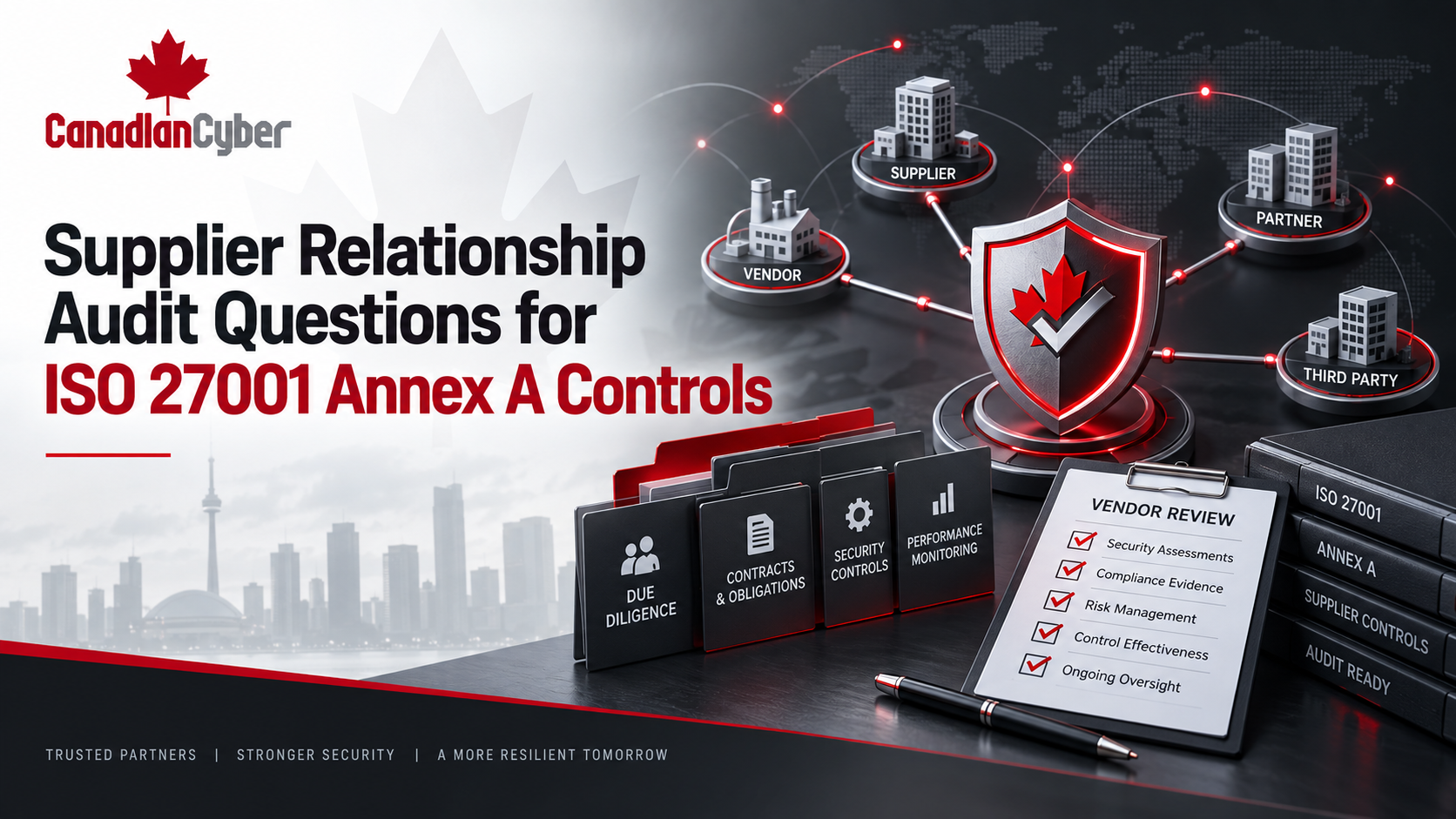
Supplier Relationship Audit Questions for ISO 27001 Annex A Controls
A practical ISO 27001 supplier relationship audit guide for testing vendor inventories, criticality, due diligence, contracts, ICT supply-chain risks, supplier access, cloud providers, AI suppliers, monitoring, incidents, renewals, and termination.
Quick Answer
What should an ISO 27001 supplier relationship audit test?
An ISO 27001 supplier relationship audit should test the full supplier lifecycle.
Auditors should confirm that suppliers are identified, classified by risk, assessed before onboarding, covered by relevant security requirements, monitored during the relationship, and reviewed when services change.
Strong evidence also shows that supplier access is controlled, incidents are tracked, renewals are reviewed, and access or data is handled correctly when the relationship ends.
A Vendor List Is Not Supplier Security Evidence
A vendor list is useful, but it does not prove supplier security.
A signed contract does not prove it either.
The same is true for a security questionnaire sitting in a folder.
Internal audit needs connected evidence showing how supplier risk is identified, accepted, monitored, changed, and closed.
Practical rule: outsourcing a service does not outsource accountability for supplier risk.
Supplier Relationship Audit Snapshot
| Supplier Audit Area | What Internal Audit Should Test |
|---|---|
| Supplier Inventory | Are all relevant suppliers identified? |
| Criticality | Are suppliers classified according to security and business risk? |
| Pre-Onboarding Review | Is security assessed before sensitive access or data sharing begins? |
| Supplier Agreements | Do contracts reflect relevant security responsibilities? |
| ICT Supply Chain | Are important downstream dependencies considered? |
| Access | Is supplier access approved, restricted, reviewed, and removed? |
| Monitoring | Are critical suppliers reviewed periodically? |
| Termination | Is access removed and data disposition confirmed? |
Why Supplier Relationships Matter During Internal Audit
Most organizations depend on third parties.
These may include cloud providers, identity platforms, payment processors, AI vendors, MSPs, contractors, backup services, ticketing systems, and customer support providers.
Each supplier can create security, privacy, availability, contractual, or operational risk.
Audit the Complete Supplier Lifecycle
Supplier controls should not be audited as isolated checkboxes.
Classify
Assess
Approve
Contract
Onboard
Monitor
Change
Renew
Terminate
The Main Supplier Audit Question
The strongest question is not, “Was the vendor approved?”
A better question is:
Can the organization explain why this supplier was acceptable, which security requirements apply, what risks remain, and how the relationship is monitored?
1. Test the Supplier Inventory
Internal audit should begin with the supplier population.
If relevant suppliers are missing, the rest of the supplier control process may also be incomplete.
Audit Questions
- Which suppliers process sensitive information?
- Which suppliers access production systems?
- Are cloud and SaaS providers included?
- Are AI providers included?
- Does each relevant supplier have a business owner?
Useful audit test: compare the supplier register with accounts payable, SSO applications, cloud inventory, or procurement records.
Practical rule: supplier completeness should be tested, not assumed.
2. Test Supplier Criticality
Not every supplier needs the same review depth.
Risk-based classification should determine how much due diligence is required.
Common finding: suppliers have high, medium, or low labels, but there is no documented methodology behind those ratings.
3. Test Security Review Before Onboarding
Security review should happen before the organization becomes dependent on a high-risk supplier where practical.
This gives the review a chance to influence the purchasing decision.
Evidence to Review
- Security questionnaire.
- Supplier risk assessment.
- Relevant ISO or SOC assurance evidence.
- Privacy assessment.
- Risk rating.
- Approval and open-risk records.
Common finding: a critical supplier entered production use before security assessment was completed.
Need to Test Supplier Controls Before Certification?
Canadian Cyber helps organizations audit supplier relationships across onboarding, due diligence, agreements, monitoring, cloud services, ICT supply chains, access, incidents, renewals, and termination.
We help move vendor management from a questionnaire exercise to evidence-based supplier assurance.
4. Test Supplier Security Requirements
The organization should know what security requirements apply before it assesses the supplier.
Requirements should reflect the supplier’s actual risk.
Practical rule: a supplier questionnaire is more useful when acceptance criteria already exist.
5. Audit Information Security Within Supplier Agreements
Do not stop at confirming that a contract exists.
Test whether the agreement addresses the supplier’s actual security responsibilities.
| Contract Area | What to Look For |
|---|---|
| Confidentiality | Protection of sensitive information. |
| Incident Notification | Defined reporting expectations where relevant. |
| Subprocessors | Notification or approval requirements where appropriate. |
| Termination | Access removal and data return or deletion expectations. |
6. Audit ICT Supply-Chain Risk
A direct supplier may depend on other providers.
Those downstream dependencies can affect your security and resilience.
Practical rule: a supplier may only be as resilient as its critical dependencies.
7. Test Supplier Access
Suppliers should not automatically receive broad or permanent access.
Supplier accounts should be approved, restricted, reviewed, and removed when no longer needed.
Audit Questions
- Which suppliers have system access?
- Who approves supplier access?
- Is privileged supplier access identified?
- Is MFA required where appropriate?
- Are supplier accounts included in access reviews?
- Is access removed after termination?
Common finding: vendor accounts exist in production but are missing from periodic access review populations.
8. Test Ongoing Supplier Monitoring
A security review performed years ago does not prove current supplier security.
Critical suppliers should be reviewed according to risk.
| Review Area | What to Verify |
|---|---|
| Frequency | A review cadence is defined. |
| Assurance Evidence | Current reports or certifications are reviewed where relevant. |
| Open Risks | Outstanding issues remain visible and assigned. |
| Conclusion | The review records a decision and next review date. |
Practical rule: “reviewed” should mean more than changing a date in a vendor register.
9. Test Supplier Service Changes
Supplier risk can change after onboarding.
Material changes should trigger reassessment.
Practical rule: supplier approval should not be permanent when the service keeps changing.
10. Test Supplier Incident Management
Third-party incidents can become your incidents.
Supplier incident handling should connect vendor management, incident response, risk, privacy, and corrective action.
Evidence to Review
- Supplier incident notification.
- Internal incident record.
- Risk assessment.
- Privacy assessment where relevant.
- Corrective action.
- Supplier follow-up and management review.
11. Audit Cloud Suppliers
Cloud suppliers often need deeper testing because organizations rely heavily on them.
Supplier assurance should be separated from customer-side security responsibilities.
Audit Questions
- Is the shared responsibility model understood?
- Who owns cloud configuration?
- Who owns identity and access?
- Are cloud admin roles reviewed?
- Are backup responsibilities clear?
- Is exit planning considered?
12. Audit AI Suppliers
AI providers can introduce additional security, privacy, contractual, and governance risks.
An AI service purchased with a corporate card is still a supplier.
Audit Questions
- What information is sent to the AI service?
- Can customer or personal information be used?
- Does the provider use submitted data for model improvement?
- Are approved use cases defined?
- Are security and privacy terms reviewed?
- Are changes to AI features reassessed?
13. Test Supplier Renewal
Renewal is a useful point to reconsider supplier risk.
Critical contracts should not renew automatically without considering open security issues.
Practical rule: renewal should not automatically mean continued security acceptance.
14. Test Supplier Termination
Supplier offboarding should be tested too.
The commercial relationship may end while technical access remains active.
Evidence to Review
- Vendor termination checklist.
- Account removal records.
- API key revocation.
- Data deletion confirmation.
- Vendor register status.
- Offboarding ticket.
Practical rule: supplier risk does not end when Finance stops paying the invoice.
Supplier Sampling Strategy for Internal Audit
You do not need to audit every supplier in equal depth.
Use risk-based sampling.
Practical rule: start with high-risk suppliers and expand testing when exceptions suggest a broader problem.
Supplier Relationship Audit Questions by Team
| Team | Questions to Ask |
|---|---|
| Procurement | When is Security involved? Can a supplier be contracted before security approval? How are renewals triggered? |
| Security | How is supplier risk assessed? What determines review depth? How are open risks tracked? |
| Legal | Which security terms are required? Are incident clauses, subprocessors, and termination requirements addressed? |
| IT | Which suppliers have system or privileged access? How is vendor access reviewed and removed? |
| Privacy | Which suppliers process personal information? Are DPAs, subprocessors, and data locations reviewed? |
Supplier Relationship Evidence Matrix
| Audit Area | Weak Evidence | Strong Evidence |
|---|---|---|
| Supplier Inventory | Purchasing list only. | Security-relevant vendor register with owners. |
| Criticality | High, medium, low without criteria. | Documented classification methodology. |
| Due Diligence | Questionnaire sent. | Reviewed assessment with documented decision. |
| Agreements | Contract exists. | Relevant security requirements incorporated. |
| Access | Vendor account exists. | Approved, limited, reviewed, removable access. |
| Monitoring | Review date changed. | Current review with conclusion and open risks. |
| Termination | Supplier marked inactive. | Access removed and data disposition confirmed. |
Common Supplier Relationship Internal Audit Findings
Sample Supplier Internal Audit Finding
Weak Finding
Supplier monitoring requires improvement.
Stronger Finding
The internal audit sampled five critical suppliers and found that two had not received a documented security review within the organization’s defined annual review cycle. One supplier processes customer information and another maintains administrative access to a production-support environment. Neither record contained a current risk conclusion, review of open security issues, or next review date.
Supplier Relationship Internal Audit Checklist
| Checklist Area | What to Confirm |
|---|---|
| Inventory | Relevant cloud, SaaS, AI, data, and system-access suppliers are recorded. |
| Criticality | Classification methodology exists and affects review depth. |
| Due Diligence | Security and privacy reviews occur before onboarding where required. |
| Agreements | Security, incident, data, subprocessor, and termination requirements are addressed where relevant. |
| Access | Vendor accounts are approved, reviewed, restricted, and removed. |
| Monitoring | Critical supplier reviews occur on schedule and include documented conclusions. |
| Termination | Access, credentials, integrations, and data disposition are addressed. |
How SharePoint Can Support Supplier Relationship Audits
A SharePoint ISMS workspace can organize supplier risk and make audit evidence easier to retrieve.
It can connect supplier classification, reviews, agreements, access, incidents, open risks, renewals, termination, and corrective actions.
Track supplier type, owner, status, and criticality.
Track assessments, decisions, and next review dates.
Track vendor accounts and privileged access.
Track third-party incidents and follow-up.
Track material service changes and reassessment.
Show overdue reviews, high-risk suppliers, open issues, and termination gaps.
Practical rule: a supplier register becomes much more useful when it connects risk, evidence, access, contracts, reviews, and actions.
High-Intent Buyer Signals for Supplier Audit Support
How Canadian Cyber Helps
Canadian Cyber helps organizations perform ISO 27001 supplier relationship audits across the complete vendor lifecycle.
We help teams test whether supplier risks are identified, contractual requirements are addressed, vendor access is controlled, critical suppliers are monitored, and audit evidence is ready.
Our support includes Annex A supplier control testing, vendor risk assessment reviews, critical supplier classification, supplier agreement security reviews, ICT supply-chain reviews, cloud supplier governance, AI supplier risk reviews, vendor access testing, supplier monitoring, termination testing, risk-based sampling, SharePoint vendor risk dashboards, corrective action tracking, management review preparation, vCISO services, SOC 2 readiness alignment, ISO 42001 AI governance readiness, ISO 27017, ISO 27018, and cybersecurity assessments.
Frequently Asked Questions
What should an ISO 27001 supplier relationship audit test?
An ISO 27001 supplier relationship audit should test supplier identification, risk classification, security assessment, contractual requirements, ICT supply-chain risk, access, monitoring, service changes, incidents, renewals, and termination.
Does every supplier need the same security assessment?
No. Review depth should normally be proportionate to supplier risk, data access, system access, business criticality, regulatory impact, and service dependency.
What evidence should be reviewed for a critical supplier?
Evidence may include the risk assessment, security questionnaire, assurance reports, contract, DPA, access records, open risks, review conclusion, incident history, and next review date.
Should supplier access be included in access reviews?
Yes. Supplier, contractor, support, and other third-party accounts should be considered when they have access to in-scope systems or information.
What is ICT supply-chain risk?
ICT supply-chain risk includes risks created by the direct supplier and by subcontractors, subprocessors, platforms, infrastructure, software components, and other dependencies used to deliver the service.
Should AI providers be treated as suppliers?
Yes. External AI services should be included in appropriate vendor, security, privacy, contractual, and risk review processes.
How often should critical suppliers be reviewed?
The organization should define a review frequency based on risk and also reassess suppliers after significant service, security, contractual, privacy, or operational changes.
Can SharePoint help manage supplier audit evidence?
Yes. SharePoint can track supplier classification, risk reviews, agreements, evidence, access, incidents, review dates, corrective actions, and management reporting.
Takeaway
Supplier relationship auditing should follow the complete supplier lifecycle.
A questionnaire alone does not prove supplier security.
A contract alone does not prove supplier security.
A vendor register alone does not prove supplier security.
Strong supplier assurance comes from connected evidence showing risk, decision, ownership, agreement, access, monitoring, change, and follow-up.
Test Supplier Relationship Controls Before Certification
Canadian Cyber can help your organization audit supplier relationships before an ISO 27001 internal audit or certification audit.
We provide ISO 27001 Annex A supplier audits, vendor risk reviews, ICT supply-chain reviews, supplier agreement testing, vendor access reviews, cloud and AI supplier governance, SharePoint ISMS vendor dashboards, corrective action tracking, management review preparation, vCISO support, SOC 2 readiness alignment, ISO 42001 AI governance readiness, ISO 27017, ISO 27018, and cybersecurity assessments.
Stay Connected With Canadian Cyber
Follow Canadian Cyber for practical guidance on ISO 27001 internal audits, supplier relationships, vendor risk, Annex A controls, ICT supply chains, cloud security, certification readiness, SharePoint ISMS, SOC 2 readiness, AI governance, vCISO services, ISO 42001, ISO 27017, ISO 27018, and cybersecurity maturity.