Cyber Insurance • 2026 Renewal • Cybersecurity Controls • vCISO • Risk Management
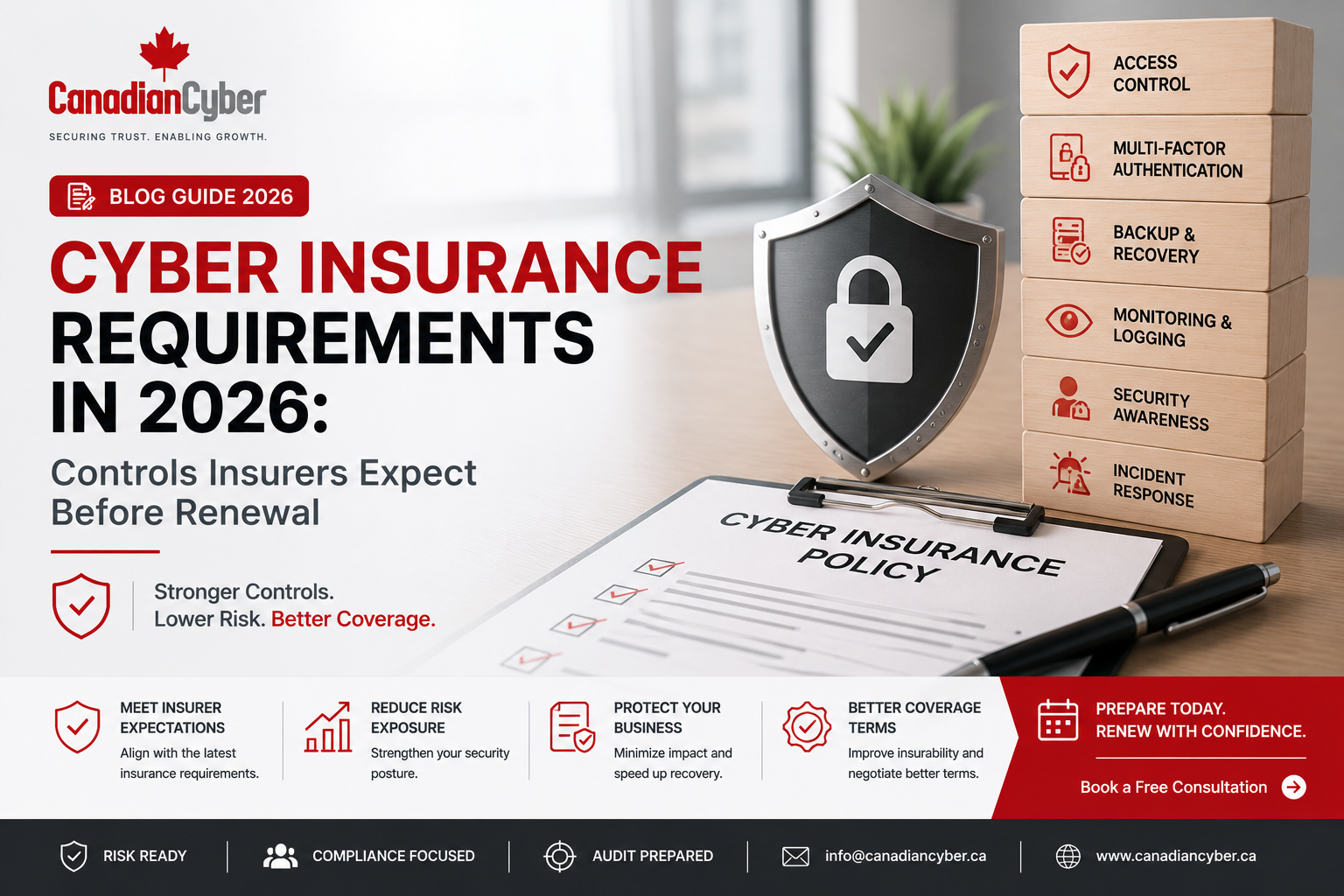
Cyber Insurance Requirements in 2026: Controls Insurers Expect Before Renewal
Cyber insurance renewal is no longer a simple formality. Insurers now want clearer evidence that cybersecurity controls are implemented, reviewed, tested, and documented before renewal.
Canadian Cyber Cyber Insurance Readiness Support
Prepare Your Controls Before the Renewal Questionnaire Arrives
Canadian Cyber helps organizations review cyber insurance controls, identify evidence gaps, prepare renewal documentation, run tabletop exercises, strengthen governance, and organize evidence inside Microsoft 365.
Quick Snapshot
| Cyber Insurance Renewal Area | What Insurers Commonly Expect |
|---|---|
| MFA | Multi-factor authentication for email, remote access, privileged accounts, and critical systems. |
| Endpoint Protection | EDR, antivirus, device monitoring, encryption, and endpoint visibility. |
| Backups | Encrypted, protected, tested, and restorable backups. |
| Incident Response | Written incident response plan and tabletop exercise evidence. |
| Patch Management | Process for identifying, prioritizing, and fixing critical vulnerabilities. |
| Evidence | Proof that controls exist, operate, and are reviewed before renewal. |
Quick Answer
Cyber insurance requirements in 2026 usually focus on whether a business can prove that core cybersecurity controls are operating before renewal.
Insurers commonly ask about MFA, endpoint detection and response, backups, incident response, patching, email security, access management, employee training, vendor risk, and recovery readiness.
Practical takeaway: Companies that cannot provide evidence may face renewal delays, higher premiums, exclusions, reduced coverage, or harder underwriting questions.
Cyber Insurance Renewal Has Changed
Cyber insurance renewal is no longer a simple formality. Insurers are asking harder questions. Underwriters want clearer evidence. Businesses are being asked to prove that cybersecurity controls are not only written in policies, but actually implemented, reviewed, tested, and documented.
For CEOs, founders, IT managers, compliance leaders, and security teams, the renewal conversation has changed.
The question is no longer only: “Do we have cyber insurance?”
The better question is: “Can we prove we have the controls insurers expect before renewal?”
In 2026, common renewal expectations include MFA, endpoint protection, backups, incident response planning, security awareness training, patch management, email security, vendor risk management, privileged access controls, and evidence of ongoing governance.
Who This Guide Is For
- SaaS companies renewing cyber insurance.
- SMBs applying for cyber liability coverage.
- MSPs supporting client renewals.
- Healthcare and HealthTech companies handling sensitive data.
- Fintech and accounting firms managing financial records.
- Law firms protecting confidential client matters.
- Manufacturing firms concerned about ransomware and downtime.
- Executives, IT managers, compliance leads, and security teams preparing insurance questionnaires.
Why Cyber Insurance Requirements Matter Now
Cyber insurance is becoming more evidence-driven. In earlier years, some organizations could complete a short questionnaire and receive a quote. That is no longer the normal experience for many businesses.
Insurers increasingly want to know:
Are backups tested?
Can the company recover from ransomware?
Are endpoints monitored?
Are critical vulnerabilities patched quickly?
Has the incident response plan been tested?
Are privileged accounts reviewed?
Can the company prove its answers?
Practical rule: Cyber insurance renewal is now a cybersecurity evidence review, not just an insurance transaction.
What Insurers Commonly Expect Before Renewal
Every insurer, broker, policy, industry, and company profile is different. Requirements can vary based on company size, revenue, industry, data sensitivity, claims history, risk exposure, and coverage limits.
However, several controls appear repeatedly in cyber insurance renewal conversations.
1. Multi-Factor Authentication
MFA is one of the most common baseline expectations. Insurers may ask whether MFA is enforced for email, VPN, cloud admin consoles, privileged accounts, financial systems, remote desktop access, SaaS applications, backup administration, and identity provider accounts.
| MFA Evidence to Prepare | Why It Matters |
|---|---|
| MFA policy | Shows formal requirement. |
| Identity provider screenshot | Shows enforcement configuration. |
| MFA coverage report | Shows adoption and gaps. |
| Admin MFA evidence | Shows privileged access protection. |
| Exception list | Shows known limitations and risk decisions. |
Practical rule: Do not answer “yes” to MFA unless you know where it is enforced and where exceptions exist.
2. Endpoint Detection and Response
Insurers want confidence that laptops, servers, and endpoints are protected. Endpoint detection and response helps detect suspicious behavior, malware, ransomware activity, and endpoint compromise.
Endpoint evidence to prepare:
- device inventory
- endpoint protection coverage report
- EDR deployment status
- device encryption evidence
- patch compliance report
- endpoint alert review evidence
- offboarding device wipe evidence
3. Backup and Recovery Controls
Backups are central to ransomware resilience. Insurers often want to know whether backups are protected, encrypted, tested, and restorable. A backup that has never been tested may not satisfy renewal expectations.
| Backup Question | Evidence to Prepare |
|---|---|
| Are critical systems backed up? | Backup scope and backup policy. |
| Are backups encrypted? | Backup encryption evidence. |
| Are backups protected from deletion? | Retention and access settings. |
| When was the last restore test? | Restore test report. |
| Are backup failures monitored? | Backup failure alert evidence. |
Practical rule: Backups reduce insurance risk only if the organization can actually restore from them.
4. Incident Response Planning
A written incident response plan is important. But many insurers and buyers also expect evidence that the plan has been tested.
Incident response evidence may include:
- incident response plan
- roles and responsibilities
- escalation matrix
- cyber insurance notification process
- ransomware response procedure
- tabletop exercise agenda and attendance record
- lessons learned
- corrective action tracker
Need Senior Advisory Support Before Renewal?
Canadian Cyber helps organizations prepare for cyber insurance renewal by reviewing cybersecurity controls, identifying gaps, organizing evidence, and building practical remediation plans.
5. Patch and Vulnerability Management
Unpatched systems are a common cause of incidents. Insurers may ask how quickly critical vulnerabilities are identified, prioritized, and fixed.
Patch management evidence may include:
- patch management policy
- vulnerability scan report
- critical vulnerability remediation tracker
- patch exceptions
- system owner assignments
- evidence of resolved findings
6. Email Security and Phishing Controls
Email remains a major attack path. Insurers may ask about phishing protection, domain security, employee awareness, and business email compromise prevention.
| Email Security Control | Evidence to Prepare |
|---|---|
| SPF, DKIM, and DMARC | Domain authentication records. |
| Anti-phishing protection | Email security configuration screenshots. |
| Security awareness training | Training completion reports. |
| Business email compromise controls | Payment verification procedure and escalation process. |
7. Security Awareness Training
Insurers often expect employees to receive cybersecurity training. Training helps reduce phishing, credential theft, unsafe AI use, data handling mistakes, and reporting delays.
Training evidence should show:
- who completed the training
- when training was completed
- what topics were covered
- whether new hires are trained
- how overdue training is followed up
8. Privileged Access Management
Privileged accounts create high risk. Insurers may ask whether admin accounts are limited, reviewed, protected by MFA, and removed quickly when no longer needed.
Privileged access evidence may include:
- admin account inventory
- privileged access review
- least privilege policy
- break-glass account procedure
- admin MFA report
- offboarding evidence
9. Access Reviews and Offboarding
Insurers may ask how user access is managed. This includes joiners, movers, leavers, contractors, vendors, and privileged users.
Access review evidence may include:
- user access review
- system owner sign-off
- terminated user removal evidence
- contractor access review
- SaaS application access review
- exceptions and remediation records
10. Vendor and Cloud Risk Management
Many businesses rely on cloud providers, SaaS platforms, MSPs, payment processors, AI tools, backup vendors, and support platforms. Insurers may ask how critical vendors are reviewed.
| Vendor Evidence | Purpose |
|---|---|
| Vendor register | Shows critical suppliers and ownership. |
| Data processed by vendor | Defines exposure and sensitivity. |
| SOC 2 or ISO report | Supports vendor assurance. |
| Risk rating | Shows vendor risk prioritization. |
| Review date and next review date | Shows ongoing governance. |
11. Logging, Monitoring, and Alert Response
Insurers may ask how the organization detects suspicious activity. Monitoring should show that alerts are reviewed and escalated, not only collected.
Monitoring evidence may include:
- alert configuration
- security monitoring procedure
- log retention settings
- sample alert review
- incident tickets
- monthly security review notes
12. Cyber Governance and Evidence Management
Cyber insurance renewal is easier when evidence is already organized. Companies often struggle because controls may exist, but proof is scattered across email, screenshots, spreadsheets, Teams chats, personal folders, vendor portals, ticketing systems, cloud consoles, HR systems, and backup tools.
Practical rule: The fastest renewal response comes from companies that can produce evidence without a last-minute search.
Cyber Insurance Controls Table for 2026 Renewals
| Control Area | Insurer Concern | Evidence to Prepare |
|---|---|---|
| MFA | Account takeover and remote access risk. | MFA reports, conditional access settings. |
| EDR | Endpoint compromise and ransomware. | EDR coverage report, alert review. |
| Backups | Ransomware recovery. | Backup reports, restore test evidence. |
| Incident Response | Response readiness. | IR plan, tabletop report. |
| Patch Management | Exploited vulnerabilities. | Scan reports, remediation tracker. |
| Vendor Risk | Third-party exposure. | Vendor register, SOC 2 reports. |
| Governance | Control accountability. | Risk register, dashboard, owner matrix. |
Practical Checklist: Prepare Before Cyber Insurance Renewal
Use this checklist 60–90 days before renewal.
| Action Item | Done? |
|---|---|
| Confirm MFA is enforced for email, remote access, admin accounts, and critical systems. | |
| Export endpoint protection or EDR coverage reports. | |
| Review backup reports and complete a restore test. | |
| Update the incident response plan. | |
| Run a tabletop exercise and document lessons learned. | |
| Review critical vulnerabilities and patch status. | |
| Confirm email security controls such as SPF, DKIM, and DMARC. | |
| Complete security awareness training records. | |
| Review privileged and standard user access. | |
| Update the vendor register and critical supplier reviews. | |
| Collect monitoring and alert review evidence. | |
| Store all renewal evidence in a central workspace. |
Common Mistakes to Avoid
- Waiting until the renewal form arrives. By then, there may not be enough time to fix control gaps.
- Answering “yes” without evidence. Every answer should be backed by proof.
- Assuming IT knows everything. Renewal may require input from IT, security, HR, legal, finance, operations, vendors, and leadership.
- Ignoring restore testing. Backup reports are useful, but restore testing proves recovery readiness.
- No incident response tabletop. A plan that has never been tested is weaker than a plan supported by tabletop evidence.
- Weak access review evidence. Former employees, contractors, vendors, and unnecessary admin accounts create underwriting concerns.
- No vendor risk documentation. Critical vendors can affect your security and recovery posture.
- Scattered evidence. If evidence is scattered, renewal becomes stressful and slow.
How Canadian Cyber Helps
Canadian Cyber helps organizations move from uncertain cyber insurance renewal preparation to structured security evidence and stronger control readiness.
We help organizations understand what controls may be expected, what evidence is missing, what remediation is needed, and how to organize renewal documentation.
Canadian Cyber can support:
SharePoint Cyber Insurance Evidence Workspace
Canadian Cyber’s ISMS SharePoint Solution can help organize MFA evidence, EDR reports, backup and restore test evidence, incident response records, tabletop exercise evidence, access reviews, vendor reviews, patch remediation trackers, security training records, email security evidence, risk registers, corrective action trackers, and management review dashboards.
This helps leadership, IT, security, compliance, and insurance stakeholders work from one structured evidence system.
Frequently Asked Questions
What are the main cyber insurance requirements in 2026?
Common requirements include MFA, endpoint protection or EDR, tested backups, incident response planning, patch management, email security, security awareness training, access reviews, privileged access controls, vendor risk management, and evidence of monitoring.
Can cyber insurance be denied if controls are missing?
Yes, depending on the insurer and risk profile. Missing or weak controls can lead to denial, higher premiums, exclusions, reduced limits, higher deductibles, or additional underwriting questions.
How early should we prepare for cyber insurance renewal?
Organizations should start preparing at least 60–90 days before renewal. More time may be needed if MFA, EDR, backups, access reviews, incident response, or vendor evidence is incomplete.
Do insurers require incident response tabletop exercises?
Not every insurer requires tabletop evidence, but tabletop exercises are increasingly useful because they show that the organization has tested its incident response process.
Do backups need to be tested for cyber insurance?
Insurers often ask whether backups are tested. A restore test provides stronger evidence than simply stating that backups exist.
Can Canadian Cyber help prepare our cyber insurance renewal evidence?
Yes. Canadian Cyber can review current controls, identify renewal gaps, support remediation planning, run tabletop exercises, and organize evidence in a SharePoint-based ISMS workspace.
Takeaway
Cyber insurance requirements in 2026 are becoming more evidence-based. Insurers commonly expect organizations to prove core cybersecurity controls such as MFA, EDR, backups, incident response, patching, email security, training, access reviews, privileged access control, vendor risk management, and monitoring.
The companies that prepare early have a better renewal experience. They know their gaps, collect evidence, test recovery, assign owners, document decisions, and build confidence before the insurer asks.
Cyber insurance renewal should not be a scramble. It should be part of your cybersecurity governance cycle.
Cyber Insurance Renewal Coming Up?
Canadian Cyber can help you review current controls, identify gaps, support remediation, run an incident response tabletop, organize evidence, and help leadership understand what needs attention before renewal.
Stay Connected With Canadian Cyber
Follow Canadian Cyber for practical guidance on cyber insurance renewal, cybersecurity assessments, vCISO services, ISO 27001, SOC 2, ISO 42001, ISO 27017, ISO 27018, incident response, SharePoint ISMS, and audit evidence.