SOC 2
HealthTech
Internal Audit
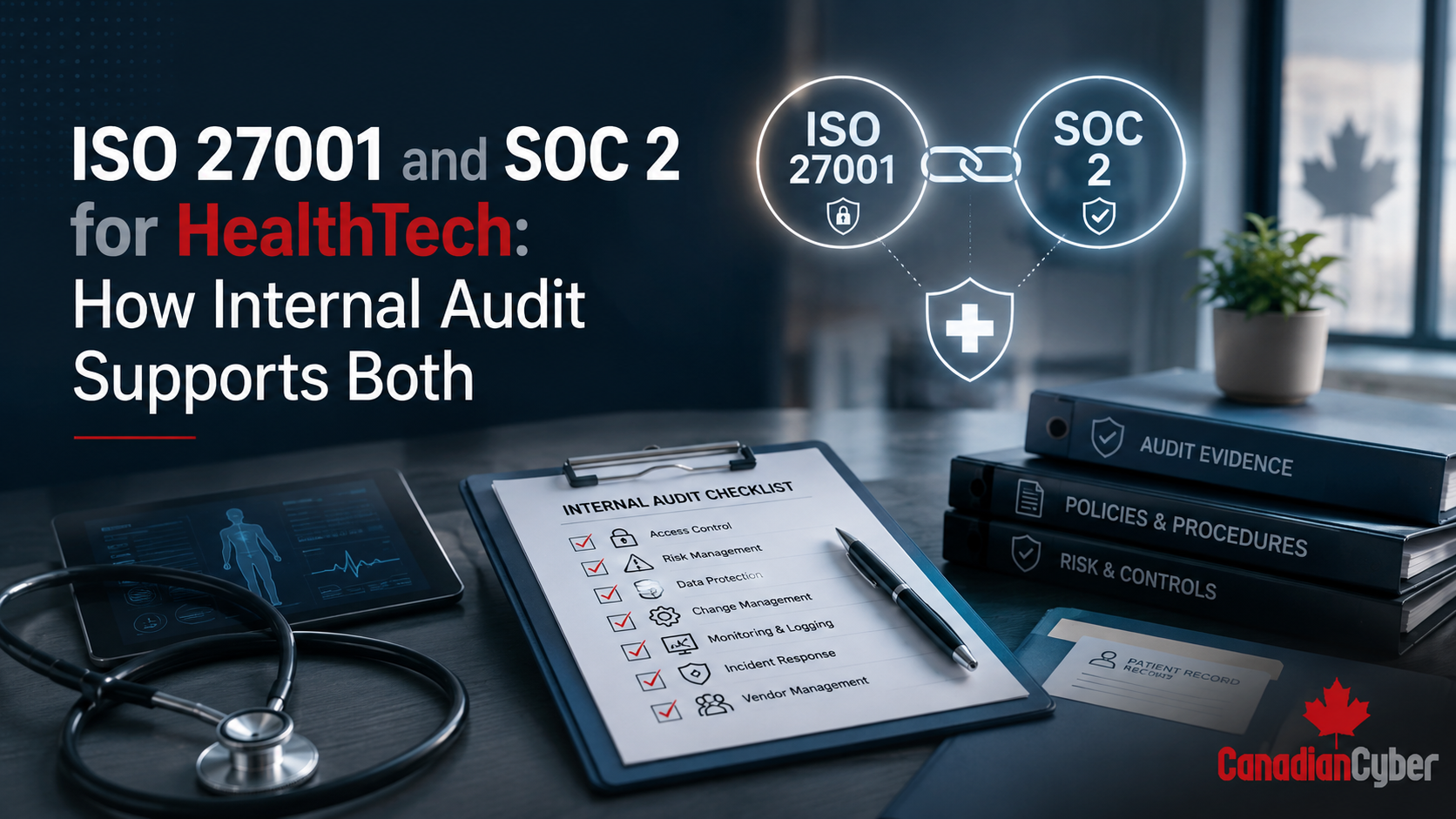
ISO 27001 and SOC 2 for HealthTech: How Internal Audit Supports Both
HealthTech companies do not need two disconnected audit programs. A strong internal audit can support ISO 27001, SOC 2, hospital security reviews, and client trust at the same time.
Quick Answer
How can internal audit support ISO 27001 and SOC 2 for HealthTech?
Internal audit supports both ISO 27001 and SOC 2 by testing shared control areas.
These areas include access control, risk management, vendor reviews, cloud security, incident response, backup and recovery, logging, change management, AI governance, support ticket handling, and corrective actions.
Bottom line: one mapped evidence program can support ISO 27001 readiness, SOC 2 readiness, hospital reviews, client questionnaires, and leadership reporting.
Canadian Cyber HealthTech Audit Support
Build One Internal Audit Program for Both Frameworks
Canadian Cyber helps HealthTech companies align ISO 27001 and SOC 2 evidence without duplicating audit work.
We review patient data flows, cloud systems, vendors, AI tools, support workflows, access reviews, internal audit findings, corrective actions, and SharePoint evidence rooms.
Quick Snapshot
| Internal Audit Area | Supports ISO 27001 | Supports SOC 2 |
|---|---|---|
| Risk Register | Shows ISMS risk assessment and treatment. | Supports control design and risk context. |
| Access Reviews | Supports access control and least privilege. | Supports logical access evidence. |
| Vendor Reviews | Supports supplier relationship controls. | Supports third-party control evidence. |
| Cloud Security | Supports asset, access, logging, backup, and configuration controls. | Supports security and availability evidence. |
| AI Governance | Supports risk, supplier, access, and data protection controls. | Supports security, privacy, confidentiality, and processing integrity considerations. |
| Corrective Actions | Supports continual improvement. | Supports remediation and control improvement. |
Why HealthTech Companies Are Asked for Both
HealthTech companies are often asked for both ISO 27001 and SOC 2.
A hospital may ask for ISO 27001. An enterprise buyer may ask for SOC 2. A partner may ask for both.
A cyber insurance provider may ask for control evidence. A client security review may ask for policies, access reviews, vendor risk, incident response, and cloud security records.
At first, this can feel like two separate compliance projects. In practice, the control areas overlap heavily.
The goal is not to duplicate work. The goal is to build one strong internal audit program that supports both frameworks.
Who This Blog Is For
- HealthTech companies and Healthcare SaaS providers.
- Digital health platforms, telehealth providers, and patient portal providers.
- Clinical workflow software vendors and AI health platforms.
- Medical billing SaaS companies and healthcare analytics platforms.
- Security managers, privacy officers, IT managers, founders, compliance teams, internal auditors, and vCISO teams.
- Organizations trying to reduce duplicate ISO 27001 and SOC 2 audit work.
Practical rule: HealthTech companies should not treat ISO 27001 and SOC 2 as two unrelated efforts. They should build one evidence-driven security program that supports both.
The Main Internal Audit Question
The strongest question is not this:
“Are we doing ISO 27001 or SOC 2?”
The stronger question is this:
“Can we prove that our HealthTech controls are designed, operating, reviewed, and improving?”
How Internal Audit Supports ISO 27001
ISO 27001 internal audit reviews whether the ISMS is working.
It looks at governance, risk, policies, controls, evidence, nonconformities, corrective actions, and management review.
Internal Audit Should Test
- ISMS scope.
- Risk assessment and risk treatment.
- Statement of Applicability.
- Policy approval.
- Access control and supplier risk.
- Incident response.
- Cloud controls and backups.
- Corrective actions and management review.
HealthTech Focus
- Patient data inventory.
- Clinical data workflows.
- Support ticket handling.
- PHI-related evidence.
- AI tool governance.
- Vendor access to patient systems.
- API and integration security.
- Restore testing for patient data systems.
How Internal Audit Supports SOC 2
SOC 2 readiness depends on control design and operating evidence.
For HealthTech companies, SOC 2 often connects to patient data protection, platform uptime, secure processing, restricted access, and privacy-related evidence.
Internal Audit Should Test
- Security governance.
- Logical access.
- MFA and identity controls.
- Privileged access.
- Change management.
- Vendor management.
- Logging and monitoring.
- Backup, recovery, and continuity.
HealthTech Focus
- Client data boundaries.
- Support access controls.
- Patient portal controls.
- Cloud infrastructure evidence.
- Vendor and subprocessor reviews.
- AI feature controls.
- Data retention evidence.
- Control owner accountability.
Where ISO 27001 and SOC 2 Overlap
Many control areas support both frameworks.
This is where HealthTech companies can save time.
Strong Overlap Areas
Example: one quarterly access review can support ISO 27001 access control evidence, SOC 2 logical access evidence, hospital review responses, client questionnaire answers, and internal risk treatment evidence.
Internal Audit Area 1: Scope and System Boundaries
HealthTech companies must define what is being audited.
This helps align the ISO 27001 ISMS scope with the SOC 2 system boundary.
Internal Audit Questions
- What HealthTech platform is in scope?
- Which cloud systems are included?
- Which patient portals are included?
- Which APIs and databases are included?
- Which AI tools and vendors are included?
- Does the ISO 27001 scope match the SOC 2 boundary?
Evidence to Review
- ISMS scope statement.
- SOC 2 system description draft.
- Architecture diagram.
- Data flow diagram.
- Asset, SaaS, and vendor inventory.
- Support workflow map.
Internal Audit Area 2: Patient Data and Clinical Data Mapping
Patient data is central to HealthTech security.
Internal audit should confirm where patient data lives, where it flows, and which systems or vendors touch it.
| Audit Question | Evidence to Review |
|---|---|
| What patient data is collected? | Patient data inventory and clinical data inventory. |
| Which APIs process patient data? | API inventory and data flow diagram. |
| Which vendors process patient data? | Vendor register and subprocessor list. |
| Which AI tools may touch patient data? | AI tool inventory and AI use case register. |
Need to Map ISO 27001 and SOC 2 Evidence?
Canadian Cyber helps HealthTech companies build one evidence map for ISO 27001, SOC 2, hospital security reviews, and client questionnaires.
For senior advisory support, view Waqar Mehboob’s profile.
Internal Audit Area 3: Access Control
Access control is one of the strongest overlap areas between ISO 27001 and SOC 2.
Internal audit should prove that access was reviewed, exceptions were resolved, and removals were completed.
Evidence to Review
Internal Audit Area 4: Privileged Access
Privileged access should be reviewed separately.
The risk is higher because administrators may change settings, export data, access backups, modify logs, or control cloud systems.
| Privileged Area | Evidence to Review |
|---|---|
| Cloud admin access | Cloud admin list and privileged access review. |
| Database admin access | Database admin list and admin MFA evidence. |
| Service accounts | Service account register and review record. |
| Break-glass accounts | Break-glass procedure and monitoring evidence. |
Internal Audit Area 5: Vendor and Subprocessor Risk
HealthTech companies depend on vendors.
Cloud providers, ticketing tools, AI platforms, analytics systems, MSPs, backup providers, and contractors may all support the product.
Vendor Evidence to Review
Internal Audit Area 6: Cloud Security
Cloud evidence is central for HealthTech vendors.
Internal audit should show configuration, access, logging, backup, vendor, and ownership controls.
| Cloud Audit Question | Evidence to Review |
|---|---|
| Which cloud platforms host the product? | Cloud architecture diagram and cloud inventory. |
| Who has cloud admin access? | Cloud access review and admin role export. |
| Are logs enabled? | Logging configuration and log source inventory. |
| Are backups configured? | Backup configuration and backup scope list. |
Internal Audit Area 7: Incident Response
Incident response supports both ISO 27001 and SOC 2.
For HealthTech, it should include patient data scenarios, vendor incidents, cloud issues, API compromise, and AI misuse.
Evidence to Review
Internal Audit Area 8: Backup, Recovery, and Availability
HealthTech vendors must prove recovery readiness.
Backup dashboards are not enough. Restore tests prove the business can recover.
| Recovery Question | Evidence to Review |
|---|---|
| Which systems are backed up? | Backup scope list and backup policy. |
| Are patient data systems included? | Backup reports and system inventory. |
| Are restore tests performed? | Restore test reports and RTO/RPO records. |
| Are failures reviewed? | Backup failure tickets and corrective actions. |
Internal Audit Area 9: Logging and Monitoring
Logs are important for detection, investigation, and accountability.
Log collection is not enough. Internal audit should test whether logs are reviewed and acted on.
Evidence to Review
Internal Audit Area 10: Change Management and Secure Development
HealthTech products change constantly.
Internal audit should confirm that speed does not bypass security review.
| Change Question | Evidence to Review |
|---|---|
| Are product changes approved? | Change tickets and release approvals. |
| Are code reviews performed? | Code review records and security test records. |
| Are vulnerabilities tracked? | Vulnerability tracker and corrective actions. |
| Are AI coding tools approved? | AI coding tool assessment and developer guidance. |
Internal Audit Area 11: AI Governance
AI tools are increasingly common in HealthTech.
Internal audit should review AI tools through both security and service trust lenses.
AI Governance Evidence
Internal Audit Area 12: Corrective Actions
Both ISO 27001 and SOC 2 benefit from strong remediation tracking.
A finding should not be closed until evidence is reviewed and verified.
| Corrective Action Question | Evidence to Review |
|---|---|
| Are findings documented? | Internal audit findings and SOC 2 readiness gaps. |
| Is root cause identified? | Root cause records and corrective action plan. |
| Is closure evidence required? | Closure evidence and verification notes. |
| Are repeat findings reviewed? | Risk register updates and management review summary. |
ISO 27001 and SOC 2 Evidence Mapping Example
| Evidence Item | ISO 27001 Use | SOC 2 Use |
|---|---|---|
| Risk register | ISMS risk assessment and treatment. | Control risk context. |
| Access review | Access control evidence. | Logical access evidence. |
| Vendor review | Supplier relationship evidence. | Vendor and subservice organization evidence. |
| Restore test | Backup and continuity evidence. | Availability evidence. |
| AI vendor review | Supplier and risk evidence. | Privacy, confidentiality, and security evidence. |
| Corrective action tracker | Continual improvement. | Control remediation evidence. |
Common Internal Audit Findings
Teams collect the same evidence twice because there is no mapping.
The ISO 27001 ISMS scope and SOC 2 system boundary do not match clearly.
Access exports exist, but reviewer decisions and removals are not documented.
Vendor reports are collected, but review notes and follow-up actions are missing.
AI tools are used in workflows but are not included in evidence mapping.
Findings are marked closed without evidence or review.
Practical Checklist: One Internal Audit Program for Both
| Checklist Item | Ready? |
|---|---|
| Define ISO 27001 scope and SOC 2 system boundary. | |
| Map patient data flows. | |
| Identify shared control areas. | |
| Build one evidence register. | |
| Map evidence to ISO 27001 controls. | |
| Map evidence to SOC 2 criteria. | |
| Review access and privileged access evidence. | |
| Review vendor and subprocessor evidence. | |
| Review cloud security evidence. | |
| Review backup and restore evidence. | |
| Review log monitoring evidence. | |
| Review AI governance evidence. | |
| Track findings in one corrective action tracker. | |
| Prepare management review reporting. |
How SharePoint Can Help Manage Both ISO 27001 and SOC 2 Evidence
A SharePoint ISMS workspace can help HealthTech companies manage evidence for both frameworks.
The strongest evidence workspace lets teams filter by framework, control, owner, risk, evidence period, and client-ready status.
SharePoint Can Track
- ISO 27001 evidence.
- SOC 2 evidence.
- Control mapping.
- Risk register and SoA.
- Access and vendor reviews.
- AI governance records.
- Corrective actions.
- Client-ready evidence packs.
Suggested SharePoint Views
- ISO 27001 Evidence.
- SOC 2 Evidence.
- Evidence Supporting Both.
- Patient Data Evidence.
- Vendor Evidence.
- AI Governance Evidence.
- Corrective Actions Pending Verification.
- Management Dashboard.
How Canadian Cyber Helps
Canadian Cyber helps HealthTech companies use internal audit to support both ISO 27001 and SOC 2 readiness.
We help reduce duplicate work, improve evidence quality, and prepare teams for certification audits, SOC 2 readiness, and hospital security reviews.
Frequently Asked Questions
Can one internal audit support both ISO 27001 and SOC 2?
Yes. One internal audit program can support both when control areas and evidence are mapped properly. The same evidence can often support access control, vendor risk, incident response, backup, logging, change management, and risk management across both frameworks.
Is ISO 27001 the same as SOC 2?
No. ISO 27001 is an international management system standard for information security. SOC 2 is an assurance report for service organizations based on Trust Services Criteria. They are different, but many control areas overlap.
Which should HealthTech companies do first?
It depends on client demand, sales requirements, certification goals, and current maturity. Many HealthTech companies start by building shared controls and evidence first, then prepare for ISO 27001 certification and SOC 2 readiness in parallel.
What evidence overlaps between ISO 27001 and SOC 2?
Common overlapping evidence includes access reviews, vendor reviews, incident response records, backup and restore tests, log review records, risk register updates, change tickets, security training, policies, and corrective actions.
Should AI governance be included?
Yes. AI tools should be included when they affect patient data, clinical workflows, support tickets, admin workflows, product features, or client data.
Can SharePoint manage evidence for both frameworks?
Yes. SharePoint can manage ISO 27001 and SOC 2 evidence with libraries, lists, metadata, owners, due dates, mappings, dashboards, and client-ready evidence views.
Can Canadian Cyber help with both ISO 27001 and SOC 2?
Yes. Canadian Cyber helps HealthTech companies with ISO 27001 internal audits, SOC 2 readiness, evidence mapping, SharePoint ISMS implementation, AI governance reviews, cloud and vendor control reviews, corrective action tracking, and vCISO support.
Takeaway
HealthTech companies do not need two disconnected audit programs for ISO 27001 and SOC 2.
They need one strong internal control and evidence program.
Internal audit can support both by reviewing patient data flows, access control, privileged access, vendor risk, cloud security, incident response, backup and recovery, logging, change management, secure development, AI governance, risk management, corrective actions, and management reporting.
For HealthTech companies, this is not only compliance efficiency. It is a trust strategy.
Ready to Support ISO 27001 and SOC 2 With One Internal Audit Program?
Canadian Cyber can help your HealthTech company prepare for ISO 27001 and SOC 2 without duplicating audit work.
We provide ISO 27001 internal audits, SOC 2 readiness assessments, HealthTech evidence mapping, patient data reviews, cloud security reviews, vendor access reviews, AI governance reviews, SharePoint ISMS workspaces, corrective action tracking, vCISO services, ISO 42001 readiness, ISO 27017, ISO 27018, and cybersecurity assessments.
Stay Connected With Canadian Cyber
Follow Canadian Cyber for practical guidance on ISO 27001 internal audits, SOC 2 readiness, HealthTech security, patient data protection, AI governance, SharePoint ISMS, cloud security, vendor risk, vCISO services, ISO 42001, ISO 27017, ISO 27018, and certification readiness.