Healthcare
ISO 27001
PHI Evidence
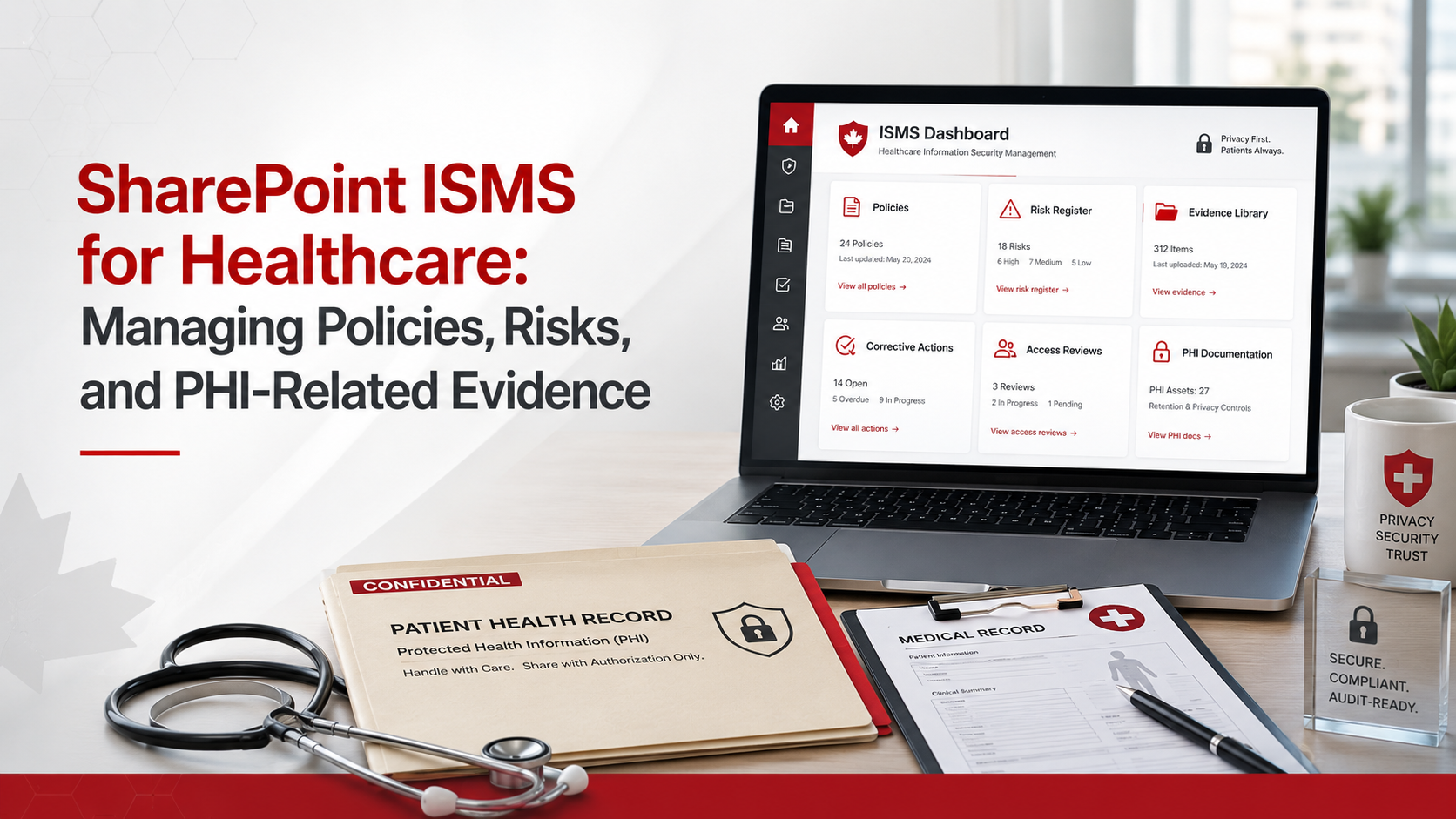
SharePoint ISMS for Healthcare: Managing Policies, Risks, and PHI-Related Evidence
A SharePoint ISMS for healthcare helps teams organize ISO 27001 policies, risks, PHI-related evidence, vendor reviews, AI governance records, and audit readiness in one Microsoft 365 workspace.
Quick Answer
How does a SharePoint ISMS help healthcare organizations?
A SharePoint ISMS helps healthcare and HealthTech organizations manage ISO 27001 internal audit readiness in one controlled workspace.
It can organize policies, procedures, risk registers, PHI evidence, access reviews, vendor records, AI governance records, incident logs, backup evidence, corrective actions, and management review documents.
Bottom line: SharePoint reduces scattered evidence and helps teams prove that PHI-related controls are operating in practice.
Canadian Cyber SharePoint ISMS Support
Build a Healthcare ISMS Inside Microsoft 365
Canadian Cyber helps healthcare and HealthTech organizations build SharePoint ISMS workspaces for ISO 27001 readiness.
We organize policies, PHI evidence, risk registers, vendor reviews, AI governance, corrective actions, dashboards, and client-ready evidence rooms.
Quick Snapshot
| SharePoint ISMS Area | Healthcare Use |
|---|---|
| Policy Library | Store approved security, privacy, AI, access, vendor, and incident policies. |
| PHI Evidence Library | Manage patient data handling, access, cloud app, support ticket, and backup evidence. |
| Risk Register | Track PHI, cloud, vendor, AI, access, and operational risks. |
| Vendor Register | Track vendors, PHI access, DPAs, contracts, subprocessors, and reviews. |
| AI Governance Register | Track AI tools, approved use cases, AI vendors, PHI restrictions, and human oversight. |
| Dashboard | Give leadership visibility into risks, findings, overdue tasks, and audit readiness. |
Why Healthcare Security Evidence Gets Messy
Healthcare security evidence gets messy quickly.
Policies may sit in one folder. Risk registers may live in spreadsheets. Vendor reviews may be buried in email.
Access reviews may come from different systems. Backup evidence may stay inside dashboards.
Then the internal audit starts, and the team has to search for everything at once.
For healthcare organizations, the problem is often not only security control design. The bigger problem is evidence management.
Who This Blog Is For
- Healthcare providers, clinic networks, and telehealth providers.
- HealthTech companies and Healthcare SaaS platforms.
- Patient portal providers, medical billing platforms, and clinical workflow platforms.
- AI health platforms and healthcare MSPs.
- Privacy officers, security managers, IT managers, ISMS managers, internal auditors, and vCISO teams.
- Organizations using Microsoft 365 and SharePoint for compliance evidence.
Why SharePoint Works Well for Healthcare ISMS Management
Many healthcare and HealthTech organizations already use Microsoft 365.
That makes SharePoint a practical place to manage ISO 27001 evidence.
SharePoint can support document control, metadata, version history, access permissions, approvals, reminders, and dashboards.
SharePoint Can Help Manage
Practical rule: SharePoint should not be used as a basic folder dump. It should be designed as a structured ISMS with lists, libraries, metadata, workflows, permissions, and dashboards.
Healthcare Privacy and PHI Context
Healthcare organizations must manage personal health information carefully.
Depending on the location, customer base, and service model, privacy and healthcare data obligations may apply.
A SharePoint ISMS should help teams prove that PHI-related controls are documented, assigned, reviewed, and supported by evidence.
The workspace should separate sensitive internal evidence from client-ready evidence that can safely support hospital or customer security reviews.
Component 1: Policy and Procedure Library
The policy library is the foundation of the ISMS.
Healthcare organizations need policies that are approved, current, reviewed, and easy to find.
Policies to Store
- Information security policy.
- Data classification policy.
- PHI handling policy.
- Access control policy.
- Vendor risk management policy.
- Incident response policy.
- AI acceptable use policy.
- Corrective action procedure.
Metadata to Add
- Policy owner.
- Approver.
- Version number.
- Approval date.
- Next review date.
- Related ISO 27001 control.
- Related risk.
- Status.
Component 2: PHI Evidence Library
Healthcare ISMS evidence should include more than generic security screenshots.
It should show how PHI-related controls operate.
PHI Evidence to Store
Need a SharePoint ISMS for Healthcare Evidence?
Canadian Cyber can help organize policies, risks, PHI-related evidence, access reviews, vendor records, AI governance evidence, corrective actions, and management dashboards.
For senior advisory support, view Waqar Mehboob’s profile.
Component 3: Healthcare Risk Register
A healthcare risk register should reflect real healthcare operations.
It should not only list generic cybersecurity risks.
Healthcare Risks to Track
- Unauthorized PHI access.
- Patient portal compromise.
- Vendor access misuse.
- AI tool PHI exposure.
- PHI in support tickets.
- Backup restore failure.
- Developer production access.
- API key exposure.
Risk Register Fields
- Risk ID and title.
- Asset or system.
- PHI involved.
- Risk owner.
- Likelihood and impact.
- Current controls.
- Treatment plan.
- Linked evidence.
Component 4: Statement of Applicability Tracker
The Statement of Applicability is a key ISO 27001 document.
For healthcare, it should connect Annex A controls to healthcare risks, PHI evidence, and control ownership.
| Control Area | Healthcare Evidence |
|---|---|
| Access Control | PHI system access review, MFA evidence, and offboarding records. |
| Supplier Relationships | PHI vendor assessment, DPA, and subprocessor review. |
| Incident Management | PHI incident procedure, tabletop report, and lessons learned. |
| Backup | Backup reports, restore test results, and backup scope list. |
| AI Governance | Approved AI tool list, AI vendor review, and PHI restrictions. |
Component 5: Vendor and PHI Access Register
Healthcare vendor evidence is one of the most important audit areas.
Vendors may host systems, process PHI, provide AI tools, support infrastructure, manage backups, or access applications.
Vendor Register Fields
Component 6: Access Review Tracker
Access reviews are often requested during healthcare internal audits.
SharePoint can help track review cycles, owners, approvals, exceptions, and removal evidence.
| Access Review Category | What to Track |
|---|---|
| PHI system access | Review period, owner, exceptions, removals, and evidence. |
| Privileged admin access | Admin roles, business need, MFA status, and approvals. |
| Vendor access | Vendor user list, access level, review decision, and removal proof. |
| Developer production access | Production permissions, approval, exceptions, and review notes. |
Practical rule: a user export is not enough. SharePoint should show review decision, evidence, exception, and closure.
Component 7: AI Governance Register
Healthcare organizations are increasingly using AI tools.
AI may support documentation, AI scribes, meeting summaries, ticket summaries, patient communication drafts, analytics, or clinical workflow support.
AI Governance Fields
Component 8: Internal Audit Tracker
The internal audit tracker helps organize audit scope, evidence requests, findings, owners, and status.
It also helps teams see what was tested, what was found, who owns it, and how it will be fixed.
Healthcare Audit Areas to Include
Component 9: Corrective Action Tracker
Findings should move from audit result to verified closure.
A corrective action tracker helps prevent findings from staying open.
| Corrective Action Field | Purpose |
|---|---|
| Root cause | Shows why the finding happened. |
| Corrective action plan | Explains what will change. |
| Evidence required | Defines what “done” means. |
| Verification owner | Confirms closure before the finding is marked closed. |
| Linked risk | Connects the finding to risk treatment. |
Component 10: Management Review Dashboard
Leadership needs visibility.
A SharePoint dashboard can help executives see risk, audit readiness, findings, overdue evidence, and corrective action progress.
Dashboard Items
Recommended SharePoint ISMS Structure for Healthcare
Libraries
- Policies and Procedures.
- Published Documents.
- PHI Evidence.
- Access Review Evidence.
- Vendor Evidence.
- AI Governance Evidence.
- Internal Audit Evidence.
- Client-Ready Evidence Room.
Lists
- Risk Register.
- Statement of Applicability.
- Vendor Register.
- AI Tool Register.
- Access Review Tracker.
- Internal Audit Tracker.
- Corrective Action Tracker.
- Evidence Task Register.
Practical rule: libraries store documents. Lists manage status, owners, dates, workflows, and audit relationships.
Evidence Metadata Model
Metadata is what makes SharePoint useful for audit readiness.
Without metadata, SharePoint becomes another folder system.
Suggested Metadata
Common SharePoint ISMS Mistakes in Healthcare
Folders alone do not create audit readiness.
Evidence becomes outdated when no one owns it.
Audit evidence may contain patient data but is not labeled or restricted properly.
The risk register says a control exists, but evidence is not connected.
AI tools are used, but they are missing from the ISMS.
Internal audit records may contain details that should not be shared externally.
Healthcare SharePoint ISMS Checklist
| Checklist Item | Ready? |
|---|---|
| Policy library has version control. | |
| Published policies are separated from drafts. | |
| PHI evidence library is created. | |
| PHI inventory is maintained. | |
| Risk register includes healthcare-specific risks. | |
| Statement of Applicability links to evidence. | |
| Vendor register tracks PHI access. | |
| Access review tracker includes PHI systems. | |
| AI tool register is maintained. | |
| Corrective actions require closure evidence. | |
| Management review dashboard is maintained. | |
| Client-ready evidence room is separated. |
Common Internal Audit Findings SharePoint Can Help Fix
SharePoint can manage version history, approvals, published documents, and review dates.
A PHI evidence library can centralize data maps, access reviews, vendor records, backups, logs, and incidents.
SharePoint can link risks to controls, policies, evidence, and corrective actions.
A vendor register can track PHI involvement, contract status, DPAs, security reviews, and due dates.
An access review tracker can show review date, owner, exceptions, removals, and evidence.
A corrective action tracker can show owner, due date, evidence required, status, and verification.
How Canadian Cyber Helps
Canadian Cyber helps healthcare and HealthTech organizations build SharePoint ISMS workspaces for ISO 27001 internal audit readiness.
We help organizations move from scattered evidence to structured audit readiness.
Frequently Asked Questions
What is a SharePoint ISMS?
A SharePoint ISMS is an information security management system workspace built inside Microsoft 365. It can manage policies, risks, controls, evidence, corrective actions, internal audits, vendor reviews, and management reporting.
Why is SharePoint useful for healthcare ISO 27001?
SharePoint is useful because healthcare teams need to manage evidence across PHI, cloud apps, vendors, access reviews, AI tools, backups, logs, incidents, and policies.
Can SharePoint manage PHI-related evidence?
Yes. SharePoint can manage PHI-related audit evidence when the workspace is designed with appropriate permissions, classification, retention, access reviews, and governance.
What evidence should healthcare organizations store in SharePoint?
Healthcare organizations can store policies, PHI inventories, data flow diagrams, access reviews, vendor assessments, DPAs, AI governance records, backup reports, restore tests, log review records, incident records, risk registers, SoA records, corrective actions, and management review minutes.
Can SharePoint replace an ISO 27001 consultant?
No. SharePoint is a workspace and evidence management tool. Organizations still need governance, control design, internal audit execution, risk assessment, leadership review, and corrective action management.
Should AI governance be included in a healthcare SharePoint ISMS?
Yes. Healthcare organizations using AI should track approved AI tools, AI vendors, use cases, PHI restrictions, human review requirements, AI risks, training, exceptions, and incidents.
Can Canadian Cyber build a SharePoint ISMS for healthcare?
Yes. Canadian Cyber can design and implement SharePoint ISMS workspaces for healthcare and HealthTech organizations, including policies, risk registers, PHI evidence libraries, vendor trackers, AI governance registers, corrective actions, dashboards, and audit readiness support.
Takeaway
Healthcare ISO 27001 internal audit readiness depends on evidence.
Not scattered evidence.
Structured evidence.
A SharePoint ISMS helps healthcare and HealthTech organizations manage policies, risks, PHI-related evidence, access reviews, vendors, AI governance, cloud evidence, backups, logs, incidents, corrective actions, management review, and client-ready evidence packs.
The goal is not just to store documents. The goal is to prove that the ISMS is working.
Ready to Build a SharePoint ISMS for Healthcare?
Canadian Cyber can help your healthcare or HealthTech organization manage ISO 27001 policies, risks, and PHI-related evidence inside SharePoint.
We provide SharePoint ISMS implementation, healthcare ISO 27001 internal audit readiness, PHI evidence libraries, risk register design, SoA tracking, vendor access trackers, AI governance registers, corrective action dashboards, management review reporting, vCISO services, SOC 2 readiness alignment, ISO 42001 readiness, ISO 27017, ISO 27018, and cybersecurity assessments.
Stay Connected With Canadian Cyber
Follow Canadian Cyber for practical guidance on SharePoint ISMS, ISO 27001 internal audits, healthcare cybersecurity, PHI evidence management, HealthTech security, AI governance, cloud security, vendor access, SOC 2, ISO 42001, vCISO services, and certification readiness.