Internal Audit
Month-End Review
HealthTech Evidence
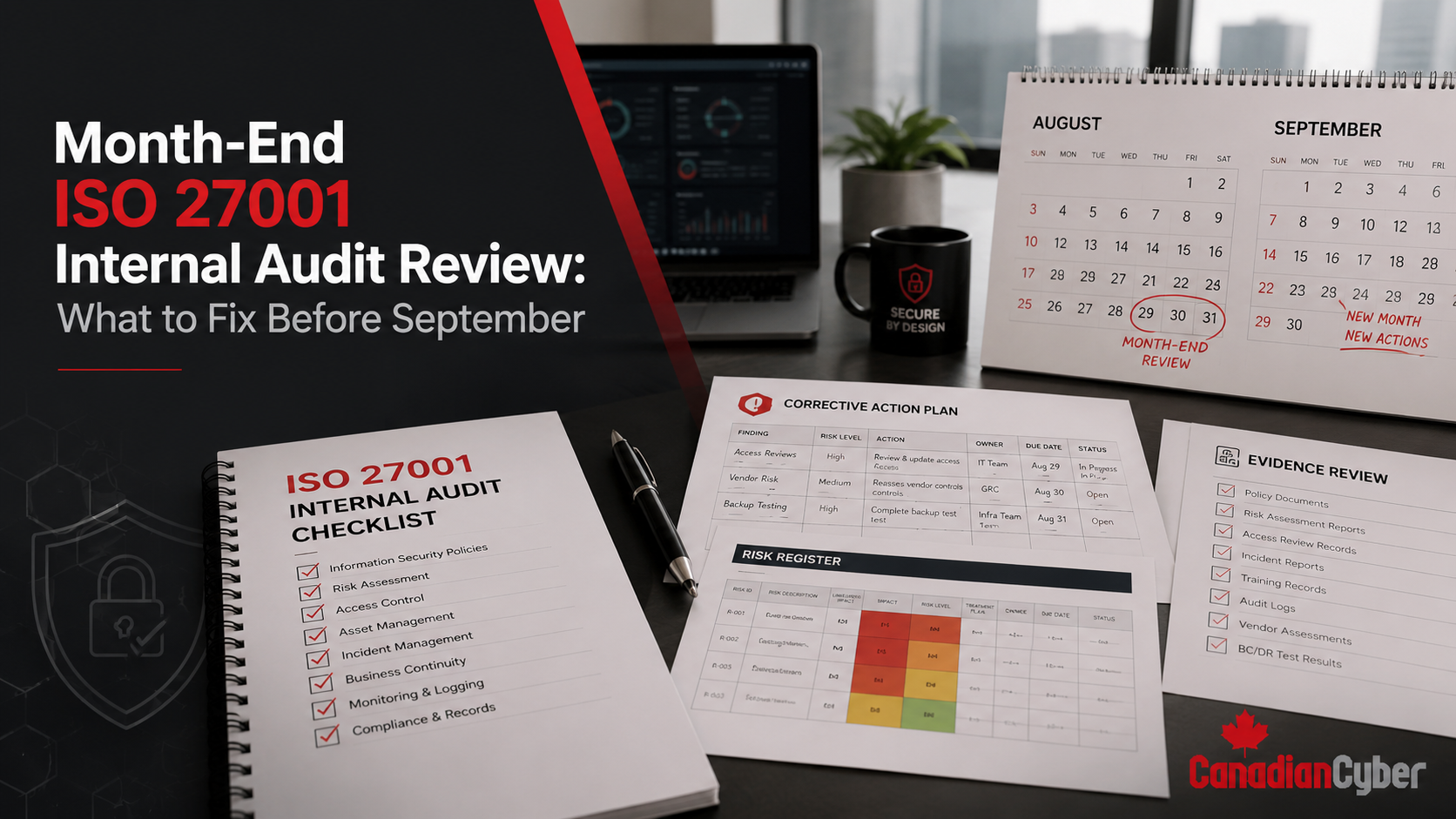
Month-End ISO 27001 Internal Audit Review: What to Fix Before September
A practical month-end ISO 27001 internal audit review checklist for fixing evidence gaps, access reviews, vendor records, PHI evidence, AI governance, and corrective actions before September begins.
Quick Answer
What should a month-end ISO 27001 internal audit review include?
A month-end ISO 27001 internal audit review should focus on evidence gaps before they become audit findings.
Teams should review access control, privileged access, vendor records, risk updates, corrective actions, backup and restore evidence, log reviews, incident records, policy approvals, AI governance, PHI-related evidence, and management review actions.
Bottom line: before September, organizations should close simple gaps, assign owners for unresolved issues, verify evidence, and update dashboards so leadership can see audit readiness clearly.
Canadian Cyber Month-End Audit Support
Clean Up ISO 27001 Evidence Before September
Canadian Cyber helps healthcare, HealthTech, SaaS, MSP, and regulated organizations run month-end ISO 27001 internal audit reviews.
We help clean up evidence gaps, update risk registers, review access, validate vendor evidence, verify corrective actions, and prepare SharePoint ISMS dashboards.
Quick Snapshot
| Month-End Area | What to Fix Before September |
|---|---|
| Access Reviews | Confirm reviews are completed, signed off, and exceptions are resolved. |
| Privileged Access | Review admins, service accounts, break-glass accounts, and cloud roles. |
| Vendor Evidence | Update vendor register, contracts, DPAs, risk reviews, and review notes. |
| Risk Register | Add new risks, update treatments, and review accepted risks. |
| PHI Evidence | Check patient data inventories, support screenshots, logs, and ticket handling. |
| AI Tools | Review approved tools, prohibited data rules, AI vendors, and AI risks. |
Why Month-End Review Matters
Month-end is the perfect time to clean up ISO 27001 internal audit evidence.
Not because every control needs to be redesigned.
It matters because small evidence gaps become bigger audit problems when they are ignored.
Common Month-End Evidence Gaps
Practical rule: month-end review is not a full audit. It is a focused cleanup of evidence, owners, risks, and open actions.
Who This Blog Is For
- Healthcare organizations and HealthTech companies.
- Healthcare SaaS vendors, digital health platforms, and telehealth providers.
- Patient portal providers, AI health platforms, and MSPs supporting healthcare clients.
- SaaS companies preparing for ISO 27001 or SOC 2 alongside ISO 27001.
- Security managers, privacy officers, IT managers, ISMS managers, internal auditors, and vCISO teams.
- Organizations using SharePoint or Microsoft 365 for ISMS evidence.
The Main Month-End Question
The strongest month-end question is not this:
“Are we ready for September?”
The stronger question is this:
“What evidence would create a finding if the auditor asked for it today?”
Review Area 1: Access Reviews
Access review evidence is one of the first things auditors ask for.
Before September, confirm that access reviews are not just exported. They must be reviewed.
Month-End Questions
- Were user access reviews completed?
- Were PHI systems reviewed?
- Were cloud systems reviewed?
- Were vendor accounts reviewed?
- Were inactive users identified?
- Were exceptions documented?
What to Fix Before September
- Add reviewer sign-off.
- Document exceptions.
- Remove unnecessary access.
- Link removal tickets.
- Separate privileged access.
- Update the next review date.
Practical rule: an access list is not an access review until someone reviews it, makes decisions, and records the result.
Review Area 2: Privileged Access
Privileged access needs special attention at month-end.
Admin accounts create higher risk because they can change systems, export data, disable controls, or change backup and logging settings.
| Privileged Access Question | Evidence to Check |
|---|---|
| Who has global admin access? | Admin role export and privileged access inventory. |
| Who has cloud or database admin access? | Cloud admin review and database admin review. |
| Are service accounts reviewed? | Service account register and ownership records. |
| Are break-glass accounts documented? | Break-glass account procedure and monitoring evidence. |
Practical rule: privileged access should never be hidden inside a general user list.
Review Area 3: Vendor and Supplier Evidence
Vendor evidence often becomes outdated quietly.
Month-end is a good time to check vendor records before client or auditor requests arrive.
Vendor Evidence to Check
Before September, update the vendor register, add review notes, assign risk ratings, add AI vendors, and create follow-up actions for missing evidence.
Practical rule: vendor evidence should prove that the vendor was reviewed, not just that a document was collected.
Review Area 4: Risk Register
The risk register should reflect what changed during the month.
New AI tools, vendors, cloud services, support workflows, or product features may all require updates.
| Risk Register Question | Evidence to Check |
|---|---|
| Were new risks identified this month? | Risk register and new vendor, AI, PHI, or cloud entries. |
| Were treatment actions completed? | Risk treatment plan and corrective action links. |
| Were accepted risks reviewed? | Accepted risk approvals and management review notes. |
| Are risks linked to evidence? | Evidence links, control links, and owner updates. |
Practical rule: the risk register should tell the current story of the business, not the story from six months ago.
Need to Fix Internal Audit Gaps Before September?
Canadian Cyber helps teams clean up ISO 27001 evidence, update risk registers, review access, validate vendor evidence, track corrective actions, and prepare SharePoint ISMS dashboards before audit deadlines.
For senior advisory support, view Waqar Mehboob’s profile.
Review Area 5: Corrective Actions
Open findings should not roll into September without review.
Month-end is the time to check what can be closed, what needs evidence, and what requires escalation.
| Corrective Action Question | Evidence to Check |
|---|---|
| Which findings are still open? | Internal audit findings and corrective action tracker. |
| Which findings are pending evidence? | Closure evidence and owner updates. |
| Which findings need verification? | Verification notes and reviewer comments. |
| Which findings need leadership decision? | Risk register updates and management escalation notes. |
Practical rule: a corrective action is not closed until evidence is reviewed and verified.
Review Area 6: Policy and Procedure Review
Policies should be current, approved, and easy to identify.
Month-end review should catch expired or unclear policy records.
Policy Evidence to Check
Before September, update review dates, assign missing owners, move approved files to the published library, archive outdated versions, and document approvals.
Review Area 7: PHI and Patient Data Evidence
Healthcare and HealthTech organizations should review PHI-related evidence before month-end close.
Sensitive evidence should be controlled, classified, and reviewed before audit or client use.
Month-End Questions
- Did any new system process patient data?
- Did support tickets include PHI?
- Were screenshots redacted?
- Were logs checked for identifiers?
- Were vendors with PHI access reviewed?
- Were PHI incidents or near misses recorded?
What to Fix Before September
- Review ticket samples.
- Redact screenshots.
- Update PHI inventory.
- Update vendor records.
- Add PHI-related risks.
- Restrict sensitive evidence permissions.
Review Area 8: AI Governance Evidence
AI use is changing quickly.
Month-end review should check whether AI tools, AI vendors, and AI use cases are controlled.
AI Governance Evidence to Check
Before September, update the AI inventory, add AI vendors, approve or restrict use cases, clarify prohibited data rules, add AI risks, review AI access, and prepare an AI evidence dashboard.
Review Area 9: Backup and Restore Evidence
Backup evidence should prove more than successful jobs.
It should prove recoverability.
| Month-End Question | Evidence to Check |
|---|---|
| Were backups successful? | Backup reports and backup scope list. |
| Were failures reviewed? | Backup failure tickets and corrective actions. |
| Were patient data systems included? | System inventory and backup configuration. |
| Were restore tests documented? | Restore test reports and RTO/RPO records. |
Practical rule: backups prove data was copied. Restore testing proves recovery can work.
Review Area 10: Logs and Monitoring
Log review evidence often gets missed until audit time.
Month-end review should confirm that monitoring is actually documented.
Monitoring Evidence to Check
Practical rule: log collection is not the control. Log review and response prove the control is operating.
Review Area 11: Incident Response Evidence
Even if no major incident occurred, month-end review should confirm incident readiness.
Incidents, near misses, vendor incidents, and AI misuse events should be recorded where relevant.
| Incident Evidence | What to Fix Before September |
|---|---|
| Incident register. | Add incidents, privacy events, near misses, and AI-related events. |
| Lessons learned. | Document learning and link actions to corrective actions. |
| Tabletop actions. | Review open tabletop action items. |
| Vendor incident records. | Confirm vendor incidents were reviewed and escalated where needed. |
Review Area 12: Management Review Inputs
Before September, leadership should know what is open, overdue, high-risk, and improving.
A one-page month-end dashboard can help leadership make faster decisions.
Evidence to Prepare
Practical rule: leadership cannot support audit readiness if it cannot see the current risk picture.
Month-End ISO 27001 Review Checklist
| Checklist Area | Items to Confirm |
|---|---|
| Access and Identity | User access reviews, PHI system access, privileged access, vendor access, offboarding, MFA, and exceptions. |
| Vendors and Cloud | Vendor register, critical vendors, contracts, DPAs, AI vendors, cloud assets, cloud access, logging, and backup scope. |
| Risk and Governance | Risk register, new risks, treatment updates, accepted risks, policy reviews, management actions, and corrective actions. |
| Healthcare and AI | PHI inventory, patient data flows, support ticket samples, screenshot redaction, AI tools, AI use cases, AI risks, and AI incidents. |
| Operations Evidence | Backup reports, restore tests, log reviews, alert tickets, incident register, tabletop actions, training records, and evidence owners. |
Top 10 Fixes Before September
Upload missing approvals, review notes, screenshots, reports, and sign-offs.
Add new vendor, AI, cloud, PHI, and operational risks.
Remove inactive users, review privileged users, and document exceptions.
Add review notes, risk ratings, contract status, and follow-up actions.
Close items only when evidence supports closure.
Review screenshots, support tickets, logs, and sensitive permissions.
Update AI inventory, vendor reviews, use cases, and risk entries.
Backup reports are useful, but restore evidence is stronger.
Keep evidence that alerts and logs were reviewed.
Give leadership a clear view of risks, overdue actions, and decisions needed.
How SharePoint Can Help With Month-End Review
A SharePoint ISMS workspace can make month-end review faster.
It can organize evidence by owner, due date, framework, control, and risk.
SharePoint Can Track
- Evidence owners.
- Review dates.
- Risk register updates.
- Access reviews.
- Vendor reviews.
- AI tool inventory.
- PHI evidence.
- Corrective actions.
Suggested SharePoint Views
- Evidence Due Before September.
- Overdue Evidence.
- Access Reviews Pending Sign-Off.
- Vendor Reviews Due.
- PHI Evidence Review.
- AI Tools Under Review.
- Findings Pending Verification.
- Management Review Dashboard.
How Canadian Cyber Helps
Canadian Cyber helps organizations perform month-end ISO 27001 internal audit reviews and fix evidence gaps before they become audit findings.
We help healthcare, HealthTech, SaaS, MSP, and regulated organizations improve audit readiness with practical evidence review, risk updates, corrective action tracking, and SharePoint ISMS workflows.
Frequently Asked Questions
What is a month-end ISO 27001 internal audit review?
A month-end ISO 27001 internal audit review is a focused check of evidence, risks, findings, access reviews, vendor records, policies, incidents, and corrective actions before the next month begins.
Is month-end review the same as a full internal audit?
No. It is not a full audit. It is a recurring evidence and readiness review designed to catch small gaps before they become larger audit findings.
What should be fixed before September?
Teams should fix missing access review sign-offs, overdue vendor reviews, stale risk register entries, missing corrective action evidence, expired policy reviews, missing restore tests, weak log review evidence, PHI evidence issues, and untracked AI tools.
Why is this important for healthcare and HealthTech?
Healthcare and HealthTech evidence often involves patient data, clinical systems, vendors, cloud apps, support tickets, AI tools, and incident response. Missing evidence can create audit, privacy, client trust, and hospital review issues.
Should AI tools be included in the month-end review?
Yes. AI tools should be reviewed for approval status, vendor risk, data restrictions, patient data exposure, access, human oversight, incidents, and risk register updates.
Can SharePoint help with month-end audit reviews?
Yes. SharePoint can track evidence owners, review dates, risks, corrective actions, access reviews, vendor records, AI governance records, PHI evidence, and dashboards.
Can Canadian Cyber help with month-end ISO 27001 reviews?
Yes. Canadian Cyber helps organizations perform month-end ISO 27001 internal audit reviews, clean up evidence, update risk registers, verify corrective actions, organize SharePoint ISMS workspaces, and prepare for client or certification reviews.
Takeaway
Month-end is not only an accounting habit.
It can also be an ISO 27001 audit readiness habit.
Before September begins, organizations should review access evidence, privileged accounts, vendor records, risk updates, corrective actions, policy approvals, PHI evidence, AI tools, restore tests, logs, incidents, and management review inputs.
The goal is simple.
Do not carry avoidable evidence gaps into the next month.
Ready to Clean Up ISO 27001 Evidence Before September?
Canadian Cyber can help your organization run a focused month-end ISO 27001 internal audit review.
We provide month-end internal audit reviews, evidence gap assessments, SharePoint ISMS workspaces, access review testing, vendor evidence reviews, AI governance reviews, PHI evidence reviews, risk register updates, corrective action tracking, vCISO services, SOC 2 readiness alignment, ISO 42001 readiness, ISO 27017, ISO 27018, and cybersecurity assessments.
Stay Connected With Canadian Cyber
Follow Canadian Cyber for practical guidance on ISO 27001 internal audits, healthcare cybersecurity, HealthTech evidence readiness, SharePoint ISMS, AI governance, vendor risk, SOC 2 readiness, ISO 42001, vCISO services, ISO 27017, ISO 27018, and certification readiness.