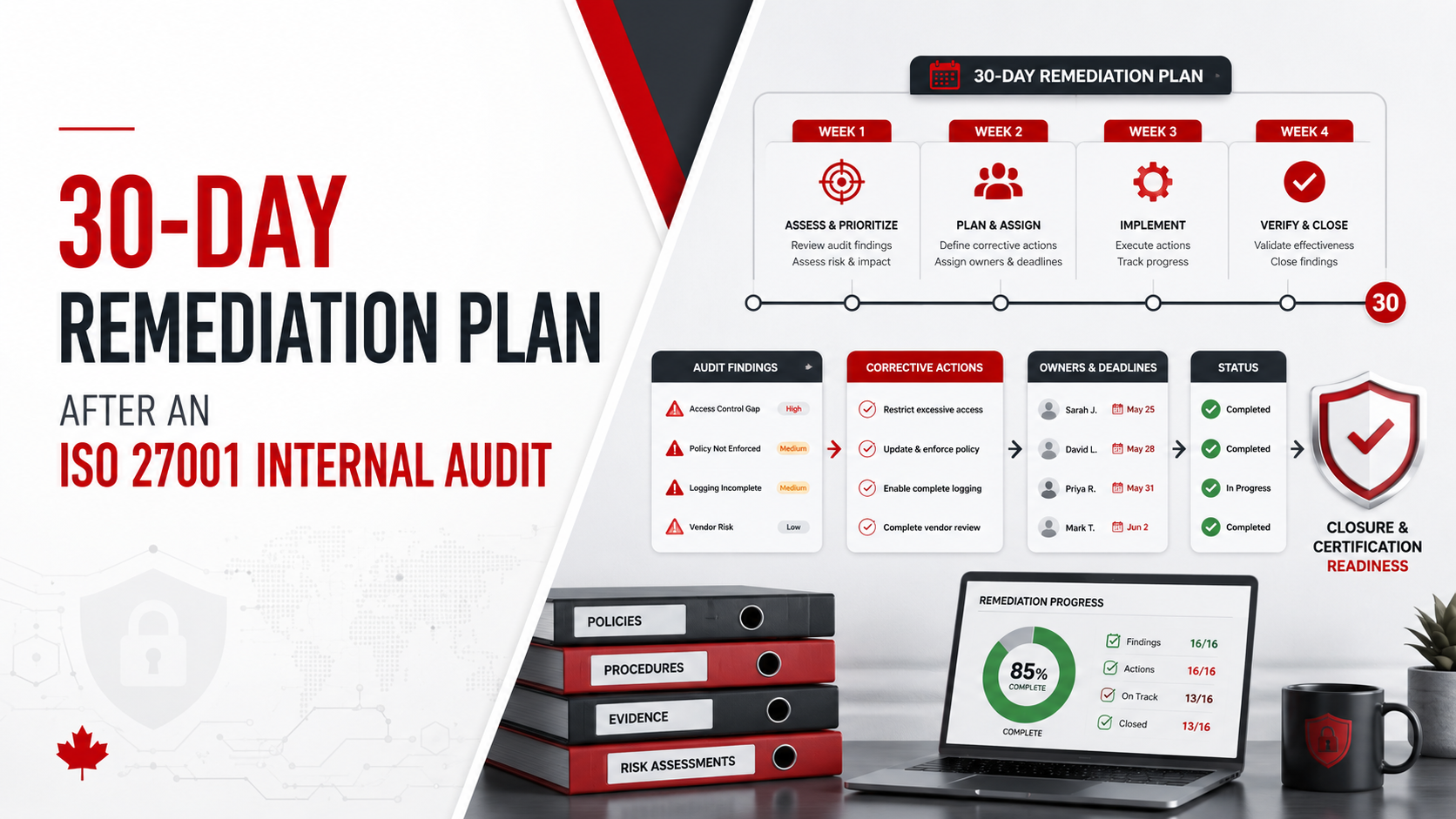
Remediation Plan
Corrective Actions
Audit Findings
30-Day Remediation Plan After an ISO 27001 Internal Audit
Use this ISO 27001 remediation plan to close internal audit findings, fix evidence gaps, assign owners, update risks, verify corrective actions, and prepare for certification readiness.
Quick Answer
What is a 30-day ISO 27001 remediation plan?
A 30-day ISO 27001 remediation plan helps organizations respond to internal audit findings in a structured way.
It helps teams review findings, identify root causes, assign owners, collect closure evidence, update the risk register, verify corrective actions, and prepare for certification or surveillance audit readiness.
Bottom line: the best plan separates quick evidence fixes from deeper control improvements and uses a corrective action tracker to manage owners, due dates, evidence links, risk updates, and verification status.
Canadian Cyber Remediation Support
Close ISO 27001 Internal Audit Findings Faster
Canadian Cyber helps organizations move from audit findings to verified closure through remediation planning, corrective action tracking, evidence review, risk updates, and SharePoint ISMS dashboards.
We support SaaS companies, MSPs, HealthTech vendors, FinTech companies, professional services firms, AI companies, cloud providers, and Canadian organizations preparing for certification readiness.
Quick Snapshot: 30-Day ISO 27001 Remediation Plan
| Timeline | Main Focus | Key Output |
|---|---|---|
| Days 1–3 | Review and classify findings. | Final findings list and risk ranking. |
| Days 4–7 | Assign owners and evidence requirements. | Corrective action tracker. |
| Days 8–14 | Fix quick wins and contain high-risk gaps. | Early closures and containment actions. |
| Days 15–21 | Complete root cause and control fixes. | Updated processes, evidence, and risk register. |
| Days 22–26 | Verify closure evidence. | Findings moved to verified closure. |
| Days 27–30 | Management review and readiness check. | Leadership dashboard and external audit prep. |
An Internal Audit Is Not the Finish Line
An ISO 27001 internal audit is not the finish line.
It is the starting point for improvement.
The audit may identify missing evidence, weak access reviews, outdated policies, vendor review gaps, unclear ownership, backup testing issues, incident response gaps, or corrective actions that were never verified.
That is normal. The real question is what happens next.
A strong 30-day ISO 27001 remediation plan turns audit findings into action, evidence, verification, and management visibility.
What Is ISO 27001 Remediation?
ISO 27001 remediation is the process of fixing gaps, nonconformities, observations, and improvement opportunities.
These issues may come from an internal audit, gap assessment, external audit, client security review, or management review.
Examples of ISO 27001 Remediation
Practical rule: a finding is not truly fixed until the root cause is addressed and closure evidence is verified.
Why a 30-Day Remediation Plan Works
Thirty days is long enough to organize, prioritize, fix, and verify many internal audit findings.
It is also short enough to maintain urgency.
A 30-Day Plan Helps You
Who This Blog Is For
- Companies preparing for ISO 27001 certification.
- Organizations that recently completed an internal audit.
- SaaS companies, MSPs, HealthTech vendors, FinTech companies, AI companies, and cloud service providers.
- Security managers, IT managers, compliance managers, ISMS managers, internal auditors, and vCISO teams.
- Canadian organizations preparing for certification, surveillance, or recertification audits.
Common ISO 27001 Internal Audit Findings That Need Remediation
ISO 27001 internal audit findings often appear in predictable areas.
The register does not reflect current systems, vendors, cloud services, AI tools, or business changes.
User lists exist, but reviewer decisions, exceptions, removals, or sign-offs are missing.
Vendor documents are collected, but risk conclusions and follow-up actions are missing.
Backup reports exist, but recoverability is not proven.
Monitoring evidence does not show review or response.
Status changes happen, but verification proof is missing.
Practical rule: most ISO 27001 findings are not caused by one missing file. They are caused by weak ownership, weak evidence management, or weak review discipline.
Days 1–3: Review and Classify the Findings
The first step is to understand what the audit actually found.
Do not rush into fixing everything at once.
Questions to Ask
- What was the finding?
- Is it a nonconformity, observation, or opportunity for improvement?
- Which ISO 27001 clause or Annex A control does it affect?
- Which system, process, or team is involved?
- Does it affect certification readiness?
- Does it need immediate containment?
Output for Days 1–3
- Final findings list.
- Risk-ranked findings.
- Urgent containment actions.
- Framework mapping.
- Initial owner suggestions.
- Evidence gap summary.
Days 4–7: Assign Owners and Build the Corrective Action Tracker
Findings stay open when ownership is unclear.
Every finding needs one accountable owner. Not a department. Not a shared inbox. A real owner.
Corrective Action Tracker Fields
Practical rule: a finding without an owner will usually become an overdue finding.
Days 8–14: Close Quick Wins and Contain High-Risk Issues
The second week should focus on fast improvements.
Some findings can be fixed quickly. Others need containment before full remediation.
Quick Wins to Close
- Missing policy approval.
- Expired policy review date.
- Missing access review sign-off.
- Missing vendor review note.
- Missing training evidence.
- Outdated risk treatment status.
High-Risk Issues to Contain
- Excessive admin access.
- Terminated user still active.
- Vendor account still enabled.
- AI tool processing confidential data without review.
- Backup failures not investigated.
- Critical logs not monitored.
Practical rule: fix the highest-risk findings first, not the easiest findings only.
Need Help Closing ISO 27001 Internal Audit Findings?
Canadian Cyber helps organizations close ISO 27001 internal audit findings faster through remediation planning, corrective action tracking, evidence review, SharePoint ISMS dashboards, risk register updates, and certification readiness support.
For senior advisory support, view Waqar Mehboob’s profile.
Days 15–21: Fix Root Causes and Update the ISMS
By week three, the organization should move beyond quick fixes.
This is where root cause matters.
| Weak Remediation | Strong Remediation |
|---|---|
| Upload a vendor SOC 2 report. | Update the vendor register, complete risk assessment, review the contract and security report, document conclusions, assign owner, and set next review date. |
| Rename a policy file as “updated.” | Approve the policy, record review date, publish the current version, archive old versions, and notify staff where needed. |
ISMS Areas to Update
Practical rule: good remediation prevents the same finding from appearing again.
Days 22–26: Verify Closure Evidence
Do not close findings too early.
A finding should move to “Pending Verification” before it becomes “Closed and Verified.”
| Finding | Weak Closure | Strong Closure |
|---|---|---|
| Access review missing | Access list uploaded. | Access list, reviewer sign-off, exceptions, and removals. |
| Policy overdue | File renamed “updated.” | Approved version, review date, approver, and publication evidence. |
| Vendor review missing | Vendor report uploaded. | Vendor report, review notes, risk rating, and next review date. |
| Restore test missing | Backup dashboard screenshot. | Restore test report, result, issues, and owner sign-off. |
Practical rule: closure is not a status update. Closure is evidence-backed verification.
Days 27–30: Management Review and Readiness Check
The final step is leadership visibility.
Management should understand what was found, what was fixed, what remains open, and what decisions are needed.
Management Review Should Cover
- Total findings.
- Findings closed.
- Findings still open.
- High-risk findings.
- Risk register changes.
- Certification readiness.
Dashboard Items
- Findings by risk level.
- Findings by owner.
- Findings pending evidence.
- Overdue corrective actions.
- Risk treatment status.
- Audit readiness score.
Practical rule: management review turns remediation from a technical task into a business decision.
30-Day ISO 27001 Remediation Plan Checklist
| Phase | Checklist Items |
|---|---|
| Days 1–3 | Review findings, confirm finding type, map to controls, rank by risk, identify containment needs, and create the initial remediation list. |
| Days 4–7 | Assign owners, define root cause requirements, set target dates, define evidence required, create the corrective action tracker, and escalate high-risk items. |
| Days 8–14 | Close approvals, update overdue reviews, complete access sign-offs, remove unnecessary access, add vendor notes, contain high-risk issues, and upload early evidence. |
| Days 15–21 | Document root cause, update the risk register, update the risk treatment plan, update the SoA where needed, improve procedures, and add recurring evidence tasks. |
| Days 22–26 | Review closure evidence, confirm root cause was addressed, verify completed actions, close verified findings, escalate blockers, and prepare the remediation evidence pack. |
| Days 27–30 | Prepare the remediation dashboard, summarize closed findings, summarize open risks, identify management decisions, approve accepted risks, and update the audit calendar. |
ISO 27001 Remediation Examples
Export user list, review with system owner, remove inactive accounts, document exceptions, save sign-off, and update the review schedule.
Add vendor to register, confirm data processed, review contract, document risk rating, assign owner, and set next review date.
Identify critical systems, perform restore test, document result, record issues, create corrective actions, and approve test evidence.
Add new cloud, vendor, and AI risks; assign owners; update treatment actions; set review dates; and prepare management summary.
Reopen weak closures, define evidence needed, assign verification owner, collect proof, and mark closed only after evidence review.
High-Priority Findings to Fix First
Some findings deserve immediate attention because they affect confidentiality, integrity, availability, customer trust, regulatory exposure, or certification readiness.
Fix These First
Common Mistakes During ISO 27001 Remediation
A finding should not be closed until evidence proves closure.
Removing one user is not enough if the offboarding process is broken.
Without root cause, the finding may repeat.
Shared responsibility often means no responsibility.
Teams may fix the issue but fail to prove it.
Leadership should know which findings remain open and why.
Corrective Action Tracker Template
| Field | Purpose |
|---|---|
| Finding ID | Unique reference. |
| Finding Type | Major, minor, observation, or OFI. |
| Control Area | Access, vendor, backup, risk, incident, or other area. |
| Risk Level | Critical, high, medium, or low. |
| Root Cause | Why the finding happened. |
| Corrective Action | What will be done. |
| Owner | Who is accountable. |
| Evidence Required | What proof is needed. |
| Status | Open, in progress, pending verification, or closed. |
| Verification Owner | Who confirms closure. |
Practical rule: the tracker should answer what happened, why it happened, who is fixing it, what evidence proves it, and who verified closure.
How SharePoint Can Help Manage ISO 27001 Remediation
A SharePoint ISMS workspace can make remediation easier to manage.
It gives owners, due dates, evidence, risk levels, and verification status one clear place to live.
SharePoint Can Track
- Audit findings.
- Corrective actions.
- Owners and due dates.
- Risk levels.
- Evidence requirements.
- Evidence links.
- Verification status.
- Management decisions.
Suggested SharePoint Views
- High-Risk Findings.
- Findings Due This Week.
- Findings Pending Evidence.
- Findings Pending Verification.
- Overdue Corrective Actions.
- Management Decision Required.
- Closed and Verified Findings.
30-Day Remediation Dashboard Metrics
Track remediation metrics weekly so work does not stall.
Useful Metrics
Practical rule: what gets measured gets closed faster.
When to Get External Help
Some organizations can close findings internally.
Others need support when findings are complex, high-risk, or time-sensitive.
External Help May Be Useful When
How Canadian Cyber Helps
Canadian Cyber helps organizations close ISO 27001 internal audit findings with structured remediation planning, corrective action tracking, evidence review, risk updates, and certification readiness support.
We help teams move from audit findings to verified closure.
Frequently Asked Questions
What is a 30-day ISO 27001 remediation plan?
A 30-day ISO 27001 remediation plan is a structured process for reviewing audit findings, assigning owners, fixing gaps, collecting evidence, updating risk records, verifying corrective actions, and preparing management reporting after an internal audit.
What should be fixed first after an ISO 27001 internal audit?
Fix high-risk findings first, especially those involving unauthorized access, privileged accounts, vendor access, missing MFA, backup failures, incident response gaps, unreviewed AI tools, critical vulnerabilities, or customer data exposure.
How do you close an ISO 27001 internal audit finding?
To close a finding, document the root cause, define corrective action, assign an owner, collect closure evidence, update related ISMS records, verify the fix, and mark the finding closed only after evidence review.
What evidence is needed for ISO 27001 remediation?
Evidence may include updated policies, access review sign-offs, removal tickets, vendor assessments, risk register updates, restore test reports, log review tickets, incident records, training records, corrective action notes, and management approvals.
What is the difference between correction and corrective action?
A correction fixes the immediate issue. A corrective action addresses the root cause so the issue is less likely to happen again.
Should the risk register be updated after internal audit findings?
Yes. If a finding affects risk, the risk register should be updated with revised risk ratings, owners, treatment actions, due dates, or accepted risk decisions.
Can SharePoint help manage ISO 27001 remediation?
Yes. SharePoint can track findings, owners, due dates, evidence links, verification status, risks, corrective actions, dashboards, and reminders.
Can Canadian Cyber help close ISO 27001 findings?
Yes. Canadian Cyber helps organizations review findings, plan remediation, update risk registers, organize evidence, verify corrective actions, build SharePoint ISMS dashboards, and prepare for certification readiness.
Takeaway
An ISO 27001 internal audit is valuable only if the findings lead to improvement.
A 30-day remediation plan helps organizations move quickly from audit results to verified closure.
The process should be clear: review findings, rank risk, assign owners, define root cause, fix quick gaps, contain high-risk issues, update ISMS records, collect evidence, verify closure, brief management, and prepare for the next audit step.
The goal is not to close findings on paper. The goal is to improve the ISMS, reduce risk, and prove that controls are working.
Ready to Close ISO 27001 Internal Audit Findings?
Canadian Cyber can help your organization turn internal audit findings into verified closure.
We provide ISO 27001 remediation planning, internal audit findings review, corrective action tracking, evidence gap assessment, risk register updates, SharePoint ISMS dashboards, vCISO support, SOC 2 readiness alignment, ISO 42001 AI governance readiness, ISO 27017, ISO 27018, and cybersecurity assessments.
Stay Connected With Canadian Cyber
Follow Canadian Cyber for practical guidance on ISO 27001 internal audits, remediation planning, corrective actions, SharePoint ISMS, evidence readiness, SOC 2 readiness, AI governance, vCISO services, ISO 42001, ISO 27017, ISO 27018, and cybersecurity maturity.