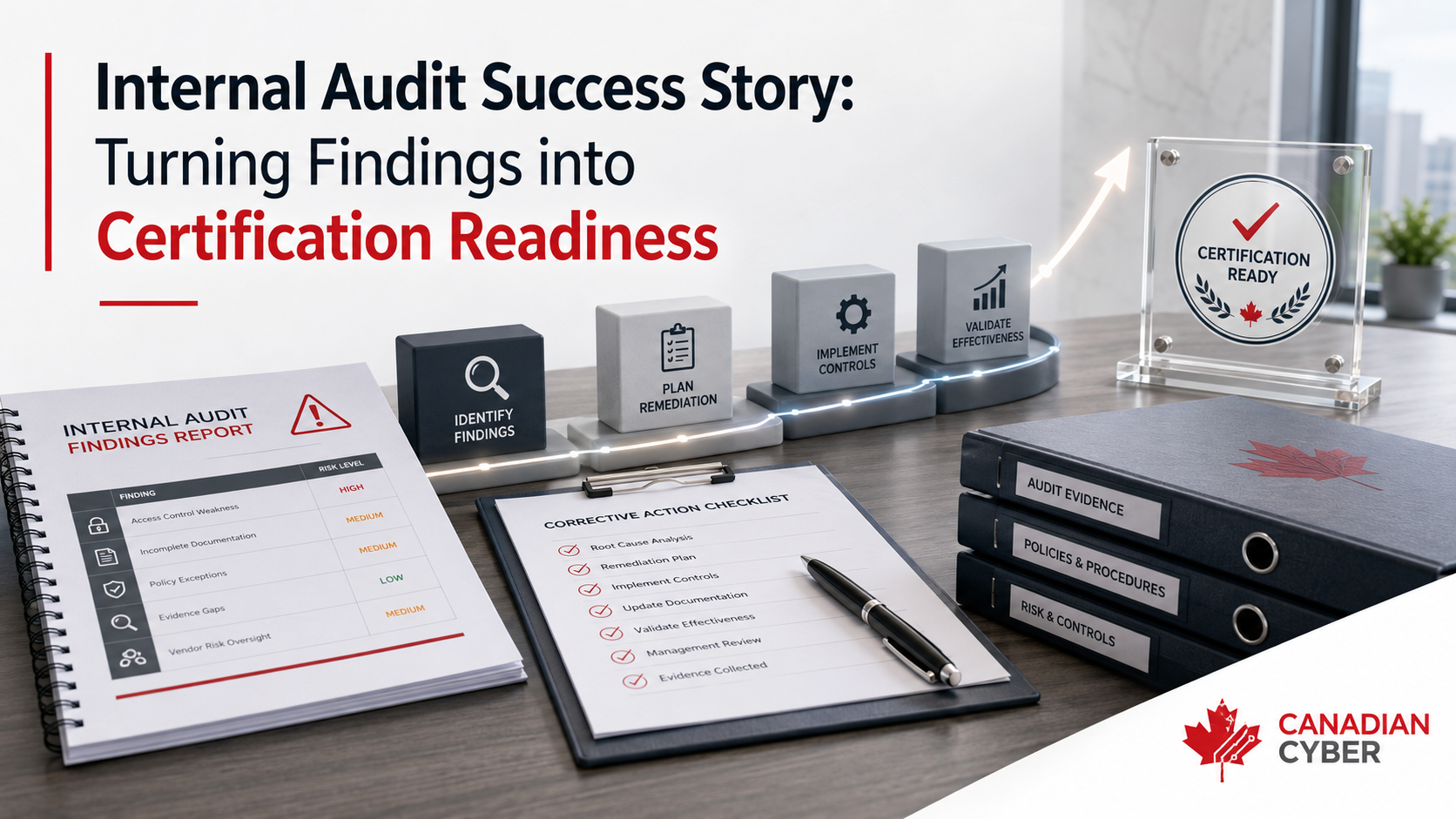
Internal Audit
Certification Readiness
Corrective Actions
Internal Audit Success Story: Turning ISO 27001 Findings into Certification Readiness
An ISO 27001 internal audit finding is not a failure. It is a clear starting point for corrective action, verified evidence, stronger risk management, and certification readiness.
Success Story Note
This is a fictionalized composite story based on common ISO 27001 internal audit challenges faced by SaaS, HealthTech, MSP, FinTech, professional services, and regulated organizations. It is designed for education and marketing, not as a claim about one specific client.
Quick Answer
How can internal audit findings support ISO 27001 certification readiness?
ISO 27001 internal audit findings support certification readiness when they are converted into corrective actions, assigned to owners, linked to risk updates, backed by evidence, and verified before closure.
The strongest organizations do not treat findings as audit failures. They use findings to improve access control, vendor risk, backup testing, incident response, AI governance, policy management, and management review.
Bottom line: internal audit becomes valuable when findings turn into ownership, evidence, verified closure, and measurable improvement.
Canadian Cyber Certification Readiness Support
Turn ISO 27001 Findings Into Verified Closure
Canadian Cyber helps organizations turn ISO 27001 internal audit findings into certification readiness through corrective action planning, evidence review, risk register updates, SharePoint ISMS dashboards, and vCISO-led remediation support.
We support SaaS, HealthTech, MSP, FinTech, professional services, AI, cloud, and regulated organizations preparing for certification, client reviews, and ongoing security maturity.
Quick Snapshot
| Audit Finding Area | Certification Readiness Action |
|---|---|
| Access Reviews | Add reviewer sign-off, exceptions, removals, and next review dates. |
| Privileged Access | Separate admin, service, break-glass, and cloud access reviews. |
| Vendor Risk | Document review notes, risk ratings, subprocessors, and follow-up actions. |
| Risk Register | Update current risks, owners, treatments, due dates, and linked evidence. |
| Backup and Restore | Move from backup reports to documented restore test evidence. |
| AI Governance | Inventory tools, approve use cases, define data rules, and add AI risks. |
The Situation Before Internal Audit
The company had been preparing for ISO 27001 for months.
Policies were drafted. Access controls were mostly in place. Vendors had been listed. A risk register existed. Backups were running.
Incident response had been documented. Security awareness training was completed. Leadership wanted certification readiness before the next major client review.
On paper, things looked close. But the internal audit told a more honest story.
The company did not have one evidence story. It had many disconnected files.
The Internal Audit Findings
The internal audit identified several findings and improvement opportunities.
None of them were impossible to fix. But together, they showed that ISO 27001 certification readiness needed better structure.
Exports existed, but decisions and sign-offs were not clear.
Admin users were not reviewed separately.
Vendor documents existed, but formal review notes were weak.
Current cloud, vendor, support, and AI risks were not fully reflected.
Backups were running, but recovery evidence was incomplete.
Some items were marked closed without strong closure proof.
Practical rule: internal audit findings become valuable when they are turned into ownership, evidence, and verified corrective action.
The First Leadership Decision
Leadership made one important decision.
No finding would be closed by words alone. Every finding needed evidence.
Every corrective action had to answer:
- What was the root cause?
- Who owns the fix?
- What evidence will prove closure?
- Who will verify it?
- Does the risk register need updating?
Step 1: Turn Findings Into a Corrective Action Tracker
The first improvement was simple.
The team created one corrective action tracker. It became the single source of truth for ISO 27001 certification readiness.
Corrective Action Tracker Fields
Practical rule: a finding without a tracker becomes a repeated finding.
Step 2: Fix Access Review Evidence
The internal audit found that access exports existed, but the review process was weak.
The company had lists of users. But it needed proof that access was reviewed and corrected.
| Access Review Gap | Certification Readiness Fix |
|---|---|
| Access exports were saved only. | Added reviewer sign-off and system owner approval. |
| Exceptions were not documented. | Created exception list and decision notes. |
| Removed users were not linked to proof. | Linked removal tickets and closure evidence. |
| Vendor access was inconsistent. | Added vendor users and contractors to access review scope. |
Practical rule: an access list is evidence of users. An access review is evidence of control.
Step 3: Separate Privileged Access
The audit highlighted that privileged access needed special treatment.
Admin roles carry higher risk because they can change systems, export data, disable controls, or modify logs.
What They Reviewed
- Global administrators.
- Cloud administrators.
- Database administrators.
- Security administrators.
- Service accounts.
- Break-glass accounts.
What Changed
- Temporary admin rights were removed.
- Service account owners were assigned.
- Break-glass accounts were documented.
- MFA evidence was saved.
- Admin activity logs were reviewed.
Step 4: Strengthen Vendor Review Evidence
The audit found that vendor documents existed, but formal review notes were missing.
The company had contracts and security reports. But it could not always show who reviewed them or what conclusion was reached.
Vendor Register Fields Added
Practical rule: a vendor file proves collection. A vendor review proves oversight.
Step 5: Update the Risk Register
The risk register had not kept pace with the business.
Several current risks were missing or outdated.
| Missing or Weak Risk Area | Risk Register Update |
|---|---|
| Cloud admin access. | Added owner, current controls, treatment action, and review date. |
| Vendor access. | Linked vendor access review and vendor risk rating. |
| Backup restore testing. | Added treatment plan and recurring test schedule. |
| AI tool use. | Added AI risks, approved use cases, and data restrictions. |
The risk register became connected to real audit findings and real business risks.
Need to Turn Audit Findings Into Certification Readiness?
Canadian Cyber helps organizations review findings, prioritize risks, assign owners, define evidence requirements, verify closure, update ISMS documents, build SharePoint dashboards, and prepare for ISO 27001 certification readiness.
For senior advisory support, view Waqar Mehboob’s profile.
Step 6: Prove Backup and Restore Readiness
The company had backup reports.
But the internal audit asked for restore test evidence. That changed the conversation.
Restore Test Evidence Included
Practical rule: backups show that data was copied. Restore testing shows whether the business can recover.
Step 7: Test Incident Response
The incident response plan existed.
But it had not been tested recently. The internal audit marked this as an improvement area.
| Tabletop Scenario | Evidence Collected |
|---|---|
| A vendor support account was suspected of unauthorized access to a production system. | Agenda, attendance list, scenario notes, decisions, lessons learned, action items, corrective action links, and management summary. |
Incident response became more realistic and more auditable.
Step 8: Fix Policy Approval and Version Control
The company had policies.
But some had unclear approval status, overdue review dates, or old versions still visible.
Policy Governance Fixes
Practical rule: a policy is only audit-ready when approval, version, owner, and review date are clear.
Step 9: Bring AI Tools Into the ISMS
The company used AI in small but important ways.
AI helped draft internal documents, support meeting summaries, assist support drafting, and support developers. At first, this was not part of the ISO 27001 evidence program.
AI Governance Gaps
- AI tools were not fully inventoried.
- AI vendors were not reviewed.
- Approved use cases were unclear.
- Data restrictions were vague.
- AI risks were missing from the risk register.
AI Register Fields
- AI tool name and vendor.
- Use case and owner.
- Approval status.
- Data allowed and prohibited.
- Human review requirement and risk link.
Step 10: Build a SharePoint ISMS Evidence Workspace
The biggest change was evidence organization.
The company moved away from scattered folders and built a SharePoint ISMS workspace.
Libraries Created
- Policies and Procedures.
- Published Documents.
- Risk Evidence.
- Access Review Evidence.
- Vendor Evidence.
- AI Governance Evidence.
- Client-Ready Evidence Pack.
Lists Created
- Risk Register.
- Statement of Applicability.
- Corrective Action Tracker.
- Vendor Register.
- Access Review Tracker.
- AI Tool Register.
- Management Review Action Log.
Practical rule: SharePoint becomes powerful when it is designed as an ISMS, not used as a folder dump.
Step 11: Make Management Review Clearer
Before the internal audit, leadership received scattered updates.
After remediation, leadership saw a dashboard.
Dashboard Included
Before and After
| Before Internal Audit | After Remediation |
|---|---|
| Evidence scattered across folders. | SharePoint ISMS workspace. |
| Findings tracked informally. | Corrective action tracker. |
| Access exports saved only. | Reviewed access with sign-off and removals. |
| Privileged access mixed with users. | Separate privileged access review. |
| Vendor documents collected. | Vendor reviews completed with conclusions. |
| Risk register outdated. | Risk register updated with real findings. |
| Backup reports only. | Restore tests documented. |
| AI tools informal. | AI governance register created. |
The Certification Readiness Outcome
By the end of the remediation cycle, the company had not simply “closed findings.”
It had improved the ISMS.
What Was Stronger
Practical rule: certification readiness is not about having a perfect audit. It is about proving that the ISMS identifies gaps, fixes them, verifies closure, and improves.
The 30-Day Success Pattern
| Week | Focus | Result |
|---|---|---|
| Week 1 | Organize findings, assign owners, define evidence, and create tracker. | Clear ownership and remediation plan. |
| Week 2 | Close quick wins, remove access issues, update vendor notes, and correct policy gaps. | Early progress and risk reduction. |
| Week 3 | Fix root causes, update risk register, test restore process, and add AI governance. | Stronger ISMS processes. |
| Week 4 | Review evidence, verify closure, update dashboards, and prepare management review. | Certification readiness visibility. |
Lessons Learned
Findings show where the ISMS needs attention.
Every finding needs a named owner.
Teams should know what proof is required before they start fixing.
Findings should connect to risk management where relevant.
Closure should be reviewed before being accepted.
AI tools should not remain invisible.
Internal Audit Success Checklist
| Checklist Item | Ready? |
|---|---|
| Findings are reviewed and classified. | |
| Each finding has an owner. | |
| Root cause is documented. | |
| Corrective action is defined. | |
| Evidence requirement is clear. | |
| High-risk findings are prioritized. | |
| Privileged access is reviewed separately. | |
| Vendor reviews include conclusions. | |
| Risk register is updated. | |
| Restore testing is documented. | |
| Incident response is tested. | |
| AI tools are inventoried. | |
| Corrective actions are verified. | |
| Management review dashboard is prepared. |
Common Questions Leadership Asked
Are we ready for certification now?
The answer depended on evidence. The organization was closer because high-risk findings were addressed, corrective actions were tracked, and closure evidence was verified.
Do we need to fix every OFI immediately?
Not every opportunity for improvement needed urgent closure. But every OFI needed a decision: accept, defer, assign, or schedule.
Can we share this evidence with clients?
Some evidence could be shared. Some evidence needed redaction. Some internal findings were not client-ready. That is why the company created a separate client-ready evidence pack.
Will these findings repeat?
They were less likely to repeat because root causes were addressed and recurring review tasks were added.
How Canadian Cyber Helps
Canadian Cyber helps organizations turn ISO 27001 internal audit findings into certification readiness.
We support companies that need practical help closing findings, organizing evidence, updating risk registers, preparing management reviews, and building audit-ready SharePoint ISMS workspaces.
Frequently Asked Questions
What is ISO 27001 certification readiness?
ISO 27001 certification readiness means the organization has implemented and can evidence an operating ISMS, including risk management, controls, internal audit, management review, corrective actions, and continual improvement.
Are internal audit findings bad?
No. Findings are useful when they help the organization identify gaps before certification, client reviews, or larger security issues.
How do you turn findings into certification readiness?
You assign owners, document root cause, create corrective actions, collect evidence, update risks, verify closure, and report progress to management.
What evidence is most important after an internal audit?
Important evidence includes access reviews, vendor reviews, risk register updates, policy approvals, restore tests, log review records, incident response testing, corrective action evidence, and management review notes.
Should AI tools be included in ISO 27001 internal audit remediation?
Yes. AI tools should be included when they process company data, client data, regulated data, source code, support tickets, confidential records, or product workflows.
Can SharePoint help with certification readiness?
Yes. SharePoint can help organize policies, risks, evidence, findings, corrective actions, owners, due dates, verification notes, dashboards, and client-ready evidence packs.
Can Canadian Cyber help close ISO 27001 findings?
Yes. Canadian Cyber helps organizations review findings, plan remediation, update evidence, verify corrective actions, build SharePoint ISMS dashboards, and prepare for certification readiness.
Takeaway
This is the real success story.
The internal audit did not prove the company was perfect. It proved the company was improving.
Findings became owners. Owners created actions. Actions produced evidence. Evidence supported verification. Verification supported ISO 27001 certification readiness.
That is how internal audit should work.
Do not fear the findings. Use them. Turn them into corrective actions, risk updates, verified evidence, leadership visibility, and certification readiness.
Ready to Turn ISO 27001 Findings Into Certification Readiness?
Canadian Cyber can help your organization turn internal audit findings into verified closure, stronger evidence, and certification readiness.
We provide ISO 27001 internal audits, remediation planning, corrective action tracking, evidence gap reviews, SharePoint ISMS dashboards, risk register updates, vCISO support, SOC 2 readiness alignment, ISO 42001 AI governance readiness, ISO 27017, ISO 27018, and cybersecurity assessments.
Stay Connected With Canadian Cyber
Follow Canadian Cyber for practical guidance on ISO 27001 internal audits, certification readiness, corrective actions, SharePoint ISMS, evidence management, SOC 2 readiness, AI governance, vCISO services, ISO 42001, ISO 27017, ISO 27018, and cybersecurity maturity.