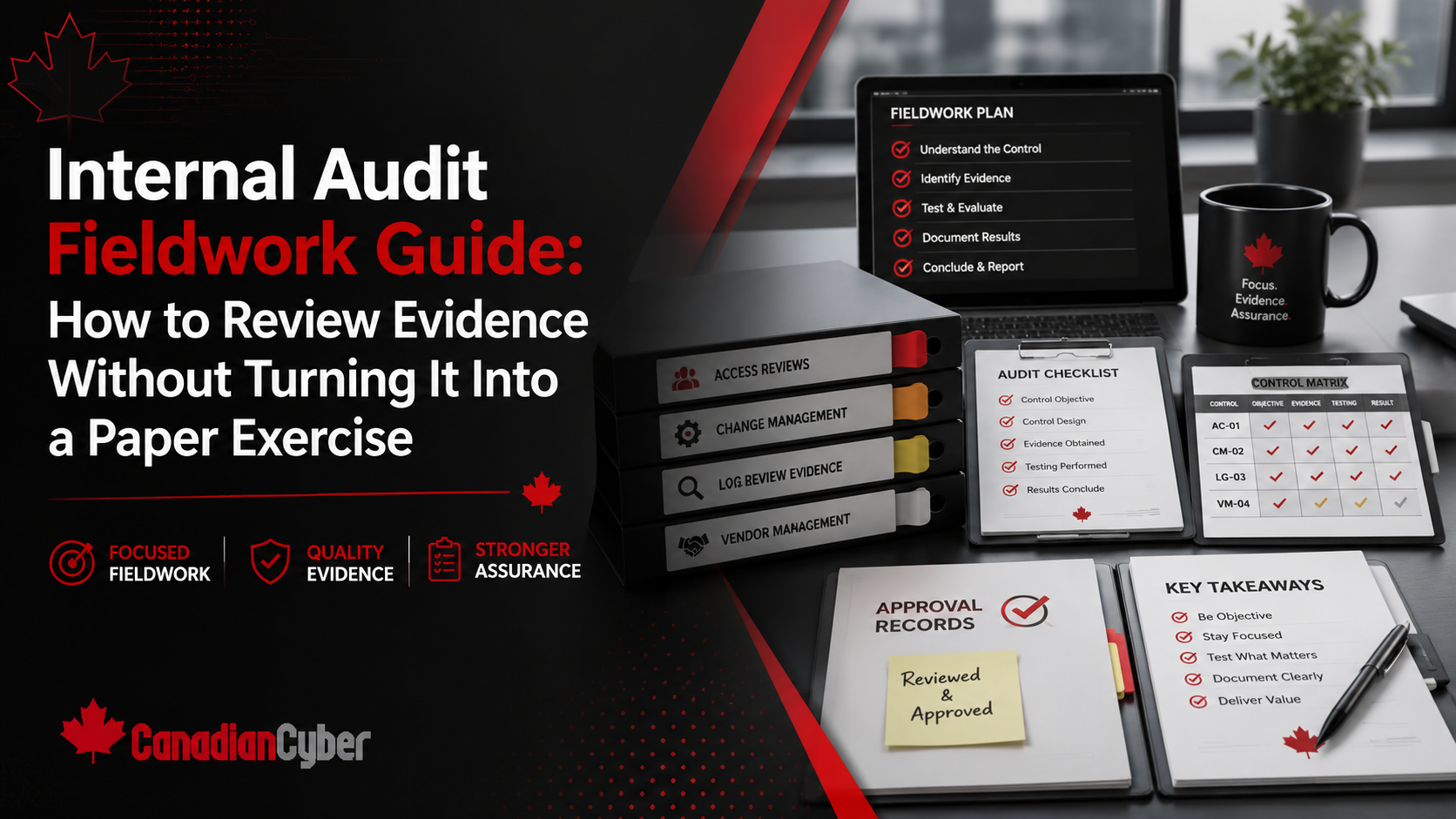
Internal Audit
Fieldwork
ISO 27001 Internal Audit Fieldwork: Review Evidence Without Turning It Into a Paper Exercise
Use ISO 27001 internal audit fieldwork to test evidence, interview control owners, sample real records, review exceptions, and build stronger certification readiness.
Quick Answer
How should ISO 27001 internal audit fieldwork review evidence?
ISO 27001 internal audit fieldwork should test whether controls are working.
The auditor should not only check whether documents exist. Instead, the auditor should review dates, owners, approvals, samples, exceptions, risks, and corrective actions.
The goal is simple: prove what happened, who owned it, what evidence supports it, and what must improve.
Fieldwork Should Not Be a Folder Review
Many audits look busy.
The auditor asks for evidence.
Teams upload policies, screenshots, tickets, reports, and exports.
However, files alone do not prove control operation.
A useful audit asks what the evidence proves.
Practical rule: fieldwork should prove control operation, not just document existence.
The Main Fieldwork Question
The strongest fieldwork question is not, “Can you send me evidence?”
A better question is:
Can you walk me through how this control worked, show a recent sample, explain exceptions, and prove the result was reviewed?
Quick Fieldwork Snapshot
| Fieldwork Area | What Good Review Looks Like |
|---|---|
| Policies | Check approval, version, owner, review date, communication, and actual use. |
| Access Reviews | Test sign-off, exceptions, removals, privileged users, and offboarding links. |
| Vendor Evidence | Confirm risk rating, review notes, contracts, security reports, and follow-up actions. |
| Backup Evidence | Review backup status, failures, restore tests, owners, and corrective actions. |
| Corrective Actions | Verify root cause, owner, due date, closure evidence, and verification notes. |
What Is ISO 27001 Internal Audit Fieldwork?
Fieldwork is the audit phase where evidence is tested.
The auditor interviews owners, samples records, checks evidence, and compares real activity against the audit criteria.
This is where the audit moves from “the policy says” to “show me where it happened.”
When Fieldwork Becomes a Paper Exercise
Fieldwork becomes weak when the auditor only checks files.
That approach may look organized, but it does not build confidence.
1. Start With the Audit Criteria
Before reviewing evidence, confirm the audit criteria.
The criteria tell the auditor what the evidence should prove.
Criteria May Include
- ISO 27001 clauses.
- Statement of Applicability.
- Risk treatment plan.
- Approved policies and procedures.
- Client security commitments.
- Previous audit findings.
Practical rule: evidence should be reviewed against a requirement, not in isolation.
2. Follow the Evidence Trail
Do not review one file and stop.
Follow the evidence trail from report to action.
| Evidence Trail | What to Verify |
|---|---|
| Access export. | Which system and users were included? |
| Reviewer comments. | Was the review actually performed? |
| Exception list. | Were issues identified? |
| Removal tickets. | Were unneeded accounts removed? |
| Approval record. | Was the result signed off? |
3. Interview the Control Owner
Documents cannot explain everything.
Fieldwork should include interviews with the people who run the process.
Ask the Owner
- How does this control work?
- Who performs it?
- How often does it happen?
- What evidence is created?
- Who reviews the result?
- What happens if it fails?
Need Fieldwork That Tests Evidence Properly?
Canadian Cyber helps organizations run ISO 27001 internal audit fieldwork that goes beyond document collection.
We test evidence, interview owners, sample records, verify corrective actions, and prepare leadership-ready readiness reports.
4. Sample Real Records
An auditor should not review only perfect examples.
Samples should include real records from the audit period.
Practical rule: samples should test ordinary operation, not only best-case evidence.
5. Test Evidence Quality
A screenshot is not always strong evidence.
Evidence should be judged by what it proves.
Strong Evidence Has
A clear date.
A clear owner.
A system name.
Approval or review notes.
A link to the requirement.
Weak Evidence Has
No date.
No owner.
No context.
No approval.
No relation to the control.
6. Compare Policy to Practice
Policies create expectations.
Fieldwork tests whether reality matches those expectations.
| Policy Says | Fieldwork Should Test |
|---|---|
| Terminated users are removed within 24 hours. | HR record, IT ticket, removal time, SaaS status, and admin access status. |
| Vendors are reviewed before approval. | Vendor rating, security review, contract status, DPA, and approval record. |
| Restore tests are performed annually. | Restore test record, results, failures, owner, and corrective actions. |
7. Review Exceptions
Exceptions often show the real value of fieldwork.
A control can still work well if exceptions are detected and corrected.
8. Link Evidence to Risk and the SoA
ISO 27001 is risk-based.
Therefore, evidence should connect to risk treatment and the Statement of Applicability.
Example: privileged access review.
Risk: unauthorized administrative access to cloud systems.
Owner: IT Manager.
Audit test: confirm admin list, approval, exceptions, removals, MFA, and logging.
9. Validate Corrective Actions
Previous findings should be tested during fieldwork.
Do not accept “closed” without evidence.
| Weak Closure | Strong Closure |
|---|---|
| Access review completed. | Q3 review, sign-off, exception list, removal tickets, updated procedure, next review date, and verification notes. |
Practical rule: corrective action closure should be tested like any other control.
Evidence Review Matrix for Fieldwork
| Evidence Type | Paper Exercise Review | Strong Fieldwork Review |
|---|---|---|
| Policy | Check file exists. | Verify approval, version, communication, and practice. |
| Access Review | Check export exists. | Test decisions, exceptions, removals, and privileged users. |
| Vendor File | Check report exists. | Review risk rating, conclusion, and follow-up actions. |
| Corrective Action | Check status says closed. | Verify root cause, closure evidence, and effectiveness. |
Internal Audit Fieldwork Checklist
Before Evidence Review
- Confirm audit criteria.
- Review audit scope.
- Review SoA.
- Review risk register.
- Select samples.
During Evidence Review
- Check dates.
- Check owner.
- Check approval.
- Check exceptions.
- Check closure proof.
Before Drafting Findings
- Confirm criteria.
- Confirm condition.
- Confirm evidence reviewed.
- Confirm risk or impact.
- Confirm owner.
What a Strong Fieldwork Finding Looks Like
A weak finding says:
“Access review evidence was incomplete.”
A stronger finding explains the risk:
“The Q3 access review for the production system did not include vendor accounts or privileged administrator accounts. Two inactive vendor accounts remained enabled during the audit period. This creates a risk of unauthorized access and shows that the access review scope is incomplete.”
How Fieldwork Should Support Leadership
Leadership does not need every evidence detail.
However, leadership should see the readiness picture.
| Area | Fieldwork Result | Leadership Action |
|---|---|---|
| Access Control | Vendor users excluded from review. | Require expanded access review. |
| Vendor Risk | Critical vendors missing review notes. | Prioritize vendor review completion. |
| Backup and Restore | Restore test missing. | Approve immediate restore test. |
SharePoint Fieldwork Workspace
A SharePoint ISMS workspace can keep fieldwork organized.
It should help the auditor test evidence, not simply store it.
Track owner, status, and due date.
Track sample, result, and notes.
Track criteria, evidence, risk, and owner.
Show leadership what needs action.
How Canadian Cyber Helps
Canadian Cyber helps organizations conduct ISO 27001 internal audit fieldwork that tests evidence properly.
We help teams move beyond document collection and into practical, risk-based audit testing.
Frequently Asked Questions
What is ISO 27001 internal audit fieldwork?
ISO 27001 internal audit fieldwork is the stage where the auditor reviews evidence, interviews control owners, samples records, tests controls, identifies findings, and validates whether the ISMS is operating as intended.
How do you review ISO 27001 audit evidence properly?
Review evidence against audit criteria. Then check dates, owners, approvals, samples, exceptions, risk links, SoA mapping, and corrective action evidence.
What makes an internal audit a paper exercise?
An audit becomes a paper exercise when it only checks whether documents exist and does not test whether controls operate, owners are accountable, and exceptions are handled.
Should internal auditors interview control owners?
Yes. Interviews show whether owners understand the process, follow the procedure, handle exceptions, and produce evidence consistently.
Can SharePoint help manage internal audit fieldwork?
Yes. SharePoint can track evidence requests, owners, samples, interview notes, findings, corrective actions, risk links, SoA mapping, and readiness dashboards.
Can Canadian Cyber support ISO 27001 internal audit fieldwork?
Yes. Canadian Cyber provides ISO 27001 internal audit fieldwork support, evidence testing, control owner interviews, sampling, findings reporting, corrective action tracking, SharePoint ISMS setup, and readiness dashboards.
Takeaway
ISO 27001 internal audit fieldwork should not become a paper exercise.
The goal is not to collect the most files.
The goal is to understand whether the ISMS works.
Strong fieldwork tests evidence, interviews owners, reviews samples, checks exceptions, and links findings to risk.
A good internal audit turns evidence into insight and insight into certification readiness.
Run ISO 27001 Fieldwork Without Turning Audit Into Paperwork
Canadian Cyber can help your organization test evidence, interview owners, sample records, verify corrective actions, and prepare leadership-ready audit findings.
We support ISO 27001 internal audit fieldwork, SharePoint ISMS dashboards, vCISO services, SOC 2 readiness, ISO 42001, ISO 27017, ISO 27018, and cybersecurity assessments.
Stay Connected With Canadian Cyber
Follow Canadian Cyber for practical guidance on ISO 27001 internal audits, audit fieldwork, evidence review, certification readiness, SharePoint ISMS, SOC 2 readiness, AI governance, and vCISO services.