

Internal Audit
ISMS Ownership
ISO 27001 ISMS Ownership: Interview Gaps That Reveal Weak Accountability
Learn how ISO 27001 internal audit interviews reveal weak ISMS ownership, unclear control accountability, poor evidence responsibility, and certification readiness risk.
Quick Answer
What interview gaps reveal weak ISO 27001 ISMS ownership?
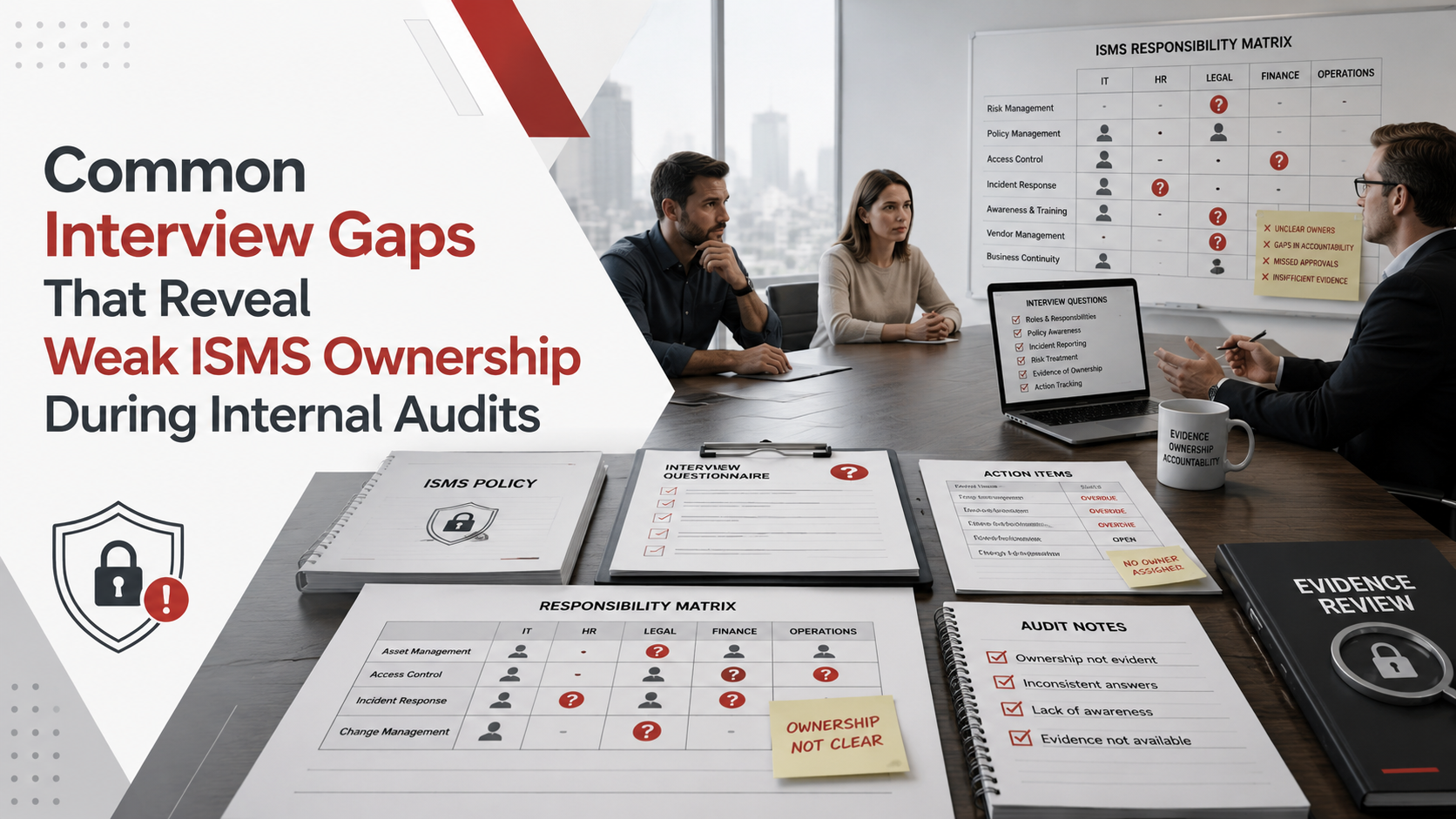
Weak ISO 27001 ISMS ownership appears when people cannot explain who owns a control, who provides evidence, who reviews exceptions, who approves risk, or who verifies corrective actions.
Common signs include vague ownership answers, over-reliance on IT, evidence collected only by compliance, unclear escalation paths, and leadership involvement only during audit deadlines.
The audit test is simple: every control should have a real owner, evidence owner, review frequency, escalation path, and management visibility.
Interviews Reveal What Documents Hide
The fastest way to find weak ISMS ownership is not always by reading policies.
It is often by interviewing people.
Documents may look clean.
Evidence folders may look organized.
But ownership gaps appear when the auditor asks how the ISMS works in daily operations.
Practical rule: if people cannot explain their ISMS responsibilities during an interview, ownership is probably weak in daily operations too.
The Main Internal Audit Question
The strongest interview question is not, “Do you have evidence?”
A better question is:
Who owns this control, how do they know what to do, what evidence do they create, and who verifies it?
Quick Interview Gap Snapshot
| Interview Gap | What It Reveals |
|---|---|
| “IT owns everything.” | Security is not embedded across the business. |
| “Compliance handles the evidence.” | Control owners may not understand accountability. |
| “We do this, but do not document it.” | The process may be informal and hard to verify. |
| “I am not sure who approves that.” | Authority and approval paths are unclear. |
| “We review it during audit season.” | Controls may not operate on a normal schedule. |
| “The owner says it is closed.” | Corrective action verification may be weak. |
What Strong ISMS Ownership Looks Like
Strong ISMS ownership does not mean everyone is a security expert.
It means each team understands its role in protecting information.
Owns access reviews, cloud evidence, backups, logs, and technical control operation.
Owns onboarding, offboarding, training, role changes, and acknowledgments.
Owns contract obligations, DPAs, client commitments, and breach clauses.
Owns vendor approval controls, payment controls, and financial system access evidence.
Owns service delivery evidence, support processes, exceptions, and continuity actions.
Owns risk acceptance, resources, management review, and strategic decisions.
Practical rule: the ISMS Manager may coordinate the ISMS, but the business must own the controls.
1. Interview Gap: “IT Owns That”
This is one of the most common ISO 27001 interview gaps.
IT may own many technical controls. However, IT does not own every ISMS requirement.
What to Ask
- Which controls does IT actually own?
- Which controls are owned by HR, Legal, Finance, Operations, or Leadership?
- Is there a control owner matrix?
- Are control owners aware of their responsibilities?
- Are owners providing evidence on schedule?
Common finding: most ISMS responsibilities are assigned to IT, even though key controls depend on HR, Legal, Finance, Operations, Procurement, and Leadership.
2. Interview Gap: “Compliance Handles the Evidence”
Compliance can coordinate evidence.
But compliance should not become the owner of every control.
| Audit Question | Why It Matters |
|---|---|
| Who performs the control? | The performer should understand the process. |
| Who owns the evidence? | Evidence ownership should not depend on one coordinator. |
| Who reviews the evidence? | Quality should be checked before audit. |
| Is evidence created during normal work? | Evidence should not appear only before audits. |
3. Interview Gap: “We Do This, But We Do Not Document It”
This answer usually means the process is informal.
The process may be happening. But without evidence, the auditor cannot verify it.
Practical rule: in ISO 27001, “we do it” needs to become “we can prove it.”
4. Interview Gap: “I Am Not Sure Who Approves That”
Approval confusion creates audit risk.
It can affect policies, access, vendors, risk acceptance, exceptions, changes, and corrective actions.
Evidence to Review
- Approval matrix.
- Policy approval workflow.
- Access approval tickets.
- Risk acceptance records.
- Vendor approval process.
- Corrective action verification records.
Need to Fix Weak ISMS Ownership Before Certification?
Canadian Cyber helps organizations identify unclear control ownership, weak evidence ownership, poor corrective action accountability, and interview readiness gaps.
We can help you build control owner matrices, evidence owner views, SharePoint dashboards, and leadership-ready readiness reports.
5. Interview Gap: “We Only Review This During Audit Season”
This is a major warning sign.
ISO 27001 is a management system. It is not a once-a-year file cleanup exercise.
| What to Check | Evidence Example |
|---|---|
| Review frequency. | Audit calendar, review schedule, or control plan. |
| Reminder process. | Power Automate reminders or Teams notifications. |
| Late reviews. | Overdue review report and escalation notes. |
| Evidence rhythm. | Evidence created throughout the year. |
6. Interview Gap: “The Policy Says One Thing, But We Do Another”
This gap is serious.
It shows a mismatch between documentation and practice.
Internal Audit Questions
- Why is practice different from the policy?
- Was the policy communicated?
- Is the policy outdated?
- Did the process change?
- Is the difference creating risk?
Practical rule: either update the policy or fix the process. Do not leave both misaligned.
7. Interview Gap: “We Close Findings When the Owner Says It Is Done”
A finding is not closed because someone says it is closed.
It is closed when evidence proves the issue was fixed and verified.
8. Interview Gap: “The Risk Register Is Managed by One Person”
The ISMS Manager may maintain the risk register.
But business owners should own risks, review treatment actions, and understand residual risk.
| Risk Ownership Question | Evidence to Review |
|---|---|
| Who owns each risk? | Risk register and risk owner list. |
| Do risk owners review ratings? | Risk review records. |
| Are treatment actions owned? | Risk treatment plan. |
| Who accepts residual risk? | Risk acceptance approvals. |
9. Interview Gap: “Vendor Reviews Are Handled by Another Team”
Supplier security often fails when ownership is split.
Procurement, Legal, IT, Finance, Operations, and Security may all contribute. Still, one coordinated process must exist.
Evidence to Review
- Vendor register.
- Vendor owner list.
- Procurement workflow.
- Contract review records.
- Vendor risk ratings.
- Vendor access review.
10. Interview Gap: “Leadership Only Gets Updates When There Is a Problem”
Leadership should not hear about the ISMS only during emergencies or certification deadlines.
ISO 27001 leadership oversight should be scheduled, evidenced, and decision-oriented.
Two More Gaps to Watch Closely
“We Are Waiting for Someone Else”
This reveals unmanaged handoffs.
Check the final owner, deadline, blocker, escalation record, and interim control.
“We Use SharePoint, But I Do Not Know Where the Evidence Is”
This reveals poor evidence structure.
Check metadata, owner views, control mapping, permissions, and published evidence libraries.
ISMS Ownership Interview Questions
Use these questions during ISO 27001 internal audit interviews.
- What ISMS control does your team own?
- What evidence do you provide?
- How often do you provide it?
- Who reviews it?
- Where is it stored?
- What happens if the evidence is late?
- What exceptions occurred recently?
- How are issues escalated?
- What risks does this control reduce?
- How do you know the control is working?
Weak Ownership Evidence vs Strong Ownership Evidence
| Area | Weak Evidence | Strong Evidence |
|---|---|---|
| Control Ownership | “IT handles it.” | Control owner matrix with named owners. |
| Evidence Ownership | Files uploaded by compliance. | Evidence owner assigned for each control. |
| Risk Ownership | ISMS Manager owns all risks. | Business risk owners assigned and active. |
| Corrective Actions | Owner says completed. | Closure evidence and verification notes. |
| Leadership Oversight | Ad hoc updates. | Management review dashboard and decisions. |
Corrective Actions for Weak ISMS Ownership
| Gap | Immediate Correction | Corrective Action |
|---|---|---|
| Control owners unclear. | Assign owners for high-risk controls. | Build a full control owner matrix. |
| Evidence owners missing. | Assign evidence owners for the current audit. | Add owner fields to the evidence matrix. |
| Risk owners inactive. | Review high risks with owners. | Start a quarterly risk owner review. |
| Corrective actions overdue. | Escalate overdue items. | Add verification and escalation steps. |
How SharePoint Can Strengthen ISMS Ownership
A SharePoint ISMS workspace can make ownership visible.
But it must be designed around owners, dates, controls, risks, evidence, and status.
Show who owns each control.
Find evidence gaps before audit.
Track who owns each risk.
Track due dates and closure proof.
Make supplier accountability visible.
Show leadership what needs action.
Practical rule: a strong SharePoint ISMS makes accountability visible before the auditor has to ask.
How Canadian Cyber Helps
Canadian Cyber helps organizations identify and fix weak ISO 27001 ISMS ownership before certification, surveillance audits, SOC 2 reviews, and client security assessments.
We help teams move from unclear responsibility to audit-ready ownership.
Frequently Asked Questions
What is ISMS ownership in ISO 27001?
ISMS ownership means the organization has clear accountability for policies, risks, controls, evidence, corrective actions, reviews, and management decisions across the business.
Why do interviews reveal weak ISMS ownership?
Interviews show whether people understand their responsibilities, can explain the process, know where evidence is stored, understand escalation paths, and know what happens when controls fail.
Is the ISMS Manager responsible for every ISO 27001 control?
No. The ISMS Manager usually coordinates the management system, but control ownership should be assigned across IT, HR, Legal, Finance, Operations, Security, and Leadership.
What are common signs of weak ISMS ownership?
Common signs include unclear owners, evidence collected only during audits, a risk register managed by one person, overdue corrective actions, fragmented vendor ownership, and leadership updates only during certification deadlines.
Can SharePoint help with ISMS ownership?
Yes. SharePoint can track control owners, evidence owners, risk owners, due dates, review status, overdue actions, corrective actions, and leadership dashboards.
Can Canadian Cyber help review ISMS ownership?
Yes. Canadian Cyber helps organizations assess ISMS ownership, conduct internal audit interviews, map controls and evidence to owners, build SharePoint dashboards, and prepare for ISO 27001 certification readiness.
Takeaway
Weak ISMS ownership rarely stays hidden for long.
It appears during interviews.
When people cannot explain who owns a control, where evidence is stored, who approves exceptions, or who verifies corrective actions, the audit has found a management system gap.
Strong ownership means controls, evidence, risks, policies, vendors, corrective actions, and leadership decisions all have clear accountability.
That is how an ISMS becomes real: not because one person manages every spreadsheet, but because the organization understands its role in protecting information.
Identify Weak ISMS Ownership Before Certification
Canadian Cyber can help your organization prepare for ISO 27001 internal audit interviews and fix weak ownership before certification.
We support ISO 27001 internal audits, ISMS ownership reviews, control owner matrices, evidence owner mapping, SharePoint ISMS dashboards, corrective action tracking, leadership readiness reporting, vCISO support, SOC 2 readiness, ISO 42001, ISO 27017, ISO 27018, and cybersecurity assessments.
Stay Connected With Canadian Cyber
Follow Canadian Cyber for practical guidance on ISO 27001 internal audits, ISMS ownership, audit interviews, certification readiness, SharePoint ISMS, SOC 2 readiness, AI governance, and vCISO services.