Internal Audit
Management Reporting
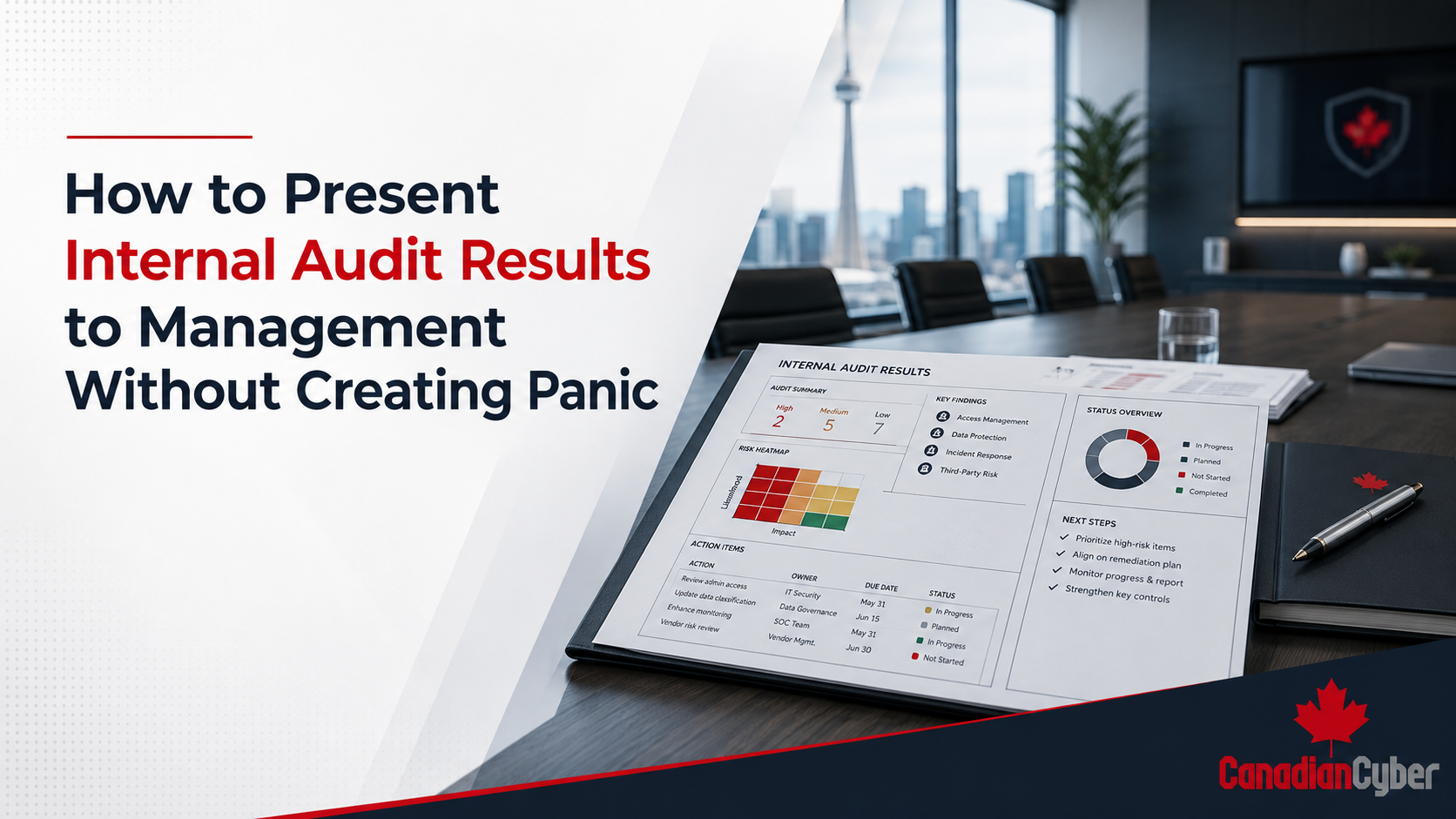
How to Present ISO 27001 Internal Audit Results to Management Without Creating Panic
Learn how to present ISO 27001 internal audit results to management clearly, calmly, and professionally with risk-ranked findings, corrective actions, decision points, and certification readiness next steps.
Quick Answer
How should ISO 27001 internal audit results be presented to management?
ISO 27001 internal audit results should be presented by business impact, risk level, certification readiness, major themes, corrective actions, owners, deadlines, and decisions needed.
Management does not need raw evidence or every technical detail. They need to know what is working, what needs attention, what could affect certification, and what support is required.
The best presentation turns audit findings into a clear improvement plan.
Internal Audit Results Should Create Clarity, Not Panic
Internal audit results can create panic when they are presented the wrong way.
A long list of findings can overwhelm leadership.
Too much technical detail can hide the real message.
No risk ranking can make every issue look urgent.
That is why ISO 27001 internal audit results need a calm and structured management presentation.
Practical rule: leadership does not need less truth. Leadership needs clearer truth.
The Main Presentation Question
The strongest management presentation question is not, “How many findings did we have?”
A better question is:
What do these findings mean for risk, certification readiness, client trust, and the actions management must support?
Quick Management Reporting Snapshot
| Management Needs to Know | Best Way to Present It |
|---|---|
| Overall Readiness | Ready, mostly ready, partially ready, at risk, or not ready. |
| Finding Count | Major, minor, observations, OFIs, and evidence gaps. |
| Risk Themes | Access, vendors, backup, policies, leadership, AI, incidents, and evidence quality. |
| Corrective Actions | Owner, due date, evidence required, and verification method. |
| Decisions Needed | Risk acceptance, budget, owners, timelines, or resources. |
| Next Steps | Action plan, dashboard, follow-up date, and accountability. |
Why Management Presentations Create Panic
Management does not panic because findings exist.
Management panics when findings are unclear.
What Management Actually Wants
Leadership usually wants practical answers to five questions.
Show certification or surveillance readiness.
Separate high-risk items from normal gaps.
Assign clear accountability.
Identify resources, budget, risk acceptance, or timelines.
Show the corrective action plan.
Practical rule: present audit results as a readiness and decision conversation, not a list of problems.
What Not to Do When Presenting Audit Results
Before building the right presentation, avoid these common mistakes.
Best Structure for Presenting Internal Audit Results
Use a simple flow that leadership can follow.
- Purpose of the audit.
- Audit scope and criteria.
- Overall readiness summary.
- What is working well.
- Key findings by risk level.
- Major themes.
- Certification or client impact.
- Corrective action plan.
- Decisions needed from management.
- Next steps and follow-up.
Practical rule: start with context, then readiness, then risk, then action.
1. Start With the Purpose
Do not start with findings.
Start with why the audit was performed.
The purpose of this internal audit was to assess the current state of the ISO 27001 ISMS, review selected controls, evaluate evidence quality, identify gaps before certification, and provide management with a clear view of readiness and corrective actions.
2. Show the Overall Readiness Status
Give leadership a simple readiness rating.
This helps management understand the situation before reviewing details.
| Readiness Rating | What It Means |
|---|---|
| Ready | Evidence is complete and key controls are operating. |
| Mostly Ready | Only limited fixes or evidence updates remain. |
| Partially Ready | Several findings need action before certification or surveillance. |
| At Risk | High-priority findings may affect readiness if not corrected. |
| Not Ready | Major evidence, process, or governance gaps remain open. |
3. Start With What Is Working
This matters.
If the presentation starts only with gaps, management may assume the ISMS is failing.
Practical rule: a fair audit presentation should show both strengths and gaps.
Need to Present Audit Results Without Creating Panic?
Canadian Cyber helps organizations present ISO 27001 internal audit results in a calm, clear, and decision-ready way.
We prepare leadership summaries, risk-ranked findings, corrective action dashboards, SharePoint ISMS views, and certification readiness reports.
4. Group Findings by Theme
Do not present findings randomly.
Group them into themes so management can see patterns.
| Theme | Main Issue | Management Concern |
|---|---|---|
| Access Control | Privileged and vendor users not fully reviewed. | Unauthorized access risk. |
| Vendor Risk | Critical vendor reviews missing conclusions. | Supplier oversight weakness. |
| Policy Governance | Approval evidence incomplete. | Document control gap. |
| Backup and Restore | Restore testing not documented. | Recovery readiness concern. |
| Corrective Actions | Closure evidence missing. | Repeat finding risk. |
5. Separate High-Risk Findings From Low-Risk Findings
Leadership needs priority.
Do not mix all findings together.
High-Priority Findings
No management review.
No current risk assessment.
No access review for critical systems.
Restore testing missing for critical systems.
Corrective actions closed without verification.
Lower-Priority Findings
Minor document metadata issues.
One review date missing.
Manual reminders that could be automated.
Dashboard improvement suggestions.
Inconsistent naming conventions.
6. Explain Risk Without Creating Fear
Risk should be clear.
It should not sound dramatic unless the evidence supports that level of concern.
Avoid Panic Language
“This is a serious failure.”
“This could cause a major breach.”
“This may destroy certification readiness.”
Use Clear Language
“This finding creates certification readiness risk because privileged access review evidence is incomplete.”
“This should be prioritized before external audit because closure evidence is needed.”
7. Connect Findings to Certification Readiness
Management needs to know which findings could affect certification.
Do not make leadership guess.
| Finding | Certification Impact | Recommended Timing |
|---|---|---|
| No restore test evidence. | Must fix. | Before external audit. |
| Vendor review conclusions missing. | Should fix. | Before Stage 2. |
| SharePoint metadata inconsistent. | Can improve. | After certification. |
| Risk acceptance missing. | Management decision required. | Before management review. |
8. Show the Corrective Action Plan
Management should leave the presentation knowing what happens next.
A clear corrective action plan makes findings feel manageable.
| Finding | Owner | Due Date | Closure Evidence |
|---|---|---|---|
| Privileged access review incomplete. | IT Manager. | Sept 15. | Revised review, exception list, removal tickets. |
| Vendor review notes missing. | Operations. | Sept 18. | Completed vendor reviews and risk ratings. |
| Restore test evidence missing. | IT Operations. | Sept 20. | Restore test report and approval. |
| Management review actions unclear. | Leadership / ISMS. | Sept 25. | Updated minutes, decision log, action owners. |
9. Highlight Decisions Needed From Management
This is one of the most important sections.
Management should know exactly what decisions are needed.
| Decision Needed | Why It Matters | Recommended Decision |
|---|---|---|
| Approve urgent restore test. | Recovery evidence is missing. | Complete before external audit. |
| Assign owner for vendor remediation. | Critical vendor evidence is incomplete. | Assign Operations and Security. |
| Approve AI tool inventory review. | AI use is not fully mapped. | Complete before client evidence pack. |
| Confirm certification timeline. | Some findings need closure. | Proceed after high-risk closures. |
Practical rule: management meetings should end with decisions, not only discussion.
Avoid Blame and Focus on System Improvement
Internal audit results should not become a blame session.
The goal is to improve the ISMS.
Blame-Oriented Message
“IT did not manage access properly.”
Improvement-Oriented Message
“The access review process should be expanded to include privileged, vendor, contractor, and service accounts, with documented exception handling and removal evidence.”
Use Visual Dashboards
Leadership responds better to dashboards than long paragraphs.
Dashboards reduce panic because they make the situation visible and manageable.
Use a Calm Executive Summary
A strong executive summary should be direct and balanced.
It should lower confusion without hiding the truth.
The internal audit found that the ISMS is partially ready for certification. Several areas are operating effectively, including policy structure, security awareness, access request workflow, and incident response documentation. The main readiness gaps relate to privileged access review scope, vendor review conclusions, restore testing evidence, and corrective action verification. No evidence indicates a complete ISMS breakdown, but high-priority corrective actions should be completed before the external audit.
What to Include in a Management Presentation Deck
A management deck should be short, focused, and decision-ready.
| Slide | Purpose |
|---|---|
| Purpose and Scope | Why the audit was performed and what was reviewed. |
| Overall Readiness | Ready, mostly ready, partially ready, at risk, or not ready. |
| What Is Working | Strengths and mature controls. |
| Findings Summary | Findings by type and risk level. |
| High-Priority Findings | Only the issues that need leadership attention. |
| Corrective Action Plan | Owners, deadlines, and closure evidence. |
| Decisions Needed | Risk acceptance, resources, timelines, and owners. |
| Next Steps | Follow-up date, reporting cadence, and verification plan. |
How to Say Difficult Things Without Creating Panic
Instead of Saying
“We are not ready.”
Say
“We are partially ready. The main blockers are restore testing evidence, vendor review conclusions, and privileged access review scope. These can be remediated with assigned owners and target dates before the external audit.”
Instead of Saying
“Access control failed.”
Say
“Access reviews are being performed, but the scope should be expanded to include privileged, vendor, contractor, and service accounts.”
How to Handle Major and Minor Findings
Major findings should not be softened.
But they should be presented with structure.
Major Findings
Explain what happened.
Explain why it matters.
Show evidence and risk.
Define immediate action.
Ask for management decisions.
Minor Findings
Summarize them by theme.
Show owners and deadlines.
Avoid unnecessary detail.
Focus on correction.
Track closure evidence.
Management Reporting Checklist
Before the Meeting
- Confirm final findings.
- Confirm finding classifications.
- Prepare readiness summary.
- Group findings by theme.
- Identify management decisions.
During the Meeting
- Start with audit purpose.
- Show what is working.
- Present readiness status.
- Focus on high-risk findings.
- Ask for decisions.
After the Meeting
- Share management summary.
- Update corrective action tracker.
- Save decision records.
- Track evidence submission.
- Verify closure.
Common Mistakes When Presenting Audit Results
How SharePoint Can Help Present Audit Results
A SharePoint ISMS workspace can turn audit findings into leadership-ready dashboards.
It helps management see control, progress, and accountability.
Show readiness status and blockers.
Show urgent issues clearly.
Assign accountability.
Track items needing escalation.
Show where leadership must act.
Show progress and proof.
Practical rule: a dashboard helps management see control, progress, and accountability.
How Canadian Cyber Helps
Canadian Cyber helps organizations present ISO 27001 internal audit results to management in a clear, calm, and decision-ready format.
We help turn audit findings into leadership insight, corrective action plans, and certification readiness dashboards.
Frequently Asked Questions
How should ISO 27001 internal audit results be presented to management?
Present results using a clear summary of audit scope, readiness status, strengths, findings by severity, key risk themes, corrective actions, owners, deadlines, certification impact, and management decisions needed.
How do you avoid creating panic when presenting audit findings?
Use calm, evidence-based language. Start with context and strengths, rank findings by risk, separate major and minor issues, explain corrective actions, and show a clear remediation plan.
Should management see every audit finding?
Management should see a summary of all findings. Detailed discussion should focus on high-risk findings, repeat findings, certification blockers, overdue corrective actions, resource needs, and decisions required.
What should leadership do after receiving audit results?
Leadership should approve priorities, assign owners, support resources, review risk acceptance, monitor corrective actions, and ensure closure evidence is verified before certification or surveillance audit.
How should major findings be presented?
Major findings should be presented clearly with criteria, evidence, risk, immediate action, corrective action plan, owner, deadline, and management decision required.
Can SharePoint help present audit results?
Yes. SharePoint can track findings, corrective actions, owners, due dates, closure evidence, verification, management decisions, risk acceptance, and certification readiness dashboards.
Can Canadian Cyber help present internal audit results to management?
Yes. Canadian Cyber helps organizations prepare ISO 27001 internal audit management summaries, findings dashboards, corrective action plans, leadership presentations, and certification readiness reports.
Takeaway
Internal audit results should not create panic.
They should create clarity.
Management needs to know what was audited, what is working, what needs attention, which findings are high risk, and which findings affect certification readiness.
They also need owners, closure evidence, decisions, and next steps.
The best audit presentations translate technical evidence into risk, readiness, and action.
Present ISO 27001 Audit Results With Confidence
Canadian Cyber can help your organization prepare internal audit results for management, build risk-ranked dashboards, define corrective action plans, and present certification readiness clearly.
We support ISO 27001 internal audit reporting, management presentation support, SharePoint audit dashboards, management review preparation, vCISO support, SOC 2 readiness, ISO 42001, ISO 27017, ISO 27018, and cybersecurity assessments.
Stay Connected With Canadian Cyber
Follow Canadian Cyber for practical guidance on ISO 27001 internal audits, management reporting, audit findings, corrective action tracking, certification readiness, SharePoint ISMS, SOC 2 readiness, AI governance, and vCISO services.