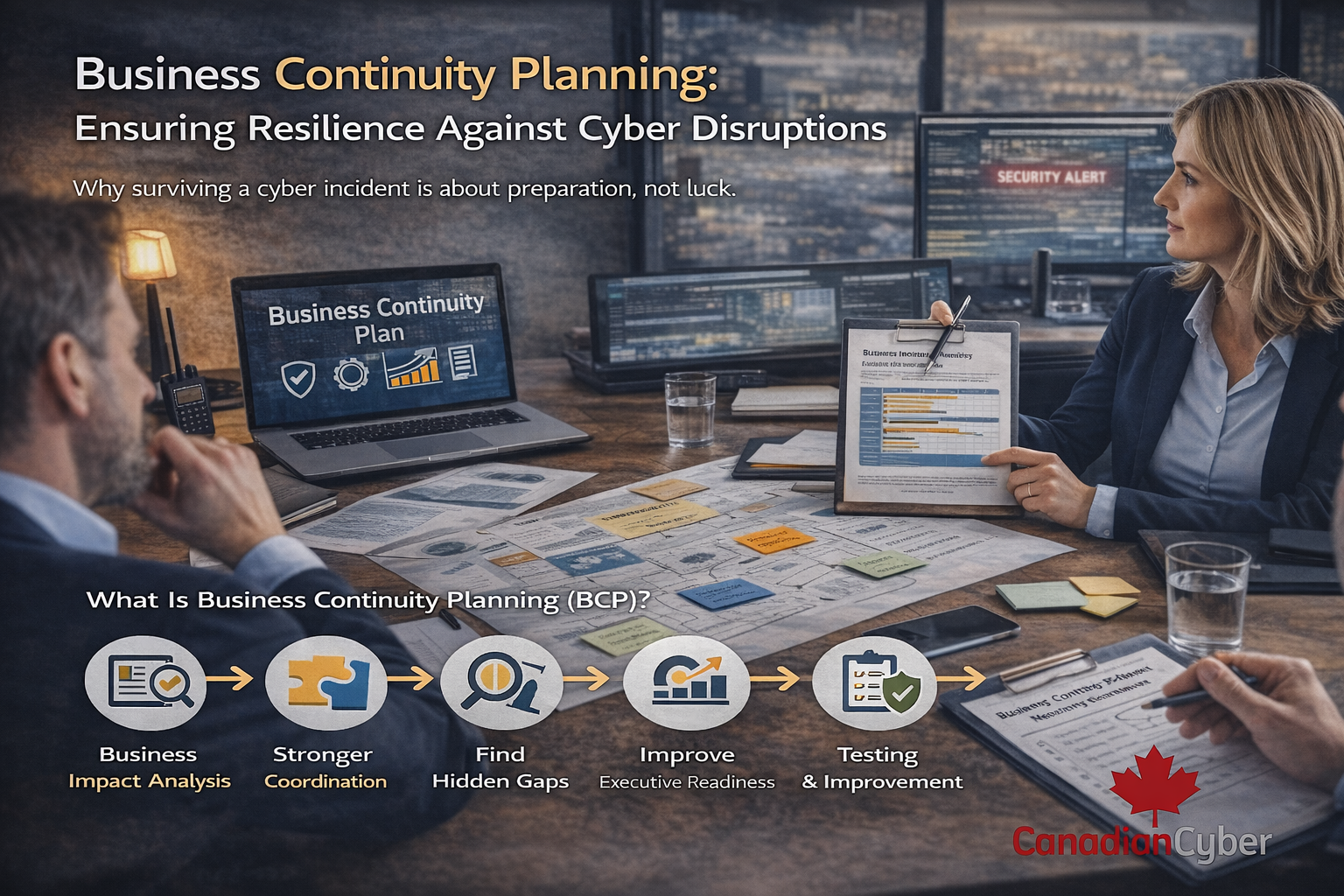
Business Continuity Planning: Ensuring Resilience Against Cyber Disruptions
Why surviving a cyber incident is about preparation, not luck.
Most cybersecurity discussions focus on prevention firewalls, monitoring tools, and threat detection. All of these matter. But they address only half the problem.
In today’s threat landscape, not every disruption can be prevented.
When ransomware encrypts systems or cloud services go down, the real question becomes: Can your business continue to operate?
Why Business Continuity Planning Is Critical Today
Cyber incidents no longer affect just IT. They affect operations, revenue, customer trust, regulatory obligations,
brand reputation, and long-term survival.
What cyber disruptions impact most
- Revenue (lost sales, delayed billing, penalties)
- Customer trust (service outages, missed SLAs)
- Regulatory exposure (privacy reporting and accountability)
- Brand reputation (public perception and media risk)
- Operational survival (extended downtime, cascading failures)
Reality check:
Industry research shows that three out of four organizations without a Business Continuity Plan fail within three years of a major disaster. That’s why continuity planning is no longer optional it’s a survival requirement.
What Is Business Continuity Planning (BCP)?
A Business Continuity Plan (BCP) prepares an organization to maintain or quickly resume critical operations during and after a disruption.
Common disruptions a BCP covers
- Cyberattacks and ransomware
- Cloud or data centre outages
- System failures and configuration incidents
- Human error and operational mistakes
- Supply chain or third-party disruptions
BCP focuses on keeping the business running even when technology is unavailable.
How ISO 22301 Supports Business Continuity
ISO 22301 is the international standard for Business Continuity Management (BCM).
It provides a structured, repeatable framework to build and improve continuity capability over time.
| ISO 22301 focus | What it enables |
|---|---|
| Identify critical activities | Clarity on what must continue during disruption |
| Understand impact | Business Impact Analysis (BIA) tied to real consequences |
| Define priorities & timelines | Recovery priorities, targets, and measurable objectives |
| Test and improve | Exercises, lessons learned, and continuous improvement |
ISO 22301 turns continuity from a reactive idea into a governed management system.
A Fictional Scenario: When Cyber Disruption Hits
This example is fictional but reflects real-world patterns.
A Canadian organization experienced a ransomware attack that shut down key systems. IT responded quickly systems were isolated and forensics began.
- Staff couldn’t perform core tasks
- Customers experienced service outages
- Leadership had no clear recovery timeline
- Manual alternatives were undefined
The incident response worked. The business continuity plan did not exist. The organization survived but at a high operational and financial cost.
Key Elements of an Effective Business Continuity Plan
A strong BCP focuses on what truly matters not every system, but every critical business function.
1) Business Impact Analysis (BIA) (what matters most)
A Business Impact Analysis identifies critical services, downtime tolerance, impact, and dependencies. This ensures recovery priorities align with business reality not assumptions.
| BIA output | Why it matters during cyber disruption |
|---|---|
| Critical processes | Protects what keeps revenue and operations running |
| Maximum tolerable downtime | Prevents “guessing” recovery priorities in a crisis |
| Impact analysis | Aligns IT actions with business consequences |
| Dependencies | Highlights vendor, people, and system reliance |
2) Backup and Recovery Capabilities (tested, not assumed)
Continuity depends on reliable recovery. Backups that are not tested regularly are not a continuity strategy.
A practical backup & recovery checklist
- Secure backups (protected from ransomware and unauthorized access)
- Defined restoration priorities (what comes back first, second, third)
- Recovery time targets (realistic, business-aligned)
- Regular restore tests (proof you can recover, not hope)
- Integrity validation (no reinfection, no corrupted data)
3) Alternative Operating Procedures (how work continues)
When systems fail, work must continue. Effective BCPs define manual or temporary processes to reduce downtime during extended outages.
Examples of continuity workarounds
- Manual intake and tracking for customer requests
- Alternative communication methods when email is down
- Temporary “minimum viable” processes for critical services
- Offline access to essential contacts, runbooks, and templates
- Defined vendor escalation paths for outages
4) Roles, Responsibilities, and Communication (clarity beats speed)
During a crisis, confusion amplifies damage. Your BCP must clearly define decision-makers, escalation paths, and communication responsibilities.
| Role | Primary responsibility | Common mistake to avoid |
|---|---|---|
| Incident/BCP Lead | Owns coordination and prioritization | Unclear authority to decide |
| IT/Security | Containment, restoration, validation | Restoring too early without checks |
| Legal/Privacy | Notifications and legal exposure | Engaged too late in the timeline |
| Comms/PR | Internal/external messaging | Inconsistent messages across channels |
5) Testing and Continuous Improvement (proof of readiness)
A BCP that isn’t tested is only theoretical. Testing builds confidence and resilience.
How mature organizations test continuity
- Business continuity tabletop exercises (leadership + operational teams)
- Restore and recovery testing (including validation checks)
- Lessons learned sessions after incidents and near misses
- Regular updates after major technology or vendor changes
Want a BCP That Works During a Cyber Outage?
Canadian Cyber helps organizations build continuity programs that are practical, tested, and aligned with cyber risk. If you want predictable recovery not guesswork, we can help.
👉 Explore Business Continuity & ISO Services
👉 Book a Free Consultation
The Business Continuity Planning (BCP) Maturity Model
Business continuity is not binary. Organizations mature over time. Understanding where you stand helps leadership decide what to improve next.
| Level | Mindset | What it looks like | Risk |
|---|---|---|---|
| 1 | Ad Hoc | No BCP, no testing, reliance on individuals | Very High |
| 2 | Documented | Basic plan exists, limited analysis, rarely tested | High |
| 3 | Defined | BIA done, critical functions prioritized, some testing | Moderate |
| 4 | Managed | Regular exercises, leadership involved, integrated with IR | Low–Moderate |
| 5 | Resilient | ISO 22301-aligned BCM, metrics tracked, continuous improvement | Low |
Why BCP Matters During Cyber Incidents
Cyber incidents often lead to extended outages, not short disruptions. Ransomware recovery can take days or weeks.
Organizations with tested BCPs can
- Resume operations faster
- Protect revenue streams
- Reduce customer impact and SLA risk
- Maintain regulator and insurer confidence
- Recover with less chaos and fewer surprises
Leadership’s Role in Business Continuity
Business continuity is not an IT document. It is a leadership responsibility.
What executives should do
- Support continuity planning and resource allocation
- Understand recovery priorities and trade-offs
- Participate in exercises and decision-making drills
- Approve communication expectations and thresholds
How a vCISO Strengthens Business Continuity
A Virtual CISO (vCISO) ensures continuity planning aligns with cyber risk and business strategy. This turns BCP from a static document into a resilience capability.
Where a vCISO adds the most value
- Integrates BCP with incident response planning
- Aligns ISO 22301 continuity practices with ISO 27001 governance
- Guides leadership during cyber disruptions
- Drives continuous improvement with measurable milestones
How Canadian Cyber Supports Business Continuity
At Canadian Cyber, business continuity is treated as a strategic resilience function not a compliance checkbox.
Business Continuity Management (ISO 22301)
- Business Impact Analysis (BIA) to identify critical functions
- BCP design with practical recovery workflows
- Testing programs and tabletop exercises
- Audit and review readiness support
Integrated Cyber Resilience
Our continuity work aligns with broader security governance so resilience improves across the organization.
- Incident response planning
- Cyber risk assessments
- ISO 27001 governance and controls
- vCISO leadership and executive reporting
Resilience Is Built Before the Crisis
When a cyber disruption occurs, it’s too late to plan. Organizations that survive are those that prepared.
Business continuity planning ensures that when systems go down, the business does not.
Ready to Strengthen Your Business Continuity Program?
If your organization wants to reduce downtime, protect revenue, and stay resilient during cyber disruptions, we can help.
Stay Connected With Canadian Cyber
Follow Canadian Cyber for insights on business continuity, cyber resilience, and security leadership: