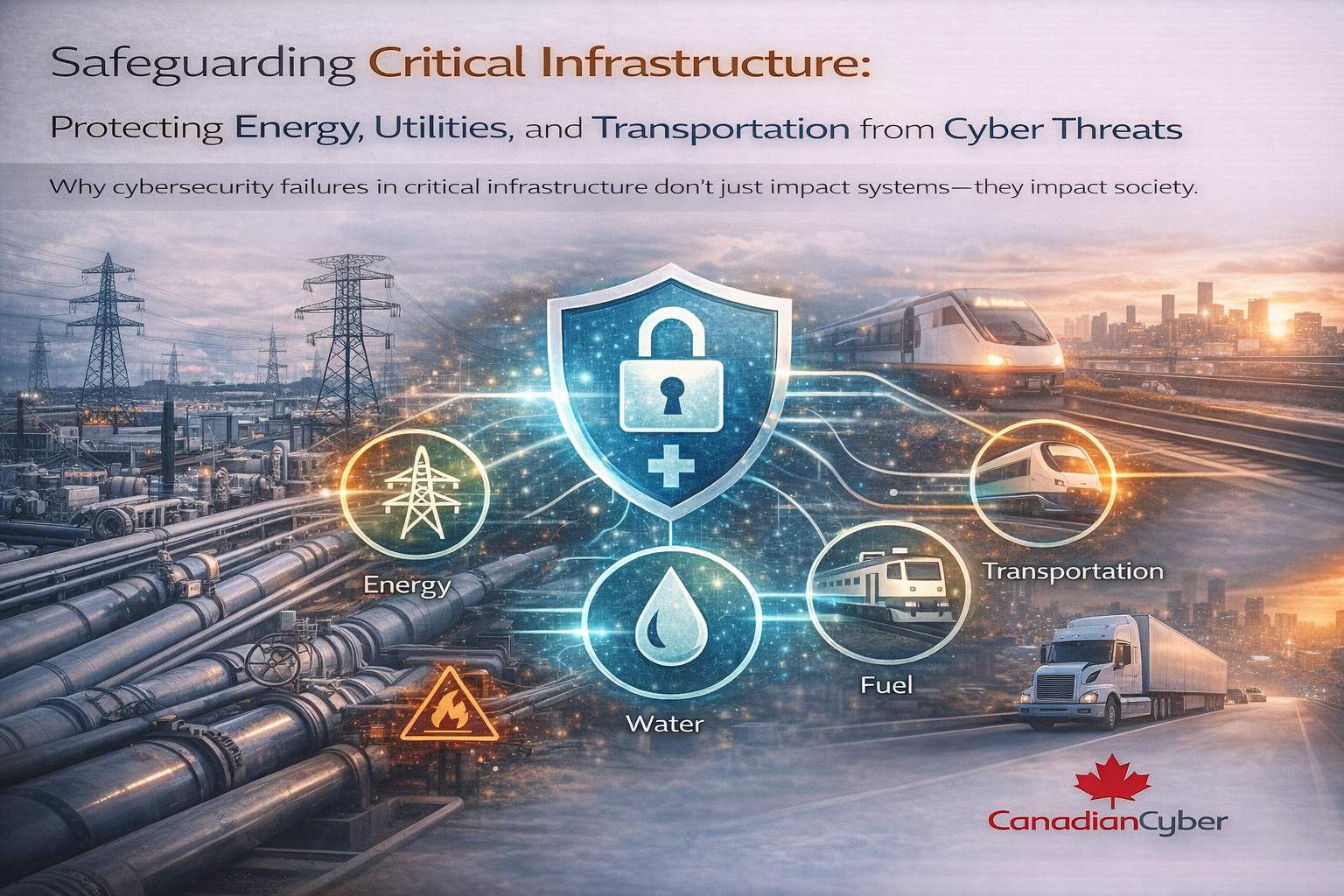
Safeguarding Critical Infrastructure: Protecting Energy, Utilities, and Transportation from Cyber Threats
Why cybersecurity failures in critical infrastructure don’t just impact systems they impact society.
When critical infrastructure works, it’s invisible. Lights turn on. Water flows. Trains run on time. Fuel reaches hospitals.
When it fails, everything stops.
Why this matters: Cyber threats to energy grids, water treatment facilities, and transportation networks are no longer theoretical.
The impact is public safety, economic stability, and national resilience.
Why Critical Infrastructure Is a High-Value Cyber Target
Critical infrastructure systems control the services society depends on every day. Disrupting them creates outsized pressure and visibility.
That’s why infrastructure operators are increasingly targeted by both criminal groups and nation-state attackers.
- Power: generation, transmission, and distribution
- Water: purification, distribution, and wastewater treatment
- Transportation: networks, logistics, rail, and operations systems
- Fuel: pipelines, refineries, and distribution
Disruption in these environments can endanger public safety, paralyze economies, and create national security risk.
That’s why governance and readiness matter as much as technology.
The Rise of Nation-State Cyber Threats
Nation-state actors and advanced persistent threats (APTs) often operate differently than criminal ransomware groups.
They are patient, strategic, and focused on long-term access.
What these attackers typically aim to do
- Map systems and identify weak points
- Learn dependencies across OT and IT
- Establish quiet access over time
- Prepare for disruption at a chosen moment
This is why detection, governance, and incident readiness are critical not just perimeter defenses.
Unique Cybersecurity Challenges in Critical Infrastructure
1) Operational Technology (OT) Environments
Energy and utility systems rely on SCADA systems, PLCs, control equipment, and industrial sensors.
Many OT environments were not designed with modern cybersecurity assumptions.
- Long lifecycles (often decades)
- Limited maintenance windows
- Modern patching is difficult
- Security changes must not disrupt operations
2) IT and OT Convergence
Modern infrastructure increasingly connects corporate IT systems, cloud platforms, and operational networks.
Without strong segmentation, a compromise in IT can become an OT incident.
3) Safety-Critical Operations
OT failures can cause physical damage, impact human safety, and trigger environmental harm.
Security controls must support availability and safety not disrupt them.
Practical reality: In critical infrastructure, cybersecurity must be engineered for safe operations.
Why Traditional Security Models Fall Short
Traditional perimeter-based security assumes trusted internal networks and clear boundaries.
Critical infrastructure environments don’t work this way.
Operators increasingly need security built on continuous verification, minimal implicit trust, and strong identity controls.
This is why Zero Trust principles are becoming essential including for operational networks.
Key Security Measures for Critical Infrastructure
The goal is to reduce risk without disrupting service delivery. These measures focus on resilience and safety-first design.
1) Zero Trust for Operational Networks
Zero Trust means no device or user is trusted by default. Access is based on identity and context, and activity is monitored continuously.
- Limits lateral movement
- Reduces blast radius
- Improves detection and containment
2) Network Segmentation and Isolation
Segmentation helps ensure IT incidents don’t become OT incidents. It also limits unnecessary access to critical systems.
- Define zones and conduits
- Restrict pathways between environments
- Monitor traffic across boundaries
3) Asset Visibility and Risk Prioritization
Operators need to know what exists, what’s critical, and how systems connect. Asset inventories are foundational to security.
- Maintain accurate IT and OT inventories
- Classify systems by safety and service impact
- Prioritize remediation based on consequence
4) Incident Response Preparedness
Critical infrastructure incidents require safety-first response, clear escalation, and coordination with external stakeholders when needed.
- Define leadership decision points
- Clarify roles across IT, OT, and operations
- Run tabletop exercises for realistic scenarios
5) Governance, Compliance, and Oversight
Security must align with national regulations, industry standards, and risk frameworks.
Governance ensures decisions are documented, intentional, and defensible.
- Define risk ownership and reporting cadence
- Maintain audit-ready documentation
- Track corrective actions and improvement
Why Leadership Matters More Than Ever
Cybersecurity in critical infrastructure is no longer just technical work. It is a governance issue, a resilience issue, and a public trust issue.
Boards and executives are increasingly expected to understand cyber exposure, oversee security strategy, and demonstrate preparedness.
Without leadership ownership, technical controls will eventually fail.
The Role of vCISO Services in Critical Infrastructure
Many operators face skills shortages, aging systems, and complex regulatory demands.
A Virtual CISO (vCISO) provides strategic cyber leadership without adding permanent headcount.
- Align IT and OT security strategy
- Translate technical risk into operational impact
- Support audits and regulatory reviews
- Deliver executive and board-ready reporting
A Fictional Example: Preventing Widespread Disruption
(This example is fictional but reflects real-world patterns.)
A utility provider invested heavily in monitoring tools, but governance was fragmented.
After engaging a vCISO, IT and OT risks were aligned, segmentation was strengthened, and incident response plans were tested.
When suspicious activity was detected, access was contained early and service continuity was preserved.
The tools helped leadership made the difference.
How Canadian Cyber Supports Critical Infrastructure Protection
At Canadian Cyber, we understand that protecting infrastructure means protecting society.
We focus on resilience, safety, and trust.
What we deliver
| Service | Outcome |
|---|---|
| vCISO Services | Strategic leadership, risk governance, and executive/regulator reporting |
| ISO 27001 & Framework Alignment | Practical ISMS implementation, risk-based controls, and audit readiness |
| Operational Resilience & Incident Readiness | OT-aware risk assessments, tabletop exercises, and recovery planning |
Cybersecurity Is Now Infrastructure Security
Energy, water, and transportation systems are no longer isolated. They are digital and therefore vulnerable.
Organizations that invest in governance, visibility, and leadership are better prepared to withstand disruption and protect the public.
Ready to Strengthen Critical Infrastructure Cybersecurity?
Let’s build governance, reduce operational risk, and improve readiness without disrupting safety-critical operations.
Stay Connected With Canadian Cyber
Follow Canadian Cyber for ISO 27001, SOC 2, and industry-specific cybersecurity insights: