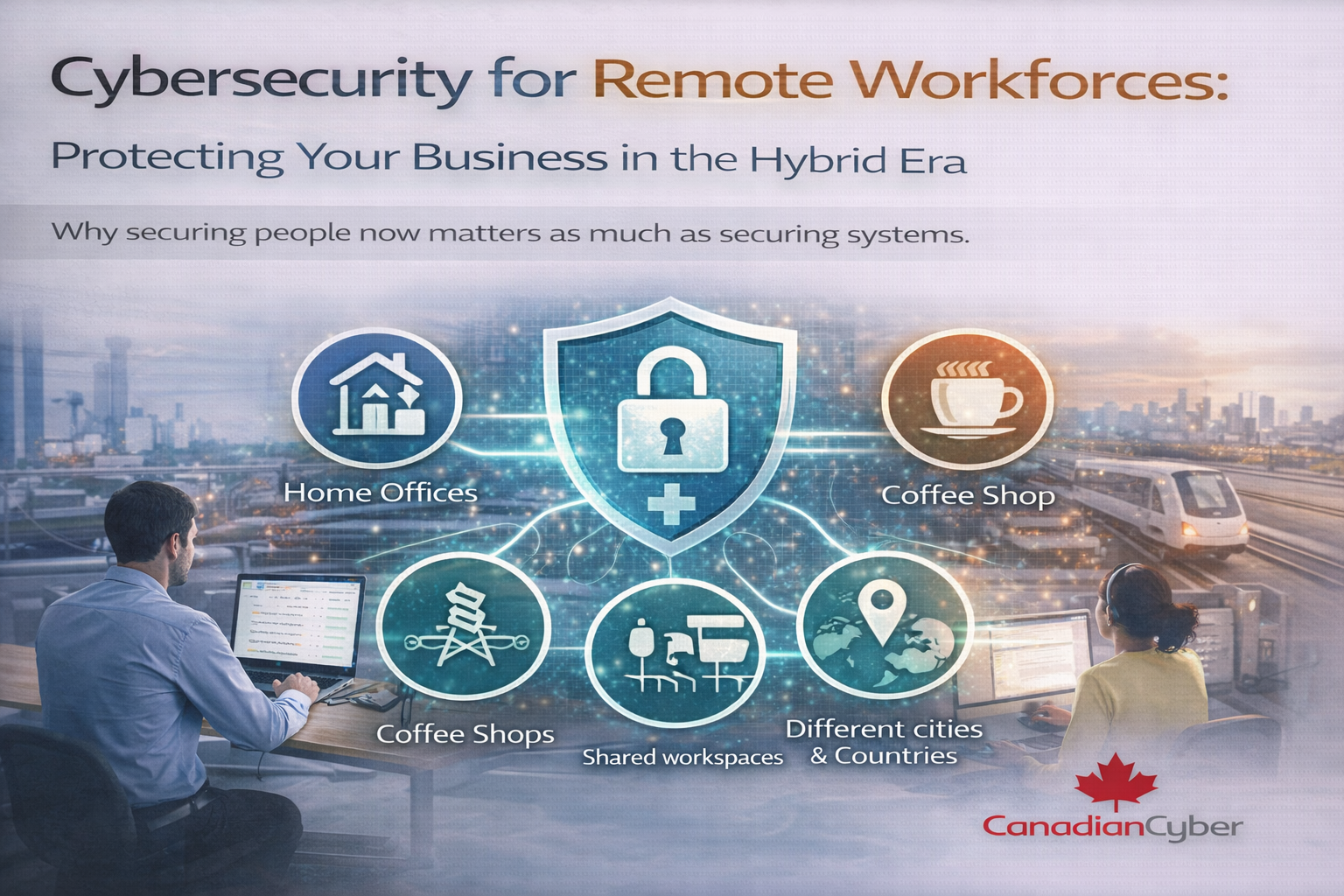
Cybersecurity for Remote Workforces: Protecting Your Business in the Hybrid Era
Why securing people now matters as much as securing systems.
Remote work is no longer a temporary shift. It’s how modern businesses operate.
Employees now work from home offices, coffee shops, shared workspaces, and even different cities and countries.
That flexibility unlocks productivity and talent but it also expands the attack surface dramatically.
Hybrid security reality: When the office no longer has walls, cybersecurity must follow the user not the building.
Why Remote Work Has Changed the Cybersecurity Landscape
In traditional office environments, networks were controlled, devices were centralized, and security teams had stronger visibility.
In hybrid and remote models, access happens everywhere and that changes the rules.
- Home networks vary widely in security
- Devices move constantly between networks
- Users access systems from anywhere, at any time
This shift introduces new risks like unsecured Wi-Fi, weaker endpoint protection, and increased phishing.
The solution is not more panic it’s better structure and better habits.
The Biggest Cyber Risks Facing Remote Workforces
1) Unsecured Home Office Networks
Many home networks use default router settings, share devices with family members, and have little monitoring.
Attackers don’t need to break into corporate offices anymore. They just need one weak home network.
2) Phishing and Social Engineering
Remote employees rely heavily on email and messaging, and they can’t always verify requests in person.
Attackers exploit isolation, urgency, and routine workflows.
3) Unmanaged or Poorly Managed Devices
Remote work often involves laptops used across networks, personal devices (BYOD), and inconsistent patching.
Unmanaged endpoints increase the risk of malware, credential theft, and lateral movement.
- Missing patches and outdated software
- Weak device encryption
- Inconsistent antivirus or EDR coverage
4) Over-Reliance on Perimeter Security
Traditional security assumes users are inside a trusted network. Remote work breaks that assumption.
Each connection should be treated as untrusted until proven otherwise.
Best Practices for Securing a Remote and Hybrid Workforce
Strong remote security is built on identity, device protection, data governance, and practical training.
These steps are simple, but they work.
1) Enforce Strong Identity and Access Controls
Identity is the new perimeter. Strong identity controls reduce account compromise dramatically.
- Enforce MFA across all critical systems
- Use role-based access so users only get what they need
- Run regular access reviews for staff and privileged users
2) Move Toward Zero Trust Access
Zero Trust means “never trust by default” and “always verify.”
It is especially effective for remote teams because it reduces hidden assumptions.
- Verify identity and device health before granting access
- Limit access by context (location, risk level, role)
- Reduce lateral movement if a user is compromised
3) Secure Devices, Not Just Networks
Remote work means devices are the new office. Protect them consistently, no matter where they go.
- Encrypt laptops and mobile devices
- Enforce patching and update policies
- Monitor endpoints for suspicious activity
- Use centralized device management for consistency
4) Protect Data Wherever It Lives
Remote work spreads data across cloud platforms, endpoints, and collaboration tools.
Data protection must travel with the information.
- Encrypt sensitive data at rest and in transit
- Restrict sharing and access to sensitive files
- Define clear data handling rules for remote teams
5) Train Employees to Recognize Threats
Technology alone can’t stop phishing. A well-trained employee is one of your strongest controls.
- Deliver short, regular security awareness training
- Use real examples your staff actually sees
- Provide a simple way to report suspicious messages
Why Governance Matters More in a Remote World
Remote work doesn’t remove responsibility. It increases it.
Policies must reflect remote realities, risks must be documented, and controls must be reviewed continuously.
Common gap: Most organizations don’t struggle with tools. They struggle with ownership and follow-through.
The Role of vCISO Services in Securing Remote Work
A Virtual CISO (vCISO) helps organizations adapt security strategy to modern work models without adding full-time headcount.
The goal is clarity and leadership not more complexity.
- Define remote access and device policies
- Align controls with ISO 27001 and SOC 2
- Translate technical risk into business impact
- Provide executive-level oversight and reporting
A Fictional Example: Securing a Distributed Team
(This example is fictional but reflects real-world patterns.)
A growing company adopted remote work quickly. Productivity improved, but security visibility declined.
After engaging a vCISO, MFA was enforced, device management was standardized, phishing training was introduced, and incident response plans were updated.
When a phishing attempt occurred, it was reported early and contained. Work continued uninterrupted.
How Canadian Cyber Helps Secure Remote Workforces
At Canadian Cyber, we help organizations secure flexibility without sacrificing control. We focus on people, process, and technology together.
Our support for hybrid teams
| Service | What you get |
|---|---|
| vCISO Services | Remote security strategy, risk reporting, and leadership oversight |
| ISO 27001 & SOC 2 Support | Remote-ready ISMS design, audit readiness, and continuous compliance |
| Awareness & Incident Readiness | Phishing training, incident response planning, and tabletop exercises |
Remote Work Is Here to Stay — Security Must Keep Up
Hybrid work is the new operating model. Organizations that adapt their cybersecurity approach will reduce risk, maintain trust, and enable growth.
Those that don’t often struggle quietly until an incident forces change.
Ready to Secure Your Remote Workforce?
Let’s protect your people, data, and systems wherever work happens with practical controls and clear ownership.
Stay Connected With Canadian Cyber
Follow Canadian Cyber for ISO 27001, SOC 2, and practical cybersecurity insights for modern workforces: