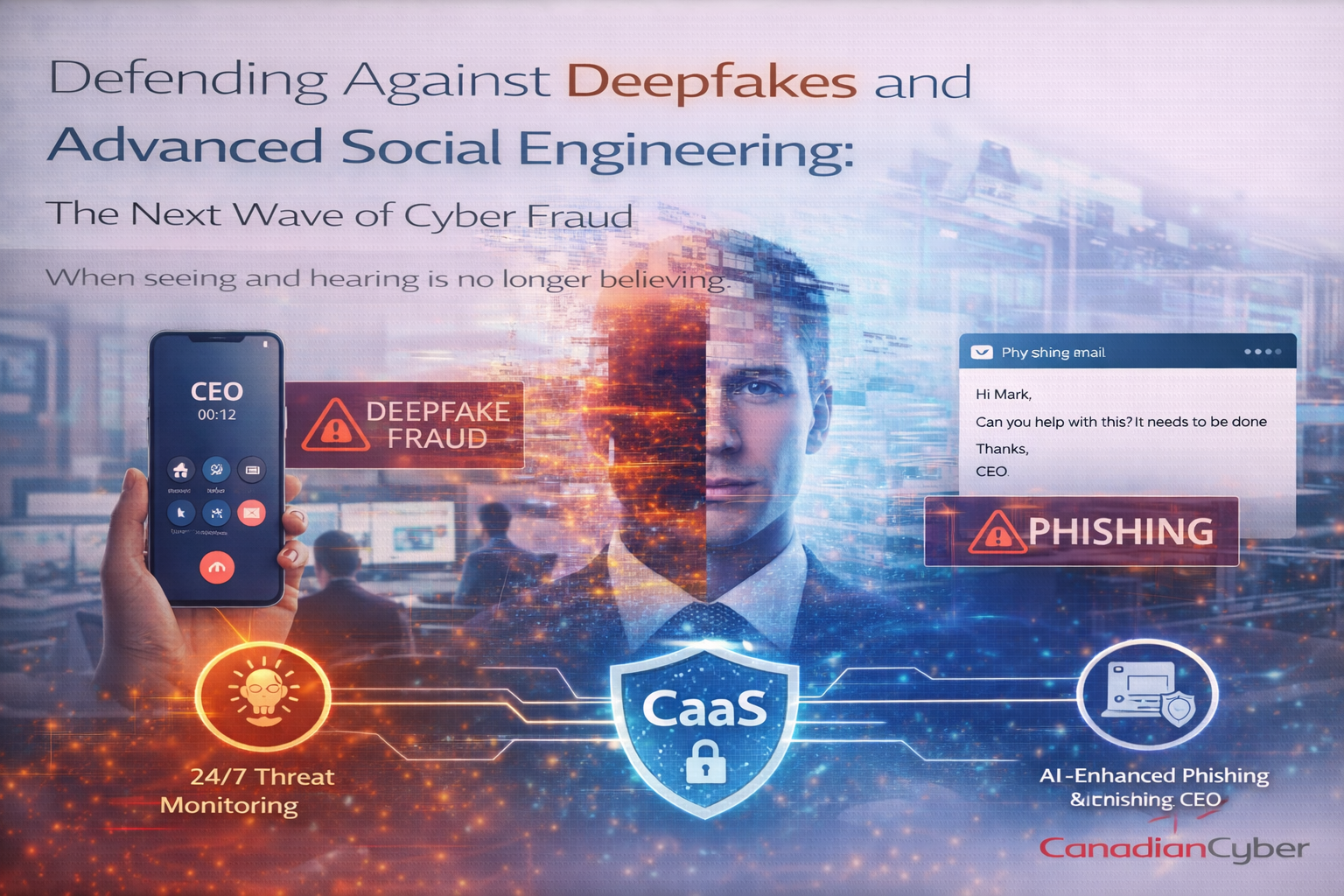
Defending Against Deepfakes and Advanced Social Engineering: The Next Wave of Cyber Fraud
When seeing and hearing is no longer believing.
For years, cybersecurity training focused on spotting suspicious emails.
Today, that’s no longer enough.
Attackers are now using deepfake audio, deepfake video, and AI-generated messages to impersonate executives, vendors, and trusted partners with alarming accuracy.
Reality check: In some cases, a single phone call has been enough to trigger fraudulent wire transfers, sensitive data disclosure, and irreversible financial loss.
This is not science fiction. It’s the next evolution of social engineering and it’s targeting human decision-making at the highest levels.
What Are Deepfakes (and Why They’re So Dangerous)?
Deepfakes use artificial intelligence to clone voices, generate realistic video, and mimic speech patterns and tone.
Unlike traditional scams, deepfakes don’t rely on poor grammar or obvious red flags.
They rely on trust.
A trusted voice. A familiar face. A believable request.
That’s what makes deepfakes so effective.
How Deepfake Fraud Works in the Real World
Deepfakes are rarely used alone. They’re usually part of a multi-step fraud attempt where attackers combine impersonation with urgency,
authority, and business context.
1) Voice Cloning Attacks
Attackers gather short audio samples from public sources like interviews, webinars, or social media clips.
AI models can recreate a convincing voice with minutes of audio.
A finance employee gets a call: “This is urgent. I need you to process this payment now.”
The voice sounds exactly like the CEO.
2) Video-Based Impersonation
Deepfake video can impersonate executives during virtual meetings, fake vendor verification calls, and bypass informal approvals.
As remote work increases, these attacks become easier to execute.
3) AI-Enhanced Phishing and Messaging
Deepfake fraud often works alongside AI-written emails, personalized messages, and accurate business context.
This creates highly convincing multi-channel attacks that feel legitimate in every direction.
Why Traditional Security Controls Struggle
Most technical controls are designed to stop malware, network attacks, and unauthorized access.
Deepfake fraud targets something else: human decision-making.
Key point: Firewalls don’t question authority. Antivirus doesn’t verify intent.
Deepfake risk is a governance and process challenge not only a technical one.
Industries Most at Risk from Deepfake Fraud
Deepfake attacks are especially dangerous where trust, urgency, and financial actions intersect.
- Finance and accounting teams handling payments and vendor changes
- Executives and board members whose authority can trigger action
- Legal and procurement departments managing contracts and sensitive approvals
- Remote-first organizations with heavy reliance on virtual communication
How Organizations Can Defend Against Deepfake and Social Engineering Attacks
The strongest defenses against deepfake fraud combine process discipline, security culture, and targeted technical controls.
Here’s what works:
1) Strengthen Verification Procedures
The most effective defense is process discipline. Organizations should require secondary verification for sensitive requests, use out-of-band confirmation (call-back via known numbers), and separate approval from execution.
Urgency should never override verification.
2) Train Employees Beyond “Phishing Awareness”
Training must evolve to include deepfake audio/video examples, realistic fraud scenarios, and clear escalation paths.
Employees should feel supported not blamed when they question a request.
3) Establish Clear Executive Communication Protocols
Executives should avoid approving financial or sensitive actions via informal channels and clearly communicate how urgent requests will be handled. Culture plays a critical role in prevention.
4) Use Technical Detection Tools Where Appropriate
Detection tools can analyze voice inconsistencies, flag synthetic media, and detect anomalous communication patterns.
They are most effective when paired with strong governance not relied on alone.
5) Include Deepfake Risk in Incident Response Planning
Incident response plans should now address social engineering fraud, executive impersonation, and financial manipulation.
Prepared teams respond faster and with less confusion.
A Fictional Example: Stopping a Deepfake Wire Fraud
(This example is fictional but reflects real-world patterns.)
A finance manager received a call from what sounded like the CEO. The request was urgent. The tone was familiar.
But the organization had one rule: all urgent payment requests require a second verification.
A call-back confirmed the truth. The request was fake. The loss was avoided.
Process beat persuasion.
Why Leadership Involvement Is Critical
Deepfake attacks exploit hierarchy. Without leadership support, employees hesitate to question authority and verification steps get skipped. Fraud succeeds quietly.
- Executives must support a verification culture
- Process adherence must be protected, not punished
- Security-first decision making must be reinforced consistently
Tone at the top matters. If leaders model verification and support employees who slow down, fraud becomes much harder to execute.
The Role of vCISO Services in Managing Deepfake Risk
A Virtual CISO (vCISO) helps organizations turn deepfake defense from an ad-hoc reaction into a structured security program.
A vCISO helps by:
- Identifying social engineering and executive impersonation risks
- Designing secure approval and verification workflows
- Updating training programs to reflect modern fraud patterns
- Aligning controls with ISO 27001 and SOC 2 requirements
How Canadian Cyber Helps Organizations Stay Ahead
At Canadian Cyber, we help organizations address modern, human-focused cyber risks with governance, discipline, and practical readiness. We focus on resilience not fear.
How we support deepfake resilience
| Service | What you get |
|---|---|
| vCISO Services | Risk governance, executive and board reporting, policy and workflow design |
| ISO 27001 & SOC 2 Support | Social engineering risk coverage, control implementation, audit-ready documentation |
| Security Awareness & Readiness | Practical training, incident preparedness, continuous improvement support |
Trust Is Still Essential — But It Must Be Verified
Deepfakes challenge one of the oldest assumptions in business:
“If it sounds right, it must be real.”
In today’s threat landscape, verification is not distrust it’s protection.
Organizations that adapt now will avoid costly lessons later.
Ready to Strengthen Your Defense Against Deepfake Fraud?
Let us help you build processes and awareness that protect your people even when attackers sound convincing.
Stay Connected With Canadian Cyber
Follow Canadian Cyber for ISO 27001, SOC 2, and practical cybersecurity insights: