How to Build an Effective Incident Response Plan
What happens in the first 60 minutes matters more than any security tool.
Most organizations believe they’ll “figure it out” if a cyber incident happens.
They won’t. When a real incident hits ransomware, data exposure, account takeover confusion spreads faster than malware. Decisions are rushed. Messages conflict. Systems stay down longer than necessary.
An Incident Response Plan (IRP) exists to prevent exactly that chaos. It doesn’t stop incidents from happening it controls the damage when they do.
Quick Snapshot
| Category | Detail |
|---|---|
| Goal | Reduce downtime, confusion, and business impact during incidents |
| Focus | Roles, communications, phases, evidence, and recovery |
| Best practice | Test the plan through tabletop exercises |
| Key idea | You don’t rise to the occasion you fall back on your plan |
Why Incident Response Planning Is No Longer Optional
Cyber incidents are not rare events anymore. They are operational risks.
The difference between a minor disruption and a major business crisis often comes down to preparation. Organizations with documented and tested incident response plans can detect, contain, and mitigate incidents faster reducing financial and reputational damage.
A Different Way to Think About Incident Response
Instead of thinking about incident response as a document, think about it as a playbook for high-pressure moments.
An effective IR plan answers questions like:
- Who makes decisions when systems are down?
- Who talks to customers, regulators, or law enforcement?
- Who isolates systems and how?
- What happens first and what waits?
- How do we recover safely without reinfection?
If these answers aren’t clear before an incident, they won’t be clear during one.
A Fictional Timeline: The First 90 Minutes of an Incident
This example is fictional but reflects real response patterns.
| Time | What Happens Without a Plan |
|---|---|
| 09:12 | An employee reports they can’t access shared files. A ransom note appears. |
| 09:15 | IT starts investigating. Leadership is not yet informed. |
| 09:25 | Another system fails. Confusion grows. “Should we shut everything down?” |
| 09:40 | Legal, IT, and leadership join the call but no one is sure who’s in charge. |
| 10:00 | Systems are disconnected. No record is kept of what was changed. |
| 10:30 | Customers notice outages. No communication plan exists. |
Now imagine the same incident with an incident response plan: roles are defined, decisions are structured, and actions follow a known sequence. The difference is night and day.
The Core Components of an Effective Incident Response Plan
A strong IR plan doesn’t need to be long. It needs to be clear, realistic, and practiced.
1) Clear Roles & Responsibilities (Ownership)
Every incident response plan must define who does what especially when pressure is high.
| Role | Primary responsibility |
|---|---|
| Incident Lead | Owns coordination, decisions, and response tempo |
| Technical Lead | Containment, investigation, eradication, recovery execution |
| Comms Lead | Internal messaging, customer notices, public statements (approved) |
| Legal / Privacy | Breach analysis, notification guidance, regulatory requirements |
| Scribe (Documentation) | Logs actions, decisions, timestamps, evidence locations, approvals |
During an incident, uncertainty wastes time. Roles should be named with backups and contact details.
2) Defined Communication Channels (Stay coordinated)
Incidents often disrupt normal communication. Your plan must work even when email or Slack is compromised.
| Scenario | Planned channel |
|---|---|
| Email unavailable / suspected compromise | Out-of-band comms (phone bridge, secure chat, emergency SMS) |
| Internal staff updates | Pre-approved message + single source of truth channel |
| Customer / partner communications | Designated spokesperson + legal-approved templates |
Poor communication causes more damage than many attacks. One voice, one channel, clear timing.
3) Step-by-Step Response Phases (Sequence matters)
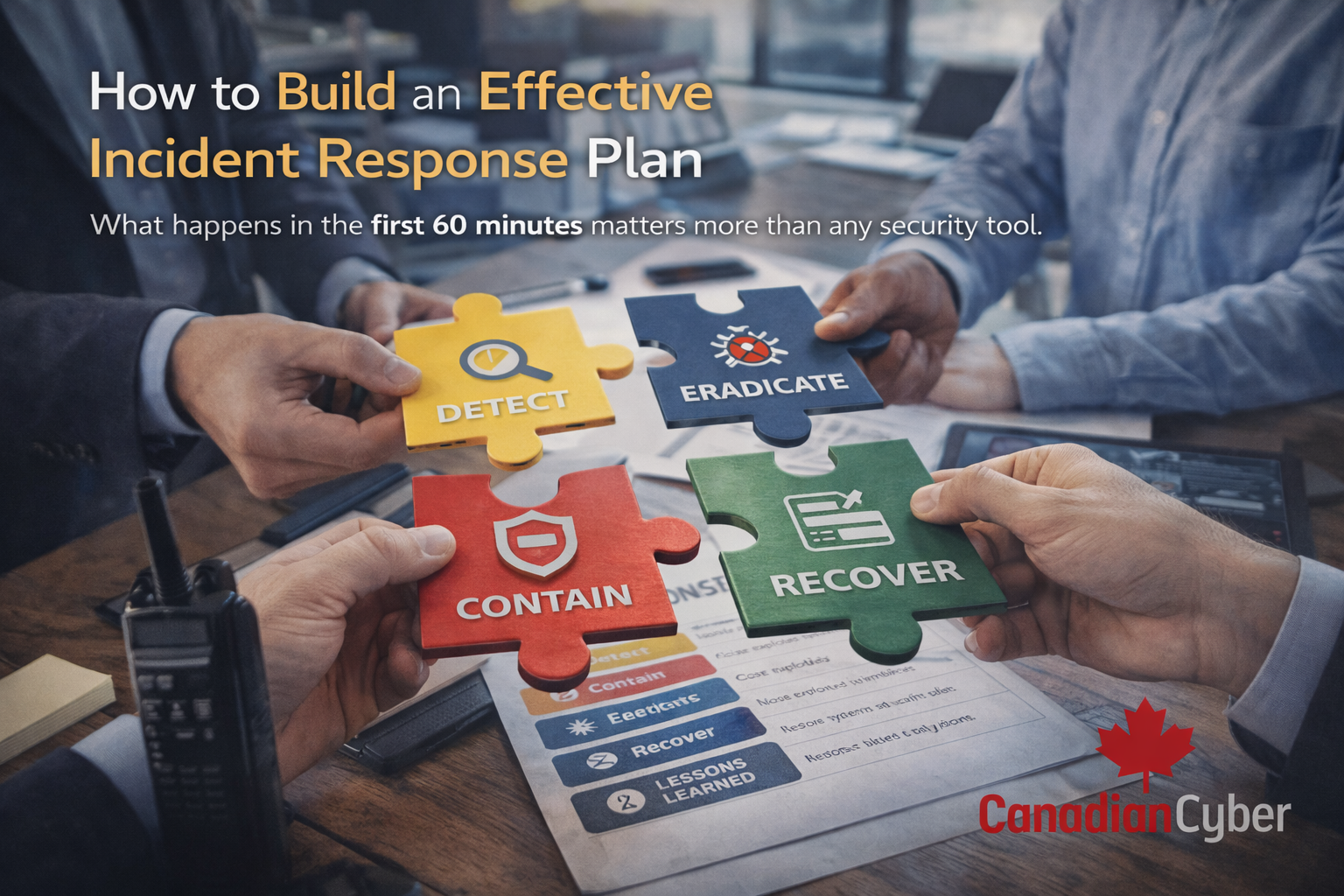
An effective IR plan follows a simple lifecycle (commonly aligned with NIST SP 800-61): detection, containment, eradication, and recovery.
| Phase | What you do | Common mistakes |
|---|---|---|
| Detection | Confirm incident, scope affected assets, start logging | Assuming it’s “just an outage” |
| Containment | Isolate systems, block IOCs, limit spread, preserve evidence | Shutting everything down blindly |
| Eradication | Remove malware/access, close exploited vulnerabilities | Not fixing root cause |
| Recovery | Restore safely, validate integrity, monitor for reinfection | Rushing systems back online |
Skipping steps or rushing recovery is how organizations get reinfected.
4) Evidence & Decision Logging (Memory fails)
During incidents, memory fails. Your plan should require consistent logging of actions and decisions.
Log at minimum:
- What happened (initial symptoms) and when
- Who made which decision (and why)
- Actions taken (containment steps, blocks, changes)
- Evidence preserved (logs, images, alerts, artifacts)
- External notifications (insurance, legal, regulators) and timing
Documentation is critical for legal review, regulatory response, insurance, and post-incident learning.
5) External Considerations (Don’t improvise)
A mature IR plan also considers decisions you do not want to improvise under pressure:
- Privacy breach notifications: who evaluates and triggers notifications, and under which conditions
- Cyber insurance: when to notify, what evidence is required, what actions need approval
- Law enforcement: when to engage and who coordinates
- Vendors & third parties: how to coordinate if cloud/SaaS providers are impacted
- Public communications: who approves messaging and where templates live
Want a Practical IR Plan Built for the First 60 Minutes?
We help you build incident playbooks that define roles, communications, and step-by-step actions so your team responds calmly under pressure.
Explore Incident Response Planning Services
Book a Free Consultation
A Practical Incident Response Plan Checklist
Use this as a quick gut-check. If several boxes are missing, the plan isn’t ready yet.
| IR Plan Element | Status |
|---|---|
| Named incident response lead + backup | ☐ Ready / ☐ Needs work |
| Escalation paths and contact list (updated) | ☐ Ready / ☐ Needs work |
| Defined response phases (detection → recovery) | ☐ Ready / ☐ Needs work |
| System isolation procedures (practical steps) | ☐ Ready / ☐ Needs work |
| Communication templates (internal + external) | ☐ Ready / ☐ Needs work |
| Evidence handling and decision logging guidance | ☐ Ready / ☐ Needs work |
| Recovery steps + integrity validation checks | ☐ Ready / ☐ Needs work |
| Post-incident review process (lessons learned) | ☐ Ready / ☐ Needs work |
Why Practicing the Plan Matters as Much as Writing It
An untested incident response plan is a false sense of security. Tabletop exercises help teams:
- Understand their roles
- Identify gaps in the plan
- Improve decision-making under pressure
- Reduce panic during real events
Organizations that practice incident response respond faster and recover sooner.
The Leadership Role in Incident Response
Incident response is not just technical. It is a leadership function.
Executives must:
- Support preparation efforts
- Participate in tabletop exercises
- Understand escalation decisions
- Accept that some risk decisions are business decisions
Many plans fail not because they are poorly written but because leadership isn’t engaged.
How a vCISO Strengthens Incident Response Readiness
A Virtual CISO (vCISO) helps turn incident response from a document into a capability.
A vCISO helps organizations:
- Design realistic IR plans and playbooks
- Align response with business priorities
- Coordinate legal, IT, and leadership roles
- Run tabletop exercises and readiness drills
- Continuously improve response maturity
How Canadian Cyber Helps Organizations Prepare for Incidents
At Canadian Cyber, incident response planning is treated as a core resilience activity not an afterthought.
| Service | What you get |
|---|---|
| Incident Response Planning & Playbooks | IR plans aligned with NIST, roles & escalation paths, practical response steps |
| Tabletop Exercises | Executive simulations, technical scenarios, and lessons-learned workshops |
| vCISO Leadership | Incident response strategy, leadership guidance, alignment with privacy & compliance obligations |
Preparation Is What Reduces Damage
Cyber incidents are stressful. But chaos is optional. Organizations with effective incident response plans:
- Detect incidents faster
- Contain damage sooner
- Recover with confidence
- Protect trust
The plan you build today determines how you perform on your worst day.
Ready to Build an Incident Response Plan That Actually Works?
If you want to reduce downtime, confusion, and impact during cyber incidents, preparation is the place to start.
Stay Connected With Canadian Cyber
Follow Canadian Cyber for practical guidance on incident readiness, governance, and cybersecurity leadership: