Your First SOC 2 Audit Doesn’t Have to Be Painful
A Practical Readiness Checklist for First-Time Compliance
First-time SOC 2 can feel like a black box. This guide explains what “audit-ready” really means and gives you a simple checklist to prepare calmly before the auditor arrives.
Read time: 5–7 minutes
Keywords: SOC 2 readiness checklist, first SOC 2 audit, SOC 2 scope, SOC 2 controls, SOC 2 evidence, vCISO
You don’t need perfection. You need a clear scope, solid policies, working controls, assigned owners, and organized evidence.
Do a readiness assessment before you book the audit.
The first time a customer asks for a SOC 2 report, it usually lands with a thud.
You may hear questions like:
- “Are we ready for this?”
- “How long will it take?”
- “What does an auditor actually expect?”
The reality:
SOC 2 is manageable when preparation starts early and stays organized.
What “SOC 2 audit-ready” really means
Being audit-ready does not mean perfection.
It means your program is clear, owned, and evidenced.
SOC 2 rewards preparation, not heroics.
Step 1: Define and lock your SOC 2 scope
Everything starts with scope. A tight scope reduces effort, risk, and audit cost.
Define:
- Which systems are in scope (apps, infrastructure, identity)
- Which services customers rely on
- Which Trust Services Criteria apply (most start with Security)
Tip: If you can’t explain scope in one paragraph, it’s too broad.
Step 2: Document core security policies
Auditors expect written policies that match how your company actually operates.
Policies do not need to be long but they must be clear and approved.
Minimum set for first-time SOC 2:
- Access control policy
- Incident response policy
- Change management policy
- Risk management policy
- Vendor management policy
Step 3: Implement key SOC 2 controls
Policies alone aren’t enough. Auditors test whether controls are operating.
Start with controls that most SOC 2 Security scopes require.
Focus first: Identity, access, change, logging, backups, incident handling.
- User access provisioning and periodic access reviews
- Multi-factor authentication (MFA) for critical systems
- Logging and monitoring (with alerts where appropriate)
- Secure backups (and proof you can restore)
- Incident handling procedures and escalation paths
Step 4: Assign clear control ownership
One of the most common audit issues is confusion during interviews.
Every control needs a clear owner who understands the “why” and can show the “proof.”
- A named control owner
- Defined responsibilities
- Evidence they can explain
Step 5: Start collecting evidence early
Evidence proves controls are working. If you wait until audit season, SOC 2 becomes stressful.
Common evidence examples:
- Access review records (screenshots, exports, tickets)
- Change tickets and approvals
- Policy approvals and version history
- System logs and monitoring alerts
- Security awareness training records
Best practice:
Store evidence centrally so you can retrieve it in minutes, not days.
Step 6: Conduct a SOC 2 readiness assessment
Before engaging an auditor, run a readiness assessment.
It helps you identify gaps early and fix them calmly.
Think of it as: a rehearsal, not a test.
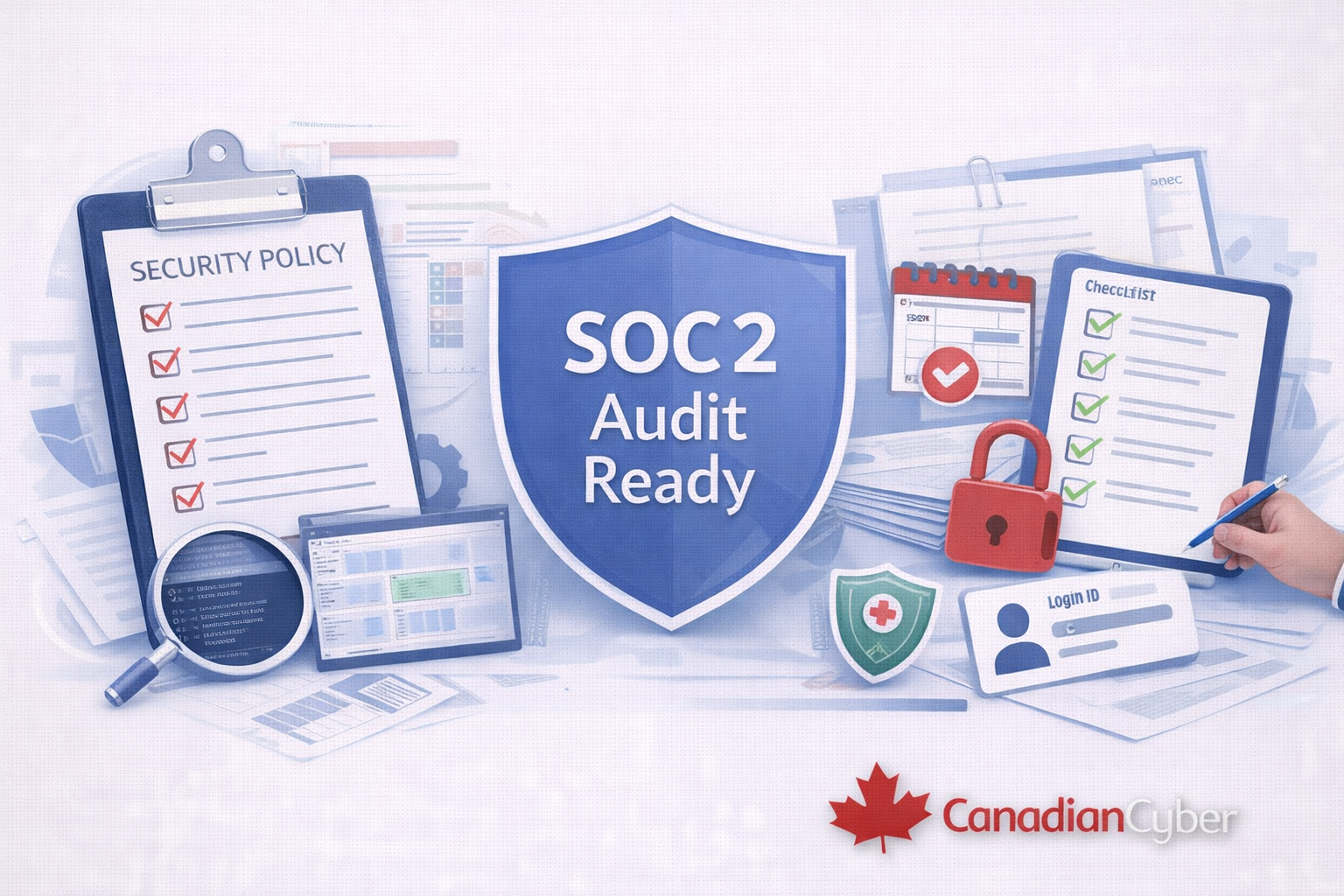
Quick snapshot: first-time SOC 2 readiness checklist
Want to know exactly what an auditor will flag?
Get a readiness check that confirms your scope, control coverage, and evidence before you’re on the audit clock.
How Canadian Cyber helps first-time SOC 2 teams
Canadian Cyber supports organizations new to SOC 2 by making the process clear, structured, and measurable.
Our vCISO-led approach removes guesswork and keeps teams calm.
- Clarify SOC 2 scope and criteria (without over-scoping)
- Create audit-ready policies that reflect real operations
- Implement practical controls and define ownership
- Organize evidence in a structured ISMS (Microsoft 365-friendly)
- Run readiness assessments to reduce surprises
A common first-time mistake to avoid
Many companies wait until the audit is booked to prepare.
That usually creates rushed fixes and higher costs.
Rule of thumb: Start readiness before the audit clock starts.
Final thought
Your first SOC 2 audit is a milestone not a threat.
With a clear checklist and steady preparation, it becomes predictable and manageable.
Prepare early, keep evidence organized, and make sure owners can confidently explain what’s in place.
That’s how first-time SOC 2 becomes a win.
Ready to make SOC 2 feel simple?
Get a clear plan, clean evidence, and confident control owners so the audit is just a formality.
Stay Connected With Canadian Cyber
Follow us for practical guidance on SOC 2, ISO 27001, vCISO leadership, and compliance readiness: