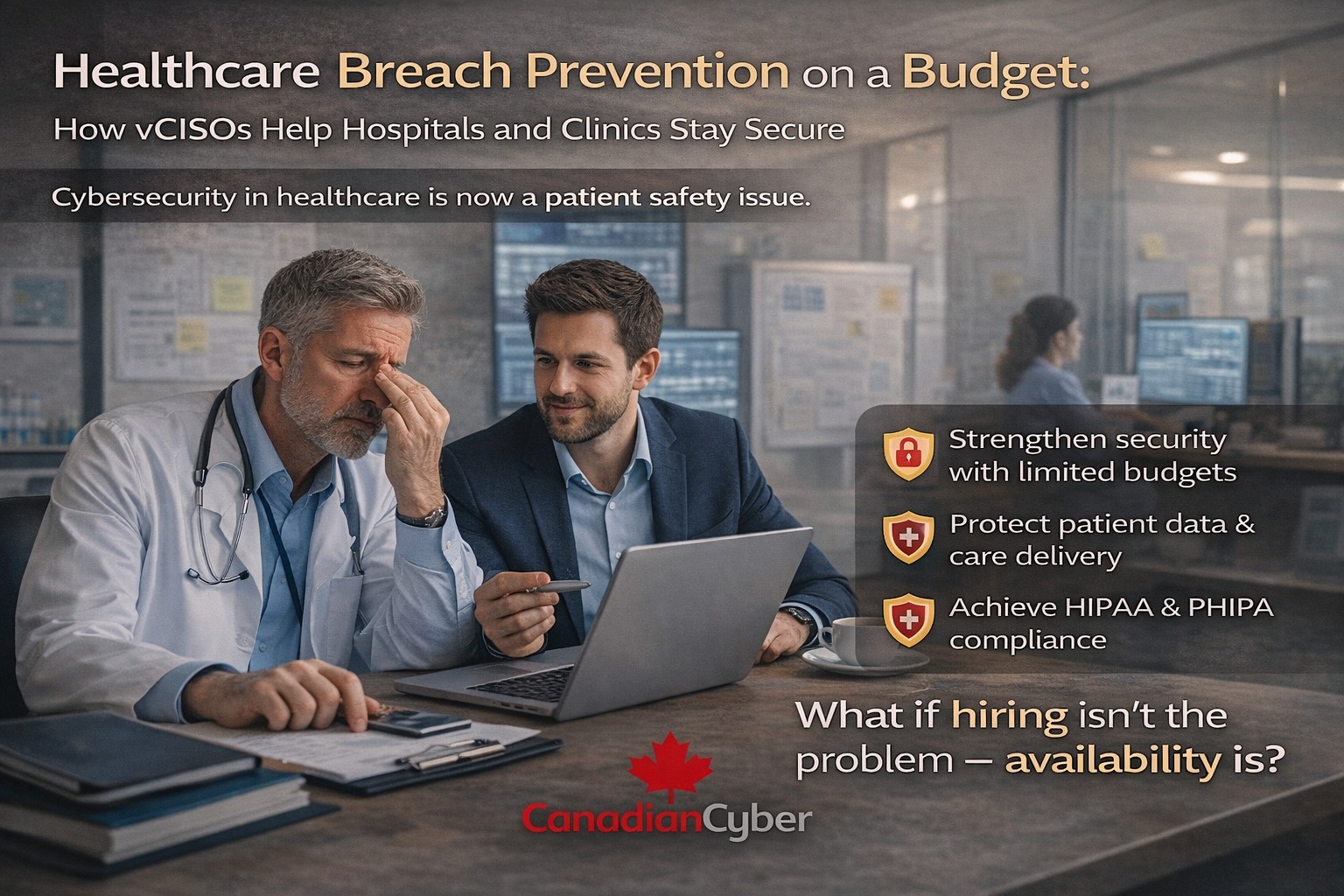
Healthcare Breach Prevention on a Budget: How vCISOs Help Hospitals and Clinics Stay Secure
Why cybersecurity in healthcare is no longer just an IT issue it’s a patient safety issue.
Healthcare organizations face a difficult reality: they’re heavily regulated, chronically underfunded, operationally complex, and one of the most targeted sectors for cyberattacks.
Ransomware, breaches, and outages no longer just disrupt operations they can put patient care at risk.
Yet most hospitals and clinics don’t have the budget or capacity for a full in-house security leadership team.
This is where Virtual CISO (vCISO) services are becoming essential.
Quick Snapshot (For Healthcare Leaders)
| Challenge | What it creates | What helps |
|---|---|---|
| Limited budgets | Security gaps + reactive spending | Risk-based roadmap |
| Complex workflows | Controls that block care or get bypassed | Clinically aligned security |
| High attack frequency | Ransomware + downtime risk | Incident readiness |
Why Healthcare Is a Prime Target for Cybercriminals
Healthcare data is uniquely valuable because it includes personal identifiers, medical histories, insurance and billing data, and prescription information.
Why attackers like healthcare data
- It can’t be “reissued” like a credit card
- Operational urgency increases pressure to pay or rush recovery
- Downtime risk can disrupt care delivery
Bottom line: Cybersecurity failures in healthcare have real human consequences.
The 2024–2025 Healthcare Threat Landscape
Healthcare risk is expanding beyond traditional IT systems. Security complexity is growing even as resources remain limited.
Emerging risks
- Connected medical devices (IoT)
- Telehealth platforms
- Cloud-hosted patient portals
- Third-party service providers
Persistent challenge
- Legacy systems that can’t be easily patched
- Mixed environments across departments
- Limited visibility into vendor controls
Why Traditional Security Models Don’t Work in Healthcare
Most healthcare organizations face constraints like tight operating margins, a shortage of specialized security talent, complex clinical workflows, and regulatory pressure from multiple directions.
Two common failure modes
- Hiring a full-time CISO is unrealistic for many hospitals and clinics
- Delegating security fully to IT or vendors leaves leadership and governance gaps
Healthcare needs leadership not just tools.
What a vCISO Brings to Healthcare Organizations
A vCISO provides experienced security leadership without full-time cost.
For hospitals and clinics, this means security becomes coordinated not reactive.
What “leadership” looks like in practice
| vCISO focus | Healthcare outcome |
|---|---|
| Clear security ownership | Decisions are documented and defensible |
| Risk-based prioritization | Budget is spent where patient impact is highest |
| Clinical workflow alignment | Controls support care instead of blocking it |
| Executive incident guidance | Calm escalation and coordinated response |
How vCISOs Help Meet Healthcare Regulations
Healthcare organizations must comply with requirements such as HIPAA (United States), PHIPA (Canada), and provincial/state privacy regulations. A vCISO translates legal requirements into practical controls.
Common “must-have” control areas
- Access management for clinical systems
- Secure handling of patient data (PII/PHI)
- Incident response planning and breach procedures
- Vendor risk management and third-party access oversight
Compliance becomes manageable when it’s mapped to real workflows not treated as paperwork.
Incident Readiness Matters More Than Perfection
In healthcare, incidents are not hypothetical. Auditors don’t expect perfection they expect readiness and coordination.
What matters most
- Early detection
- Clear escalation
- Safe clinical continuity
- Accurate communication
How a vCISO supports readiness
- Incident response plans that match real care scenarios
- Defined roles for clinical and executive leadership
- Tabletop exercises that reduce panic under pressure
A Fictional Example: Strengthening a Regional Healthcare Network
(This example is fictional but reflects real-world healthcare patterns.)
A regional healthcare network relied on outsourced IT support. Security tools existed. Policies existed.
But no one owned cybersecurity.
After engaging a vCISO:
- Patient data flows were mapped
- High-risk systems were prioritized
- Vendor access was reviewed
- Incident response plans were tested
When a ransomware attempt occurred, systems were isolated quickly, patient services continued, and regulators were notified correctly.
Technology helped but leadership made the difference.
Why vCISO Services Are Budget-Friendly for Healthcare
vCISO services work well for healthcare because they scale with organizational size, focus on the highest-risk areas, avoid long hiring cycles, and reduce reliance on emergency consultants.
A practical budget principle
Instead of spreading limited resources thinly, invest where risk is highest: systems that support care delivery, access to PHI, and incident readiness.
Security That Supports Patient Care
Healthcare cybersecurity should never block care. A vCISO helps ensure controls respect clinical workflows, support availability, prioritize safety, and balance risk with care delivery.
The goal: Security that clinicians can follow in real life not controls that get bypassed under pressure.
How Canadian Cyber Supports Healthcare Organizations
At Canadian Cyber, we understand healthcare realities and build programs that improve security without disrupting care.
What we deliver (without complexity)
🔹 vCISO Services for Healthcare
- Healthcare-specific risk assessments
- Regulatory-aligned security programs
- Executive and board reporting
🔹 Compliance & Privacy Support
- HIPAA and PHIPA alignment
- ISO-based governance where appropriate
- Practical documentation and evidence
🔹 Incident & Readiness Support
- Incident response planning
- Tabletop exercises for real scenarios
- Breach preparedness and communication
Security without disruption. Compliance without complexity.
Cybersecurity Is Now Part of Patient Safety
In healthcare, cybersecurity failures affect more than data. They affect care delivery, trust, and outcomes.
Organizations that treat security as a leadership responsibility not just IT are better prepared for what’s ahead.
Ready to Strengthen Healthcare Security Without Breaking the Budget?
If you need healthcare-ready security leadership, audit support, and incident readiness without adding headcount we can help.
Stay Connected With Canadian Cyber
Follow Canadian Cyber for healthcare-ready vCISO guidance, ISO 27001 insights, and practical breach prevention: