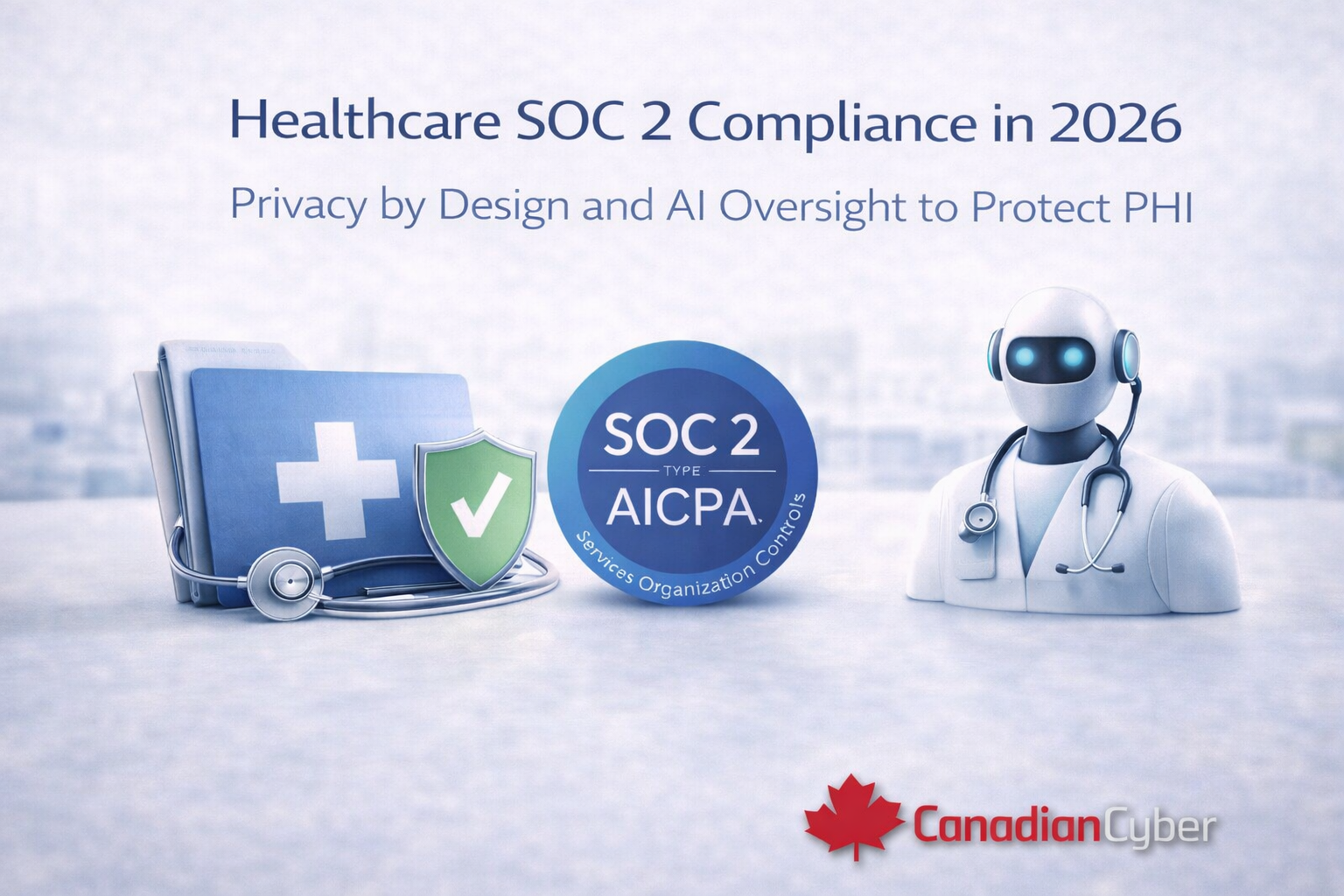
Healthcare SOC 2 Compliance in 2026: Privacy by Design and AI Oversight to Protect PHI
Healthcare runs on trust. Patients trust providers with their most sensitive data.
Hospitals trust vendors to protect it. Regulators expect proof.
In 2026, healthcare organizations increasingly expect independent security assurance.
For HealthTech and healthcare SaaS providers, SOC 2 Type II is becoming a minimum requirement.
Quick snapshot: SOC 2 for healthcare in 2026
| Risk | Expectation | Outcome |
|---|---|---|
| PHI exposure | Privacy by design + provable security controls | Lower vendor risk friction |
| Regulatory scrutiny | Accountability, audit trails, incident readiness | Faster approvals |
| AI adoption | AI oversight: access, change control, monitoring, review | Trust in new capabilities |
Why healthcare vendors face higher security expectations
Healthcare data isn’t just sensitive. It’s permanent.
Personal Health Information (PHI) commonly includes:
- Medical records
- Diagnostic data
- Prescription histories
- Insurance and billing information
A single breach can cause long-term harm to patients and severe consequences for vendors.
That’s why healthcare buyers demand proof, not promises.
The compliance reality in 2026
Healthcare organizations now expect vendors to align with privacy and security requirements, including:
- PHIPA (Ontario)
- PIPEDA (Canada-wide)
- Law 25 (Quebec)
- Hospital and health-authority security frameworks
SOC 2 doesn’t replace these laws. It demonstrates that your controls support them and operate consistently over time.
SOC 2 Type II: the healthcare trust signal
SOC 2 Type II shows that your security and privacy controls:
Exist
Policies and processes are defined and assigned to owners.
Are designed properly
Controls match the risk of PHI systems and workflows.
Operate over time
Evidence proves consistency, not a one-time effort.
For hospitals and clinics, this translates into faster vendor approvals, fewer questionnaires,
and reduced onboarding friction. SOC 2 becomes a trust accelerator.
Privacy by design is no longer optional
Healthcare buyers now expect privacy built into systems from day one. In practice, that means:
- Least-privilege access to PHI
- Strong encryption at rest and in transit
- Clear data retention and deletion rules
- Logging and monitoring of PHI access
SOC 2 helps formalize and validate these practices with ownership, evidence, and repeatable reviews.
The new factor: AI in healthcare
AI is transforming healthcare: diagnostics, telehealth, patient triage, and clinical decision support.
But AI introduces new risks and new buyer questions.
SOC 2 doesn’t regulate AI directly, but it forces governance.
Controls around access, change management, monitoring, and incident response matter more than ever.
AI oversight: a growing expectation
Healthcare organizations are asking hard questions, such as:
- Who can access training data?
- How are models secured?
- Are AI outputs auditable?
- How do you prevent misuse or bias?
Selling HealthTech solutions to hospitals or clinics?
Build trust with SOC 2 Type II and a privacy-by-design program that buyers can validate.
Mapping SOC 2 controls to healthcare privacy laws
Healthcare vendors often worry about overlap. A strong SOC 2 program supports privacy obligations by strengthening:
access control, logging, incident response, vendor oversight, and retention practices.
| Healthcare expectation | SOC 2 support (practical view) |
|---|---|
| PHI safeguards | Least privilege, encryption, monitoring, and incident readiness |
| Accountability | Owners, approvals, evidence trails, and regular reviews |
| Transparency and retention | Documented data handling, retention rules, and deletion evidence |
Common SOC 2 gaps in HealthTech
We frequently see gaps that slow audits and raise buyer concerns:
- Access reviews for PHI and clinical systems are inconsistent
- Incident response planning is incomplete or untested
- Vendor and third-party risk management lacks evidence
- AI system change control is unclear (who approves and when)
Preparing for healthcare vendor due diligence?
Avoid last-minute SOC 2 gaps and build a clean, buyer-friendly evidence story.
How Canadian Cyber supports healthcare SOC 2 compliance
Canadian Cyber understands healthcare environments. We help HealthTech companies by:
- Running SOC 2 readiness assessments and gap remediation plans
- Mapping controls to PHI-focused privacy requirements
- Supporting AI risk oversight (access, change control, monitoring)
- Preparing teams for Type II audits and buyer scrutiny
Why SOC 2 matters more in healthcare than anywhere else
In healthcare, trust isn’t abstract. It affects patient outcomes.
SOC 2 Type II gives hospitals and clinics confidence that PHI is protected and monitored,
and that privacy is treated as a first-class requirement.
Final thought
Healthcare vendors don’t lose opportunities because of features.
They lose them because buyers can’t trust how data is handled.
SOC 2 Type II, combined with privacy by design and AI oversight, is how HealthTech companies earn that trust in 2026.
Protect PHI. Prove security. Win healthcare customers.
Talk to Canadian Cyber about healthcare SOC 2 readiness, privacy by design, and AI oversight that buyers trust.
Stay Connected With Canadian Cyber
Follow us for practical insights on healthcare security, SOC 2, and privacy compliance: