

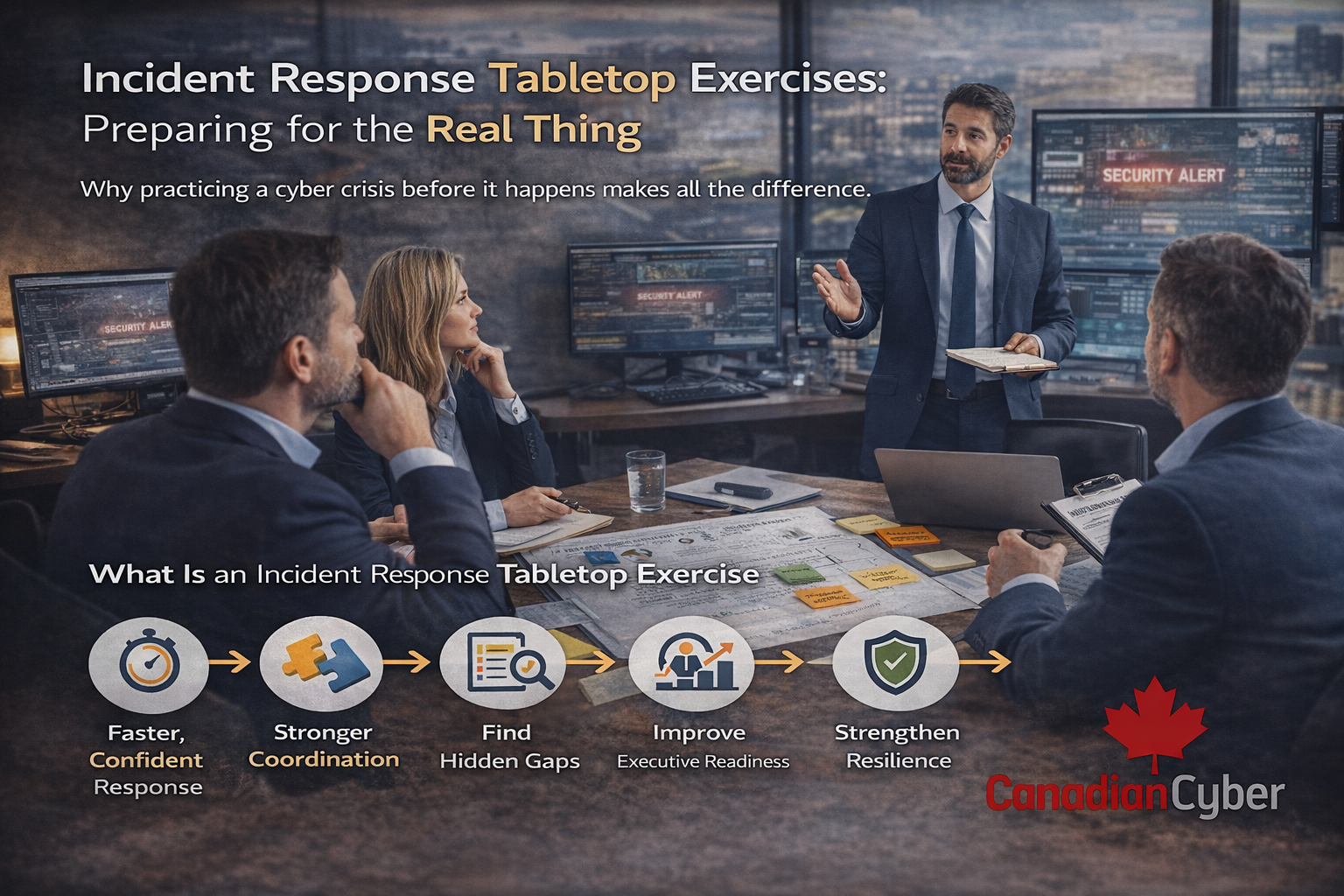
Incident Response Tabletop Exercises: Preparing for the Real Thing
Why practicing a cyber crisis before it happens makes all the difference.
Most organizations have an incident response plan. Far fewer have actually tested it.
When a real cyber incident happens ransomware, data breach, system compromise there is no time to read policies or debate roles.
Decisions must be made quickly, clearly, and under pressure.
Incident response tabletop exercises don’t stop attacks from happening. They make sure your organization knows how to respond when they do.
What Is an Incident Response Tabletop Exercise?
A tabletop exercise is a discussion-based simulation of a cyber incident. There is no live attack. No systems are disrupted. No real data is touched.
Instead, key stakeholders walk through a realistic scenario together and answer one question at a time:
“What would we do next?”
Tabletop exercises help teams practice roles and decision-making in a safe, no-impact environment before real pressure exists.
Quick Snapshot: Tabletop vs Real Incident
| Category | Tabletop Exercise | Real Incident |
|---|---|---|
| Impact | No operational disruption | Downtime, loss, pressure |
| Goal | Practice decisions and coordination | Contain, eradicate, recover |
| Risk | Controlled learning environment | High stakes, time-sensitive |
| Outcome | Plan improvements and clarity | Business continuity and trust at risk |
Why Incident Response Plans Alone Are Not Enough
Many organizations assume that having a written incident response plan means they are prepared. In reality, plans often fail because day-to-day reality doesn’t match what the document assumes.
Common failure points (what tabletops reveal early)
- Roles are unclear or duplicated
- Escalation paths and contacts are outdated
- Communication breaks down under pressure
- Leadership expectations are misaligned
- Decisions are delayed due to uncertainty
Tabletop exercises expose these gaps early when fixing them is easy.
How Tabletop Exercises Actually Work
A strong tabletop exercise is structured, realistic, and focused on decision-making. It typically follows three simple steps.
Step 1: Introduce a Realistic Scenario (relevant to your risk)
The scenario should reflect your industry, size, and actual attack surface.
Example scenarios
- Ransomware encrypting file servers or cloud shares
- Phishing email leading to credential theft
- Third-party vendor breach impacting your data
- Suspicious data exfiltration from a critical system
- Account takeover affecting executive or admin accounts
Step 2: Walk Through Decisions as a Team (one prompt at a time)
Participants explain how response would work in practice not theory.
| Discussion prompt | What you confirm |
|---|---|
| Detection | How it’s found, who triages, what “incident” means internally |
| Notification | Who is notified, when leadership joins, escalation rules |
| Containment | What is isolated first, who approves disruption, evidence handling |
| Communication | Internal updates, external messaging, customer/regulator approach |
| Recovery | Restore priorities, validation steps, “back to normal” criteria |
Step 3: Capture Gaps and Improve the Plan (the real value)
Without pressure, teams often realize key assumptions were wrong and that’s a win. These insights are what strengthen your incident response capability.
Common gaps that surface
- Two people thought the other owned the decision
- Legal or privacy was not included early enough
- Communication templates were missing or not approved
- Backup and recovery assumptions were untested
- Vendor contacts and SLAs were unclear during an outage
Want a Tabletop Exercise Built Around Your Real Risks?
Canadian Cyber designs realistic scenarios, facilitates the session, and turns lessons learned into clear improvements so your team is ready when a real incident hits.
👉 Explore Tabletop Exercise Services
👉 Book a Free Consultation
Why Tabletop Exercises Build “Muscle Memory”
Tabletop exercises build faster, more instinctive responses by letting teams rehearse their roles in a simulated crisis. When a real incident occurs, rehearsed responses kick in sooner with less hesitation.
What “incident response muscle memory” looks like
- Clear ownership of decisions and approvals
- Faster containment actions without debate
- Better executive alignment on priorities
- Less panic and fewer conflicting messages
- More confident recovery and validation steps
A Fictional Example: The Difference Practice Makes
This example is fictional but reflects common patterns.
During a tabletop exercise, leadership disagreed on a key question: Shut systems down immediately or preserve forensic evidence first?
- The disagreement surfaced early (no harm done).
- Decision authority was clarified.
- The incident response plan was updated.
- Leadership expectations were aligned.
Weeks later, when a real security alert occurred, the response was calm and coordinated because the team had already practiced the hard decisions.
Key Benefits of Incident Response Tabletop Exercises
Tabletop exercises deliver value well beyond compliance. They improve incident readiness, reduce confusion, and strengthen cross-team coordination.
| Benefit | What it improves |
|---|---|
| Faster response | Less uncertainty, quicker containment and escalation |
| Better coordination | IT, legal, privacy, comms, and leadership work as one team |
| Gap discovery | Missing templates, weak procedures, unclear authority |
| Executive readiness | Clarity on decisions, business impact, and communication expectations |
| Resilience | Improved readiness over time, faster recovery, fewer surprises |
How Often Should Tabletop Exercises Be Run?
Incident response readiness should evolve as your organization changes. Most organizations benefit from running tabletop exercises on a predictable schedule.
Recommended frequency
- At least once per year
- After major system, cloud, or business changes
- When leadership or key response roles change
- Following significant incidents or near misses
The Role of Leadership and a vCISO in Tabletop Exercises
Tabletop exercises are most effective when guided by experienced leadership. They should be practical, focused, and tied to real business priorities.
How a vCISO strengthens tabletop outcomes (turning discussion into action)
- Designs realistic scenarios aligned to your risk profile
- Facilitates balanced discussions across departments
- Keeps the exercise structured and outcome-focused
- Translates gaps into plan updates and governance improvements
- Ensures lessons learned become measurable progress
How Canadian Cyber Facilitates Tabletop Exercises
At Canadian Cyber, tabletop exercises are designed to be practical, engaging, and business-focused not performative.
| What we deliver | What it includes |
|---|---|
| Tabletop facilitation | Realistic incident scenario, structured prompts, guided decisions |
| Gap identification | Contacts, escalation paths, templates, roles, technical assumptions |
| Actionable outcomes | Lessons learned, prioritized improvements, plan and playbook updates |
| vCISO-led readiness | Executive alignment, risk-based improvements, maturity growth over time |
Preparation Is What Makes the Difference
When a cyber incident happens, it’s not the plan that saves you. It’s the people who have practiced using it.
Tabletop exercises turn theory into confidence and confusion into clarity.
🚀 Ready to Practice Before the Real Thing Happens?
If your organization wants to be prepared not just compliant tabletop exercises are a powerful step forward.
Stay Connected With Canadian Cyber
Follow Canadian Cyber for practical guidance on incident response, resilience, and cybersecurity leadership: