

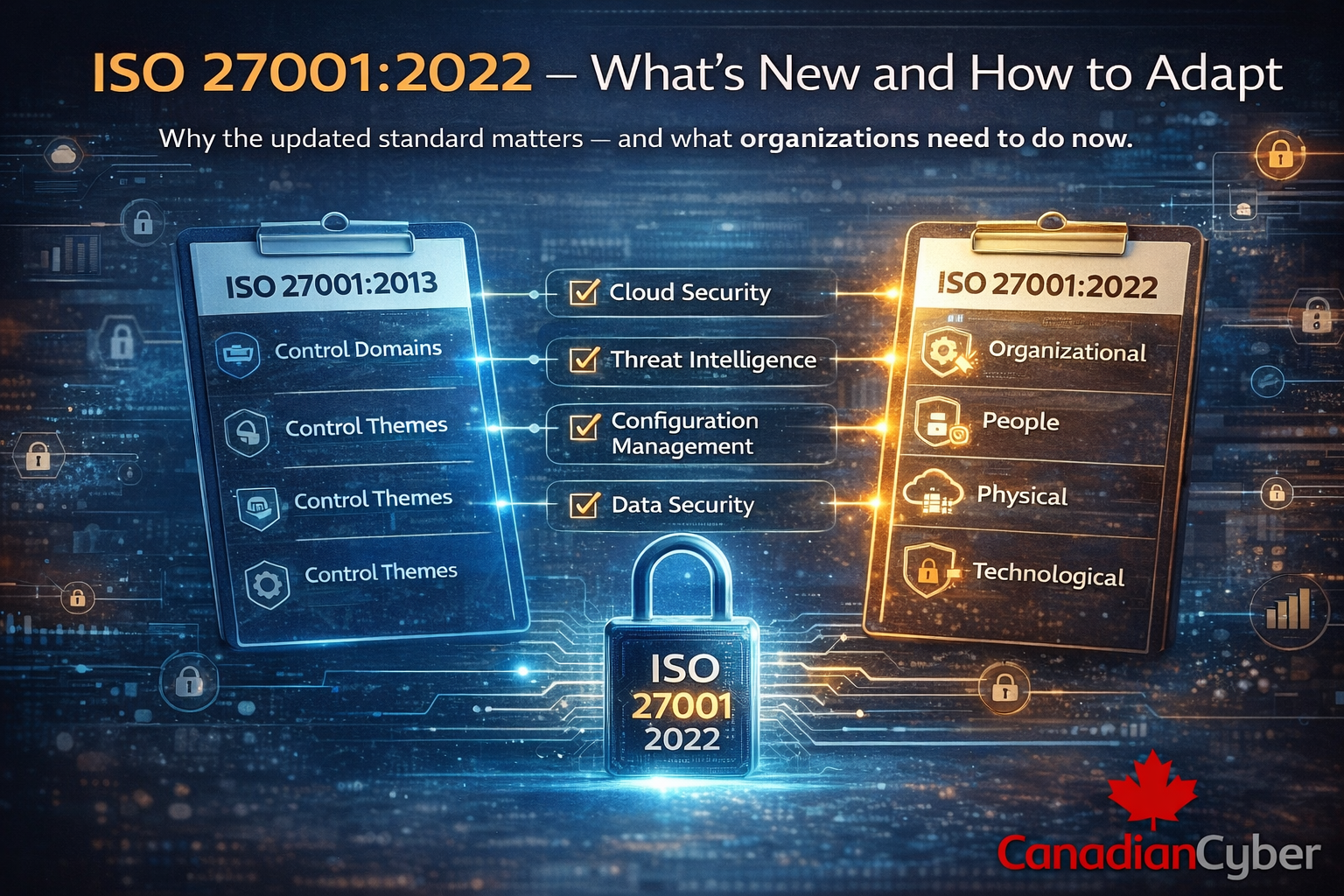
ISO 27001:2022 What’s New and How to Adapt
Why the updated standard matters and what organizations need to do now to stay audit-ready without disrupting the business.
ISO 27001 has always evolved with the threat landscape, but ISO/IEC 27001:2022 is not a cosmetic refresh.
It reflects how dramatically cloud adoption, remote work, supply-chain risk, and modern threats have changed.
For organizations already certified and those planning certification the big question is:
What’s changed in ISO 27001:2022 and how do we adapt without disrupting the business?
The good news: most organizations don’t need to “rebuild” their ISMS. They need to map, update, and prove a few key areas more clearly especially around cloud, configuration, threat intelligence, and resilience.
Why ISO 27001 Was Updated
The 2013 edition was built for a different operating model. Since then:
- Cloud services became the default for infrastructure and business apps
- Remote and hybrid work exploded
- Supply-chain attacks increased
- Ransomware became a business continuity issue
- Automation and AI entered daily operations
Key point: ISO 27001:2022 modernizes Annex A and aligns it with ISO/IEC 27002:2022, making controls easier to apply and maintain in today’s environments.
The Big Picture: What Actually Changed?
The core ISMS model is familiar. The biggest practical change is Annex A the control set that supports your risk treatment plan.
Annex A was reduced and reorganized to better match how organizations operate (not just how IT is structured).
ISO 27001:2013 vs ISO 27001:2022 Side-by-Side
The 11 New Controls in ISO 27001:2022 (Annex A)
Several controls were merged or renamed, but the standout change is the addition of 11 new controls that reflect modern security realities.
These “new” controls don’t necessarily mean brand-new tooling. For many SMBs, it means clearer governance, better evidence, and tighter operational discipline.
Need help mapping ISO 27001:2013 to ISO 27001:2022?
We’ll review your ISMS, update your SoA mapping, and build an auditor-ready transition plan — without overengineering.
What Did Not Change (And That’s Important)
ISO 27001 is still a management system. The fundamentals remain the same:
- Scope: what’s in your ISMS, and what’s not
- Risk assessment: identify, evaluate, and treat information security risk
- Statement of Applicability (SoA): selected controls + justification
- Internal audit & management review: governance and oversight
- Continuous improvement: corrective actions and measurable progress
How to Adapt to ISO 27001:2022 (Practical Steps)
Whether you’re newly implementing or transitioning from 2013, a clean adaptation plan is usually a mapping + evidence exercise. Here’s a practical sequence.
- Confirm your Annex A mapping (2013 controls → 2022 controls) and update your SoA accordingly.
- Review the 11 new controls and decide: implement, partially implement, or justify exclusion based on risk.
- Validate cloud governance (responsibilities, requirements, IAM, logging, supplier oversight).
- Strengthen secure configuration management (baselines, drift monitoring, change control evidence).
- Formalize threat intelligence inputs and show how they influence risk and controls.
- Connect cyber resilience to continuity (RTO/RPO, recovery tests, IR/BC alignment).
- Run an internal audit against the 2022 structure and close gaps with corrective actions.
ISO 27001:2022 Transition Checklist (Fast Read)
Pro tip for SMBs:
Don’t overcomplicate scoring or tooling to “look compliant.” Auditors reward clarity, consistency, and evidence that matches your real operations.
Transition Timing: What to Know
Many certification bodies referenced a three-year transition window, with ISO 27001:2013 certificates expiring/withdrawing by
October 31, 2025.
If you were certified to ISO 27001:2013 and haven’t transitioned, you should treat this as urgent: speak with your certification body and close the gap immediately.
How Canadian Cyber Helps You Adapt (Without the Chaos)
We help Canadian and global SMBs transition and implement ISO 27001:2022 in a way that stays practical and audit-ready.
- SoA & Annex A mapping: clean mapping from 2013 to 2022 with clear control justification
- Risk-driven updates: integrate the 11 new controls into your risk treatment plan
- Evidence-first implementation: prove what you do (logs, tickets, reviews, approvals)
- Internal audits & readiness checks: find gaps before the auditor does
- vCISO support: leadership, governance, and continuous improvement without a full-time hire
Ready to modernize your ISMS for ISO 27001:2022?
We’ll help you update Annex A, strengthen evidence, and align cloud + resilience controls with the new expectations.
Stay Connected With Canadian Cyber
Follow Canadian Cyber for practical guidance on ISO 27001, SOC 2, vCISO services, and security governance.