Get in touch
info@canadiancyber.ca


Rafia Rizwan

December 8, 2025
AI tools boost productivity but without governance, they can expose sensitive data, create privacy violations, and introduce new security risks. ISO 27001 provides a structured, risk-based framework to adopt AI safely, ensuring approved tools, vendor assessments, access controls, and clear policies. With ISO 27001, AI innovation becomes secure, compliant, and auditable.
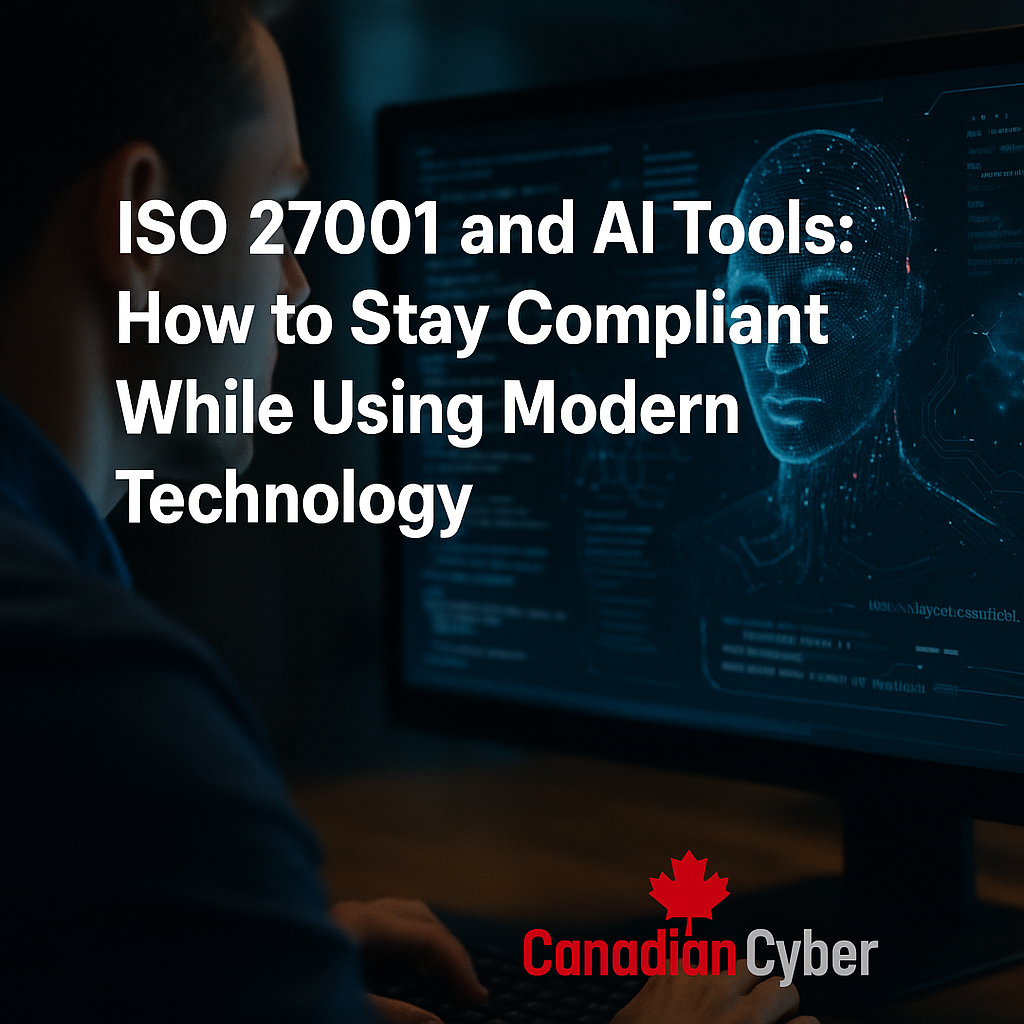
The Future of Security Lies in Responsible AI Adoption. Here’s How ISO 27001 Keeps You Safe and Compliant
AI tools can transform productivity but without structure, guardrails, and governance, they can also introduce serious compliance, privacy, and security risks. ISO 27001 gives Canadian organizations a practical, risk-based framework to adopt AI safely, without slowing innovation.
AI tools have exploded into the workplace chatbots, automation engines, text generators, image processors, data analyzers, code assistants, and more. They boost productivity, reduce workload, and accelerate decision-making.
But there’s a risk no one wants to talk about:
AI tools can break your security program in seconds if they’re not governed properly.
From confidential data leakage into AI models, to unreviewed vendor risks, to bias, misinformation, and unmonitored cloud storage AI introduces new attack surfaces faster than most companies can recognize them.
ISO 27001 is one of the few frameworks that offers a structured, compliant, risk-driven approach to adopting AI tools safely.
Let’s explore how.
Note: This is a fictional scenario created for illustration, inspired by real patterns across tech, healthcare, and consulting businesses in Canada.
NovaBridge Tech, a mid-sized SaaS company, encouraged employees to use AI tools to speed up support responses and analyze customer feedback.
One afternoon, a support agent pasted a snippet of a client conversation into an AI platform to generate a better summary. Unknowingly, that snippet included:
Three days later, their legal team discovered something alarming: the AI provider stored user inputs indefinitely and used them to retrain its models.
The result?
When NovaBridge performed a security review, they realized something worse: 61 employees had been using AI tools with no policy, no approval, no logging, and no vendor vetting.
This wasn’t a technology problem it was a governance failure. And it’s exactly the kind of risk ISO 27001 is designed to prevent.
AI doesn’t break ISO 27001.
ISO 27001 breaks the chaos around AI.
Here’s how key ISO 27001 requirements translate directly into safer AI adoption.
| AI Risk Area | Typical Problem | Relevant ISO 27001 Focus |
|---|---|---|
| Data Leakage | Staff paste confidential data into public AI tools. | Asset classification, data handling rules, acceptable use policies. |
| Vendor Risk | AI provider stores inputs, trains models, or hosts data offshore. | Supplier risk assessment, contracts, security requirements, monitoring. |
| Excessive Access | AI integrations can see more than they should (e.g., full CRM, code repo). | RBAC, least privilege, access reviews, technical controls on APIs. |
| Shadow AI | Teams quietly adopt unapproved AI tools to “get work done faster”. | Policies, awareness training, monitoring, central tool approval. |
| Privacy Violations | Personal data sent to AI tools without consent or proper controls. | Privacy-by-design, data minimization, DPIAs, lawful processing. |
Canadian Cyber helps Canadian organizations design ISO 27001-aligned AI governance from policies and vendor assessments to access control and audit-ready documentation, so your teams can use AI confidently and safely.
ISO 27001 is built on a simple but powerful principle:
Know where your data is, who can access it, and how it is protected at all times.
AI tools disrupt this if employees can:
ISO 27001 forces organizations to:
This turns AI usage from a risky free-for-all into a controlled, auditable practice.
Every AI platform you use is a third-party vendor.
ISO 27001 requires organizations to:
This prevents employees from grabbing the shiniest AI tool they see online and putting your organization and your customers at risk.
AI tools are increasingly integrated into:
This introduces privileged access concerns. ISO 27001 requires:
Under ISO governance, AI integrations become secured extensions of your environment, not uncontrolled backdoors.
Modern ISO 27001 programs now commonly include dedicated AI governance policies, such as:
Without clear policies, AI becomes a Shadow IT explosion. With them, AI becomes a controlled, measurable productivity booster.
You can’t manage what you can’t see.
ISO 27001 requires:
When AI tools and integrations are included in this monitoring strategy, AI actions become:
AI stops being a “black box” and becomes part of your managed security ecosystem.
Canada’s privacy laws (PIPEDA, PHIPA, Law 25) impose strict rules on:
AI tools often violate these principles by default unless properly governed.
ISO 27001 ensures that:
ISO becomes the missing bridge between innovation and privacy.
After adopting ISO 27001, NovaBridge Tech took control of their AI program:
ISO 27001 didn’t stop AI innovation it made AI safe, compliant, and scalable.
AI is accelerating faster than many security and compliance teams can keep up.
Companies that adopt AI without governance face:
ISO 27001 modernizes your security program for an AI-driven world. Organizations that implement ISO now will be far ahead of their competitors when AI-specific regulations and compliance expectations solidify globally.
Canadian Cyber helps organizations:
AI is powerful but only when controlled. ISO 27001 gives you the governance engine to innovate safely.
👉 Explore Our ISO 27001 Services
👉 Book a Free Consultation With Our ISO & AI Governance Experts
Follow Canadian Cyber for more practical ISO 27001, AI governance, and security insights: