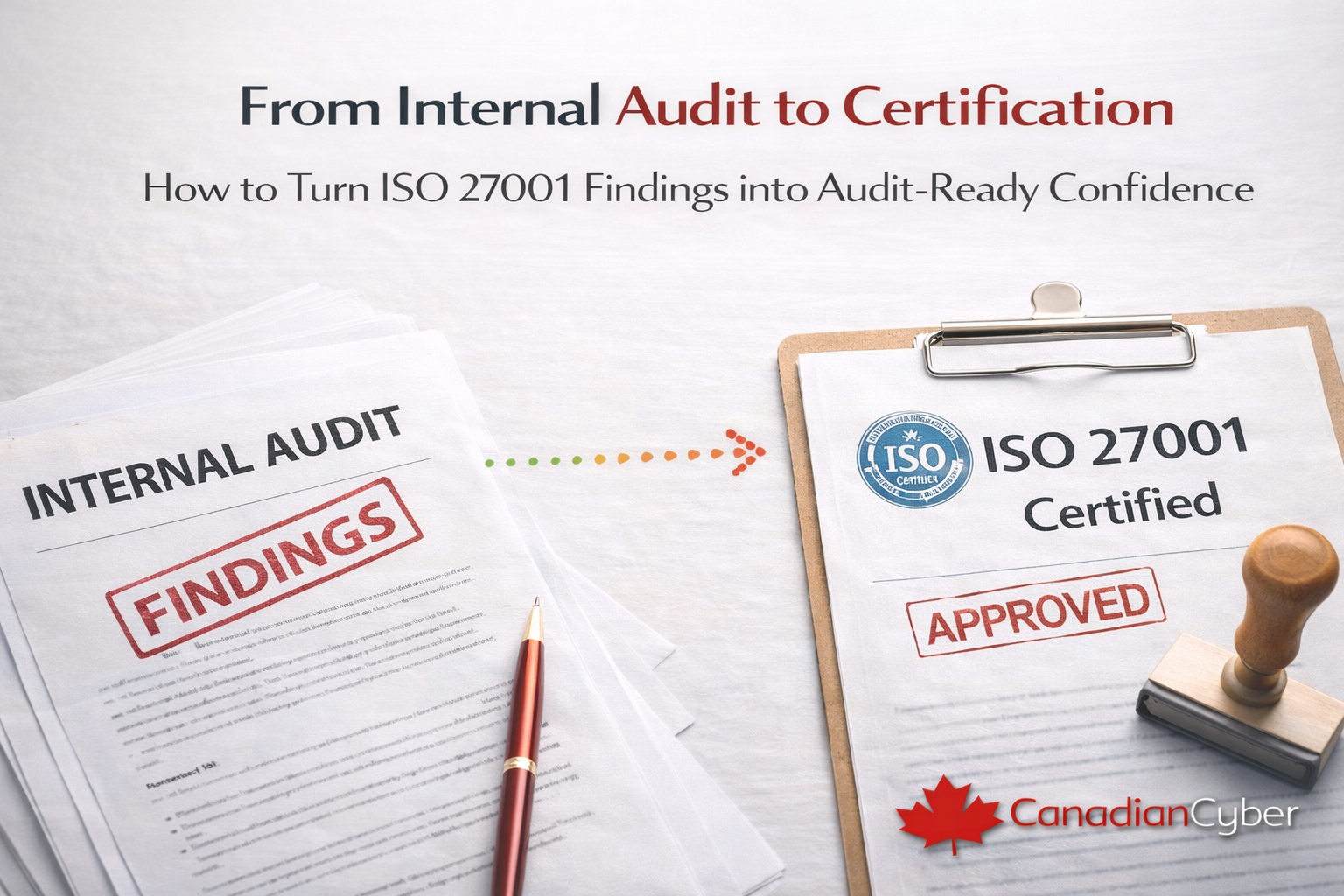
From Internal Audit to CertificationHow to Turn ISO 27001 Findings into Audit-Ready Confidence
Your internal audit is done. Now comes the dangerous part not the certification audit itself, but everything in between.
This guide shows how to convert internal audit results into full ISO 27001 audit readiness so there are no surprises.
An internal audit is not the finish line. It’s a diagnostic report.
What happens next determines whether your Stage 1 is smooth, your Stage 2 passes cleanly, or you end up in corrective actions, delays, and re-audits.
Why the Gap Between Audits Is Where Certifications Fail
- Small issues get deprioritized and become audit findings.
- Evidence is “somewhere” until it’s needed quickly.
- Controls drift after the audit report is issued.
- Teams assume “basically ready” is the same as “audit-ready.”
| Finding type | What it means | Certification impact | What to do next |
|---|---|---|---|
| Nonconformity | A required ISMS element/control is missing or not working as required. | High risk of Stage 2 issues or corrective action requirements. | Fix first, document root cause, capture evidence, verify effectiveness. |
| Observation | A risk area or weak point auditors will probe. | Medium can become a finding if evidence is weak. | Strengthen evidence and consistency; coach owners for interviews. |
| Opportunity for Improvement | Enhancement suggestion for maturity (not required for certification). | Low but helpful for long-term resilience. | Log it, prioritize later, and track in continual improvement. |
Step 1: Categorize Findings Correctly
Not all findings carry the same weight. Start by separating nonconformities, observations, and improvement opportunities.
This prioritization becomes your remediation plan.
Mistake to avoid: treating everything as “minor” or “we’ll address later.”
Certification auditors will test what you fixed and what you ignored.
Step 2: Assign Owners and Deadlines (Auditors Expect Proof)
Every finding needs a named owner, a corrective action, and a realistic deadline. Auditors will ask:
“Who was responsible, and how did you verify the fix?”
| Finding | Owner | Corrective action | Due date | Evidence & verification |
|---|---|---|---|---|
| Access reviews not documented | IT Manager | Implement quarterly review workflow + approvals | YYYY-MM-DD | Completed review record + approval trail + sample evidence set |
| Policy review dates missed | Compliance Lead | Set automated reminders + approval workflow | YYYY-MM-DD | Version history + approval logs + reminder proof |
| Risk register not updated after changes | Security Owner | Run risk refresh for impacted systems + update treatments | YYYY-MM-DD | Updated risks + treatment plan + management review notes |
Step 3: Remediate with Evidence in Mind
Fixing the issue is only half the job. You also need evidence that the change happened and the control operates.
- Update policies and procedures that were impacted
- Adjust control execution (frequency, approvals, logging)
- Capture proof: approvals, logs, tickets, screenshots, records
Pro tip: Store remediation evidence where auditors can find it in seconds.
Centralized evidence tracking turns “we fixed it” into “here’s the proof.”
Step 4: Update the Risk Register and Statement of Applicability
After remediation, reassess affected risks, confirm treatment decisions, and update the SoA if controls changed.
Certification auditors cross-check internal audit findings, risk updates, and SoA consistency.
Step 5: Organize Documentation for Stage 1 Audit
Stage 1 is primarily documentation and readiness. Before it begins, ensure the basics are clean and current:
- ISMS scope is finalized and approved
- Risk assessment and SoA are aligned
- Policies are current, approved, and version-controlled
- Internal audit and management review are complete
Validate readiness before the certifier does
Not sure if your remediation is enough or if your documentation will survive Stage 1 review?
Get an objective check and close gaps early.
Step 6: Coach Staff for Auditor Interviews
Auditors talk to people, not just documents. Prepare control owners to explain their role, describe control operation,
and confidently reference policies and evidence. The goal isn’t scripted answers it’s consistent understanding.
Step 7: Run a Final Readiness Simulation
A mock audit tests evidence retrieval speed, identifies weak explanations, and reduces audit-day anxiety.
It’s the difference between hoping you’re ready and knowing you are.
The Biggest Mistake at This Stage
Assuming: “The internal audit went well, so certification will too.”
Internal audits reveal issues. Certification audits validate maturity. Preparation bridges that gap.
How Canadian Cyber Helps You Cross the Finish Line
- Validate internal audit remediation and evidence quality
- Perform pre-certification readiness assessments
- Run ISO 27001 audit simulation workshops
- Provide vCISO coaching for auditor interviews
- Centralize evidence using our SharePoint-based ISMS platform
Final Takeaway
Internal audits tell you what’s wrong. Audit readiness is proving what’s right.
When remediation, documentation, and people are aligned, certification becomes predictable not stressful.
Ready to certify without surprises?
Get a structured readiness plan, clean evidence, and confident control owners before the certification auditor arrives.
Stay Connected With Canadian Cyber
Follow us for ISO 27001 insights, audit readiness tips, and real-world compliance guidance: