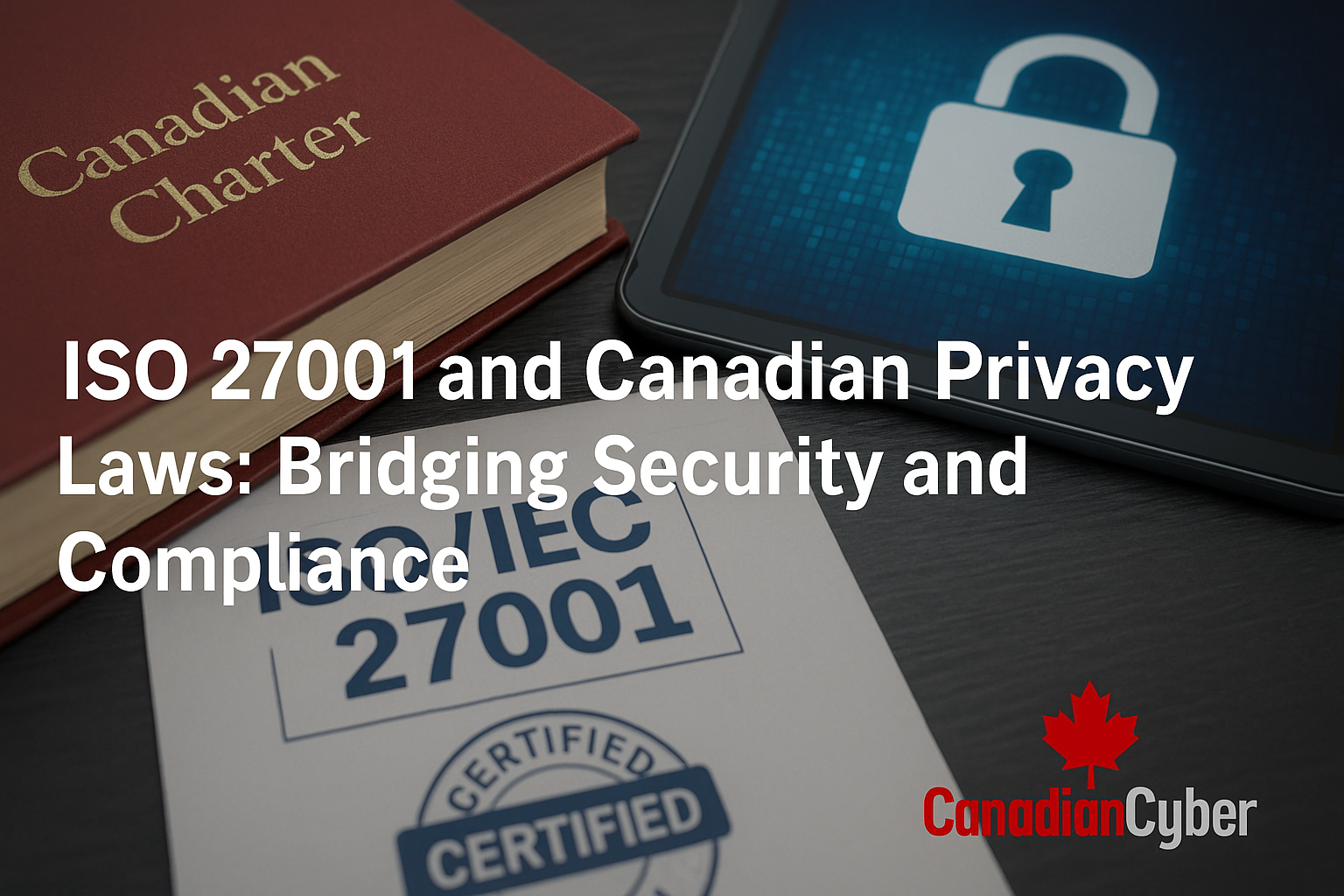
ISO 27001 and Canadian Privacy Laws: Bridging Security and Compliance
Why ISO 27001 has become the missing link between cybersecurity and privacy compliance in Canada.
Canadian organizations face a growing challenge.
- Privacy expectations are rising
- Regulators are paying closer attention
- Customers want proof, not promises
At the same time, many organizations struggle with a key question:
How do we prove that we are taking “reasonable safeguards” seriously?
For an increasing number of Canadian businesses, the answer is ISO/IEC 27001.
ISO 27001 does not replace privacy laws like PIPEDA or Quebec’s Law 25.
Instead, it provides the security foundation that makes privacy compliance practical, defensible, and auditable.
Quick Snapshot
| Category | Detail |
|---|---|
| Topic | ISO 27001 as the security backbone for privacy compliance |
| Audience | Executives, privacy leads, IT/security teams, compliance owners |
| Why it matters | It helps prove “reasonable safeguards” with evidence and structure |
| Key insight | Privacy laws define the obligation. ISO 27001 makes it operational. |
Why Privacy and Security Can No Longer Be Separated
Privacy laws focus on personal information. Security frameworks focus on how information is protected.
In practice, the two are deeply connected.
If personal information is not secured properly, privacy compliance fails no matter how good the privacy policy looks.
Canadian regulators increasingly assess not just what organizations say about privacy, but how they protect data in real operations.
That’s where ISO 27001 fits in.
A Quick Refresher: What ISO 27001 Is Designed to Do
ISO/IEC 27001 is an internationally recognized standard for establishing and maintaining an Information Security Management System (ISMS).
Its purpose is to help organizations:
- Identify information security risks
- Implement appropriate controls
- Assign accountability
- Monitor effectiveness
- Continuously improve
Rather than focusing on individual tools, ISO 27001 focuses on governance, risk, and controls exactly what privacy laws expect behind the scenes.
Canadian Privacy Laws Expect “Reasonable Safeguards”
Under PIPEDA, organizations must protect personal information using safeguards appropriate to the sensitivity of the data.
Quebec’s Law 25 goes further by raising expectations around:
- Strong governance
- Clear accountability
- Access controls
- Logging and monitoring
- Incident response readiness
- Evidence of compliance
Regulators don’t expect perfection. They expect structure, intent, and accountability.
ISO 27001 supports all three.
How ISO 27001 Maps to Canadian Privacy Requirements
One reason ISO 27001 is gaining traction in Canada is how naturally it aligns with privacy obligations. Here’s a practical view of that alignment.
| Privacy Expectation | ISO 27001 Enables | What This Proves |
|---|---|---|
| Governance & accountability | Defined roles, management involvement, risk ownership, reviews | Someone is responsible and decisions are documented |
| Access control | Role-based access, reviews, offboarding, privileged controls | Personal data is limited to those who need it |
| Data protection | Encryption, secure handling of backups, controlled transfers | Safeguards match data sensitivity |
| Incident response | Procedures, escalation, investigation, improvement cycle | You can respond quickly and learn from incidents |
| Vendor oversight | Third-party risk reviews, contract requirements, monitoring | Due diligence over outsourced processing |
Governance and Accountability
Privacy laws expect organizations to be accountable for how personal information is handled.
ISO 27001 creates structure with defined responsibilities, management oversight, and regular performance review.
Access Control and Least Privilege
Unauthorized access is one of the most common privacy failures. ISO 27001 strengthens least privilege with role-based access,
regular reviews, and clean offboarding.
Encryption and Data Protection
ISO 27001 supports encryption and secure data handling so your safeguards match the sensitivity of the personal information you store or process.
Incident Response and Breach Management
When something goes wrong, regulators expect prompt response and clear accountability.
ISO 27001 enforces defined escalation paths, investigation steps, and improvement after incidents.
Vendor and Third-Party Risk Management
If a vendor mishandles data, you are still accountable. ISO 27001 helps prove that vendor risk is assessed and managed over time.
A Fictional Example: Privacy Policy vs. Privacy Reality
This scenario is fictional but reflects common situations in Canada.
A Canadian organization had a strong privacy policy and clear consent language. On paper, they looked compliant.
But during an internal review, they discovered:
- No formal access reviews
- No vendor security assessments
- No incident response testing
- No documented risk assessments
They weren’t negligent just unstructured.
After implementing ISO 27001, they gained clear accountability, risk-based controls tied to data sensitivity, evidence of safeguards, and confidence when responding to privacy inquiries.
Why ISO 27001 Strengthens Trust With Regulators and Customers
From a regulator’s perspective, ISO 27001 signals:
- Intentional security design
- Management involvement
- Continuous improvement
- Documented evidence
From a customer’s perspective, it signals:
- Professional handling of personal data
- Alignment with global best practices
- Reduced risk of misuse or exposure
ISO 27001 helps turn privacy obligations into operational reality not just written statements.
ISO 27001 Is Not a Privacy Law and That’s Its Strength
ISO 27001 does not replace legal advice or privacy programs.
Instead, it provides the security backbone that privacy compliance depends on.
Privacy tells you what must be protected. ISO 27001 tells you how to protect it consistently.
✅ Want ISO 27001 Guidance That Aligns With Canadian Privacy Requirements?
If you need a defensible, evidence-based security foundation for privacy compliance, we can help you build it.
How Canadian Cyber Helps Bridge Security and Privacy
At Canadian Cyber, ISO 27001 is implemented with privacy alignment in mind. We help you connect the dots between security controls and Canadian privacy obligations.
| Service | How it helps |
|---|---|
| ISO 27001 Consulting & ISMS Design | Risk assessments, ISMS implementation, control selection, certification readiness |
| Privacy-Aligned Security Programs | Align controls with PIPEDA, Law 25, provincial privacy requirements, and sector obligations |
| vCISO Services | Security leadership, governance, risk decisions, and reporting to leadership/boards |
| Internal Audits & Continuous Improvement | Validate control effectiveness, identify gaps early, stay audit- and regulator-ready long term |
ISO 27001 Makes Privacy Compliance Defensible
Privacy compliance is no longer just about policies. It’s about demonstrating that safeguards exist, work, and are reviewed.
ISO 27001 gives Canadian organizations a structured, trusted way to do exactly that.
Privacy is the obligation. ISO 27001 is the operating system that helps you meet it with consistency and evidence.
🚀 Ready to Bridge Security and Privacy the Right Way?
If your organization wants a stronger, more defensible approach to privacy compliance, ISO 27001 is the right foundation.
👉 Book a Free Consultation
👉 Learn How We Align Security With Privacy
Stay Connected With Canadian Cyber
Follow Canadian Cyber for insights on ISO 27001, privacy compliance, and cybersecurity governance in Canada: