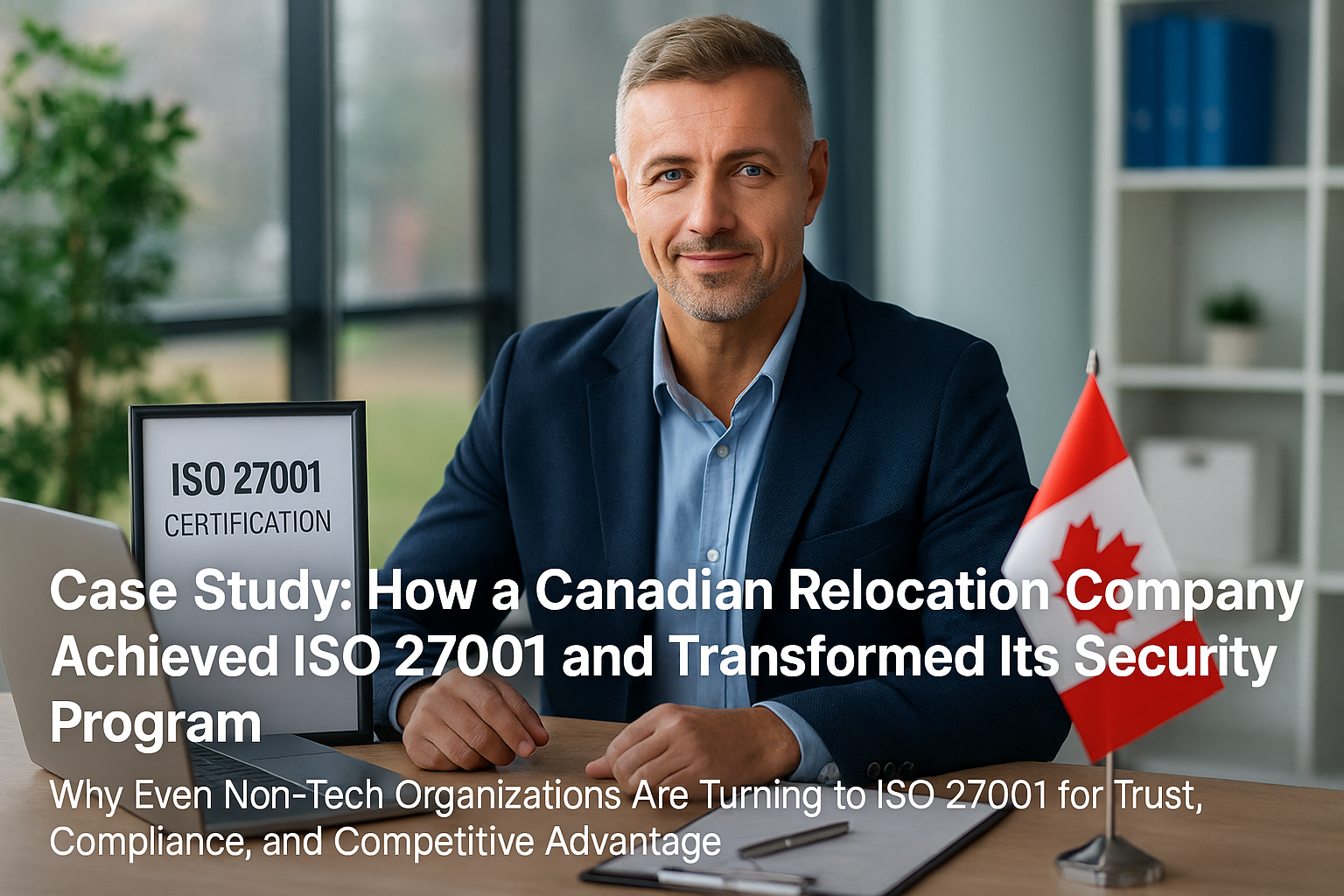
Case Study: How a Canadian Relocation Company Achieved ISO 27001 and Transformed Its Security Program
Why Even Non-Tech Organizations Are Turning to ISO 27001 for Trust, Compliance, and Competitive Advantage
Organization (Fictional): NorthernMove Relocation Group
Industry: Relocation, logistics, and warehousing
Focus: ISO 27001 certification and security transformation for a non-tech business
Note: NorthernMove is fictional, but the challenges are based on real Canadian non-tech organizations.
This case study follows NorthernMove Relocation Group, a fictional Canadian relocation and logistics company that began an unexpected journey toward ISO 27001 certification. Although fictional, NorthernMove represents the real challenges faced by non-tech organizations such as logistics providers, law offices, moving companies, and professional services firms.
With limited IT resources and rising client expectations, NorthernMove pursued ISO 27001 to build trust, strengthen
security, and meet enterprise requirements.
Background: A Non-Tech Company Suddenly Needs Enterprise-Level Security
NorthernMove managed relocation programs for corporate clients across Canada. Their operations involved:
- Customer relocation files
- Vendor coordination and scheduling
- Warehousing and inventory details
- Address and move-date information
- Internal documentation and HR records
Although they were not a technology company, they handled sensitive information at every step. This made them more vulnerable to risk and increasingly scrutinized by enterprise clients, especially those with strong privacy and compliance requirements.
The Trigger Event: A Lost Contract Worth Millions
During a major RFP process, a large enterprise client made a simple request:
NorthernMove couldn’t provide it.
- The deal collapsed.
- Revenue projections dropped.
- Leadership realized they needed a formal security framework.
This moment became the catalyst for change and pushed NorthernMove to treat security as a strategic priority not just an IT problem.
The Challenge: ISO 27001 With Limited IT Staff
NorthernMove’s starting point looked like many non-tech organizations:
- A small two-person IT team
- No documented security or privacy policies
- No structured access control model
- Scattered data across multiple systems and locations
- No centralized logging or monitoring
- Outdated hardware and legacy processes
- Tight deadlines from sales and executive teams
Internal leadership agreed: they couldn’t build an ISO 27001 program alone. The company turned to Canadian Cyber’s ISO 27001 Implementation Program for expert support.
Canadian Cyber helps Canadian businesses tech or non-tech achieve international-grade cybersecurity maturity,
even with small IT teams and legacy environments.
The Solution: Canadian Cyber’s vISO Implementation Team
Canadian Cyber assigned a Virtual ISO Lead (vISO) supported by a multidisciplinary team. Together, they followed a structured four-phase framework tailored to a non-tech environment.
Phase 1: Assessment & ISMS Foundation
A full gap analysis revealed major vulnerabilities and misalignments with ISO 27001 requirements. NorthernMove’s starting point was documented in a clear summary.
Gap Summary
| Area | Pre-ISO Status | ISO Requirement | Gap Severity |
|---|---|---|---|
| Policies | Outdated and incomplete | Documented governance and policy framework | High |
| Access Control | Inconsistent and ad-hoc | Role-based access and least privilege | High |
| Logging | Minimal and fragmented | Log retention, monitoring, and review | High |
| Vendor Management | Informal and reactive | Supplier review and formal oversight | Medium |
| Risk Assessment | No formal methodology | Documented risk methodology and register | High |
| Data Lifecycles | Unclear retention and disposal | Structured retention and secure disposal | Medium |
Based on this, Canadian Cyber helped NorthernMove define an ISMS (Information Security Management
System) structure, including:
- Scope and boundaries of the ISMS
- Leadership roles and responsibilities
- Policy and documentation framework
- Communication and awareness plan for staff
Phase 2: Policy & Control Development
Over 10 weeks, Canadian Cyber delivered a full ISO 27001-aligned policy and control set, including:
- Information Security Policy
- Access Control Policy
- Logging & Monitoring Policy
- Incident Response Plan
- Supplier Management Policy
- Cryptography Standards
- Business Continuity Plan
- Data Retention & Disposal Policy
For the first time, NorthernMove had a coherent security governance framework that clearly explained
expectations to staff, vendors, and leadership.
Phase 3: Implementation & Operationalization
As policies turned into action, real-world gaps quickly surfaced. During an access-rights review, a critical twist emerged:
This discovery reinforced the importance of ISO 27001 and validated leadership’s decision to invest in security.
Canadian Cyber helped implement concrete improvements, including:
- MFA enforced across key systems
- Least-privilege, role-based access control
- Structured onboarding and offboarding checklists
- Centralized logging and alerting for critical systems
- Formal vendor reviews and security clauses in contracts
- Employee security awareness training including warehouse staff
Security became a company-wide responsibility, not just an IT concern.
Phase 4: Internal Audit & Certification
Before inviting an external auditor, Canadian Cyber conducted a thorough internal audit of NorthernMove’s ISMS.
- Only minor nonconformities were found.
- Evidence was already organized and mapped to ISO controls.
- Leadership had clear talking points for audit interviews.
NorthernMove proceeded confidently to external certification.
The Auditor’s Reaction
NorthernMove passed ISO 27001 certification on the first attempt.
Results
1. Won Back Enterprise Clients
With ISO 27001 certification in place, enterprise buyers began to trust NorthernMove again. Security questionnaires that previously caused delays now became opportunities to showcase maturity.
2. 72% Risk Reduction
Canadian Cyber helped quantify improvements. NorthernMove achieved an estimated 72% reduction in risk across identity, access, and vendor processes, measured through a repeatable risk-scoring model.
3. Clean Operational Processes
Access control, asset management, and logging moved from informal, person dependent processes to structured, auditable workflows. Leadership gained visibility into who had access to what and why.
4. Competitive Advantage in a Crowded Industry
In an industry where few competitors had formal security certifications, ISO 27001 became a clear differentiator. NorthernMove used its certification in marketing, RFP responses, and strategic sales conversations.
5. Ongoing Partnership With Canadian Cyber
The engagement did not end at certification. Canadian Cyber continued to support NorthernMove through:
- Annual ISO 27001 internal audits
- Policy reviews and updates
- Risk reassessments and control tuning
- Support for new systems, vendors, and projects
Conclusion: ISO 27001 Is Not Just for Tech Firms
NorthernMove’s fictional journey reflects a very real industry shift. Canadian non-tech organizations are realizing
that:
- ISO 27001 is not a “technology certificate”
- It is a trust framework that touches processes, people, and culture
- Clients, partners, and regulators expect strong security practices from every sector
From logistics and relocation to legal, transportation, and professional services, organizations across Canada are
using ISO 27001 to show that they take security and privacy seriously.
ISO 27001 offers the structure. Canadian Cyber provides the expertise.
Start Your ISO 27001 Journey With Canadian Cyber
Whether you are a traditional business or a tech company, ISO 27001 can help you build trust and unlock new opportunities with enterprise clients and partners.
Stay Connected With Canadian Cyber
Follow Canadian Cyber for more case studies, ISO 27001 insights, and practical security guidance: