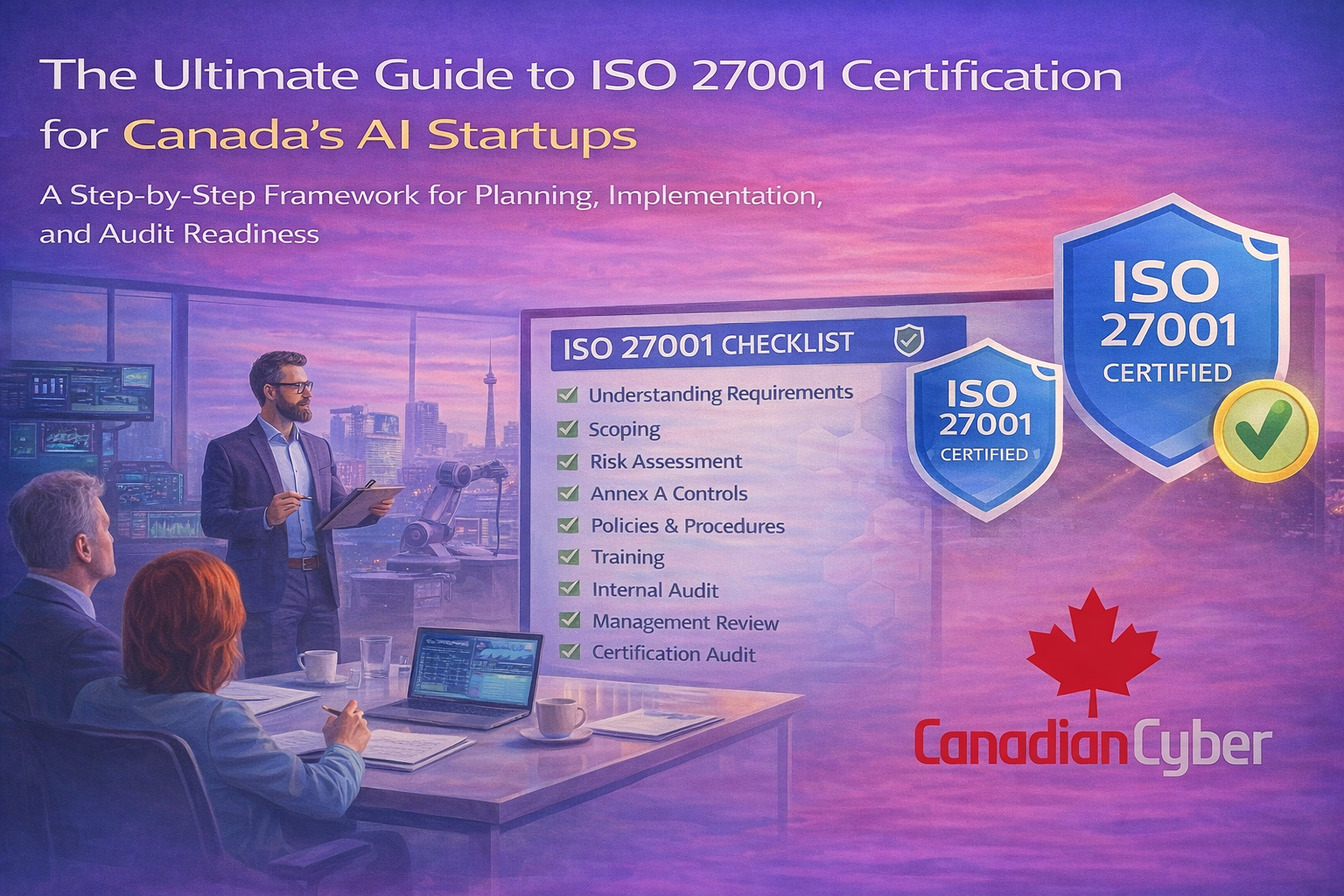
The Ultimate Guide to ISO 27001 Certification for Canada’s AI Startups
A step-by-step framework for planning, implementation, and audit readiness
Canada’s AI startups move fast.
New models.
New data.
New customers.
But security expectations move just as quickly.
• Enterprise buyers ask for proof
• Investors want governance
• Regulators expect accountability
That is why ISO 27001 certification is becoming a must-have for AI-driven startups and growing SaaS companies in Canada.
This guide walks you through the entire ISO 27001 journey, step by step.
What Is ISO 27001 (And Why AI Startups Need It)
ISO 27001 is an international standard for information security management.
It focuses on how organizations:
- Identify security risks
- Apply appropriate controls
- Monitor and improve security over time
For AI startups, ISO 27001 helps protect:
- Training data
- Customer data
- Proprietary algorithms
- Cloud infrastructure
Security is no longer assumed.
It must be demonstrated.
Who This Guide Is For
This guide is designed for:
- Canadian AI startups
- AI-driven SaaS companies
- Small and mid-sized businesses (SMBs)
- Founders preparing for enterprise deals
- Teams planning SOC 2 later
If you handle sensitive data, this applies to you.
Quick Snapshot: ISO 27001 at a Glance
| Item | Details |
|---|---|
| Framework type | Information Security Management System (ISMS) |
| Best for | AI startups, SaaS, data-driven businesses |
| Core focus | Risk-based security governance |
| Certification model | Audited by accredited certification bodies |
| Why it matters in Canada | Supports PIPEDA and privacy accountability |
Step 1: Understand What ISO 27001 Really Requires
ISO 27001 is not a checklist.
It is a management system.
- Define your security scope
- Assess risks
- Apply appropriate controls
- Document policies and processes
- Prove ongoing improvement
Technology alone is not enough.
Process matters.
Evidence matters.
Step 2: Define Your ISO 27001 Scope
Scope is where most startups go wrong.
Too broad.
Too complex.
Hard to audit.
Your scope should include:
- Core AI platform
- Customer-facing systems
- Supporting infrastructure
A focused scope keeps audits faster and cleaner.
Mid-Guide Checkpoint
If your scope feels unclear, stop. A bad scope causes delays later.
Step 3: Perform a Risk Assessment
Risk assessment drives everything.
For AI startups, this often includes:
- Data leakage risks
- Model access risks
- Cloud misconfiguration
- Insider threats
- Third-party vendors
This becomes your risk register.
Auditors will ask for it.
Step 4–9: Controls, Audits, and Certification
From selecting Annex A controls to management review and certification audits,
ISO 27001 follows a logical flow:
- Select and justify Annex A controls
- Document policies and procedures
- Train your team
- Conduct an internal audit
- Complete management review
- Pass Stage 1 and Stage 2 audits
Preparation is everything.
Well-prepared startups pass smoothly.
ISO 27001 and Canadian Compliance Requirements
ISO 27001 aligns naturally with Canadian regulations.
- PIPEDA accountability principles
- Privacy-by-design expectations
- Enterprise due diligence requirements
Security becomes proactive, not reactive.
Common Mistakes AI Startups Make
- Over-scoping the ISMS
- Skipping risk treatment logic
- Writing policies no one follows
- Waiting too long to involve leadership
Avoiding these saves months.
How Canadian Cyber Supports ISO 27001 for AI Startups
We specialize in fast-moving companies.
- Readiness and gap assessments
- Risk assessment and treatment
- Policy and ISMS development
- Audit preparation support
Focused.
Practical.
Audit-aligned.
🚀 Get Started With ISO 27001 the Right Way
Build trust early. Scale securely. Stay audit-ready.
👉 Start Your ISO 27001 Journey
👉 Talk to an ISO 27001 Expert
Stay Connected With Canadian Cyber
Follow us for practical insights on compliance, risk, and cybersecurity: