email-svg
Get in touch
info@canadiancyber.ca

ISO 27001 Certification DIY Guide

This ISO 27001 certification DIY guide outlines 10 practical steps to help organizations kickstart an ISMS internally without hiring a consultant.
Main Hero Image

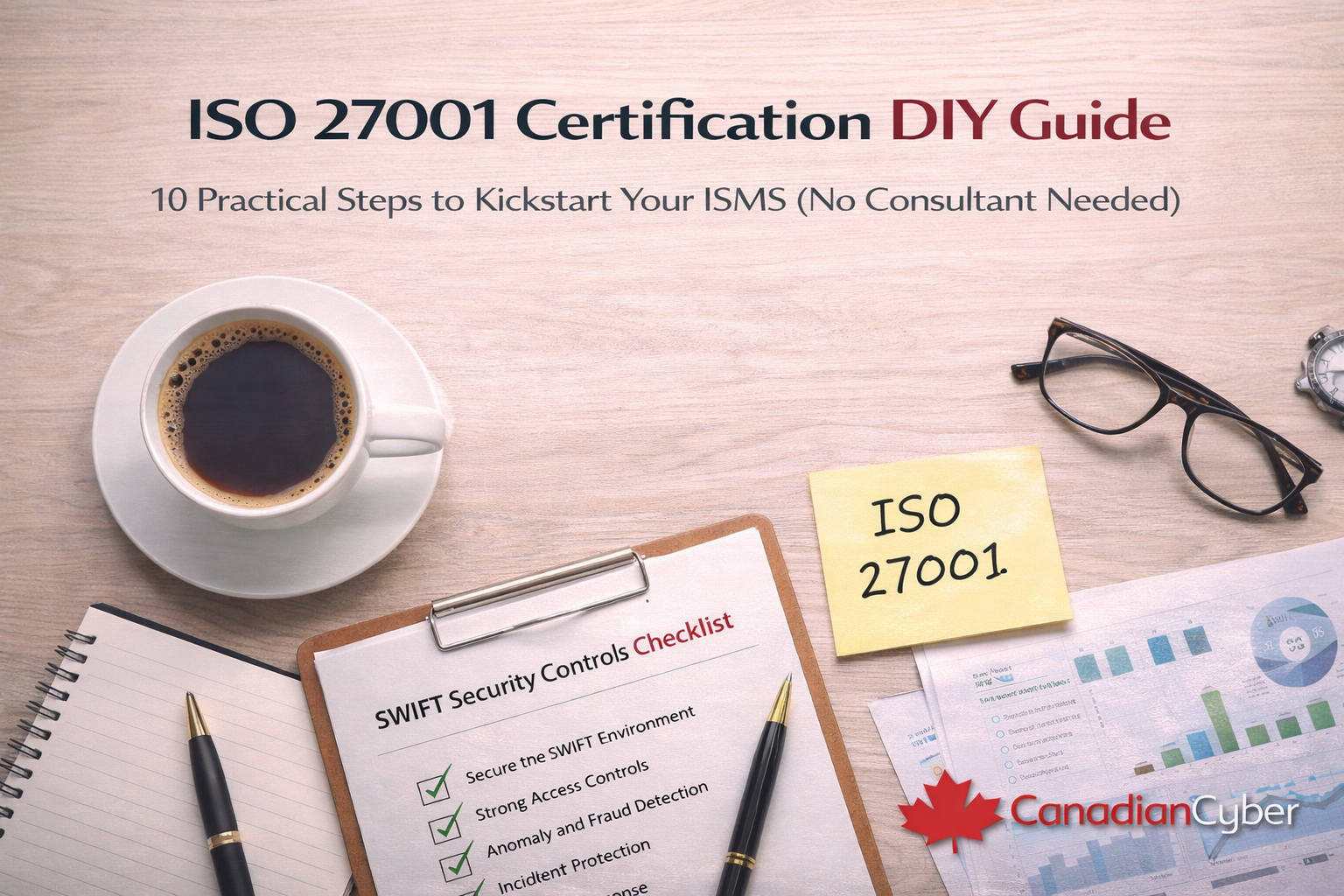
ISO 27001 Certification DIY Guide

10 Practical Steps to Kickstart Your ISMS 

Most organizations don’t start ISO 27001 because they hired a consultant. They start because a deal stalls, a customer asks for certification, or leadership asks: “Are we actually secure?”

If you’re resourceful and ready to roll up your sleeves, you can kickstart ISO 27001 internally.
This guide shows you the right way to start and where DIY teams typically decide to get targeted help.

First: What ISO 27001 Really Is (and Isn’t)

ISO 27001 is NOT:

  • A checklist
  • A tool you install
  • A one-time project

ISO 27001 IS:

  • A management system (ISMS)
  • A structured way to manage risk
  • A continuous program auditors expect to see working

The DIY Roadmap (At a Glance)

If you do nothing else, do these steps in order. This is the “no drama” path to a real ISMS.

Step What you produce DIY pitfall to avoid
1–2 Scope + assets Scope statement + asset list Scope too broad too early
3–4 Risks + SoA Risk register + Statement of Applicability Spreadsheet sprawl + missing reasoning
5–8 Policies + evidence Core policies + operational evidence Writing “ideal” policies you don’t follow
9–10 Audit + review Internal audit + management review minutes Skipping governance (auditors notice)

10 Practical DIY Steps to Kickstart Your ISMS

1) Define the Scope (Don’t Skip This)

Your scope answers: What parts of the business does ISO 27001 apply to?
Start small one product, platform, or business unit.

  • In-scope systems
  • In-scope data
  • In-scope teams

DIY warning: Most DIY failures start with scopes that are too broad.

2) Identify Your Information Assets

You can’t protect what you haven’t identified. List:

  • Systems: cloud platforms, apps, servers, endpoints
  • Data types: customer data, IP, employee data, financials
  • Processes: deployments, support, backups, access provisioning

3) Perform a Risk Assessment (Simple, Not Perfect)

ISO 27001 doesn’t require complex math. It requires consistent decisions:
identify threats, assess likelihood/impact, and treat risk.

Asset Threat Impact Likelihood Treatment
Customer DB Credential theft High Medium MFA + access reviews
Production CI/CD Unauthorized change High Low–Med Change control + approvals

Tip: This is where many teams outgrow spreadsheets and move to an ISMS platform for clean tracking.

4) Choose Applicable Annex A Controls (Build Your SoA)

Not every Annex A control applies to every organization that’s normal.
Your job is to review controls, decide applicability, and document reasoning in your Statement of Applicability (SoA).

Audit reality: The SoA is one of the first things auditors ask for.

5) Write Core Policies (Keep Them Practical)

Start with practical policies that reflect how you operate today:

  • Information Security Policy
  • Access Control Policy
  • Incident Response Policy
  • Risk Management Policy
  • Supplier / Vendor Management Policy

DIY trap: Over-engineered policies create nonconformities because teams can’t follow them.

6) Assign Ownership (ISO 27001 Is About Accountability)

Every control needs a named owner (not “IT” and not “the team”). Auditors care about: ownership, awareness, and responsibility.

Quick win: Add control owners directly into your risk register and SoA notes.

7) Train Your Team (Yes, Really)

ISO 27001 requires awareness. Keep it simple and repeatable:

  • Security awareness training for all staff
  • Role-specific training for control owners
  • Document attendance and completion

8) Collect Evidence as You Go (Don’t Wait)

Evidence proves your ISMS operates. Examples:

  • Access reviews and approvals
  • Incident logs and lessons learned
  • Risk register updates
  • Policy approvals and review records

Why DIY teams struggle: evidence isn’t centralized, so audit prep becomes a scavenger hunt.

9) Conduct an Internal Audit (Before Certification)

Before certification, you must audit your ISMS: are controls implemented, is documentation consistent, and what needs fixing before the external auditor arrives?

Pro tip: an independent reviewer increases objectivity and catches blind spots.

10) Management Review (The Step Most Teams Forget)

Leadership must review risks, incidents, audit results, and improvement actions.
This proves governance and auditors take it seriously.

  • Top risks and trends
  • Incident summary
  • Internal audit results
  • Corrective actions and deadlines

Reality Check: Where DIY Teams Usually Hit a Wall

  • Keeping documentation organized as versions multiply
  • Tracking evidence over time (without spreadsheets exploding)
  • Preparing confidently for audits (without last-minute panic)
  • Scaling the ISMS as the business grows

Good news: This is a tooling + structure problem not a “you failed” problem.

Want to know if your DIY ISO 27001 setup would survive an audit?

Get a quick readiness check and a prioritized fix list so you don’t waste weeks building the wrong things.

How Canadian Cyber Helps DIY Teams Succeed Faster

Canadian Cyber supports teams that want control not dependency. We help by:

  • Reviewing DIY ISMS setups and closing critical gaps
  • Centralizing policies, risks, and evidence in SharePoint
  • Reducing audit preparation time with structure and automation
  • Providing vCISO support only where it adds measurable value

What DIY teams do What audit-ready teams do
Policies in folders + email approvals Version control + workflow approvals in one place
Evidence collected near audit time Evidence captured continuously during operations
Risk register becomes a spreadsheet monster Structured risk tracking with owners, dates, and history

Final Thought

You don’t need a consultant to start ISO 27001. But you do need structure, discipline, visibility, and proof.
The smartest teams combine DIY effort with the right platform and targeted support.

Ready to turn your DIY start into certification-ready momentum?

Get the structure you need without losing ownership policies, risk, evidence, and audit readiness in one place.

Stay Connected With Canadian Cyber

Follow us for hands-on ISO 27001 guidance, ISMS automation tips, and real-world compliance insights:
Related Post