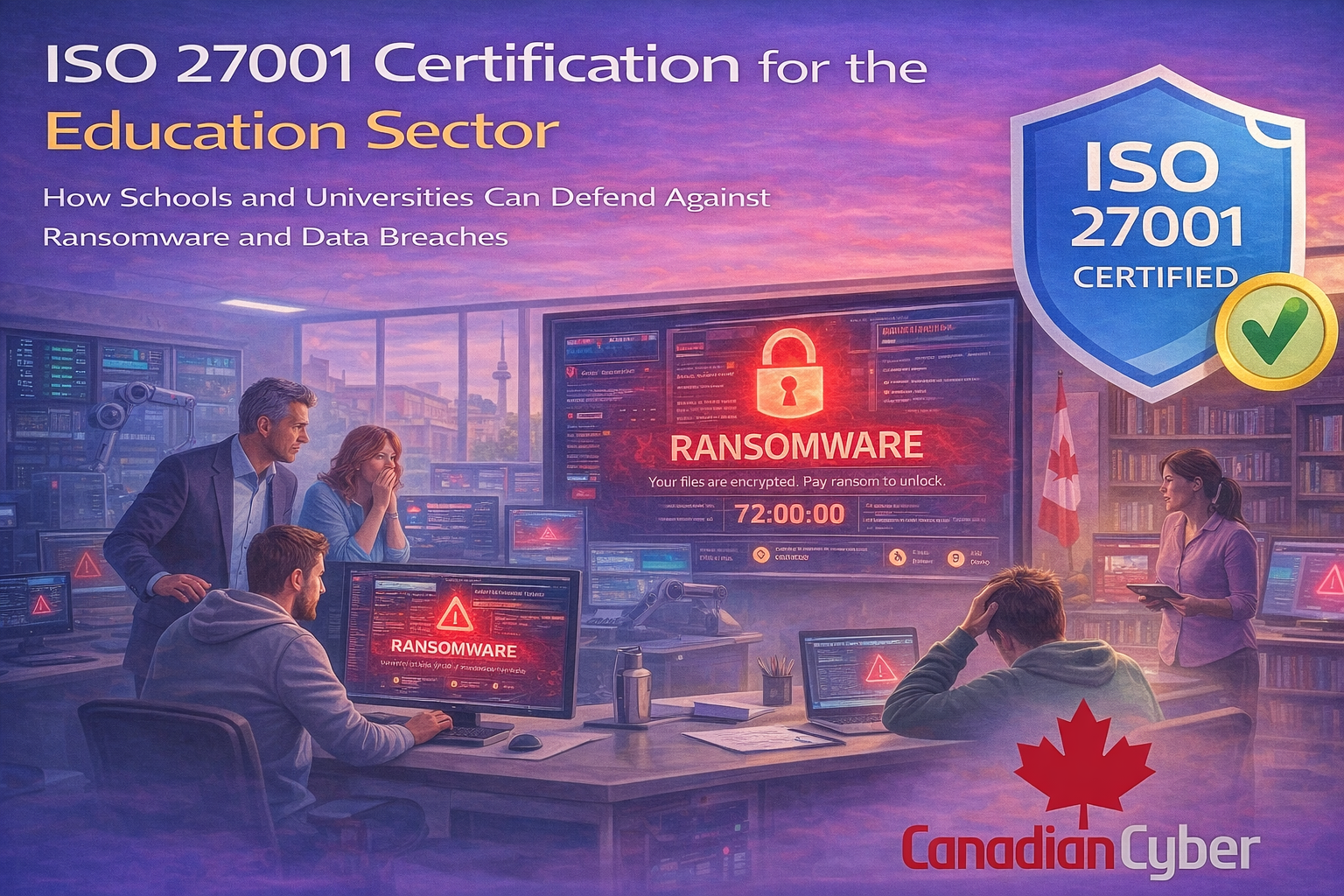
ISO 27001 Certification for the Education Sector
How schools and universities can defend against ransomware and data breaches
It usually starts quietly.
A teacher opens an email.
A student clicks a link.
A server locks itself down.
Classes stop.
Systems freeze.
Data disappears.
Across Canada, schools and universities are becoming prime targets for cyberattacks.
And most are under-resourced.
ISO 27001 offers a structured, realistic way forward.
It strengthens governance, reduces risk, and improves readiness without forcing unnecessary complexity.
Why Cybersecurity Is Now Critical for Canadian Education Institutions
Educational institutions store sensitive data.
• Student records
• Research data
• Financial information
• Health and accessibility data
Yet many schools rely on:
- Legacy systems
- Decentralized IT
- Limited security budgets
Attackers know this.
Ransomware groups increasingly target education because disruption creates pressure to pay.
Security is no longer an IT issue.
It is an institutional risk.
What Is ISO 27001 and Why It Fits Education
ISO 27001 is an international standard for information security management.
It focuses on:
- Identifying risks
- Applying appropriate controls
- Documenting processes
- Continuous improvement
For schools and universities, ISO 27001 helps:
- Reduce ransomware risk
- Protect student and research data
- Demonstrate accountability
- Meet privacy obligations
It is flexible.
And it works within budget constraints.
Quick Snapshot: ISO 27001 for Education
| Category | Details |
|---|---|
| Best for | Schools, colleges, and universities |
| Primary risks addressed | Ransomware, phishing, data breaches |
| Key benefit | Structured, auditable security program |
| Works with | Existing IT and cloud platforms |
| Supports | Canadian student data privacy laws |
Common Cyber Threats Facing Schools and Universities
Education environments are unique.
Open access is essential.
Security controls must balance usability.
Common threats include:
- Ransomware attacks
- Phishing emails targeting staff and students
- Compromised Learning Management Systems (LMS)
- Unauthorized access to research data
- Weak third-party vendor controls
ISO 27001 helps manage these risks systematically.
Securing Learning Management Systems (LMS)
LMS platforms are mission-critical.
They store:
- Student records
- Assignments and grades
- Communication data
ISO 27001 supports LMS security by enforcing:
- Role-based access controls
- Strong authentication
- Logging and monitoring
- Vendor risk management
Security becomes part of daily operations.
Not an afterthought.
Educating Staff and Students on Phishing
Technology alone is not enough.
Most education breaches begin with phishing.
ISO 27001 requires:
- Security awareness training
- Clear incident reporting processes
- Defined user responsibilities
For schools, this means:
- Training staff annually
- Educating students on safe digital behaviour
- Creating a culture of reporting
Awareness reduces risk significantly.
Phishing remains the top entry point for attackers.
Protecting Student Data and Privacy in Canada
Student data is highly sensitive.
Canadian institutions must comply with:
- PIPEDA
- Provincial education and privacy laws
- Research data governance requirements
ISO 27001 supports compliance by:
- Defining data handling processes
- Limiting access to sensitive records
- Documenting privacy controls
- Enforcing accountability
Auditors and regulators expect this structure.
Step-by-Step: ISO 27001 Certification for Education Institutions
Step 1: Define Scope
Focus on critical systems:
- Student information systems
- LMS platforms
- Research infrastructure
Avoid over-scoping.
Step 2: Conduct a Risk Assessment
Identify risks such as:
- Ransomware exposure
- Phishing susceptibility
- Unauthorized data access
Document and prioritize them.
Step 3: Apply Relevant Controls
Select controls from ISO 27001 Annex A, such as:
- Access management
- Incident response
- Backup and recovery
- Vendor security
Only apply what is relevant.
Step 4: Document Policies and Procedures
Key documents include:
- Information security policy
- Incident response plan
- Data protection procedures
Policies must reflect reality.
Step 5: Train and Communicate
Security responsibilities must be clear.
Staff training is essential.
Student awareness is equally important.
Step 6: Internal Audit and Management Review
Before certification:
- Review controls
- Identify gaps
- Involve leadership
Governance matters.
Step 7: Certification Audit
The final step involves an external audit.
Well-prepared institutions pass with minimal disruption.
Preparing for ISO 27001 in your school or university?
Build a practical roadmap with minimal disruption.
👉 Talk to an Education Cybersecurity Specialist
👉 Build a Practical Certification Roadmap
Why ISO 27001 Works With Limited Budgets
ISO 27001 does not require expensive tools.
It focuses on:
- Process
- Accountability
- Risk prioritization
Many improvements are procedural.
This makes it ideal for education environments.
How Canadian Cyber Supports Education Institutions
We understand the education sector.
We know budgets are tight.
We know disruption must be minimal.
Our ISO 27001 services include:
- Education-specific risk assessments
- LMS and cloud security reviews
- Policy development
- Audit preparation support
Security that fits how schools actually operate.
Start Building Cyber Resilience in Education
If your institution is:
- Concerned about ransomware
- Responsible for student data
- Preparing for audits or reviews
ISO 27001 provides a proven path.
Start your ISO 27001 journey with a practical plan built for schools and universities.
👉 Start Your ISO 27001 Journey Today
👉 Speak With a Cybersecurity Expert
Stay Connected With Canadian Cyber
Follow us for practical insights on compliance, risk, and cybersecurity: