email-svg
Get in touch
info@canadiancyber.ca

ISO 27001 Control 5.23 Cloud Services

ISO 27001 Control 5.23 cloud services requires clear governance, vendor review, configuration security, and ongoing monitoring. Use this audit-ready script and evidence checklist to prepare clean, defensible proof.
Main Hero Image

ISO/IEC 27002:2022 • Control 5.23 • Internal Audit–Ready

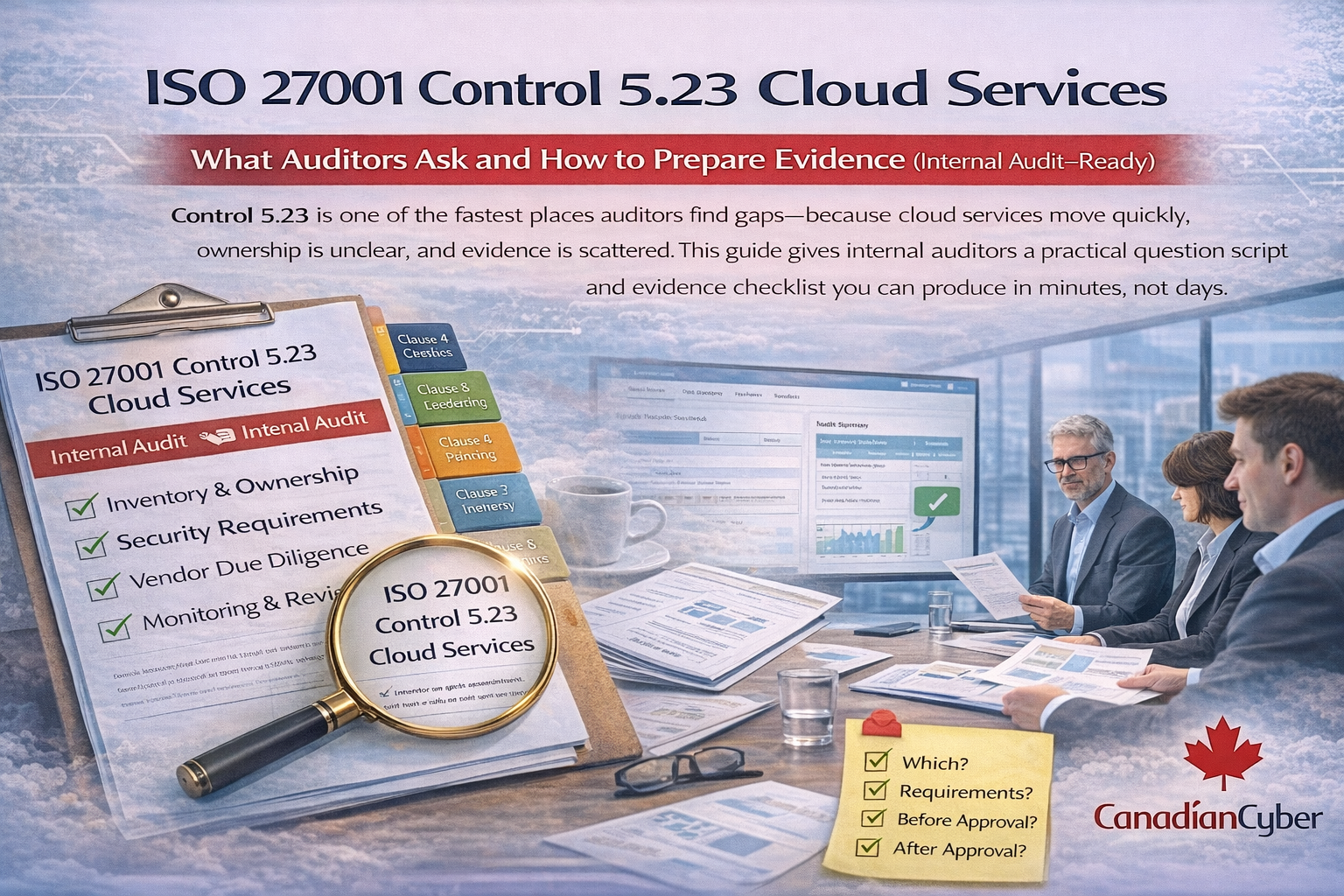
ISO 27001 Control 5.23 Cloud Services

What Auditors Ask and How to Prepare Evidence (Internal Audit–Ready)

Control 5.23 is one of the fastest places auditors find gaps because cloud services move quickly, ownership is unclear, and evidence is scattered.
This guide gives internal auditors a practical question script and an evidence checklist you can produce in minutes, not days.

What auditors want
Proof of governance: inventory, requirements, approval, monitoring, and exit.
Common gap
Evidence is scattered across procurement, IT, security, and vendors.
This guide gives
Interview script + evidence checklist you can produce fast.

Why Control 5.23 matters in an internal audit

ISO/IEC 27002:2022 Control 5.23 (Information security for use of cloud services) expects the organization to define, implement, and monitor information security requirements when using cloud services.

Internal audits often surface the same issues:

  • Cloud is used, but no one can prove governance
  • Security requirements exist, but they aren’t applied to real cloud services
  • Supplier reviews are done once, but not monitored
  • Evidence is buried across procurement, IT, security, and vendors
If your ISMS includes cloud services, you need to show:
  • which cloud services are in use
  • what security requirements apply
  • how those requirements are assured over time

What Control 5.23 is really asking for (plain English)

Auditors are looking for proof that you can answer these four questions:

  1. What cloud services do we use and why?
  2. What security requirements apply to each service?
  3. How did we assess the vendor and service before using it?
  4. How do we monitor it after approval (not just onboarding)?

Internal Audit Interview Script: What auditors ask

Auditor tip
Use these questions exactly as written. Ask “Show me…” and “Walk me through…”. Keep answers factual and evidence-based.

A. Scope and ownership
Goal: prove governance has clear owners and recorded approvals.
Auditor questions
  • What cloud services are in scope for the ISMS (SaaS, IaaS, PaaS)?
  • Who owns cloud governance (security, IT, procurement, legal)? Show me the RACI.
  • Who approves a new cloud service before it’s used?
Evidence to request
  • ISMS scope statement referencing cloud services
  • Cloud governance policy/standard (or supplier security standard including cloud)
  • RACI or documented responsibilities
  • Cloud service approval workflow (ticket, form, procurement process)
Common red flags:
“No owner”; Shadow IT/Shadow AI unmanaged; approvals verbal with no record.

B. Cloud inventory and classification
Goal: prove you know what’s in use and what data is in each service.
Auditor questions
  • Show me the inventory of cloud services in use today. How is it kept current?
  • How do you classify the data stored/processed in each cloud service?
  • Which cloud services handle personal or sensitive data?
Evidence to request
  • Cloud services register (name, owner, purpose, data types, criticality)
  • Data classification policy + mappings
  • One-page data flow summary for high-risk services
Common red flags:
no inventory (or outdated); missing owners/data types; no classification applied.

C. Security requirements: what you demand from cloud services
Goal: prove requirements are defined and applied per service.
Auditor questions
  • What baseline security requirements must a cloud provider meet?
  • How do requirements change based on data sensitivity and criticality?
  • Show me the requirement set and how it’s applied to one real service.
Examples auditors expect to see
  • Identity and access: MFA, SSO, RBAC, least privilege
  • Logging and monitoring: audit logs available, retention defined
  • Encryption: in transit + at rest (where applicable)
  • Data location/processing: cross-border handling
  • Incident notification: timelines and contacts
  • Subprocessors: visibility and controls
  • Backup/availability: RTO/RPO expectations
  • Vulnerability management: security updates
  • Exit/portability: export and terminate cleanly
Evidence to request
  • Cloud security requirements checklist (baseline + enhanced)
  • Supplier security clause templates (contracts / DPA / addendum)
  • Risk acceptance process for unmet requirements
Common red flags:
requirements are generic; contract has no security clauses; incident notification undefined.

D. Due diligence before approval
Goal: prove assessment → decision → sign-off is traceable.
Auditor questions
  • For a new cloud service, what due diligence happens before go-live?
  • Show me one approved vendor’s evidence: assessment, risk decision, and sign-off.
  • Who can accept risk if requirements are not fully met?
Evidence to request (sample one service end-to-end)
  • Vendor assessment results (questionnaire, SOC 2, ISO, pen test summary)
  • Risk assessment record + treatment plan
  • Approval record (procurement + security sign-off)
  • Contract/DPA with security + privacy clauses
Common red flags:
“Reviewed SOC 2 once” with no notes; risk acceptances have no expiry/owner; critical vendor has no assessment.

E. Configuration and operational security in your cloud environment
Goal: prove configuration controls exist and are monitored over time.

This is where audits become evidence-heavy because auditors expect proof you configured security controls, not just “we use the cloud.”

Auditor questions
  • How do you enforce secure configuration for your tenant/environment?
  • Do you have baseline settings (M365 baselines, AWS guardrails, Azure policies)?
  • How do you detect misconfigurations and respond?
Evidence to request
  • Baseline configuration standard (M365 baseline, Azure policies, AWS guardrails)
  • Admin account list + privileged access controls
  • MFA/SSO configuration proof
  • Security monitoring records (alerts, tickets, response evidence)
  • Configuration review logs / periodic checks
Common red flags:
admin access not reviewed; MFA not enforced for admins; no monitoring for risky sign-ins; no periodic reviews.

F. Monitoring and review after approval
Goal: prove governance continues after onboarding.
Auditor questions
  • How do you monitor cloud providers after onboarding?
  • How often do you re-review critical cloud services?
  • What triggers an out-of-cycle review (incident, major change, new subprocessors)?
Evidence to request
  • Review cadence (annual vendor review; quarterly for critical vendors)
  • Proof of periodic review (SOC 2 renewals, reassessment notes, issue tracking)
  • Vendor incident/change notifications log
  • Supplier performance monitoring (uptime, incidents, support)
Common red flags:
approval is “one and done”; no re-review schedule; no tracking of vendor changes/subprocessors.

G. Exit strategy and resilience
Goal: prove you can exit cleanly and recover critical services.
Auditor questions
  • If we needed to exit a cloud service, how would we export data and switch?
  • What is the offboarding process (access removal, deletion confirmation)?
  • Have we tested restoration or migration for critical services?
Evidence to request
  • Exit plan for critical cloud services
  • Offboarding checklist + completed examples
  • Data deletion certificates (where applicable)
  • Backup/restore tests for critical systems/data
Common red flags:
no exit plan; offboarding manual/inconsistent; no deletion confirmation evidence.

Evidence Pack Checklist (what to prepare before the audit)

If you prepare only one thing, prepare this 5.23 evidence pack. It makes internal audits smooth and repeatable.

Minimum evidence pack
  • Cloud services inventory (owner, purpose, data type, criticality)
  • Cloud security requirements checklist (baseline + enhanced)
  • Due diligence record for one sampled critical service
  • Contract/DPA/security addendum evidence
  • Ongoing monitoring evidence (cadence + last review proof)
Strong evidence pack (good looks like)
  • Cloud risk assessment + treatment plan linked to the service
  • Configuration baseline evidence (M365/Azure/AWS guardrails)
  • Privileged access review (admin list, MFA enforced, review record)
  • Logging/monitoring evidence (audit logs, workflow, sample tickets)
  • Exit/offboarding evidence (checklist + completed example)

Sample evidence artifacts auditors love (fast to produce)

  • Screenshot/export of MFA enforcement for admins
  • Screenshot/export of conditional access policies (if applicable)
  • Admin role assignments list + monthly/quarterly review record
  • One vendor review file: SOC 2 received → review notes → risks → decision
  • One-sheet cloud service register with owners + data type
  • Small ticket set showing security review, approval, and follow-ups

Common nonconformities for 5.23 (and how to prevent them)

Pre-check before your internal audit
Pattern 1: No inventory
Fix: Maintain a cloud services register and update via procurement and SSO/app discovery.
Pattern 2: No evidence of vendor review
Fix: Standardize an assessment template + store SOC 2/ISO evidence + review notes.
Pattern 3: Cloud configured, but not governed
Fix: Baselines + periodic review + admin access control evidence.
Pattern 4: One-time approval
Fix: Define review cadence and keep proof of the last review.
Pattern 5: No exit plan
Fix: Add an exit/offboarding checklist for critical services and keep one completed example.

How to audit 5.23 properly (a simple sampling method)

A practical method
  1. Select 3 cloud services: 1 critical, 1 handling personal/sensitive data, 1 low risk.
  2. For each, test: inventory, classification, due diligence, mapped requirements, ongoing review evidence.
  3. Trace one service end-to-end: request → approval → risk decision → contract → configuration → monitoring → review.
This produces clear, factual findings without excessive scope.

Want an internal audit-ready 5.23 evidence pack?
If your cloud evidence is scattered across emails, procurement folders, and admin portals, we can package it into an audit-ready structure.
Canadian Cyber vCISO teams build:
  • a cloud services register
  • a reusable 5.23 evidence pack
  • a review cadence and ownership model
  • audit-ready artifacts that match how your cloud works

Quick “Auditor’s Cheat Sheet” (one-page summary)

If you want to keep 5.23 simple, remember:
  • List the cloud services
  • Classify the data
  • Set requirements
  • Approve with evidence
  • Monitor over time
  • Exit cleanly
That’s what the control is asking for.

Download the 5.23 Internal Audit Toolkit
Want to run a clean internal audit for cloud services? Get the toolkit with templates and a ready-to-use audit structure.
Includes:
  • auditor interview script (copy/paste)
  • cloud services inventory template
  • vendor due diligence checklist
  • evidence pack folder structure
  • sampling guide for internal audits

Follow Canadian Cyber
Practical cybersecurity + compliance guidance for Canadian teams:


Related Post