email-svg
Get in touch
info@canadiancyber.ca

ISO 27001 Internal Audit Interview Questions

A clause-by-clause ISO 27001 internal audit interview script for 2022. Includes evidence prompts, red flags, and practical auditor guidance for consistent, risk-based audits.
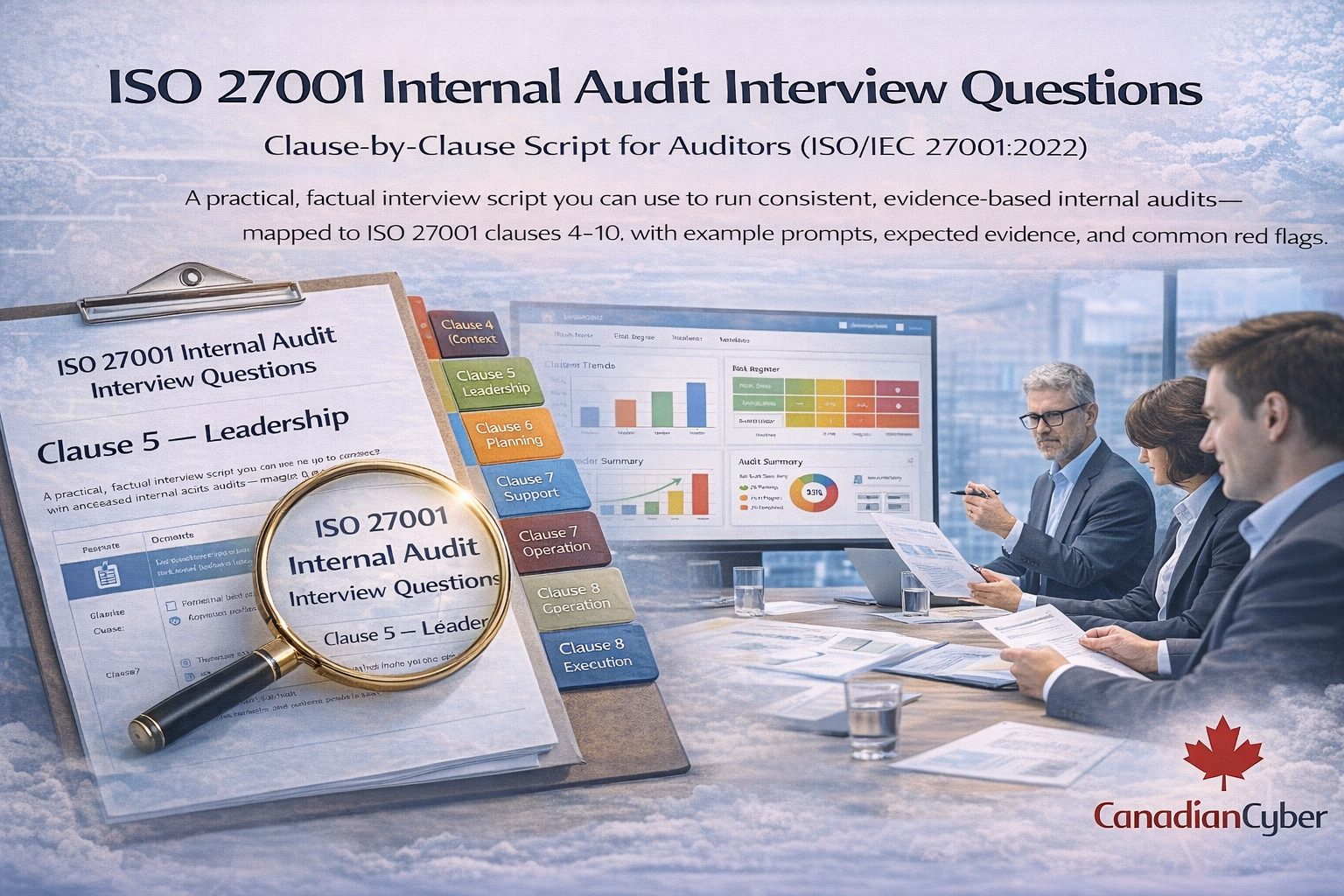
Main Hero Image
ISO/IEC 27001:2022 • Clauses 4–10 • Interview Script

ISO 27001 Internal Audit Interview Questions

Clause-by-Clause Script for Auditors (ISO/IEC 27001:2022)

A practical, factual interview script you can use to run consistent, evidence-based internal audits mapped to ISO 27001 clauses 4–10, with example prompts, expected evidence, and common red flags.

Best use
Use as a repeatable interview script so audits stay consistent across teams and quarters.
What it includes
Interview prompts, evidence to request, and red flags clause-by-clause.
Auditor mindset
Verify the ISMS works in practice. Don’t audit “intent” audit evidence.

How to use this script in a real internal audit

Internal audits are not “asking people if they comply.” They’re verifying that the ISMS is working as designed.

A solid interview approach
  • Ask how the process works in practice
  • Request evidence (records, logs, tickets, minutes, outputs)
  • Confirm consistency (what people say matches what evidence shows)
  • Sample a few recent examples and trace end-to-end
Auditor tip: Avoid yes/no questions. Ask “Show me…” and “Walk me through…”.

Clause 4 — Context of the Organization

4.1 Understanding the organization and its context
Goal: confirm context is current and drives risk decisions.
Interview questions
  • What internal and external issues could affect our information security outcomes?
  • How is this context reviewed and kept current?
  • What changed recently (business model, suppliers, technology, legal/regulatory) that could affect risk?
Evidence to request
  • Context analysis / ISMS context document
  • Risk register inputs reflecting changes
  • Management review notes mentioning changes
Red flags: context is one-time only; major changes not reflected in risk assessment.

4.2 Needs and expectations of interested parties
Goal: confirm obligations are owned, tracked, and linked to controls.
Interview questions
  • Who are our key interested parties (customers, regulators, insurers, partners)?
  • What security requirements do they impose (contracts, privacy expectations, questionnaires)?
  • How do we track and update these requirements?
Evidence to request
  • Interested parties register
  • Contract security requirements / customer security addenda
  • Regulatory obligations list (privacy laws, sector guidance)
Red flags: no owner for obligations; requirements “known” but not documented or linked to controls.

4.3 Scope of the ISMS
Goal: confirm scope is clear, auditable, and boundaries are managed.
Interview questions
  • What’s included in scope (sites, units, products, services, systems)?
  • What is explicitly excluded—and why is that justified?
  • How are interfaces/dependencies outside scope still managed?
Evidence to request
  • ISMS scope statement
  • Network/system diagrams showing boundaries
  • Supplier/service dependency documentation
Red flags: scope is vague or too broad to audit; exclusions used to dodge key risks.

4.4 Information Security Management System
Goal: confirm ISMS is a managed system, not a document folder.
Interview questions
  • What are the main ISMS processes (risk, treatment, incidents, audit, mgmt review)?
  • How are these processes maintained and improved?
  • Who is accountable for ISMS performance?
Evidence to request
  • ISMS process map
  • Roles/responsibilities (RACI)
  • Metrics/KPIs and reports
Red flags: people can’t explain daily ISMS operations; “the ISMS is a folder.”

Clause 5 — Leadership

5.1 Leadership and commitment
Goal: verify commitment is evidenced in decisions, not slogans.
Interview questions
  • How does top management demonstrate commitment beyond approving policies?
  • What security decisions did leadership make last quarter (risk, budget, resourcing)?
  • How are security objectives integrated into business planning?
Evidence to request
  • Leadership communications
  • Budget/resourcing approvals tied to risks
  • Management review decisions and follow-ups
Red flags: support is verbal only; objectives exist but aren’t tracked or resourced.

5.2 Information security policy
Goal: verify the policy is current, communicated, and used.
Interview questions
  • What is the policy purpose and who does it apply to?
  • How is it communicated and enforced?
  • When was it last reviewed, and what changed?
Evidence to request
  • Approved policy with version control
  • Policy distribution/acknowledgements
  • Review schedule and revision history
Red flags: policy is outdated/generic; staff unaware of key rules (data handling, acceptable use).

5.3 Organizational roles, responsibilities and authorities
Goal: confirm named ownership for risks, controls, and response.
Interview questions
  • Who owns risk management? controls? incident response?
  • How are responsibilities included in job roles or contracts?
  • How do we handle accountability for third parties?
Evidence to request
  • Role descriptions / org chart
  • Security responsibilities in HR documentation
  • Supplier ownership and escalation contacts
Red flags: critical tasks have no named owner; “IT owns everything,” including business risk decisions.

Clause 6 — Planning

6.1.2 Information security risk assessment
Goal: confirm method is consistent and traceable end-to-end.
Interview questions
  • What risk methodology do we use (likelihood/impact, criteria, thresholds)?
  • How do we identify risks (assets, threats, vulnerabilities, processes)?
  • How often do we reassess risk, and what triggers off-cycle review?
  • Show me one recent risk from identification to evaluation.
Evidence to request
  • Risk assessment procedure
  • Risk register (current version)
  • Risk criteria and scoring definitions
Red flags: inconsistent scoring; risks don’t map to business impact or assets.

6.1.3 Information security risk treatment
Goal: confirm controls are selected, tracked, and evidenced.
Interview questions
  • How do we decide treatment options (mitigate, transfer, accept, avoid)?
  • How are controls selected and tracked to completion?
  • Show me a treatment plan and evidence it’s being executed.
Evidence to request
  • Risk treatment plan(s)
  • Statement of Applicability (SoA)
  • Risk acceptance records with approval
Red flags: SoA exists but status is unclear; risk acceptances lack rationale/owner/expiry date.

6.2 Information security objectives and planning to achieve them
Goal: verify objectives are measurable, owned, and tracked.
Interview questions
  • What are our security objectives for this year/quarter?
  • How are they measured (KPIs) and who owns them?
  • Show progress reporting and corrective actions when off track.
Evidence to request
  • Documented objectives with metrics
  • KPI dashboards or reports
  • Project plans / improvement initiatives
Red flags: vague objectives; no evidence of monitoring or follow-up.

6.3 Planning of changes
Goal: confirm changes are planned and risk-assessed before deployment.
Interview questions
  • How are ISMS changes planned (scope, policies, controls, major systems)?
  • How do you assess impact and ensure changes don’t break compliance?
  • Show an example of a significant change and how it was managed.
Evidence to request
  • Change management records
  • Risk assessments tied to changes
  • Approval records and testing evidence
Red flags: changes happen informally; security brought in after deployment.

Clause 7 — Support

7.1 Resources
Interview questions
  • Do we have enough people, tools, and budget to run the ISMS?
  • How are resource gaps identified and escalated?
Evidence to request
  • Resourcing plans and budgets
  • Open risks/issues linked to lack of resources
Red flags: known gaps persist for months with no decisions recorded.

7.2 Competence
Interview questions
  • What security competencies are required by role?
  • How do we verify competence for critical roles?
  • Show evidence of training or qualification.
Evidence to request
  • Training matrix by role
  • Certifications / training completion logs
  • Onboarding checklists
Red flags: ad hoc training with no tracking; high-risk roles have no requirements.

7.3 Awareness
Interview questions
  • How do employees learn key security rules (classification, phishing, incident reporting)?
  • What happens when people don’t follow rules?
  • Ask a sample employee: “How do you report a suspected incident?”
Evidence to request
  • Awareness program plan
  • Phishing simulations and results
  • Communications and acknowledgements
Red flags: employees can’t explain reporting steps; awareness isn’t measured.

7.4 Communication
Interview questions
  • What security communications are required internally and externally?
  • Who communicates during incidents?
  • How do we communicate requirements to suppliers?
Evidence to request
  • Communication plan
  • Incident comms templates
  • Supplier communication requirements
Red flags: no comms owners for incidents; notification triggers unclear.

7.5 Documented information (7.5.1 / 7.5.2 / 7.5.3)
Interview questions
  • How do we control ISMS documents (approvals, versioning, access)?
  • How do we ensure people use the current version?
  • How do we retain records and protect them from unauthorized access/changes?
Evidence to request
  • Document control procedure
  • Version history and access permissions
  • Record retention schedule
Red flags: conflicting versions; no evidence of review/approval controls.

Clause 8 — Operation

8.1 Operational planning and control
Interview questions
  • What operational controls ensure security processes run consistently?
  • How do we ensure outsourced processes meet requirements?
  • Show operational evidence (tickets, logs, approvals) for a sample period.
Evidence to request
  • Operational procedures/runbooks
  • Supplier oversight records
  • Change/incident/problem records
Red flags: procedures exist but aren’t used; operational work isn’t traceable.

8.2 Information security risk assessment (operational)
Interview questions
  • When was the last risk assessment performed? What triggered it?
  • How do operational teams contribute risk inputs (incidents, changes, vulnerabilities)?
Evidence to request
  • Risk assessment records over time
  • Inputs from incidents/vulnerability management
Red flags: risk assessment is only done for audits.

8.3 Information security risk treatment (operational)
Interview questions
  • How do we implement selected controls and validate they work?
  • How do we track progress and handle exceptions?
Evidence to request
  • Control implementation evidence (configs, screenshots, logs)
  • Exception/risk acceptance records
Red flags: control “implemented” with no operational proof of effectiveness.

Clause 9 — Performance Evaluation

9.1 Monitoring, measurement, analysis and evaluation
Interview questions
  • What do we measure to know security is improving (not just activity)?
  • Who reviews metrics, and how often?
  • What actions were taken based on metrics?
Evidence to request
  • KPI definitions (what, how, frequency)
  • Reports/dashboards and meeting notes
  • Improvement actions
Red flags: metrics tracked but never acted on; only tool metrics (no risk indicators).

9.2 Internal audit
Interview questions
  • How is the audit program planned (scope, frequency, methods)?
  • How is auditor independence ensured?
  • How do you track findings to closure?
  • Show a completed audit with evidence and corrective actions.
Evidence to request
  • Audit program and schedule
  • Audit reports and evidence trails
  • Corrective action tracker and closure verification
Red flags: checklist-only audits; findings closed without verifying effectiveness.

9.3 Management review
Interview questions
  • When was the last management review? What inputs were included?
  • What decisions were made (actions, resources, improvements)?
  • How do you follow up and verify completion?
Evidence to request
  • Management review minutes
  • Action list with owners and deadlines
  • Follow-up evidence
Red flags: reviews produce no decisions; actions repeat quarter after quarter.

Clause 10 — Improvement

10.1 Nonconformity and corrective action
Interview questions
  • How do you record nonconformities (audits, incidents, KPI failures)?
  • How do you determine root cause and corrective actions?
  • How do you verify actions are effective and prevent recurrence?
Evidence to request
  • Corrective action procedure
  • Root cause analyses (RCA)
  • Effectiveness verification records
Red flags: symptom-only fixes; no effectiveness checks after closure.

10.2 Continual improvement
Interview questions
  • What improvements were implemented in the last 6–12 months?
  • How do you select improvements (risk, audit results, incidents, objectives)?
  • What’s the next improvement plan?
Evidence to request
  • Improvement roadmap
  • Completed initiatives with outcomes
  • Updated risk register/objectives reflecting improvements
Red flags: continual improvement claimed but not evidenced; same gaps persist across cycles.

Optional add-on: Annex A interview prompts (if you audit controls too)

ISO 27001:2022 references Annex A controls (aligned to ISO/IEC 27002:2022). Many internal audits include sampling key control areas.
Here’s a fast, high-value set to append:

  • Access control / Identity: MFA, admin reviews, joiner-mover-leaver, recertification
  • Asset management: inventory, ownership, acceptable use
  • Supplier security: requirements, reviews, incident notification
  • Incident management: reporting, triage, lessons learned
  • Backup and recovery: restore tests, RTO/RPO alignment
  • Secure configuration & patching: baselines, remediation SLAs
  • Logging & monitoring: alerting, response times, coverage
  • Cryptography: key management, encryption at rest/in transit
If you want, we can convert Annex A into the same “control-by-control” script style.

Practical auditor tips to keep the audit factual

Keep it evidence-based
  • Triangulate: interview + system evidence + record sampling
  • Sample recent items: last 30–90 days is more reliable than “in theory”
  • Follow the trail: a policy without evidence of use is not implementation
  • Write findings with facts: what you saw, the requirement, and the supporting evidence

Make internal audits feel like real assurance (not paperwork)
A vCISO-led internal audit approach helps you standardize interviews, collect evidence cleanly, and turn findings into measurable improvements.
  • Standardize interviews across teams
  • Build clean, repeatable evidence trails
  • Convert findings into tracked improvement actions
  • Prepare for certification or surveillance audits with confidence

Follow Canadian Cyber
Practical cybersecurity + compliance guidance for Canadian teams:


Related Post