email-svg
Get in touch
info@canadiancyber.ca

ISO 27001 Management Review Minutes Template

A complete ISO 27001 management review minutes template for Clause 9.3. Includes agenda structure, required inputs and outputs, evidence checklist, and common audit findings to avoid.

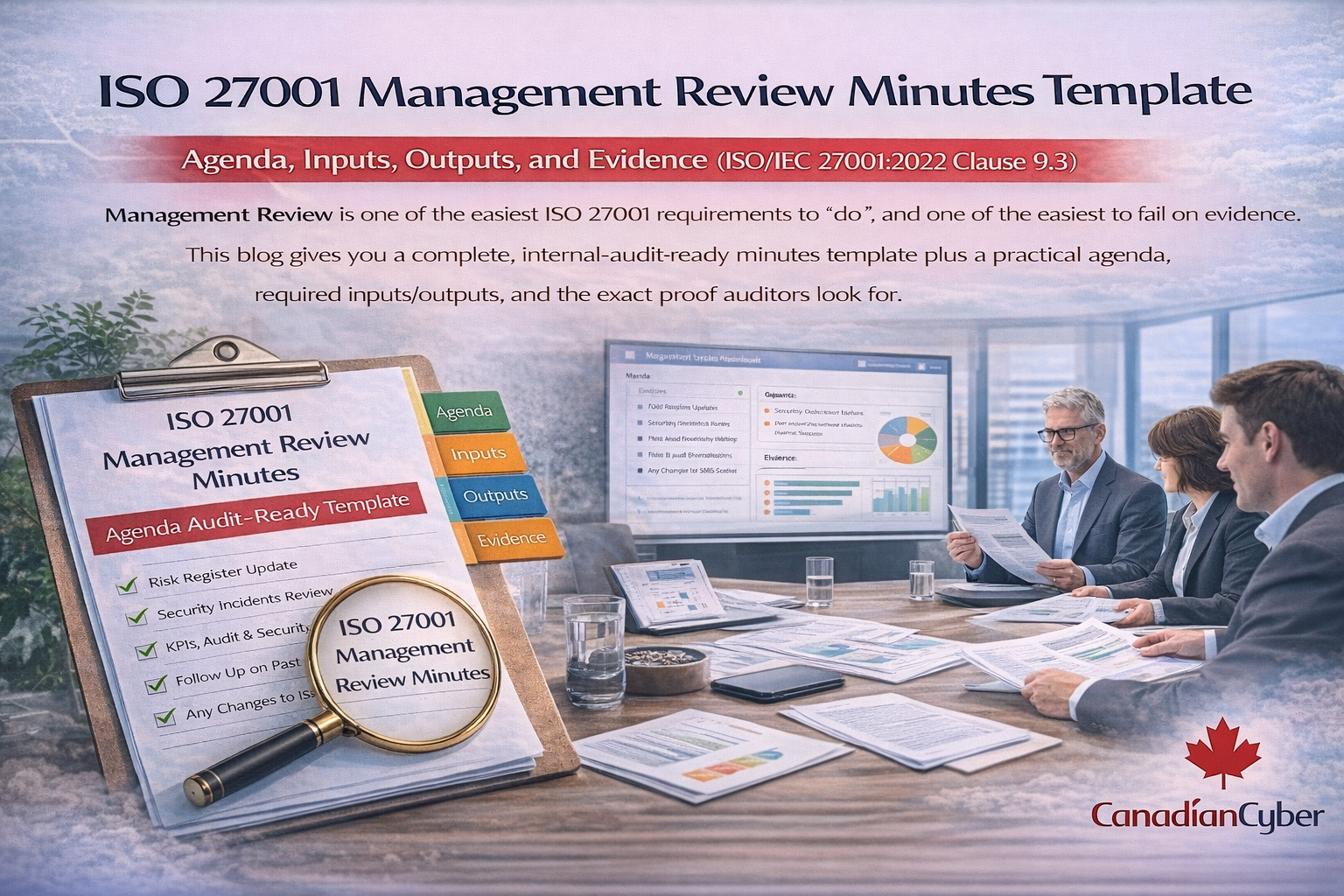
Main Hero Image
ISO/IEC 27001:2022 • Clause 9.3 • Audit-Ready Minutes

ISO 27001 Management Review Minutes Template

Agenda, Inputs, Outputs, and Evidence (ISO/IEC 27001:2022 Clause 9.3)

Management Review is one of the easiest ISO 27001 requirements to “do,” and one of the easiest to fail on evidence.
This blog gives you a complete, internal-audit-ready minutes template plus a practical agenda, required inputs/outputs,
and the exact proof auditors look for.

What 9.3 proves
Top management is governing the ISMS using evidence and decisions.
Why audits fail
Minutes list topics, but no decisions, no owners, no evidence references.
Fast win
Standard agenda + action tracker + evidence pack folder.

Why management review minutes matter (and why auditors focus on them)

Clause 9.3 Management Review proves one thing: top management is actually governing the ISMS.

Auditors don’t just want to see that a meeting happened. They want evidence that management:

  • reviewed the required inputs,
  • made decisions,
  • assigned owners and timelines,
  • and followed up.
High-intent reality
If you’re preparing for ISO 27001 certification (or a surveillance audit), clean 9.3 minutes can save you from avoidable nonconformities.

What ISO 27001 Clause 9.3 requires (plain English)

Management must review the ISMS at planned intervals to ensure it remains suitable,
adequate, effective, and aligned with strategic direction.

The review must include specific inputs and produce specific outputs. That’s why auditors ask for:

  • an agenda that maps to 9.3 inputs,
  • minutes showing discussion and decisions,
  • evidence attachments (reports, KPIs, audit results),
  • and action tracking (owners, due dates, status).

Management Review Agenda (ISO 27001:2022 Clause 9.3 Inputs)

Use this agenda structure to keep your meeting factual and auditor-ready.

Clause 9.3 agenda structure (copy/paste)
Agenda item What to cover Output to record
1) Opening (meeting details) Date/time, attendees, scope reviewed, last actions status Status decisions + carry-forward actions
2) Changes that affect the ISMS Internal + external changes and impact Risk/control updates required
3) ISMS performance results Objectives, KPIs, monitoring results, incidents, nonconformities Decisions on targets, actions, priorities
4) Audit results Internal/external audits + closure effectiveness Closure decisions + resourcing
5) Feedback from interested parties Customer questionnaires, contracts, complaints, regulator/insurer feedback Actions for obligations and responses
6) Risk + treatment status Top risks, movement, acceptances, RTP, SoA updates Accept/mitigate decisions + dates
7) Resource adequacy Staffing, tooling, budget, training needs Approvals, constraints, risk decisions
8) Opportunities for improvement Controls, processes, automation, policy/training Approved improvements + owners
9) Decisions and actions (outputs) Decisions, actions, owners, due dates, approvals Action tracker + sign-offs

What auditors look for in management review minutes

Auditors typically look for these proof points:

  • ✅ Meeting happened at planned interval (annual minimum; many do quarterly)
  • ✅ Inputs are explicitly covered (not implied)
  • ✅ Outputs are clearly recorded
  • ✅ Actions have owners + deadlines
  • ✅ Evidence is attached or referenced
  • ✅ Follow-up exists from previous review
Common audit finding
Minutes list topics, but no decisions, no owners, and no evidence references.

ISO 27001 Management Review Minutes Template (Copy/Paste)

Tip
Keep minutes factual. Avoid storytelling. Capture decisions, evidence reviewed, and actions assigned.

ISO 27001 ISMS Management Review Minutes (Template)
Organization: [Company Name]
ISMS Scope: [Scope statement or reference]
Meeting Type: Management Review (ISO 27001:2022 Clause 9.3)
Period Covered: [e.g., Q1 2026 / Jan–Mar 2026]
Date/Time: [YYYY-MM-DD, Time]
Location/Mode: [In-person / Teams / Zoom]
Chair: [Name, Title]
Minute Taker: [Name, Title]
Attendees
[Name, Role/Title]
[Name, Role/Title]
[Name, Role/Title]
Absentees
[Name, Role/Title]
Agenda Reference
This meeting followed the Management Review agenda aligned to ISO 27001:2022 Clause 9.3 inputs.
1) Review of Previous Actions
Summary of last review actions:
Action #1: [Description] — Owner: [Name] — Due: [Date] — Status: [Open/Closed]
Action #2: [Description] — Owner: [Name] — Due: [Date] — Status: [Open/Closed]Notes / Evidence reviewed:
[Link/report name/version]
[Ticket IDs / tracker reference]

Decisions:
[Decision, if any]

2) Changes in Internal and External Issues (Clause 4.1 + 9.3 input)
Internal changes since last review: [System/org/process changes]
External changes since last review: [Regulatory/customer/threat changes]
Impact on ISMS: [Risk/control priority changes]Evidence reviewed:
[Risk register update]
[Change log / project list]
[Legal/regulatory tracking list]

Decisions / Actions:
Action: [Description] — Owner: [Name] — Due: [Date]

3) Interested Parties Feedback (Clause 4.2 + 9.3 input)
Key feedback received: [Questionnaires/complaints/SLA]
Regulator/insurer feedback: [Details]Evidence reviewed:
[Customer security requests log]
[Contracts/security addenda changes]

Decisions / Actions:
Action: [Description] — Owner: [Name] — Due: [Date]

4) ISMS Performance and Effectiveness (Clause 9.1 + 9.3 input)
Security objectives status:
Objective 1: [Objective] — Metric: [KPI] — Current: [Value] — Target: [Value] — Trend: [Up/Down/Stable]
Objective 2: [Objective] — Metric: [KPI] — Current: [Value] — Target: [Value] — Trend: [Up/Down/Stable]Monitoring and measurement highlights: [Key metrics + meaning]
Incidents and near-misses: Number: [#] — Material: [Yes/No] — Lessons applied: [Yes/No + list]

Evidence reviewed:
[KPI dashboard/report]
[Incident summary report]
[Awareness/phishing report]

Decisions / Actions:
Action: [Description] — Owner: [Name] — Due: [Date]

5) Audit Results (Clause 9.2 + 9.3 input)
Internal audit summary: Audits completed: [#] — Findings: Major [#], Minor [#], Opportunities [#] — High-risk findings: [List]
External audit summary (if applicable): [Type/date + findings]Evidence reviewed:
[Internal audit reports]
[Corrective action tracker]

Decisions / Actions:
Action: [Description] — Owner: [Name] — Due: [Date]

6) Nonconformities and Corrective Actions (Clause 10.1 + 9.3 input)
Open NCs: NC #1: [Desc] — Owner: [Name] — Due: [Date] — Status: [Open/In progress]
NC #2: [Desc] — Owner: [Name] — Due: [Date] — Status: [Open/In progress]Effectiveness verification: Closed actions verified? [Yes/No] — Method: [Sample/test/metrics]

Evidence reviewed:
[RCA reports]
[Verification results]

Decisions / Actions:
Action: [Description] — Owner: [Name] — Due: [Date]

7) Risk Assessment and Risk Treatment Status (Clause 6.1 + 9.3 input)
Top risks (current period):
[Risk] — Level: [H/M/L] — Owner: [Name] — Treatment: [On track/At risk]
[Risk] — Level: [H/M/L] — Owner: [Name] — Treatment: [On track/At risk]Risk acceptances: Accepted risk: [Risk] — Approved by: [Name] — Date: [Date] — Review date: [Date]
SoA changes (if any): [Control changes + justification]

Evidence reviewed:
[Risk register version/date]
[Risk treatment plan]
[SoA version/date]

Decisions / Actions:
Action: [Description] — Owner: [Name] — Due: [Date]

8) Resource Adequacy (Clause 7.1 + 9.3 input)
Resources reviewed: Staffing: [Adequate/Not] — Tools: [Adequate/Gaps] — Training: [Status]
Constraints and risks: [List]Decisions: Approved resource/budget: [What] — Amount: [If applicable] — Owner: [Name] — Date: [Date]
Actions: Action: [Description] — Owner: [Name] — Due: [Date]

9) Opportunities for Improvement (Clause 10.2 + 9.3 input)
Opportunities identified: [Process] [Control] [Automation] [Policy/training]
Decisions / Actions: Action: [Description] — Owner: [Name] — Due: [Date]
10) Management Review Outputs (Clause 9.3.3)
Outputs Summary
Decisions related to ISMS improvements: [Decision]
Decisions related to changes needed to ISMS: [Decision]
Decisions related to resource needs: [Decision]Assigned actions (tracker):
Action ID: [#] — Description: [Action] — Owner: [Name] — Due: [Date] — Priority: [H/M/L]

11) Attachments / Evidence Pack (References)
[KPI dashboard/report name + date]
[Internal audit summary + reports]
[Corrective action tracker export]
[Risk register + RTP + SoA]
[Incident report summary]
[Supplier/security questionnaire log]
[Training/awareness metrics]
[Change management summary]
12) Sign-Off
Chair (Top Management): ___________________ Date: __________
ISMS Manager / Security Lead: _______________ Date: __________
Minute Taker: _____________________________ Date: __________


Evidence pack folder structure (simple and audit-friendly)

If you want auditors to move fast, store evidence in a predictable structure.

/ISMS/Management Review/2026-Q1/
01_Agenda.pdf
02_Minutes_Signed.pdf
03_KPIs_and_Objectives.pdf
04_Internal_Audit_Summary.pdf
05_Corrective_Actions.xlsx
06_Risk_Register_RTP_SoA.pdf
07_Incident_Summary.pdf
08_Training_Awareness.pdf
09_Supplier_Feedback.pdf
10_Change_Summary.pdf
Auditors love this because it reduces time spent “hunting.”

Common internal audit findings for Clause 9.3 (avoid these)

Quick pre-check
  • Minutes don’t show the required inputs
  • No evidence referenced (no reports, no data)
  • Actions exist but no owner or due date
  • Same actions repeat each quarter (no closure)
  • No proof of top management participation
  • “Reviewed risks” is written, but risk register isn’t updated

If you’re preparing for certification or surveillance audits, the fastest win is making Management Review consistent and evidence-based.
A vCISO-led approach typically includes:
  • a quarterly management review cadence
  • board-ready KPI dashboards (not tool noise)
  • a clean action tracker tied to risk and audit findings
  • an evidence pack structure that passes audits

Follow Canadian Cyber
Practical cybersecurity + compliance guidance for Canadian teams:


Related Post