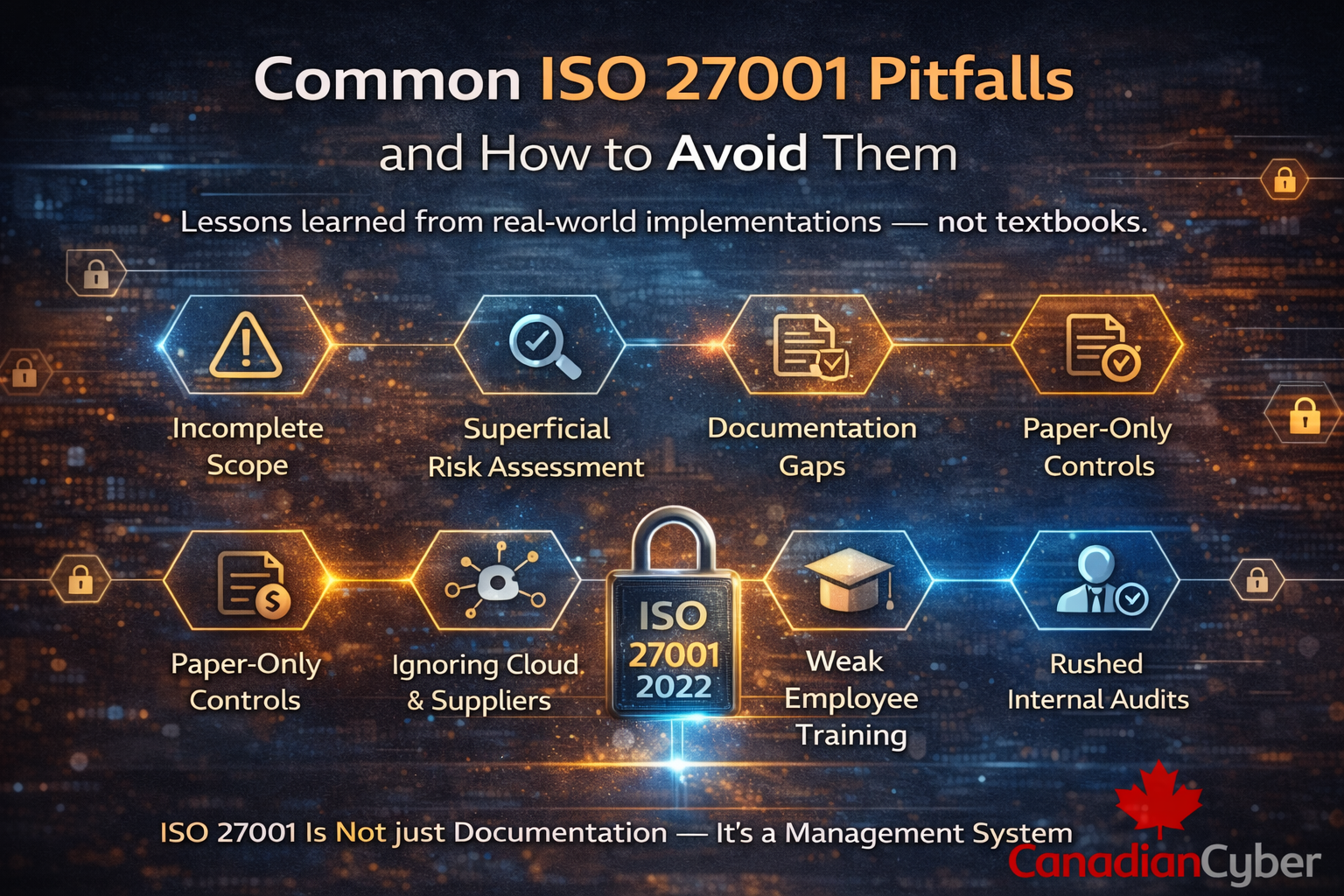
Common ISO 27001 Pitfalls and How to Avoid Them
Lessons learned from real-world implementations not textbooks.
ISO 27001 looks straightforward on paper: define a scope, assess risks, write policies, pass the audit.
But in practice, many organizations struggle even with good intentions because ISO 27001 is a management system, not just documentation.
Below are the most common ISO 27001 pitfalls we see in real implementations and exactly how to avoid them.
Pitfall #1: Defining an Incomplete or Unrealistic Scope
Scope is the foundation of your ISMS. When it’s wrong, everything else suffers.
What goes wrong
- Scope is too broad (“everything we do”)
- Scope is too narrow (“only IT systems”)
- Cloud services and third parties are excluded
- Business context is unclear
Auditors quickly spot misaligned scopes.
How to avoid it
- Define scope based on business reality, not convenience
- Include systems, people, processes, and suppliers that actually matter
- Document scope boundaries clearly
- Review scope with leadership before locking it in
Tip: A focused, defensible scope beats an ambitious one.
Pitfall #2: Treating Risk Assessment as a Formality
ISO 27001 is risk-driven but risk assessment is often rushed.
What goes wrong
- Generic risk templates
- All risks rated “low”
- No clear link between risks and controls
- Risk treatment decisions not justified
How to avoid it
- Identify real business risks (not theoretical ones)
- Use simple, repeatable scoring
- Clearly link risks to selected controls (and your SoA)
- Keep a living risk register not a static document
Auditors care more about thinking quality than scoring complexity.
Pitfall #3: Over-Documenting or Under-Documenting
Many organizations misunderstand documentation requirements leading to confusion and audit findings.
What goes wrong
- Dozens of policies no one reads
- Copy-paste templates that don’t match operations
- Missing required documents
- Inconsistent terminology
How to avoid it
- Keep documentation short, clear, and usable
- Write policies based on how the organization actually works
- Ensure consistency across documents
- Review documentation at least annually
ISO 27001 rewards clarity, not volume.
Pitfall #4: Controls That Exist Only on Paper
One of the fastest ways to fail an audit: “We have a policy but it’s not followed.”
What goes wrong
- MFA policy exists but isn’t enforced
- Access reviews are defined but not performed
- Incident response plan exists but never tested
- Backups are documented but not verified
Auditors look for evidence not intentions.
How to avoid it
- Implement controls before documenting them
- Collect evidence as you go (tickets, logs, screenshots, approvals)
- Test key controls periodically (don’t assume)
- Assign owners to every control
If it isn’t happening in practice, it doesn’t count.
Want a no-surprise ISO 27001 implementation?
We help SMBs build audit-ready ISMS programs with practical controls, clean evidence, and strong governance.
Pitfall #5: Ignoring Cloud and Third-Party Risk
Modern organizations rely heavily on vendors and cloud services and auditors increasingly focus here.
What goes wrong
- No vendor risk process
- No cloud responsibility clarity
- Third-party access not reviewed
- No supplier security criteria
How to avoid it
- Identify critical suppliers (risk-based)
- Define security expectations contractually
- Perform basic vendor risk assessments
- Document shared responsibility models (cloud)
Third-party risk is business risk.
Pitfall #6: Weak Employee Awareness and Training
ISO 27001 is not just for IT. People are part of the ISMS.
What goes wrong
- One-time training with no follow-up
- Employees unaware of policies
- No role-based security awareness
- No training evidence
How to avoid it
- Provide regular, simple security training
- Tailor training to roles
- Keep attendance records
- Reinforce key messages throughout the year
Reality: Security culture matters more than checklists.
Pitfall #7: Skipping or Rushing Internal Audits
Internal audits are often treated as a hurdle. That’s a mistake.
Pitfall #8: Lack of Leadership Involvement
ISO 27001 requires management ownership. Auditors expect leadership engagement.
What goes wrong
- ISMS delegated entirely to IT
- Leadership unaware of key risks
- Management review done as a formality
How to avoid it
- Involve leadership in risk discussions
- Conduct meaningful management reviews
- Align ISMS goals with business objectives
Reminder: ISO 27001 is not an IT project.
Pitfall #9: Treating Certification as the Finish Line
Certification is not the end. ISO 27001 requires ongoing risk management and continuous improvement.
What goes wrong
- Controls decay after audit
- Documentation becomes outdated
- Risks not revisited
- Surveillance audits become painful
How to avoid it
- Build continuous improvement into operations
- Schedule regular reviews (risk, access, suppliers, incidents)
- Track metrics and near-misses
- Treat ISO 27001 as a living system
The goal is resilience, not a certificate.
A Fictional Example: Learning the Hard Way
A company passed ISO 27001 barely. Six months later, access reviews were skipped, the risk register was outdated, and the supplier list was incomplete. Surveillance audit findings followed.
ISO 27001 didn’t fail them. Process ownership did.
How a vCISO Helps Avoid These Pitfalls
Most pitfalls stem from lack of security leadership. A Virtual CISO (vCISO) helps organizations:
- Own the ISMS and keep it operational
- Guide risk decisions and priorities
- Ensure controls operate in practice (with evidence)
- Prepare teams for audits (and reduce surprises)
- Maintain compliance year-round
How Canadian Cyber Helps Organizations Succeed
At Canadian Cyber, we focus on practical ISO 27001 implementations built to pass audits and work in real operations.
🔹 ISO 27001 Consulting
- Realistic scoping
- Risk-driven control selection
- Audit-ready documentation and evidence structure
🔹 vCISO Services
- ISMS ownership
- Leadership reporting
- Continuous improvement
🔹 Internal Audit & Health Checks
- Gap identification
- Surveillance audit support
- No-surprise audits
Ready to avoid these ISO 27001 pitfalls?
If you want to implement or maintain ISO 27001 confidently, we can help you build a clean, practical ISMS that stands up in audits.
Explore Our ISO 27001 Services
Learn About Our vCISO Services
Stay Connected With Canadian Cyber
Follow Canadian Cyber for insights on ISO 27001, privacy compliance, and cybersecurity governance in Canada: